
Ever notice how your YouTube Shorts feed feels like it's reading your mind? You watch three cooking clips and suddenly your entire feed is sourdough recipes and knife skills. That's not a coincidence. Are YouTube Shorts based on what you watch? Yes, and understanding exactly how that works matters if you're trying to grow an audience on the platform.
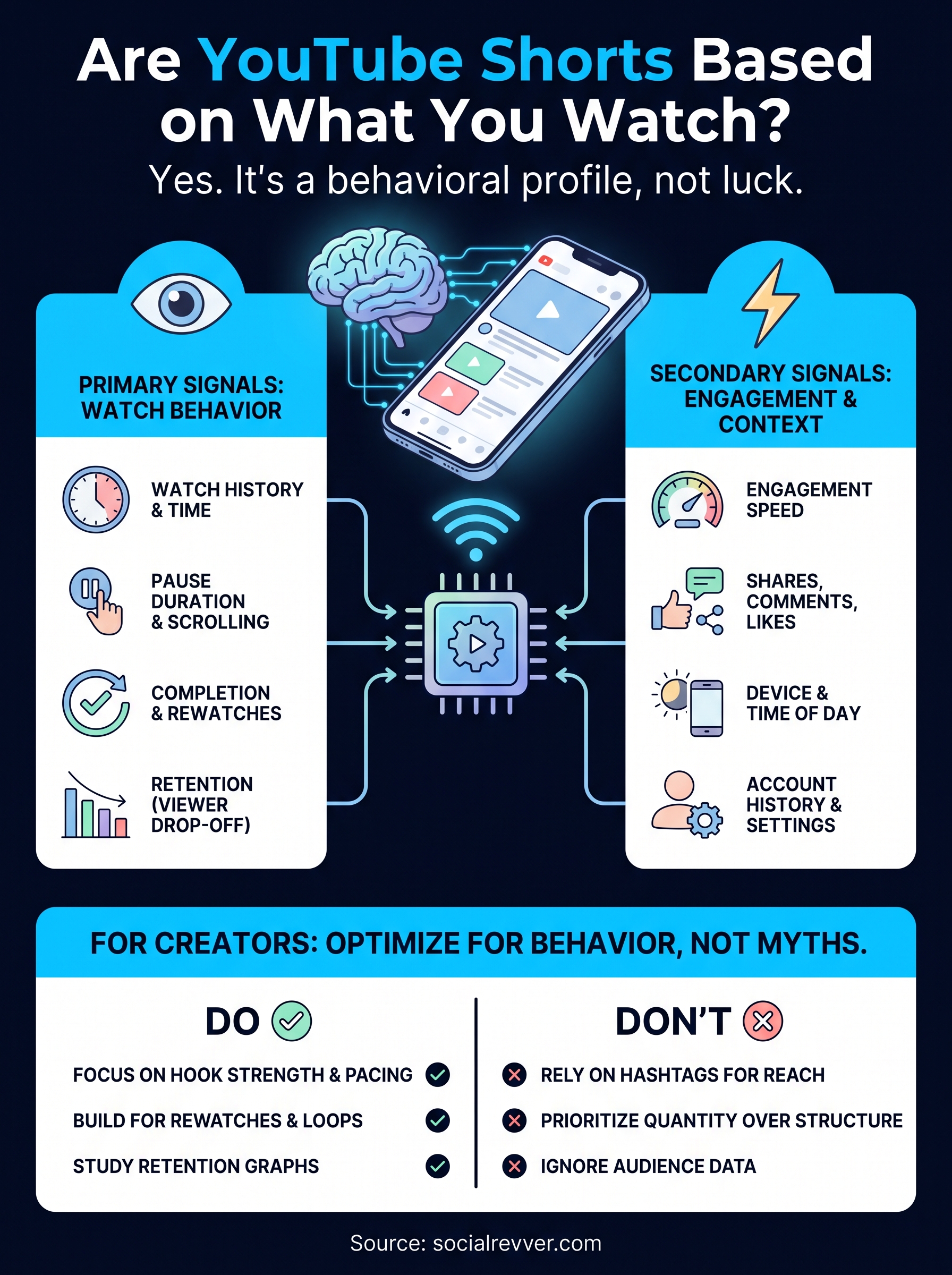
The short answer is that YouTube's recommendation system tracks your watch history, watch time, likes, and even how long you pause on a video before scrolling away. Every action feeds a behavioral profile that shapes what the algorithm shows you next. It's not random, and it's not just about the video's topic either. It's about viewing patterns built from thousands of tiny signals collected in real time.
In this article, we'll break down exactly which signals the algorithm weighs, how quickly your feed adapts to new behavior, and what that means if you're publishing Shorts and trying to reach the right audience. Whether you're a viewer curious about your own feed or a creator trying to reverse-engineer the system, this gives you the full picture.
Why the Shorts algorithm matters for your growth strategy
Growth on Shorts isn't about posting more, it's about matching what the recommendation system already rewards. If you're publishing content without understanding that the algorithm is built around individual viewing behavior, you're basically guessing. Every creator who's had a video flop despite "good" production value has run into this: the algorithm didn't care about your editing, it cared about whether people kept watching. That distinction changes how you should approach every piece of content you publish.
The feed rewards retention, not just reach
YouTube doesn't push your Short to more people because it's well-made. It pushes your Short to more people because a test audience watched it, rewatched it, or watched it all the way through without swiping away. This is the core mechanic behind why Shorts can blow up overnight for accounts with zero prior audience. YouTube isn't ranking creators, it's ranking individual videos against individual viewer behavior, then scaling distribution when the match works.
The algorithm doesn't reward good content. It rewards content that keeps people watching.
This matters for strategy because it means every video gets its own shot, regardless of your subscriber count. A new channel can outperform an established one on a single upload if the retention numbers hold up in early testing. That's good news if you're building from scratch, but it also means consistency in performance requires consistency in structure, not just consistency in posting.
What happens when you ignore watch-based signals
Creators who don't account for watch time patterns tend to make the same mistakes repeatedly: slow openings, unclear hooks, or content that doesn't match what their actual audience has shown interest in watching. YouTube's own team has published guidance confirming that watch time and audience retention are central ranking signals across the platform, not just for long-form video (see YouTube's official How YouTube Shorts algorithm works page). Ignoring that guidance means you're fighting the system instead of using it.
Here's what tends to separate accounts that scale from accounts that stall:
- Hook strength in the first second: viewers decide almost instantly whether to keep watching
- Loop potential: videos that get rewatched signal high value to the algorithm
- Topic consistency: jumping between unrelated niches confuses the behavioral profile the algorithm builds around your typical viewer
- Session context: what a viewer watched right before your video affects whether your content gets served next
If you're a founder or business owner treating Shorts as a side project, this is exactly where things break down. You post inconsistently, the algorithm never builds a clear read on your audience's viewing habits, and your reach stays flat no matter how much content you push out. Treating distribution as a system, rather than a creative afterthought, is the difference between a channel that compounds and one that plateaus at a few thousand views per video.
How to optimize Shorts around real viewing behavior
Optimizing for the algorithm starts with treating your analytics dashboard as a research tool, not a scoreboard. YouTube Studio shows you audience retention graphs for every Short you post, and those graphs tell you exactly where viewers drop off. Studying that data before you script your next video beats guessing what your audience wants based on gut feeling.
Study your own analytics before you publish
Open the retention graph on your last five Shorts and look for the pattern, not the outlier. Most creators find a steep drop somewhere between the first three seconds and the ten second mark. That drop point tells you where your hook structure is failing, and it's usually the same problem repeating across videos: a slow intro, an unclear premise, or an opening line that doesn't create curiosity fast enough.
Your retention graph is more honest feedback than any comment section will ever give you.
Run this checklist against your last few uploads:
- Does the first line create a question the viewer wants answered?
- Does the pacing pick up in the first three seconds, or does it start slow?
- Do your best-performing videos share a topic, format, or tone?
- Are you publishing at times when your specific audience is actually online?
Build for the rewatch, not just the view
Secondly, structure your content so it rewards a second pass. Loops, reveals, and payoffs that land on the final frame push viewers to watch again, and rewatches signal strong quality to the recommendation system. This is why format matters as much as topic: a video that ends on a punchline or a visual callback to the opening tends to outperform one that simply stops.
Growth-focused brands rarely leave this to chance. A managed system built around behavioral data, like the one SocialRevver runs for clients, tests hook variations and pacing choices against real audience response instead of relying on assumptions about what should work.
Other signals that shape what the algorithm shows
Watch time drives most ranking decisions, but it's not the only input. Engagement signals like likes, comments, shares, and even how fast someone taps "not interested" all feed into the same behavioral profile. YouTube also weighs account-level data, including your search history, subscriptions, and the topics you've explicitly flagged through settings or reactions, building a viewer profile that goes far beyond a single watch session.
Engagement speed and quality
Fast, early engagement tells the algorithm a video deserves a wider test audience. A Short that picks up comments and shares within the first hour signals stronger potential than one that trickles in views slowly over several days.
A video that earns fast engagement gets tested faster, and tested faster means it either scales or dies quickly.
Roughly in order of weight, these engagement signals matter most:
- Shares to private messages: the strongest signal of perceived value
- Comments with replies: shows the video sparked conversation, not just a passive watch
- Likes relative to views: a baseline quality signal, easiest to game and weighted accordingly
- Explicit "not interested" taps: a negative signal that suppresses future reach almost instantly
Context clues beyond the video itself
Device type, time of day, language settings, and even location shape what gets served next. Someone watching on a TV screen in the evening sees a different mix than someone scrolling during a commute. Google's own YouTube Data API documentation confirms that regional and language metadata directly affect content matching, which is one reason localizing captions and titles for your actual audience improves distribution outcomes over time. Ignoring these contextual signals means your content might be technically strong but mismatched to the moments when your audience is actually receptive to watching it.
Common myths about the Shorts algorithm, debunked
Misinformation about the Shorts algorithm spreads fast because creators want a shortcut. Most of what circulates in comment sections and creator forums doesn't hold up against what YouTube actually publishes about how it ranks content. Clearing up these myths saves you from optimizing for the wrong thing entirely.
"Hashtags control what the algorithm shows you"
Hashtags help with basic categorization, but they don't override watch behavior as a ranking signal. Stacking ten hashtags on a video with weak retention won't save it. YouTube's own creator guidance treats hashtags as a discovery aid, not a ranking lever, which means your energy is better spent fixing the hook than tagging your way to reach.
"New accounts get suppressed until they build history"
Creators assume the algorithm punishes fresh channels, but that's backwards. Every Short gets tested against a small audience regardless of channel age, and performance in that test, not account history, decides whether it scales.
A brand-new channel with a strong hook can outrank a channel with a million subscribers on a single upload.
"Posting more often guarantees more reach"
Volume without structure just multiplies your failure rate. Quantity helps you generate data points, but each video still lives or dies on its own retention numbers.
"The algorithm is random or unpredictable"
Randomness is the myth people reach for when a video underperforms and they don't want to look at their own retention graph. In reality, the same behavioral inputs, watch time, rewatches, and engagement speed, produce consistent, testable outcomes.
Here's a quick reality check on the most common claims:
| Myth | Reality |
|---|---|
| Hashtags drive reach | Retention and rewatch rate drive reach |
| New accounts get suppressed | Every video is tested independently |
| More posts always help | Structure and hooks matter more than volume |
| Results are random | Behavioral signals produce repeatable patterns |
What this means for your content strategy
So yes, are YouTube Shorts based on what you watch? Without question. The feed is built from watch time, rewatches, and engagement speed, not luck and not hashtags. Once you accept that, the whole game changes. You stop guessing at trends and start engineering hooks, pacing, and formats around actual viewer behavior, the same way YouTube's own systems are engineered to measure it.
Treating your content like a system rather than a creative hobby is what separates channels that compound from channels that plateau. That shift takes more than watching your own analytics dashboard, though. It takes a structured production process built on real behavioral data, tested hooks, and distribution timed to when your audience actually shows up.
If you'd rather have a team build that system for you, get your free 40+ slide social media strategy and see exactly how SocialRevver turns watch data into predictable growth.