
You've probably heard someone on your team say "let's use behavioral data" without ever defining what that actually means. Behavioral data in marketing is the record of what people actually do: the videos they watch to completion, the posts they pause on, the links they click, the purchases they make after a specific touchpoint. It's the opposite of asking people what they like. It's watching what they do when nobody's asking.
This article answers the practical question most founders and creators have: what counts as behavioral data, what types actually matter, and how you turn raw activity logs into decisions that move revenue. You'll get concrete examples, from scroll-stop patterns on short-form video to purchase-trigger sequences in email funnels, so you can see the concept in action rather than in theory.
We built our entire content system around this idea because guessing what audiences want is slow and expensive. Below, you'll find a clear breakdown of behavioral data types, real marketing examples, and a framework for applying audience psychology and performance patterns to your own content and campaigns, whether you run the analysis yourself or hand it to a system built for it.
Why behavioral data matters for modern marketers
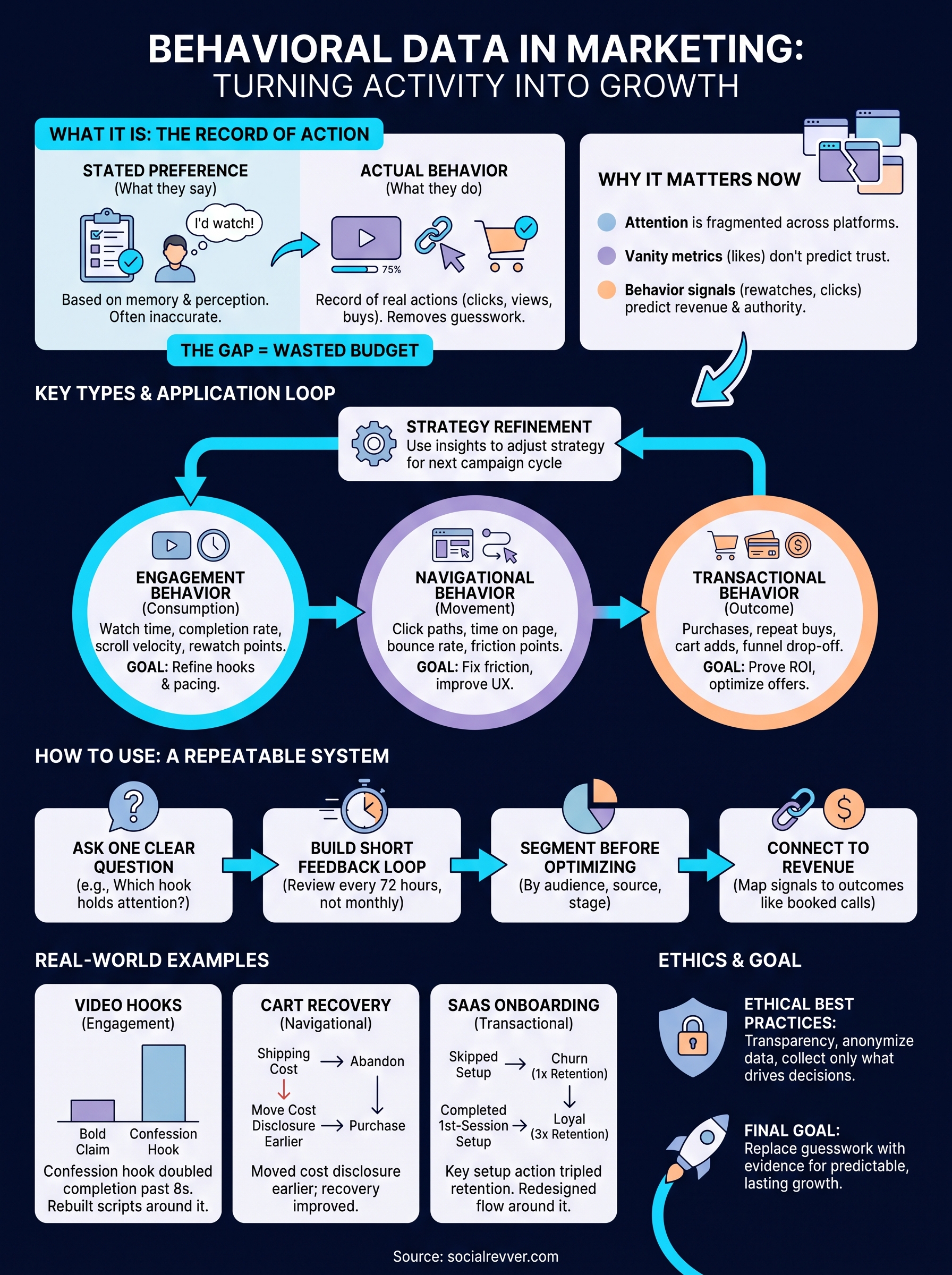
Marketers spent decades relying on surveys, focus groups, and gut instinct to guess what audiences wanted. That approach fails now because attention is fragmented across dozens of platforms, and people rarely say what they actually do. Behavioral data in marketing flips the script: instead of asking customers what they prefer, you watch what they actually click, watch, and buy. This shift matters because stated preference and actual behavior diverge constantly, and the gap between them is where most marketing budgets get wasted.
Stated preference lies, behavior doesn't
Ask someone in a survey if they'd watch a three-minute explainer video, and most will say yes. Watch the actual completion rate, and you'll find most viewers drop off in the first eight seconds. This isn't dishonesty, it's how human memory and self-perception work. People overestimate their own patience, underestimate their impulsivity, and rarely notice the emotional triggers that actually drive a purchase decision. Behavioral data removes the guesswork because it records the action itself, not someone's memory or explanation of the action.
The gap between what customers say and what they do is where most marketing budgets get wasted.
Why this matters more for founders and creators than ever
For founders building investor credibility or creators chasing brand deals, vanity metrics like follower count tell you almost nothing about whether your audience trusts you enough to buy, refer, or invest. Engagement quality, not volume, is what behavioral data captures: the rewatch rate on a founder story, the comment sentiment on a product demo, the click-through from a specific hook style. These consumer behavior signals predict revenue and authority far better than raw reach ever will.
The cost of ignoring behavioral signals
Skipping behavioral analysis doesn't just slow growth, it creates active waste. Consider a common scenario most teams recognize:
- A brand posts content based on what "feels right" to the founder.
- Engagement swings wildly, up one week, flat the next, with no clear pattern.
- The team can't explain why one video worked and another flopped.
- Ad spend gets pushed toward whichever post looks good that week, not the one backed by proven behavioral signals.
- Six months later, there's no repeatable system, just a pile of one-off wins.
Compare that to a team tracking completion rates and click-through sequences across every post. They know within days which hook structures and pacing choices actually hold attention, and they can replicate that pattern instead of hoping for another lucky video.
It's the foundation of predictable growth
Behavioral data matters because it turns marketing from a creative gamble into a system you can measure and improve. Google's own guidance on creating content people find genuinely useful reinforces this: real interaction and satisfaction signals, not assumptions, should guide what you build next (Google Search Central). Once you treat audience behavior as a dataset instead of a mystery, every campaign becomes an experiment that either confirms or challenges your assumptions, and your next move gets sharper every time.
Key types of behavioral data marketers track
Most teams lump everything into one vague bucket called "engagement," but behavioral data actually splits into distinct categories, each answering a different question about your audience. Knowing which type you're looking at determines what action you take next, so treating them separately matters more than most marketers realize.
Engagement behavior
This covers what happens while someone is actively consuming your content: watch time, rewatch rate, scroll velocity, and where exactly a viewer drops off. On short-form video, engagement behavior tells you whether your hook actually held attention past the first three seconds, which is usually the make-or-break window. A founder story that gets rewatched at the same ten-second mark repeatedly is telling you something specific worked there, and you can rebuild future scripts around it.
Navigational and site behavior
Clickstream data shows the path someone takes across your website or landing page: which link they clicked, how long they lingered on a pricing page, whether they bounced after one scroll. This navigational behavior exposes friction points that surveys never catch, because most visitors won't bother telling you the checkout button felt confusing. They'll just leave.
Transactional and purchase behavior
This is the most valuable category because it ties directly to revenue: what someone bought, when, after which touchpoint, and how often they repeat the purchase. Transactional data answers whether your content actually drives buying decisions or just generates likes.
If a behavior doesn't eventually connect to a purchase, a signup, or a referral, it's a vanity metric wearing a data costume.
Comparing the core behavioral data types
| Type | What it captures | Example signal | Marketing use |
|---|---|---|---|
| Engagement | Attention during content consumption | Video completion rate, rewatch points | Refine hooks and pacing |
| Navigational | Movement across site or app | Click paths, time on page, bounce rate | Fix friction, improve UX |
| Transactional | Actual purchase behavior | Cart adds, repeat buys, funnel drop-off | Prove ROI, optimize offers |
| Interaction/social | Response to specific content | Comment sentiment, shares, saves | Gauge trust and authority |
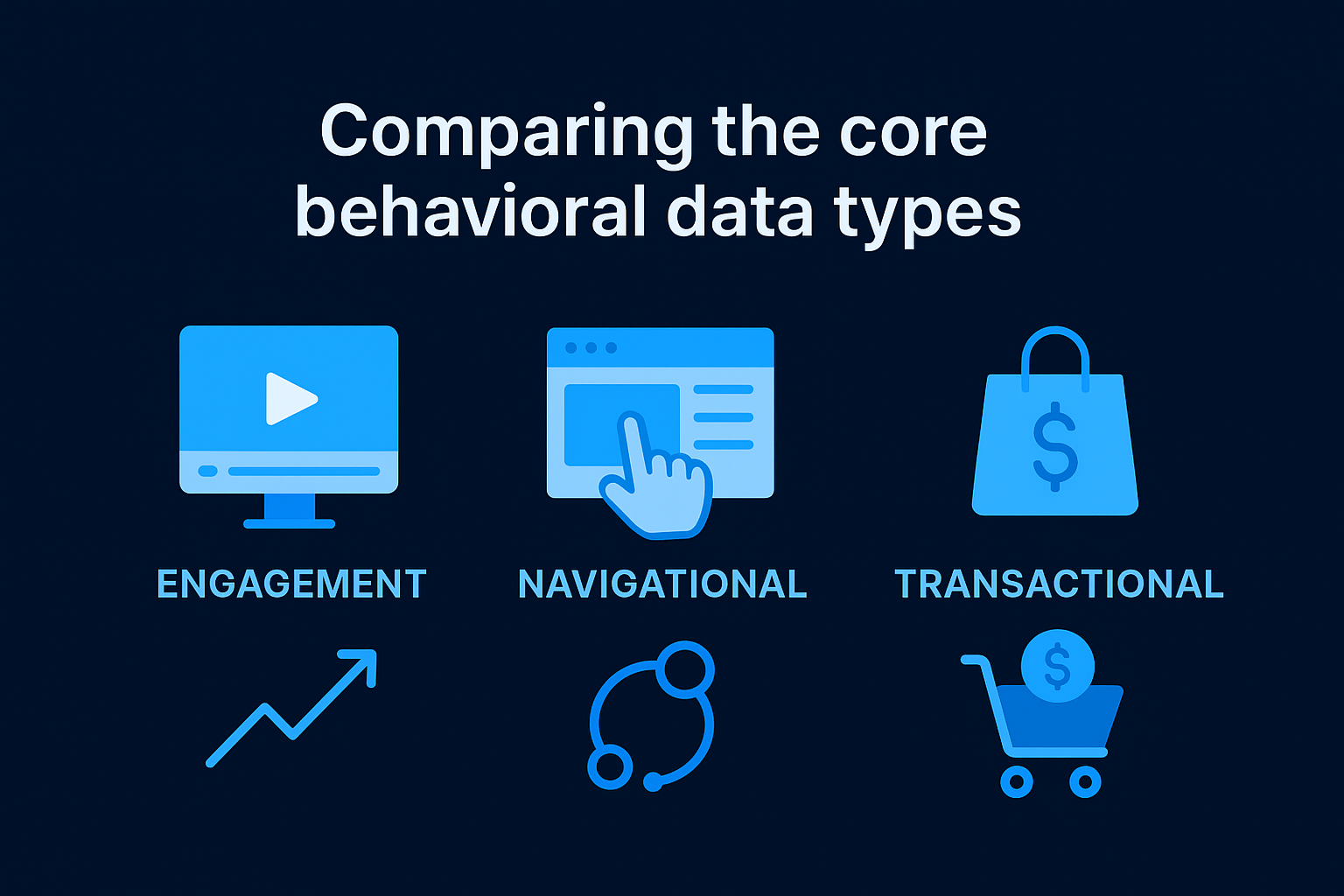
Each type feeds the others. Engagement data tells you who's paying attention, navigational data tells you where they go next, and transactional data tells you if any of it actually paid off.
How to use behavioral data in your marketing strategy
Knowing the types of behavioral data means nothing until you build a process around them. Applying behavioral data in marketing effectively requires a repeatable loop, not a one-time audit you run before a big campaign and then forget. The goal is to turn every post, email, and landing page into a small experiment that feeds the next decision.
Start with one clear question per campaign
Before you touch analytics, decide what decision the data needs to inform. Are you testing which hook style holds attention longer? Which CTA placement drives more clicks? Vague goals produce vague dashboards. A specific question like "does a founder-on-camera hook outperform a text-overlay hook in the first five seconds" gives you a clean signal to act on.
Data without a decision attached is just noise dressed up as analytics.
Build a short feedback loop
Most teams check analytics once a month, which is too slow to matter. Set a weekly review of your audience engagement metrics and act on what you find immediately. A useful loop looks like this:
- Publish content with one variable changed (hook, pacing, CTA).
- Track completion rate, click-through, and conversion within 72 hours.
- Flag the top and bottom performers.
- Rebuild your next script or campaign around the winning pattern.
- Repeat weekly, not quarterly.
Segment before you optimize
Averaged data hides the truth. A video that flops with cold audiences might crush it with warm retargeting traffic. Break your behavioral analytics by audience segment, traffic source, and funnel stage before drawing conclusions, otherwise you'll optimize for the wrong group entirely.
Connect behavior to revenue, not just reach
Engagement without a revenue tie is a vanity number. Map every behavioral signal back to a business outcome: does this hook style correlate with more booked calls, more repeat purchases, more referrals? If you can't draw that line, the metric probably isn't worth chasing. Founders and creators serious about authority and inbound leads should treat this connection as the whole point of tracking behavior in the first place, not an afterthought.
Real-world examples of behavioral data in action
Theory only helps if you can see it applied. Below are examples pulled from real marketing situations where behavioral data in marketing changed the outcome, not because the team guessed better, but because they watched what audiences actually did and adjusted fast.
Short-form video hook testing
A creator building authority for brand deals ran the same core message through three different hooks: a bold claim, a question, and a founder-on-camera confession. Completion rates showed the confession hook held viewers past the eight-second drop-off point at nearly double the rate of the others. The team didn't ask the audience which hook they liked. They watched the scroll-stop patterns and rebuilt the next twenty scripts around the winning structure.
E-commerce cart recovery
An online retailer noticed a spike in cart abandonment specifically at the shipping cost reveal step. Navigational data showed visitors weren't leaving randomly, they were bouncing at one exact click. Once the team moved shipping cost disclosure earlier in the funnel, recovery rates improved without changing a single price.
The exact moment someone leaves tells you more than any survey ever will.
SaaS onboarding and feature adoption
A software company tracked which onboarding step correlated with long-term retention. Users who completed a specific setup action within their first session stayed subscribed at nearly triple the rate of those who skipped it. That single behavioral signal reshaped the entire onboarding flow.
| Scenario | Behavioral signal tracked | Business change made |
|---|---|---|
| Short-form video hooks | Completion rate past 8 seconds | Rebuilt scripts around winning hook style |
| Cart abandonment | Drop-off at shipping cost step | Moved cost disclosure earlier |
| SaaS onboarding | First-session setup completion | Redesigned onboarding around key action |
Each case follows the same pattern: a team noticed a specific action, not a general trend, and changed one variable based on what the data showed. None of these fixes required a bigger budget, just closer attention to what people actually did.
Privacy, ethics, and best practices to keep in mind
Collecting behavioral data in marketing without a clear ethical line turns a useful system into a liability. The same tracking that reveals which hook holds attention can also feel invasive if you're not transparent about what you're recording and why. Founders building investor credibility can't afford a privacy misstep, and creators chasing brand deals lose trust fast once an audience feels surveilled instead of served.
Collect only what drives a decision
Gathering every possible data point because it's technically available is how teams end up with bloated dashboards nobody trusts. Before tracking a new signal, ask whether it will change a real decision, like a script rewrite or a funnel fix. If the answer is no, skip it. This discipline keeps your behavioral analytics lean and defensible.
If you can't explain to a customer why you're tracking something, you shouldn't be tracking it.
Be transparent about what you track
Disclosure isn't just a legal requirement, it's a trust signal. Google's guidance on page experience and trustworthy content makes clear that sites earning long-term authority are the ones that treat visitors honestly, not the ones hiding data practices in fine print (Google Search Central). Clear privacy notices and honest cookie banners cost you almost nothing and protect the brand you're building.
Practical best practices
A short checklist keeps your team consistent instead of improvising privacy decisions on the fly:
- Anonymize or aggregate data whenever individual identity isn't required for the insight.
- Store raw behavioral logs only as long as they're actively useful, then purge them.
- Separate sensitive data (payment, health, location) from general engagement tracking.
- Give users a real, working way to opt out, not a buried settings menu.
- Audit your data vendors and platforms for compliance with regulations like GDPR and CCPA.
Ethics as a growth advantage
Handled well, ethical consumer behavior tracking becomes a competitive edge rather than a compliance chore. Audiences increasingly reward brands that respect their attention and their data, and that respect shows up in retention numbers just as clearly as any hook or CTA test does.
Turning behavioral insights into lasting growth
Every example in this article comes back to one idea: behavioral data in marketing replaces guesswork with evidence. You don't need more opinions about what your audience wants, you need a system that watches what they actually do and adjusts fast. Engagement patterns, navigational clicks, and purchase behavior each answer a different question, and once you treat them as a connected loop instead of scattered metrics, growth stops feeling random.
Founders and creators who win long-term aren't the ones posting the most, they're the ones who let consumer behavior signals shape every script, hook, and funnel decision. That's the entire premise behind our system at SocialRevver, built on analysis from over 750,000 videos so you don't have to guess your way to authority. If you'd rather hand this process to a team that already runs it daily, get your free 40+ slide social media strategy and see what the data says about your next move.