Every piece of short-form content you publish generates data. Watch time, engagement rate, shares, click-throughs, these numbers tell you exactly what's working and what's burning budget. But raw data sitting inside native platform dashboards doesn't do much. You need the best social media analytics tools to pull those signals together, spot patterns across platforms, and actually make decisions that move revenue.
At SocialRevver, analytics aren't optional, they're the backbone of our entire content system. Our Attention Engine runs on performance data from over 750,000 videos, and we've tested or integrated with most of the major analytics platforms on the market. That experience gives us a clear picture of which tools deliver genuine insight and which ones just look pretty in a screenshot.
This guide breaks down 13 analytics tools built for brands that need more than surface-level reporting. We compared features, pricing, ease of use, and how well each platform supports the kind of data-driven content strategy that actually converts attention into leads. Whether you're a founder tracking ROI on organic content or a marketing team optimizing distribution across multiple channels, you'll find a tool here that fits your workflow and budget.
Let's get into it.
1. SocialRevver Attention Engine
SocialRevver isn't a standard analytics dashboard you log into to pull weekly reports. It's a managed content infrastructure system built around one core idea: data should drive every creative decision, not the other way around. The Attention Engine sits at the center of SocialRevver's service and processes behavioral signals from over 750,000 videos to identify what actually makes content perform across short-form platforms.
Best for
SocialRevver works best for founders, business owners, and creators who want a hands-off system that handles strategy, production, and optimization at once. If you're tired of guessing why some content lands and other content doesn't, this platform closes that loop. You get a full data-to-distribution pipeline rather than a tool that hands you metrics and leaves you to figure out what to do with them.
This option fits particularly well if your goal is building authority and generating inbound leads rather than chasing follower counts. SocialRevver is built for brands that want measurable business outcomes from organic social, not just more detailed analytics reports.
Key analytics and optimization capabilities
The Attention Engine analyzes patterns across hook psychology, content structure, and audience behavior to surface what works in your specific niche. Rather than showing you what happened after posting, it informs the creative process before production begins. That upstream influence on strategy is what separates it from most of the best social media analytics tools on this list.
Knowing your engagement rate after the fact is useful. Knowing which hook structure drives completion rates before you publish is a competitive advantage.
Capabilities also include AI-supported script generation, cut optimization, and real-time performance monitoring tied directly to distribution scheduling. Every element of the content pipeline feeds back into the analytics layer, so the system continuously refines its recommendations based on your actual results.
Pros and tradeoffs
The primary advantage is that you don't need to interpret data yourself. The system acts on insights directly, adjusting strategy and production based on what the data shows. This makes SocialRevver valuable for time-constrained founders and operators who can't dedicate hours each week to digging through platform-level analytics.
One tradeoff worth noting is that SocialRevver is a managed service, not a self-serve tool. You won't log in to build custom dashboards or export raw CSV files. If your team wants granular manual control over data exploration, you'll want to pair it with a standalone analytics platform.
Pricing and plans
SocialRevver operates on a custom engagement model rather than tiered monthly software subscriptions. Pricing reflects the full scope of the content infrastructure, including strategy, scripting, production, and distribution. You can request specific pricing details directly through the SocialRevver website to get a proposal aligned with your brand's output volume and growth goals.
2. Buffer
Buffer is one of the most widely used social media management platforms for small to mid-sized teams. It covers scheduling, publishing, and analytics in one workspace, making it a practical entry point if you're evaluating the best social media analytics tools without committing to enterprise-level pricing. The platform prioritizes simplicity, so you spend less time navigating menus and more time acting on what the data actually tells you.
Best for
Buffer works best for small businesses, freelancers, and content creators who need straightforward analytics without a steep learning curve. If you manage a handful of social accounts and want clean, digestible performance data, Buffer delivers that without overwhelming you with complexity or features you'll never touch.
Key analytics and reporting features
Buffer's analytics layer covers engagement metrics, post performance breakdowns, and audience growth trends across major platforms including Instagram, Facebook, LinkedIn, and X. You can filter results by date range and compare performance across individual posts to identify what content resonates most with your specific audience.
Buffer's "Answers" feature surfaces AI-generated recommendations based on your posting history, giving you direction rather than just raw numbers to interpret on your own.
The reporting interface is clean and export-friendly, which makes it easy to share results with clients or stakeholders without building custom reports from scratch.
Pros and tradeoffs
Buffer's biggest strength is simplicity and accessible pricing. You can extract meaningful analytics without paying for capabilities your team won't use. The tradeoff is depth: Buffer doesn't offer competitor benchmarking or advanced audience segmentation, so if your brand needs that level of strategic insight, you'll hit a ceiling relatively quickly as your content operation scales.
Pricing and plans
Buffer offers a free plan covering up to three social channels with basic analytics included. Paid plans start at $6 per channel per month on the Essentials tier, which unlocks more detailed analytics and reporting exports. Team and Agency plans are available for higher channel volumes and multi-user collaboration needs.
3. Metricool
Metricool has built a strong reputation as an all-in-one platform that handles scheduling, analytics, and competitor research without the price tag of enterprise tools. It covers a wide range of platforms including Instagram, TikTok, LinkedIn, YouTube, Pinterest, and X, making it one of the more versatile options among the best social media analytics tools available for growing brands.
Best for
Metricool fits well for freelancers, marketing agencies, and small-to-medium businesses that need multi-platform analytics in one place. If you manage content across several channels and want a single dashboard that tracks performance without requiring separate logins for each platform's native analytics, Metricool handles that consolidation cleanly.
Key analytics and reporting features
The platform delivers detailed engagement metrics, reach data, and follower growth tracking across all connected accounts. One standout feature is Metricool's competitor analysis tool, which lets you benchmark your content performance directly against other accounts in your niche without leaving the platform.
Being able to measure your content against competitors in the same dashboard where you schedule posts gives you a context that raw numbers alone can't provide.
Metricool also includes heatmap-style posting time recommendations based on when your specific audience is most active, so your distribution decisions are grounded in behavioral data rather than general best practices.
Pros and tradeoffs
Metricool's multi-platform coverage and competitor benchmarking at its price point make it genuinely competitive. The reporting features are solid for agencies that need to deliver client-facing results quickly. The tradeoff is that advanced audience segmentation and deep content attribution are limited compared to higher-priced enterprise platforms, so larger teams with complex reporting needs may find it constraining over time.
Pricing and plans
Metricool offers a free plan that supports one brand profile with basic analytics included. Paid plans start at $22 per month on the Starter tier and scale up based on the number of brands managed and feature access. Agency plans are available for teams managing multiple client accounts simultaneously.
4. Vista Social
Vista Social has grown into a capable social media management platform that punches above its price point, particularly for small teams and agencies. It covers scheduling, publishing, engagement, and analytics in a single interface, and its reporting tools have steadily improved to the point where it holds its own among the best social media analytics tools available for budget-conscious brands.
Best for
Vista Social is a strong fit for small agencies and independent business owners who need multi-platform analytics without enterprise-level costs. If you manage multiple client accounts and need clear, presentable reporting that doesn't require hours of manual work to compile, Vista Social's reporting suite handles that efficiently.
Key analytics and reporting features
Vista Social tracks engagement, reach, follower growth, and post-level performance across platforms including Instagram, Facebook, TikTok, LinkedIn, Pinterest, and X. The platform lets you build customizable analytics reports that can be white-labeled for client delivery, which makes it particularly practical for agencies that present results on a regular cadence.
White-label reporting saves agencies real time every month, since you're delivering polished, branded reports without touching a design tool.
The platform also surfaces best time to post recommendations derived from your historical performance data, so your distribution schedule stays grounded in actual audience behavior rather than generic advice.
Pros and tradeoffs
Vista Social's reporting flexibility and multi-account support at its price tier are genuine strengths. You get white-label reports, review management, and a clean analytics interface without paying for capabilities reserved for enterprise platforms. The tradeoff is that competitor benchmarking and advanced sentiment analysis are not as developed as what you'd find in tools like Rival IQ or Brandwatch, so brands that prioritize competitive intelligence may find the depth limited.
Pricing and plans
Vista Social offers a free plan with basic features for up to one profile. Paid plans start at $39 per month for the Pro tier, which unlocks full analytics, reporting, and multi-profile management across the platform's supported channels.
5. Sprout Social
Sprout Social sits at the higher end of the market for the best social media analytics tools, and that price reflects genuine depth. It's a full-featured platform that combines publishing, engagement, listening, and analytics in one workspace, built specifically for teams that need enterprise-grade reporting without building a custom data stack.
Best for
Sprout Social is best for mid-sized to large marketing teams that need robust analytics alongside active community management. If your brand handles high volumes of social interactions daily and your leadership expects detailed performance reports on a regular basis, Sprout Social has the infrastructure to support that without your team spending hours compiling numbers manually.
Key analytics and reporting features
The platform tracks engagement, impressions, reach, and audience demographics across Instagram, Facebook, LinkedIn, TikTok, X, and Pinterest. Sprout's reporting suite includes cross-channel performance reports and tag-based content analysis, which lets you measure how different content themes perform against each other over time rather than just looking at individual post results.
Sprout's Smart Inbox consolidates messages and comments from every connected platform into a single feed, so your analytics context and your engagement workflow stay in the same place.
You also get competitor benchmarking tools and industry-level trend data, which helps you measure your content not just against your own historical performance but against what similar brands are producing.
Pros and tradeoffs
Sprout's reporting depth and workflow integrations are among the strongest you'll find at this market tier. The platform is built for teams, so collaboration features like task assignment and approval workflows are well developed. The primary tradeoff is cost: Sprout Social is one of the more expensive options on this list, and the pricing jumps significantly as you add users or seats.
Pricing and plans
Sprout Social's Standard plan starts at $249 per month for one user, billed annually. The Professional and Advanced tiers add deeper analytics features, competitive tools, and additional user seats at higher price points. Enterprise pricing is available for large organizations with custom requirements.
6. Hootsuite Analytics
Hootsuite has been around long enough to become a default reference point when people evaluate the best social media analytics tools, and its analytics layer has matured significantly over the years. What started as a basic scheduling platform has expanded into a comprehensive analytics and reporting suite that serves brands managing high-volume content operations across multiple channels simultaneously.
Best for
Hootsuite Analytics is a solid fit for mid-to-large marketing teams that need detailed reporting across a broad channel mix. If your brand operates across Instagram, Facebook, LinkedIn, TikTok, X, and YouTube at the same time, Hootsuite consolidates all of that performance data into a unified reporting interface without requiring you to build workarounds or use separate tools for each platform.
Key analytics and reporting features
The platform tracks engagement rates, impressions, follower growth, and click-through data at both the account level and individual post level. Hootsuite's customizable dashboards let you build views tailored to what your leadership team actually wants to see, which cuts down the time you spend formatting data before sharing it internally.
Hootsuite's benchmark feature compares your performance against industry averages, giving you external context rather than measuring your growth only against your own historical baseline.
You also get best time to post recommendations generated from your specific audience activity data, so your publishing schedule is based on behavioral signals rather than assumptions.
Pros and tradeoffs
Hootsuite's platform breadth and reporting customization are clear advantages for teams managing complex, multi-channel content programs. The platform integrates with a wide range of third-party tools, which makes it easier to connect your social data to broader marketing workflows. The tradeoff is that pricing scales quickly as you add users and features, and some advanced analytics capabilities are locked behind higher-tier plans that push the total cost well above competing options.
Pricing and plans
Hootsuite's Professional plan starts at $99 per month for one user and up to ten social accounts. The Team plan starts at $249 per month and expands user access and account limits. Enterprise pricing is available for large organizations with custom reporting or compliance requirements.
7. Rival IQ
Rival IQ is a competitive intelligence platform built specifically around social media benchmarking, making it one of the more specialized entries among the best social media analytics tools on this list. While most analytics tools focus primarily on your own performance data, Rival IQ centers the analysis on how your content stacks up against competitors, giving you external context that's hard to find elsewhere at this price point.
Best for
Brands and marketing teams that treat competitive benchmarking as a core part of their content strategy get the most value from Rival IQ. If you regularly ask how your engagement rates compare to industry peers or want to identify gaps between your content and what top performers in your niche produce, Rival IQ answers those questions with structured, actionable data rather than internal metrics alone.
Key analytics and reporting features
The platform tracks engagement rate, posting frequency, content themes, and audience growth across Instagram, Facebook, LinkedIn, TikTok, X, and YouTube for both your accounts and your competitors' accounts simultaneously. You can build a competitive landscape with multiple rivals, and Rival IQ continuously monitors their activity alongside yours in real time.
Knowing that a competitor's video content drives three times your engagement rate on LinkedIn tells you far more about your content gaps than your own historical numbers ever could.
Another standout feature is boosted post detection, which flags when competitors run paid amplification on content that looks organic, so your benchmarking comparisons stay accurate and reflect true organic performance across your competitive set.
Pros and tradeoffs
Rival IQ's competitive depth and benchmarking precision are its defining strengths, particularly for teams that need to justify content strategy decisions to leadership with industry context. The tradeoff is that publishing and scheduling capabilities are absent, so you'll need to pair Rival IQ with a separate publishing tool rather than relying on it as an all-in-one platform.
Pricing and plans
Rival IQ's Drive plan starts at $239 per month, billed annually. Higher tiers unlock more competitors per landscape, additional social channels, and deeper historical data access for teams with broader competitive monitoring needs.
8. Socialinsider
Socialinsider is a social media analytics platform built for brands and agencies that need structured competitive analysis alongside their own performance tracking. It occupies a clear niche in the benchmarking space, giving you content-level insights that go deeper than most basic analytics dashboards while remaining accessible for teams that don't need enterprise-level complexity.
Best for
Socialinsider suits marketing agencies and in-house content teams that prioritize competitive research and detailed content audits. If your strategy involves studying what competitors publish, how frequently they post, and what engagement patterns emerge across their content, this platform delivers that structured competitive view without requiring you to compile data manually from multiple native dashboards.
Key analytics and reporting features
The platform tracks engagement rates, reach, impressions, posting frequency, and content performance across Instagram, Facebook, LinkedIn, TikTok, and X. One standout capability is content benchmarking by industry category, which lets you compare your brand's performance against sector averages rather than relying solely on your own historical baseline.
Measuring your engagement rate against your industry average tells you whether your content is genuinely strong or simply performing well in a vacuum.
Beyond benchmarking, the tool generates PDF and CSV reports directly from the platform, which means agencies can deliver polished, client-ready documentation without reformatting raw exports in external tools.
Pros and tradeoffs
The depth of competitive data and content audit features make Socialinsider a strong pick for teams that invest heavily in research before making creative decisions. The tradeoff is that no publishing or scheduling functionality is included, so you need to pair it with a separate content management platform rather than treating it as an all-in-one solution.
Pricing and plans
Paid plans on Socialinsider start at $99 per month, billed annually. Higher tiers expand the number of profiles you can track, extend historical data access, and increase competitor profile limits for teams monitoring a broader competitive landscape.
9. Social Status
Social Status is a dedicated analytics and reporting platform that strips away the scheduling and publishing features most tools bundle together. Instead, it focuses entirely on delivering structured performance data across social channels, making it one of the more specialized picks among the best social media analytics tools available for brands that need reporting clarity above all else.
Best for
Social Status works best for marketing agencies and brand managers who spend a significant portion of their week generating client or stakeholder reports. If your workflow involves pulling data from multiple platforms and formatting it into something presentable on a repeating schedule, Social Status automates most of that process so your team can redirect that time toward actual strategy work.
Key analytics and reporting features
The platform tracks engagement, reach, impressions, follower growth, and ad performance across Instagram, Facebook, LinkedIn, TikTok, X, and YouTube. One of its more distinctive capabilities is automated report generation, which lets you set reports to run and deliver on a schedule without any manual intervention once the initial setup is complete.
Automated reporting removes a low-value weekly task from your team's plate and ensures stakeholders receive consistent, formatted data without anyone chasing it down.
Social Status also supports profile-level and ad-level analytics in the same dashboard, giving you a complete view of both organic and paid performance without switching between tools.
Pros and tradeoffs
The reporting automation and multi-platform coverage make Social Status genuinely efficient for agencies managing multiple client accounts simultaneously. White-label report options add additional value for teams delivering results directly to clients. The tradeoff is that no content publishing, scheduling, or competitor benchmarking features are included, so you'll need separate tools to cover those parts of your workflow.
Pricing and plans
Social Status offers a free plan with limited profile access and basic reporting. Paid plans start at $29 per month, scaling up based on the number of profiles connected and the depth of reporting features required.
10. Keyhole
Keyhole is a real-time social media analytics and tracking platform that focuses heavily on hashtag tracking, influencer analytics, and campaign monitoring. It gives brands a structured way to measure campaign-specific performance rather than just ongoing account metrics, which sets it apart from the broader management tools that dominate most conversations about the best social media analytics tools.
Best for
Keyhole fits best for marketing teams and PR professionals who run frequent campaigns, events, or influencer partnerships and need granular tracking data tied to specific initiatives. If your brand regularly launches short-term campaigns and you need to measure reach, sentiment, and audience response tied directly to those campaigns rather than your overall account, Keyhole delivers that focused view cleanly.
Key analytics and reporting features
The platform tracks hashtag performance, keyword mentions, and account-level metrics across Instagram, X, Facebook, LinkedIn, and TikTok. Its influencer analytics feature lets you evaluate the reach and engagement quality of potential partners before committing budget, so your influencer selection process is based on actual performance data rather than follower counts alone.
Tracking a campaign hashtag in real time during a product launch or live event gives you immediate feedback on whether your messaging is landing with the right audience.
Keyhole also supports historical data retrieval, so you can pull performance data from past campaigns and benchmark new initiatives against what you've already run.
Pros and tradeoffs
Keyhole's campaign tracking precision and real-time monitoring make it genuinely useful for brands that run frequent activations rather than purely evergreen content programs. The tradeoff is that general account analytics and content scheduling are not as developed as what you'd find in broader platforms, so teams managing ongoing organic content alongside campaigns may need a second tool to fill that gap.
Pricing and plans
Keyhole's paid plans start at $79 per month, billed annually. Higher tiers expand the number of tracked profiles, keywords, and historical data access for teams with larger campaign volumes.
11. Talkwalker
Talkwalker is a social listening and analytics platform built for enterprise brands that need to track conversations happening about them across the open web, not just inside native social platforms. It connects social media monitoring with broader digital intelligence, making it one of the more powerful options among the best social media analytics tools for brands that need to understand sentiment and brand perception at scale.
Best for
This platform is designed for enterprise marketing teams and communications professionals who need to monitor brand mentions, track campaign impact, and analyze consumer sentiment across social media, news sites, blogs, and forums simultaneously. If your brand operates at a scale where reputation management and real-time crisis detection matter as much as content performance, Talkwalker delivers the scope you need.
Key analytics and reporting features
The platform processes mentions, sentiment, and engagement data across major social networks alongside external sources like online news and review sites. Its image recognition technology identifies logo appearances in user-generated content, giving you visibility into organic brand exposure that text-based monitoring tools typically miss entirely.
Brand mentions without images attached represent only part of your actual visibility online, and Talkwalker closes that gap with visual monitoring at scale.
You also get customizable dashboards and automated alerts that flag significant spikes in brand conversation volume, so your team can respond to developing situations before they escalate into larger problems.
Pros and tradeoffs
Talkwalker's breadth of data sources and sentiment analysis depth make it a strong fit for enterprise teams managing brand reputation alongside performance analytics. The tradeoff is that this scope comes with a significant price premium, and smaller teams with straightforward content performance needs will find the complexity and cost difficult to justify.
Pricing and plans
Pricing runs on a custom enterprise model, which means you contact their sales team directly for a quote. The final cost reflects your data volume, monitored channels, and selected feature configuration.
12. Brandwatch
Brandwatch is one of the most recognized names in the consumer intelligence and social listening space, operating at a scale that most analytics platforms don't approach. It processes data from billions of online sources, giving enterprise teams a comprehensive view of brand perception, audience behavior, and market trends across social media and the broader digital landscape.
Best for
This platform is built for enterprise marketing teams, communications professionals, and market research departments that need deep consumer intelligence alongside social performance data. If your organization needs to understand not just how your content performs but what consumers genuinely think about your brand, your competitors, and your product category, Brandwatch gives you the data infrastructure to answer those questions at scale.
Key analytics and reporting features
The platform monitors brand mentions, sentiment trends, and audience demographic signals across social media, news, blogs, forums, and review sites simultaneously. Its AI-powered analysis categorizes conversation themes and surfaces patterns you would miss reviewing data manually, which makes it one of the more analytically capable entries among the best social media analytics tools built for enterprise use.
Tracking how consumer sentiment shifts during a product launch or public incident gives your communications team the real-time context needed to respond with precision rather than assumption.
You also get customizable dashboards and data visualization tools that let your team configure reporting views around the specific metrics your leadership team needs to see consistently across reporting cycles.
Pros and tradeoffs
Brandwatch's depth of consumer intelligence and data source breadth make it a genuine competitive advantage for enterprise brands managing complex brand narratives. The tradeoff is significant: pricing and platform complexity put it well out of reach for smaller teams, and the learning curve requires dedicated onboarding time before your team extracts full value from the system.
Pricing and plans
Pricing follows a custom enterprise model, which means you contact their sales team directly to receive a quote based on your data volume, monitored sources, and required feature access.
13. Sprinklr
Sprinklr is an enterprise-grade unified customer experience management platform that includes one of the most comprehensive social media analytics suites available at scale. It's built for organizations that need to connect social performance data to broader business intelligence, making it a heavyweight entry among the best social media analytics tools designed for large, complex marketing operations.
Best for
Enterprise brands, global marketing teams, and large agencies that operate across dozens of social accounts and channels simultaneously get the most from Sprinklr. If your organization needs unified analytics across social media, paid media, and customer care data in one platform, Sprinklr is designed to handle that level of operational scale without requiring you to stitch together multiple separate tools.
Key analytics and reporting features
Sprinklr tracks engagement, reach, sentiment, and competitive benchmarks across every major social platform, including Instagram, Facebook, LinkedIn, TikTok, X, and YouTube. Its AI-powered listening engine monitors brand conversations and surfaces real-time sentiment signals across social and digital channels simultaneously.
Connecting social analytics to paid media and customer service data in one platform gives enterprise teams a view of performance that no single-channel tool can replicate.
The platform also includes customizable reporting dashboards that can be configured at the team, region, or brand level, making it easier to distribute relevant data to the right stakeholders without overloading everyone with the same generic report.
Pros and tradeoffs
Sprinklr's breadth of integrated capabilities and enterprise infrastructure make it one of the most complete platforms on this list for large organizations. The tradeoff is that complexity and cost are significant, and smaller teams will find the platform far more than they need to run an effective content analytics operation.
Pricing and plans
Pricing runs on a custom enterprise model. You contact their sales team directly for a quote based on your account volume, required modules, and team size.
Quick wrap-up
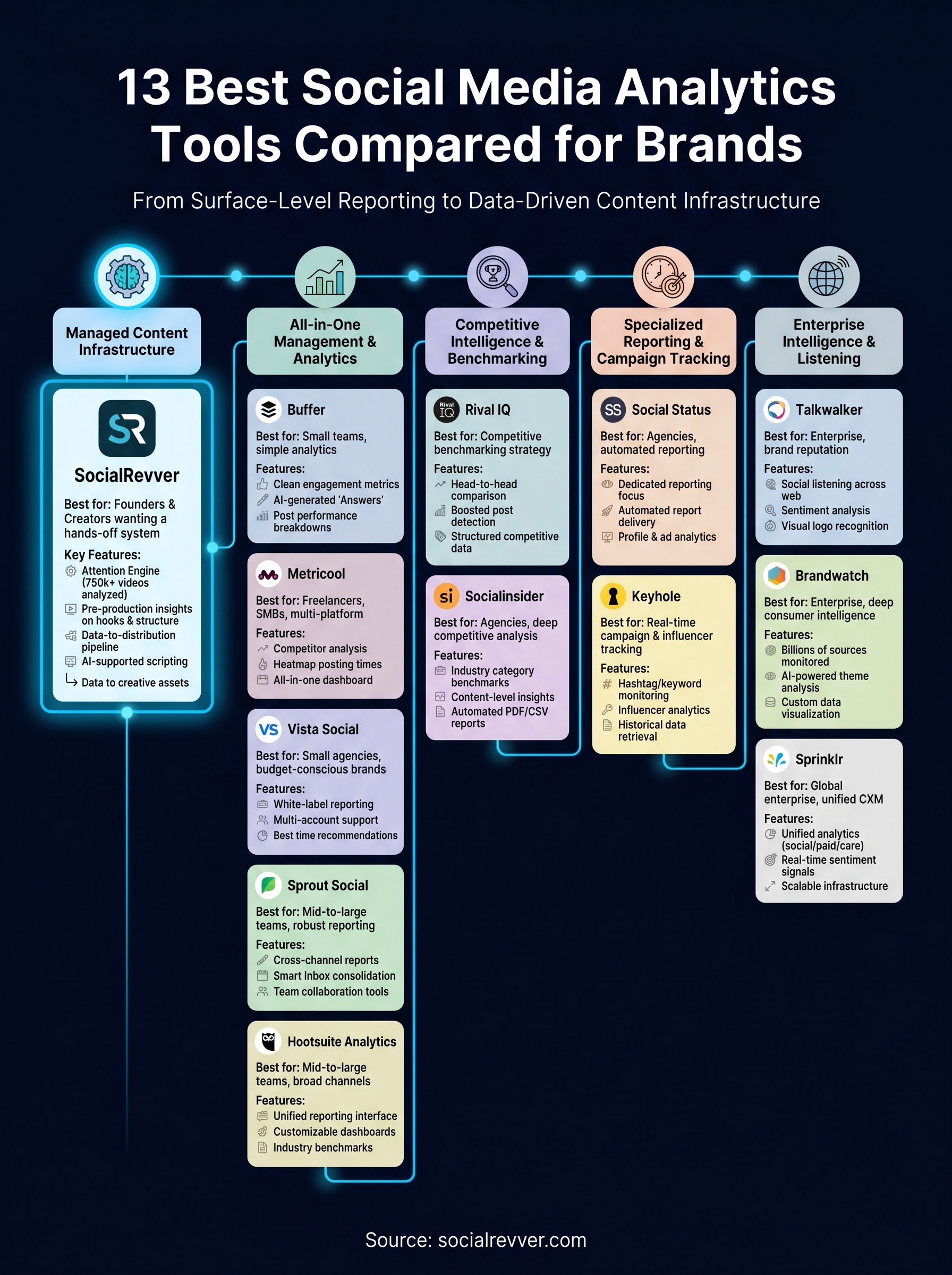
The best social media analytics tools range from lightweight reporting dashboards to full-scale enterprise intelligence platforms, and the right pick depends entirely on what your brand actually needs to measure. If you run a small operation and need clean post-level data, Buffer or Social Status will cover you well. If competitive benchmarking drives your strategy, Rival IQ or Socialinsider belong on your shortlist. And if your priority is moving beyond tracking what happened toward building a system that shapes what you publish before you hit record, SocialRevver operates at a different level entirely.
Most tools show you the data. SocialRevver acts on it, using behavioral patterns from over 750,000 videos to inform every creative decision your brand makes. If you want a content system that converts attention into real business outcomes rather than better-looking reports, apply to work with our team and get a free 40+ slide social media strategy.