
You've watched a Short hit a million views and wondered what that actually put in your pocket. The honest answer surprises most creators: how much does YouTube Shorts pay varies wildly, and the number is almost always lower than people expect from a view count that big.
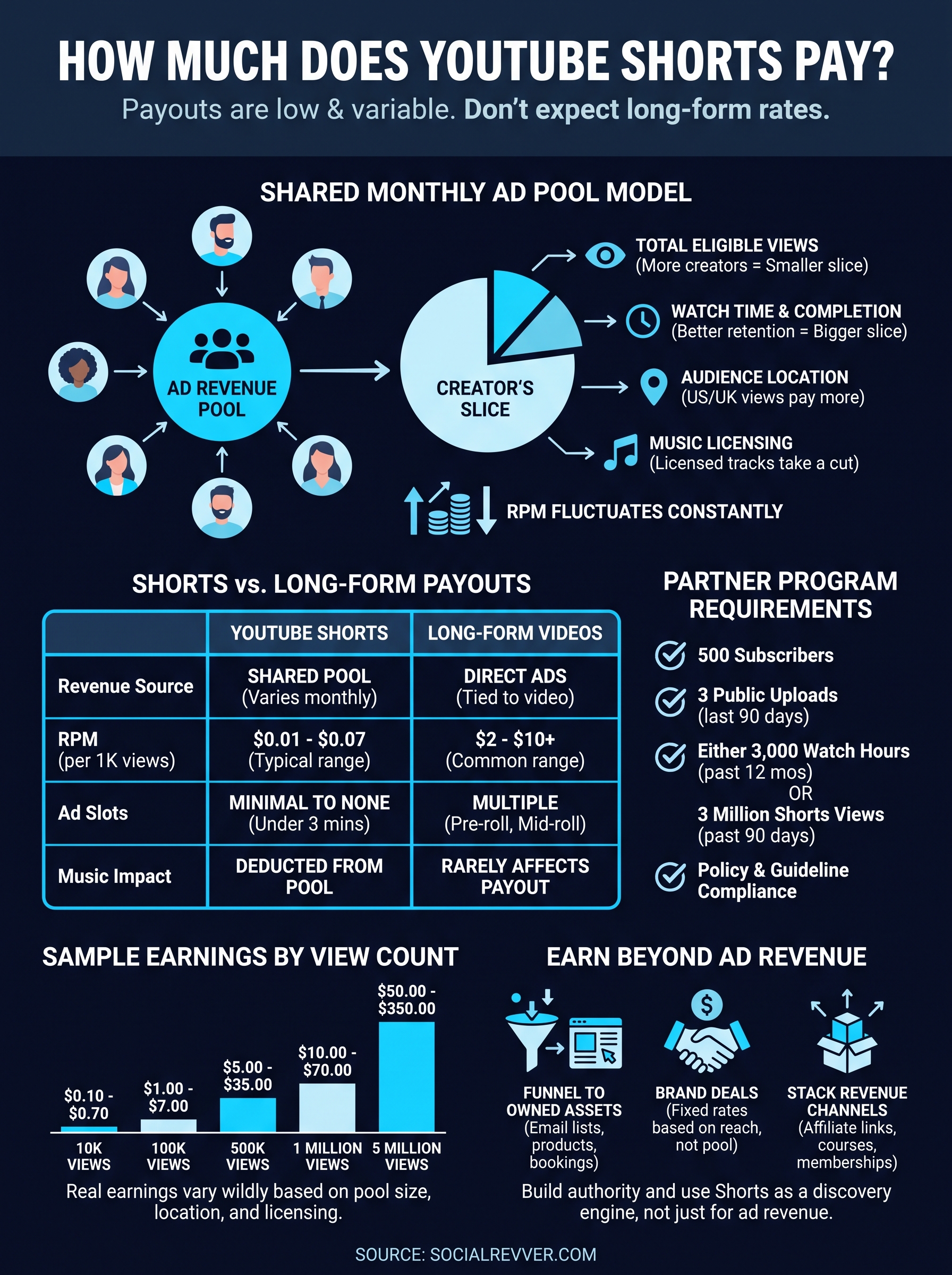
YouTube Shorts pays through the Shorts fanned-out revenue pool, not a fixed rate per view like long-form ads. Your cut depends on watch time, audience location, licensing costs for any music used, and your share of the total pool that month compared to every other eligible creator. Most creators report earnings somewhere between $0.01 and $0.07 per thousand views, though that range shifts constantly. This article breaks down the real numbers, the eligibility requirements for the YouTube Partner Program, and the specific factors that push your rate up or down.
We built this guide because the creators and founders we work with need accurate numbers before they invest time or budget into a Shorts strategy. If you're serious about turning views into actual revenue instead of chasing vanity metrics, understanding the payout math is step one before you build anything on top of it.
Why YouTube Shorts pay so much less than long videos
Long-form YouTube pays you for the ads shown against your specific video. Shorts work differently. YouTube pools ad revenue from Shorts across the entire platform each month, then divides it based on your share of total views relative to every other monetized creator. That structural difference is the single biggest reason your payout per view looks so small compared to a 10-minute video with mid-roll ads.
The pool model changes the math entirely
Understanding YouTube Shorts monetization starts with accepting that you're not paid for your video in isolation. You're paid a slice of a shared fund, and that slice shrinks as more creators upload eligible Shorts. A viral month for the platform overall, more competition, more creators hitting eligibility, more content flooding the pool, can actually lower your rate even if your own views stay flat. Long-form ads don't work that way. A pre-roll or mid-roll ad on your channel generates revenue tied specifically to your content and your audience.
A Short's payout depends less on your views and more on your slice of a shared monthly pool.
Shorter runtime means less ad inventory
A Short caps out at three minutes, and most successful ones run well under 60 seconds. That leaves almost no room for ad placement compared to a long-form video where YouTube can insert multiple ads without disrupting the viewing experience. Fewer ad slots per video means less total advertising revenue generated by the format overall, which directly limits the size of the pool creators are splitting. You can confirm the mechanics of this system directly through YouTube's own Shorts monetization documentation, which lays out how the fund is calculated and distributed.
Music licensing takes a cut before you see a dime
Here's a detail most creators miss: if your Short uses licensed music from YouTube's audio library, a portion of that pool gets diverted to cover licensing costs before creator payouts happen. Since a huge percentage of Shorts lean on trending audio, this licensing deduction meaningfully shrinks what's left for everyone using popular tracks. Creators who rely on original audio or voiceover-driven content often see a slightly better cut of the pool for this exact reason.
A side-by-side look at the difference
| Factor | YouTube Shorts | Long-form YouTube |
|---|---|---|
| Revenue source | Shared monthly ad pool | Direct ads on your video |
| Typical RPM | $0.01-$0.07 per 1,000 views | $2-$10+ per 1,000 views |
| Ad slots per video | Minimal to none | Multiple pre-roll/mid-roll |
| Music licensing impact | Deducted from shared pool | Rarely affects payout |
| Payout stability | Fluctuates with total platform volume | Tied to your own performance |
Seeing the numbers laid out this way explains why how much do YouTube Shorts pay is such a common frustration point for creators expecting long-form-level returns. The format was built to drive discovery and reach, not direct ad income, and treating it as a standalone revenue stream instead of a top-of-funnel tool is where most creators misjudge the opportunity.
How to qualify for YouTube Shorts monetization
Before any payout math matters, you need to clear YouTube's eligibility bar. Qualifying for the YouTube Partner Program is the first gate, and Shorts revenue sharing only kicks in once you're inside that program, not before.
The baseline requirements
Getting accepted into the YPP requires hitting specific thresholds that YouTube checks before approving any channel. These aren't negotiable, and falling short on even one disqualifies your application until you catch up.
- 500 subscribers minimum
- 3 valid public uploads in the last 90 days
- Either 3,000 watch hours on long-form content in the past 12 months, or 3 million valid public Shorts views in the past 90 days
- Compliance with all YouTube monetization policies and community guidelines
- An active AdSense account linked to your channel
You can't earn a cent from Shorts until your channel clears YouTube's Partner Program thresholds first.
Hitting the Shorts-specific view threshold is often faster than the long-form watch hour path, which is exactly why so many creators use Shorts as their entry point into monetization even if they plan to focus on long-form content later. You can verify the current numbers directly on YouTube's Partner Program eligibility page, since thresholds occasionally shift.
Original content matters more than people assume
Once you're inside the program, individual Shorts still need to qualify separately for the revenue pool. YouTube's system flags reused, reposted, or lightly edited content and excludes it from monetization, even if the video technically meets the platform's format requirements. A Short built from someone else's footage with a filter slapped on top won't generate a cut of the fund, regardless of how many views it pulls.
Essentially, the same originality standards that apply across YouTube apply here, just enforced more aggressively because Shorts make repurposing so easy. If you're stitching together clips, adding meaningful commentary, editing, or transforming the source material substantially changes how the system evaluates it. This is also where a professional production workflow pays off: content built with intentional structure and original framing clears these filters cleanly, while low-effort compilations get quietly excluded from the pool without much warning.
How much YouTube Shorts pay by view count
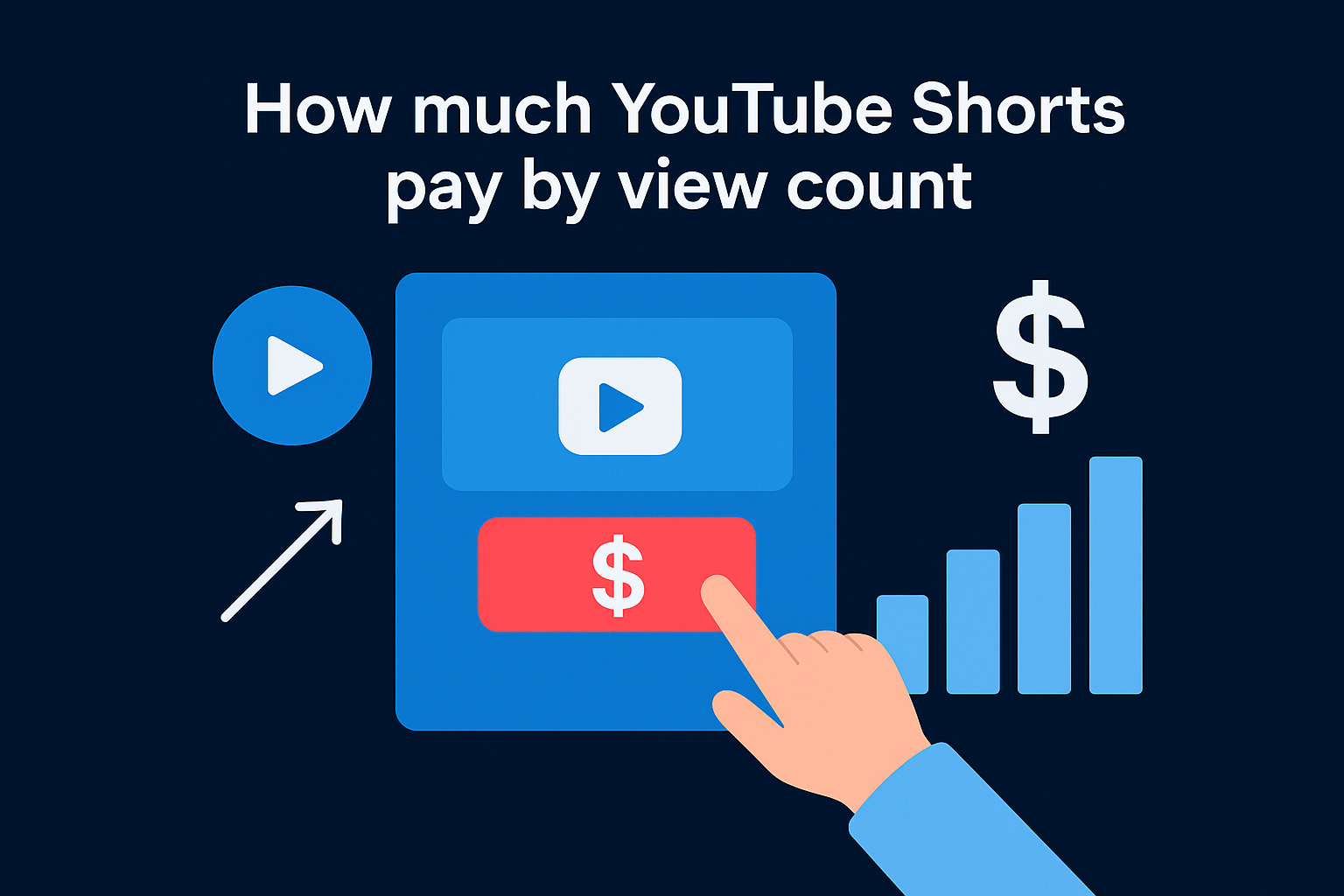
Numbers help more than percentages, so let's map out what real view counts translate to in dollars. YouTube Shorts pay on a range so wide that a single viral hit can land you $20 or $2,000 depending on your audience location, the month's total pool size, and how many other creators are splitting that same fund. These figures use the commonly reported $0.01 to $0.07 per 1,000 views range, but treat them as a rough guide, not a guarantee.
Sample earnings by view tier
Here's how that RPM range plays out across common view milestones creators actually hit:
| Views | Low estimate ($0.01/1K) | High estimate ($0.07/1K) |
|---|---|---|
| 10,000 | $0.10 | $0.70 |
| 100,000 | $1.00 | $7.00 |
| 500,000 | $5.00 | $35.00 |
| 1,000,000 | $10.00 | $70.00 |
| 5,000,000 | $50.00 | $350.00 |
A million views on Shorts might earn you less than a single sponsored story on Instagram.
Why the same view count pays differently every month
Run the same video twice, and you could see two completely different payouts. That's because the pool gets divided across every eligible creator's Shorts views during that specific month, so your dollar amount shifts based on total platform volume, not just your own performance. A viral trend that pulls in millions of new Shorts creators during a slow ad season can shrink everyone's slice, even if your video's view count stays identical to last month's numbers.
Geography plays a role too. Views from the United States, Canada, or the UK typically generate more ad revenue per thousand views than views from regions where advertisers pay less for impressions. Viewer location matters more than most creators realize when comparing why one viral Short outperforms another financially despite similar view counts.
Seasonality shows up in these numbers as well. Advertising budgets typically increase in the fourth quarter, which can temporarily boost the pool size and your resulting cut. January and February often show the opposite effect, with tighter ad spend translating into a thinner payout even for creators posting consistent volume. None of this means Shorts revenue is worthless, it means you shouldn't build a business model around a number that moves this much from one month to the next.
What affects your YouTube Shorts RPM
Your YouTube Shorts RPM isn't a fixed number you can look up once and forget. It moves based on a handful of variables that stack on top of each other, and understanding which ones you actually control changes how you plan content. Some factors are structural and outside your influence, like the total pool size in a given month. Others are within your reach, and ignoring them leaves money on the table.
Audience location drives most of the variance
Geography remains the single biggest lever affecting your rate. Advertisers pay significantly more to reach viewers in the United States, Canada, Australia, and the UK than viewers in markets where ad budgets are thinner. If your Shorts pull heavy traffic from lower-paying regions, your RPM drops even when your view count looks identical to a creator with a US-heavy audience. You can check this breakdown directly in YouTube Analytics under the audience tab, and it often explains RPM gaps between creators that raw view counts can't.
Content category and advertiser demand
Some niches simply attract more advertiser dollars than others. Finance, business, and technology content tends to draw higher-paying advertisers than general entertainment or meme-style content, which shifts the available pool toward those categories. This is one reason our approach at SocialRevver leans on strategy intelligence pulled from a database of hundreds of thousands of videos, since knowing which formats and topics align with stronger advertiser demand changes how you prioritize content, not just how you produce it.
Watch time and completion rate
YouTube's algorithm rewards Shorts that hold attention through the full runtime, and that signal indirectly affects your earnings by influencing how widely the platform distributes your content within the pool-eligible pool of views. A Short with a strong completion rate gets pushed to more viewers, which increases your total share of eligible views even if your per-view rate stays flat.
Your RPM depends less on luck and more on where your viewers live and what they watch next.
Music and licensing choices
As covered earlier, licensed trending audio pulls a cut from the pool before payouts happen. Choosing original sound, voiceover, or licensed-free music can quietly improve your take-home rate, especially at scale where that deduction compounds across thousands of videos each month.
How to earn more from Shorts beyond ad revenue
Asking how much do YouTube Shorts pay through the ad pool alone misses the bigger opportunity. The real money for founders and brands comes from treating Shorts as a discovery engine that feeds something with a higher ceiling. Smart creators stop chasing pool math and start building systems that convert attention into revenue outside YouTube's payout structure entirely.
Funnel viewers into something you own
A Short can drive thousands of viewers toward a lead magnet, email list, or booking page in a single caption line. Automated funnels built specifically to catch that traffic convert passive viewers into leads before they scroll away, and that conversion is worth far more than any RPM fluctuation. A single consult booked from a Short can outearn a month of pool payouts from a viral hit.
The pool pays pennies, but the audience it builds can pay your entire business.
Brand deals pay what the pool never will
Once your Shorts consistently pull strong view counts, brand deals become the real revenue driver. Sponsors pay flat fees or commissions based on reach and engagement, not YouTube's shifting fund, and those rates climb fast once you can show consistent numbers. A creator with 500,000 average views per Short can often command sponsorship rates that dwarf a full year of ad pool payouts.
Repurpose and stack revenue channels
High-performing Shorts also work as raw material for other revenue paths. Consider stacking these on top of your existing content:
- Affiliate links in captions or pinned comments tied to products you already use
- Courses or digital products promoted through a linked landing page
- Membership or community access sold directly to your most engaged viewers
- Long-form video expansions that pull the same audience into higher-RPM content
Authority compounds faster than views
Founders and business owners often see the biggest return not from direct monetization but from authority building. A steady stream of well-produced Shorts positions you as a category leader, which attracts investors, talent, and inbound deals that never show up in an analytics dashboard. That compounding effect is exactly why we built the SocialRevver Attention Engine around production quality and strategic distribution, not just chasing pool payouts.
Putting Shorts earnings in perspective
So, how much does YouTube Shorts pay? Directly through the ad pool, not much. A million views might net you $10 to $70, and that number swings based on geography, licensing, and total platform volume every single month. Chasing a higher RPM as your only goal means optimizing for a number you barely control. The creators and founders actually building wealth from Shorts treat the format as top-of-funnel infrastructure, not a paycheck. They use views to build authority, fill funnels, and land brand deals that make pool payouts look irrelevant by comparison.
That shift in thinking, from chasing views to engineering outcomes, is exactly what a real content system should do for you. If you want a strategy built around that math instead of guesswork, get your free 40+ slide social media strategy and see what a data-driven approach to Shorts actually looks like.