
Most brands pour hours into content that gets ignored, not because it's bad, but because it's aimed at nobody in particular. The fix isn't more content. It's knowing exactly who you're talking to. That's why learning how to create buyer personas is one of the highest-leverage moves you can make before you publish a single post, script, or ad. At SocialRevver, our entire Attention Engine runs on this principle: every script, hook, and distribution decision starts with a deeply researched profile of the person we're trying to reach.
A buyer persona isn't a vague demographic sketch. It's a documented, research-backed representation of your ideal customer, their goals, frustrations, decision-making patterns, and the language they actually use. Get this right, and your messaging stops feeling generic. Your content starts converting because it speaks directly to real problems real people have.
This guide breaks down the full process into a repeatable system. You'll learn how to gather the right data, segment your audience, build detailed persona documents, and put them to work across your marketing. We've also included templates and tool recommendations so you walk away with something actionable, not just theory. Whether you're a founder building a personal brand or a team scaling content operations, this framework applies from day one.
What a buyer persona is in 2026
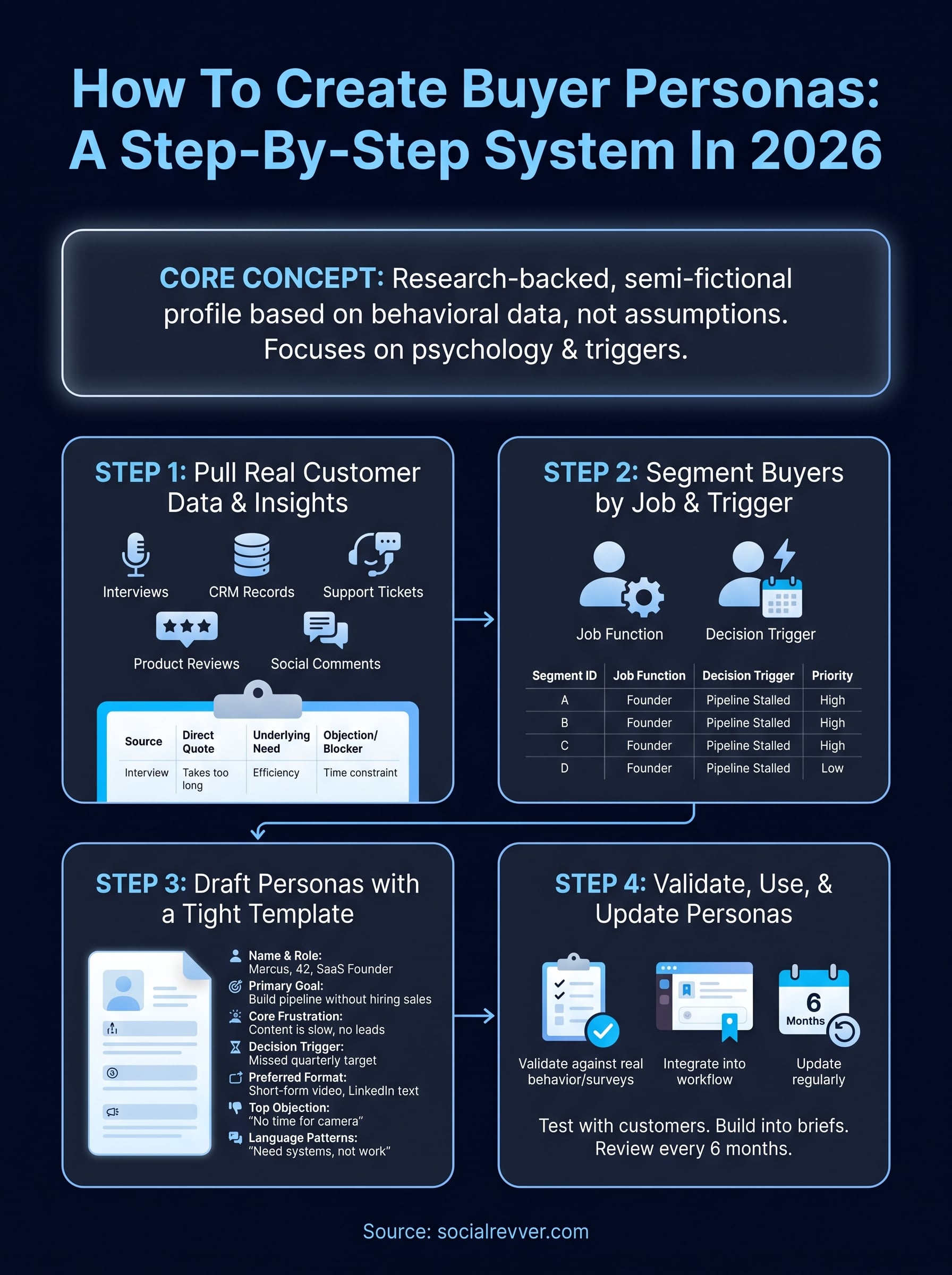
A buyer persona is a research-backed, semi-fictional profile of your ideal customer, built from real behavioral data, direct interviews, and purchase patterns rather than assumptions. The word "semi-fictional" matters here: you're creating a named, detailed character, but every attribute in that profile should trace back to something you observed or heard from actual customers. In 2026, with AI-generated content flooding every channel, the brands that win aren't the ones producing the most. They're the ones speaking with the most precision.
A persona isn't a demographic box. It's a decision-making model you can use to predict what your customer will respond to before you spend a dollar on production.
How personas have evolved since the early days
For years, personas looked like this: "Sarah, 35, lives in the suburbs, uses Instagram." That level of detail was barely useful then, and it's useless now. Modern buyer personas go deeper into psychology, focusing on the specific triggers that push someone from passive interest to active buying. Audiences in 2026 are fragmented across platforms and saturated with content, so your personas need to capture not just who someone is, but why they act when they do and what stops them from acting sooner.
The shift toward short-form video has made this even more critical. When you understand how to create buyer personas that reflect real emotional drivers, you can build a hook in the first two seconds of a video that stops a specific person mid-scroll. Generic personas produce generic content. Specific personas produce content that feels like it was made for one person, because it was.
What a strong persona actually contains
A weak persona is a job title and an age range. A strong persona is a complete behavioral and psychological snapshot you can hand to a scriptwriter, a media buyer, or a sales rep and have them immediately understand who they're talking to. Here's what a complete persona document should include:
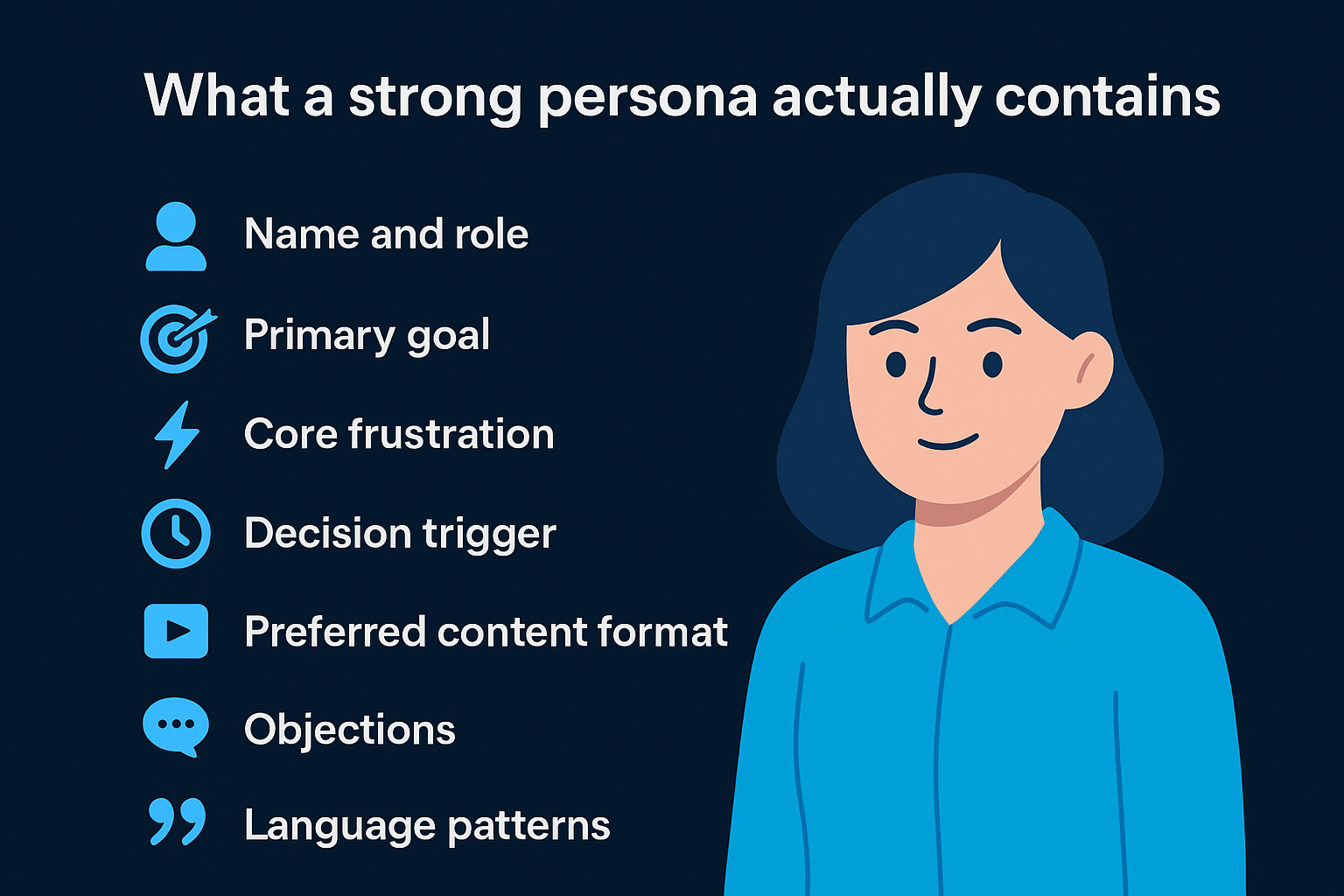
| Field | What to capture |
|---|---|
| Name and role | A real-sounding name, job title, and industry |
| Primary goal | The one outcome they're actively working toward |
| Core frustration | The specific problem blocking that goal |
| Decision trigger | The event or moment that makes them start looking for a solution |
| Preferred content format | Where they consume information and how they prefer it |
| Objections | The reasons they hesitate before buying |
| Language patterns | The exact words and phrases they use to describe their problem |
Each row in that table should be filled with direct quotes or paraphrased observations from real customer conversations, reviews, or support tickets, not guesses. The more specific your inputs, the more useful the persona becomes when your team makes creative decisions under pressure.
Step 1. Pull real customer data and insights
You can't build a useful persona from a conference room brainstorm. The first step in learning how to create buyer personas is going to the source: your existing customers, your CRM data, and the places where your audience already talks openly. The goal is to collect raw material before you form any conclusions about who your buyer actually is.
Skip the assumptions. Every persona field you fill in with a guess instead of evidence will cost you later when your messaging misses.
Where to find the data
Your best sources are closer than you think. Customer interviews are the most valuable, even five to ten conversations can surface patterns that no analytics dashboard will show you. Beyond interviews, here are the primary sources you should pull from:
- CRM records: Look at deal notes, close reasons, and lost deal reasons to identify patterns in what problems drove the buying decision
- Support tickets: The language customers use when frustrated is some of the most honest copy you'll ever find
- Sales call recordings: Tools like Gong or your CRM's call log give you direct access to objections and questions in real time
- Product reviews: Your own reviews and your competitors' reviews on platforms like Amazon or app marketplaces reveal what buyers value and what they resent
- Social comments: Look at comment threads under your own content for recurring themes and questions
What to capture from each source
Once you have your sources lined up, you need a consistent capture format so your data stays organized across channels. Use a simple spreadsheet with these columns:
| Column | What to log |
|---|---|
| Source | Interview, review, ticket, etc. |
| Direct quote | Exact words the customer used |
| Underlying need | What problem they were describing |
| Objection or blocker | What made them hesitate |
Fill this sheet before you write a single persona. The patterns in your filled rows will tell you exactly how many distinct personas you actually need.
Step 2. Segment buyers by job and trigger
Once your data sheet is full, you'll likely notice that not everyone in it looks the same. Different roles show up with different problems, and the same role can have completely different reasons for buying at different moments. Segmenting by job function and decision trigger is what separates a useful persona from a bloated one. This step is where the raw material you collected starts to take shape, and it's one of the most important moves in learning how to create buyer personas that actually drive decisions.
Two people with the same job title can be completely different buyers if one is reacting to a crisis and the other is planning ahead.
Why job title and trigger work together
Job title tells you what someone is responsible for. Decision trigger tells you what pushed them to act right now. Neither is enough on its own. A founder who hires help because their Q2 pipeline is empty is in a different mental state than a founder who hires proactively to scale. Their content, their objections, and their timeline for converting are all different. Treat them as the same persona and your messaging lands flat for both.
How to run the segmentation
Go back to your data sheet and group rows by two criteria: the buyer's primary job function and the specific trigger that brought them into your orbit. A trigger could be a milestone, a failure, a new hire, a funding event, or a competitive threat. Use this template to sort your segments before you build any persona documents:
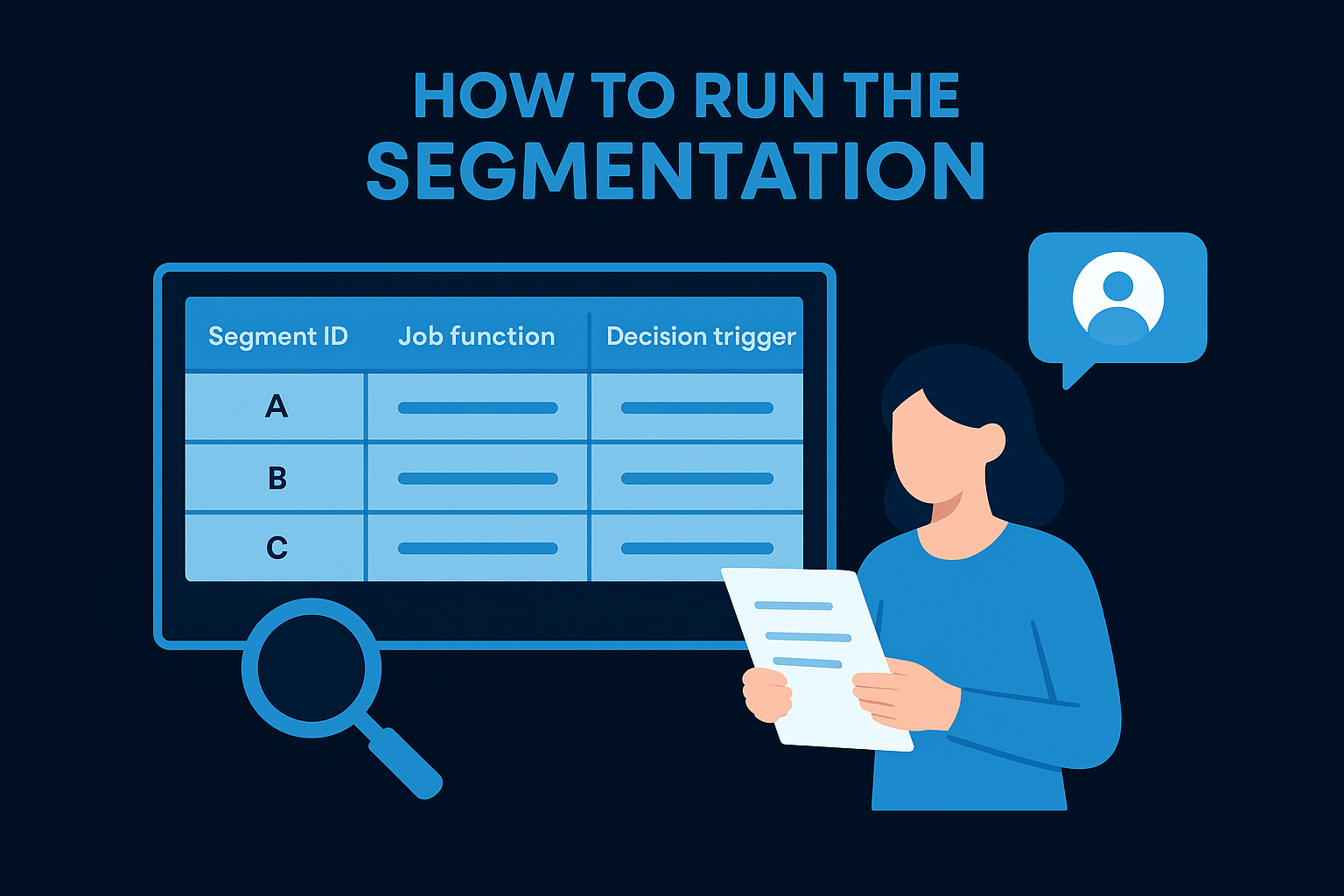
| Segment ID | Job function | Decision trigger | Volume in data | Priority level |
|---|---|---|---|---|
| A | Founder | Pipeline dropped or stalled | High | Build first |
| B | Marketing lead | New channel budget approved | Medium | Build second |
| C | Content creator | Monetization plateau | Low | Build third |
Fill every row with what your data actually shows, not what you expect to find. Segments with the highest volume in your data should become your first personas. Start there, then build outward.
Step 3. Draft personas with a tight template
With your segments defined, you're ready to build the actual documents. This is where many people get stuck: they overthink the format when learning how to create buyer personas and end up with documents no one reads. A persona doesn't need to be a 20-page report. It needs to be something your team can read in two minutes and immediately use to make a creative or strategic decision. Keep it tight, specific, and built entirely from what your data sheet already shows.
The best persona document is the one your team actually opens before they write a script, a headline, or a pitch.
What to put in each persona document
Your template should fit on a single page. Each field needs a direct, specific answer, not a range or a vague description. Pull from your data sheet and fill in every row with observed patterns from real customers, not assumptions. Use the template below as your starting point:
| Field | Example output |
|---|---|
| Name and role | Marcus, 42, SaaS founder, Series A |
| Primary goal | Build pipeline without hiring a sales team |
| Core frustration | Content takes too long and produces no leads |
| Decision trigger | Missed quarterly revenue target |
| Preferred format | Short-form video, LinkedIn text posts |
| Top objection | "I don't have time to be on camera" |
| Language they use | "I need systems, not more work" |
How to keep personas usable after you build them
Once you fill the template, store it somewhere your team can find in under ten seconds, a shared drive, a Notion page, or a pinned message in your team's main channel. A persona buried in a slide deck never gets used. Every piece of content your team produces should reference the relevant persona before the first draft is written, not after. Build that habit early and your output consistency will follow.
Step 4. Validate, use, and update personas
A persona document that never gets tested is just a hypothesis. The final step in learning how to create buyer personas is closing the loop: you take what you built, put it in front of real customers, and check whether the document matches how those people actually think and buy. If it doesn't match, you update the document, not your opinion of the customer.
A persona that hasn't been validated is an assumption dressed up as a strategy.
Test your personas against real behavior
The fastest way to validate a persona is to run it against your next sales conversation or content piece. Before the conversation or publish date, share the persona with the person running it and ask them to note any field that felt off or missing. You can also use a short survey to cross-check key fields:
| Persona field to test | Validation question to ask |
|---|---|
| Core frustration | "What's the biggest problem you were trying to solve?" |
| Decision trigger | "What made you start looking for a solution right now?" |
| Top objection | "What almost stopped you from moving forward?" |
| Language patterns | "How would you describe this problem to a colleague?" |
Run this check with five to ten real customers per segment and look for fields where the answers consistently contradict your document.
Build personas into your daily workflow
Validation only works if your team actually uses the personas before they create anything. Pin each persona document in the channel or folder your team works from most. Require anyone writing a script, ad, or email to name the target persona in the first line of their brief.
Updating on a set schedule keeps your personas accurate as markets shift. Review each persona document every six months, or immediately after a product launch or major market change. Replace any field where three or more recent customer conversations contradict what's currently written.
Next steps
Now you have a complete system for how to create buyer personas that actually drive decisions. You covered where to pull real data, how to segment by job and trigger, how to build a tight template, and how to validate your work against real customer behavior. Each step builds on the last, and skipping any one of them will leave gaps in your messaging that show up the moment a customer reads your content and keeps scrolling.
The personas you build from this process become the foundation for every creative decision your team makes. A strong persona document means your team stops guessing and starts working from evidence, which makes scripting, targeting, and content planning faster across the board. Applying this system to short-form video is where the real leverage is. If you want that done for your brand, apply to work with our team and get a free 40+ slide social media strategy built around your exact audience.