You've posted consistently for weeks, maybe months, and your follower count barely moves. That's the frustrating reality for most people trying to figure out how to grow on TikTok fast: the platform rewards patterns most creators never see, and guessing your way to virality wastes time you don't have.
Here's the direct answer: growing fast on TikTok isn't about luck or posting more randomly. It comes down to hook structure, timing, and reading what the algorithm is already telling you through your analytics. The creators who scale quickly treat content like a system with repeatable inputs, not a creative gamble.
We built SocialRevver on that exact idea, analyzing patterns across 750,000+ videos to find what actually drives growth instead of relying on generic advice. In this article, we're sharing 9 proven strategies pulled from that data, covering everything from scripting hooks that stop the scroll to posting schedules that match how TikTok's algorithm actually distributes content. Whether you're starting from zero or trying to break a growth plateau, these tactics give you a concrete plan instead of another list of vague tips.
1. Let a managed content system do the heavy lifting
Most creators trying to figure out how to grow on TikTok fast hit the same wall: they're doing everything themselves, from scripting to editing to posting, and it's not sustainable. A managed content system replaces that guesswork with a repeatable process built on data instead of intuition. This is the foundation strategy because it makes every other tactic on this list easier to execute consistently.
How it works
A system like SocialRevver's Attention Engine runs on four connected stages: strategy intelligence, scripting, production, and distribution. Strategy intelligence pulls from a database of over 750,000 videos to identify which hooks, pacing patterns, and psychological triggers are currently driving watch time in your niche. That analysis feeds a scripting engine that writes conversion-focused scripts matched to your voice, so the content sounds like you, not a template. From there, an AI-supported editing pipeline handles cut optimization, sound design, and captions, while distribution schedules posts based on real-time performance data rather than a generic "best time to post" chart.
Why it works
Speed comes from removing the two biggest bottlenecks: creative uncertainty and inconsistent output. When you're guessing at hooks and editing between meetings, you can't post often enough or well enough to trigger the algorithm's growth loop. A managed system treats content like an engineering problem with measurable inputs, which is exactly why it scales faster than manual creation.
Growth compounds when content production stops depending on your personal bandwidth.
This matters most for founders and business owners who need visibility without becoming full-time editors. You get the authority-building output of a professional content team without hiring one internally.
How to start today
You don't need to overhaul your entire process overnight. Start by auditing where your current bottleneck actually is:
- Strategy: Are your topics based on data or guesses?
- Scripting: Do your hooks follow a proven structure, or are they improvised?
- Production: Is editing eating hours you could spend elsewhere?
- Distribution: Are you posting on a schedule tied to performance data?
Once you know where you're losing time or momentum, look at whether a managed system fits your stage. If you're a founder, creator, or business owner who needs consistent output without becoming the bottleneck, SocialRevver's Attention Engine is built specifically for that handoff, turning content into infrastructure instead of a recurring task on your to-do list.
2. Nail a niche your audience can't scroll past
Generic content is the fastest way to stay invisible. If you're still trying to figure out how to grow on TikTok for beginners, the answer usually starts with narrowing your focus, not widening it. A defined niche gives TikTok's algorithm a clear signal about who to show your videos to, which means faster distribution to the right people instead of a scattershot audience that never engages twice.
How it works
Your niche isn't just a topic, it's a specific angle, tone, and audience problem you consistently address. Instead of "business advice," think "cash flow tactics for founders under $1M in revenue." That specificity shows up in your captions, your hooks, and even your comment replies, training the algorithm to recognize your content pattern quickly. TikTok's system rewards accounts that build a recognizable content identity because it can predict who'll watch to the end.
Why it works
Viewers scroll past content that feels aimed at everyone. A tight niche makes your audience feel like you're speaking directly to them, which drives the completion rates and shares that fuel distribution.
A niche that's too broad gets ignored; a niche that's specific gets remembered.
This is also why growing your account on TikTok gets easier once you stop chasing every trend outside your lane. Authority builds faster when your content answers the same core question from different angles.
How to start today
Define your niche with three filters:
- Audience: Who exactly are you talking to?
- Problem: What specific frustration do you solve for them?
- Angle: What makes your take different from competitors covering the same topic?
Write this down before your next script. If you can't answer all three clearly, your content will keep feeling scattered no matter how often you post.
3. Post on a consistent, data-backed schedule
Posting sporadically confuses the algorithm and stalls your reach. If you want to know how to grow faster on TikTok, consistency has to come before volume. TikTok's distribution system needs a reliable pattern to test your content against new audiences, and irregular posting resets that testing process every time.
How it works
A data-backed schedule isn't about hitting a fixed time slot every day. It's about tracking when your specific audience is active and how quickly your last few videos hit their engagement plateau, then timing your next post around that window. Real-time performance monitoring, the kind built into distribution systems like SocialRevver's, adjusts posting windows based on actual watch-time data instead of generic "best time to post" charts that ignore your niche entirely.
Why it works
Frequency signals reliability to both the algorithm and your audience. Accounts that post three to five times a week on a predictable cadence build momentum because each video benefits from residual reach left by the last one.
Consistency isn't a vanity metric, it's the input the algorithm uses to decide how far to push your next video.
This is where most people stall when learning how to grow quickly on TikTok: they post in bursts, get a good week, then disappear for ten days and lose the momentum entirely.
How to start today
Pull your last 15 posts and check three things:
- Posting gaps: Are there stretches longer than three days between uploads?
- Engagement timing: Which two-hour windows show the highest average watch time?
- Volume: Are you posting enough per week to let the algorithm test you against new audiences?
Set a minimum cadence you can sustain for 30 days straight before judging results.
4. Hook viewers in the first two seconds
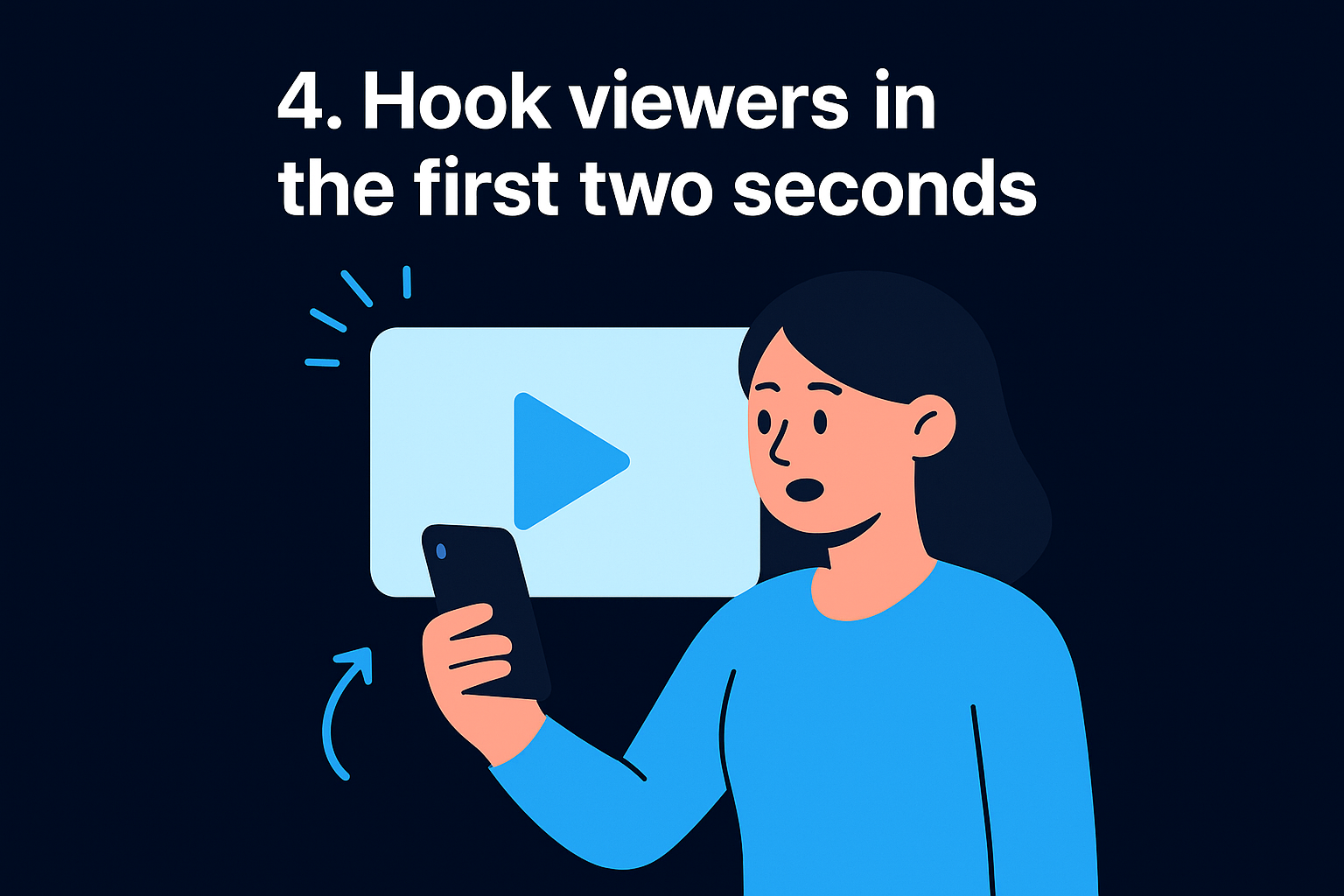
TikTok decides whether to keep testing your video against new audiences based on what happens in the first two seconds. If your hook is weak, viewers scroll before the algorithm even has a chance to gauge interest. Anyone serious about how to grow bigger on TikTok needs to treat the opening line as the single highest-leverage part of the entire video.
How it works
Strong hooks work by interrupting a pattern: a question the viewer didn't expect, a visual that breaks the scroll rhythm, or a statement that contradicts common advice in your niche. Our scripting engine pulls hook structures from patterns across 750,000+ videos, testing which openings correlate with the highest completion rates in specific niches rather than guessing at what sounds catchy. The hook isn't separate from the script, it's built first, then the rest of the video is structured to pay off the promise it makes.
Why it works
Watch time starts accumulating the moment someone doesn't swipe away, so the hook directly controls how much data the algorithm gets to work with. A video with a flat opening might have great content buried at the 15-second mark, but most viewers never see it.
If the first two seconds don't earn attention, nothing else in the video gets a chance to.
This single fix often moves the needle faster than any other tactic on this list because it affects every video you post going forward.
How to start today
Rewrite your last five hooks using one of these proven structures:
- A specific number or result ("3 mistakes killing your reach")
- A direct callout to your exact audience ("If you're a founder under $1M...")
- A contradiction to common advice in your niche
Film just the hook first and gauge your own reaction before scripting the rest.
5. Ride trending sounds, hashtags, and formats
Trends are shortcuts, not gimmicks. When TikTok pushes a sound or format hard, it's already testing well with the algorithm, and jumping in early lets you borrow that momentum instead of building distribution from zero. Anyone figuring out how to grow my account on TikTok should treat trend-spotting as a weekly habit, not an occasional afterthought.
How it works
Trending audio and formats work because TikTok's recommendation system is already primed to surface them to new audiences. Your job is to adapt the format to your niche fast, usually within 24 to 48 hours of spotting it, before saturation kills the novelty. Strategy intelligence tools that scan large video datasets can flag which sounds are climbing before they peak, giving you a window most creators miss because they're scrolling for inspiration instead of tracking data.
Why it works
A trending sound acts like a signal boost. The algorithm associates that audio with high completion rates from other videos, so your version inherits some of that initial push. Hashtags work similarly, though far more weakly. They help categorize content, but they won't save a weak hook or a slow opening.
Trends don't create growth on their own, they amplify content that's already structured to hold attention.
This is why tips on how to grow your TikTok account always mention trends but rarely explain the timing. Late adoption of a trend gets buried under thousands of similar videos.
How to start today
Check TikTok's Discover page daily and note three things:
- Sound velocity: Is the audio's usage climbing fast or already flattening?
- Format fit: Can you adapt it to your niche without forcing it?
- Timing: Can you film and post within 48 hours?
Skip any trend that doesn't pass all three checks.
6. Edit for watch time, not just polish
A beautifully shot video with no pacing still loses to a rougher clip that keeps people watching. If your goal is how to grow bigger on TikTok, stop optimizing for cinematic quality and start optimizing for the seconds someone actually stays. Watch time is the metric that decides distribution, and editing choices control it more than lighting or camera gear ever will.
How it works
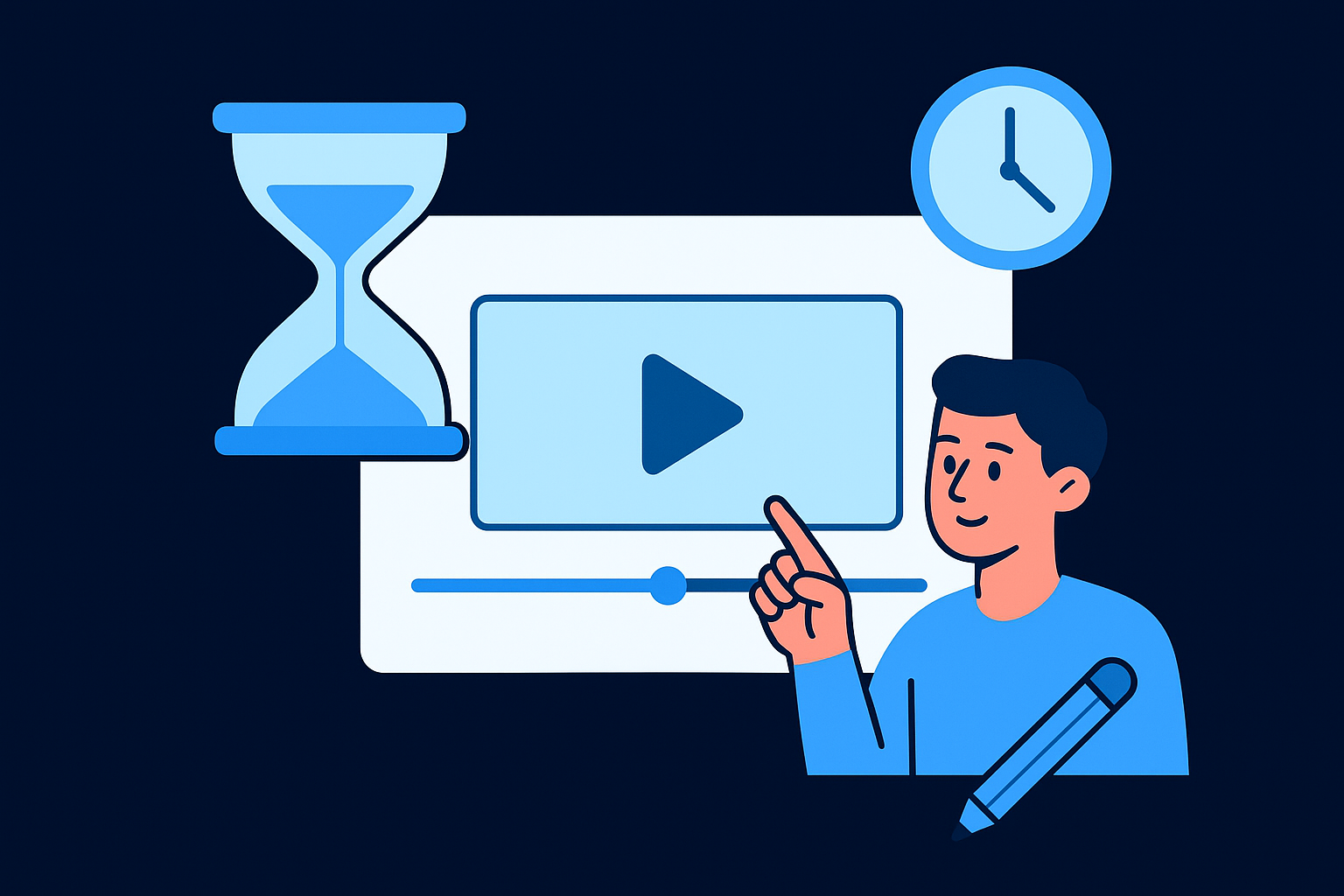
Cut optimization means removing dead air, filler words, and slow transitions that give viewers a reason to swipe. Motion pacing keeps the frame shifting just enough to hold attention without becoming distracting, while sound design and captions reinforce the point being made instead of just decorating it. An AI-supported editing pipeline applies these adjustments consistently across every video, so pacing doesn't depend on how much time an editor had that day.
Why it works
TikTok's algorithm tracks completion rate and rewatches, not visual polish. Videos edited for pace keep viewers engaged past the drop-off points that usually happen around three, seven, and fifteen seconds.
Polish gets compliments, pacing gets watch time, and watch time gets distribution.
Business owners chasing authority often over-invest in production value while under-investing in cut rhythm, which caps growth even with strong scripts.
How to start today
Review your last three videos and flag every point where the pace drags:
- Silence gaps: Cut anything over half a second with no visual or audio movement.
- Repeated points: Trim restated ideas that slow the payoff.
- Caption timing: Make sure captions land with the spoken word, not after it.
Re-edit one video using only these three fixes and compare its watch time to your average.
7. Engage your community and collab with creators
Growth stalls when creators treat TikTok as a broadcast channel instead of a conversation. If you're still asking how to grow your account on TikTok past a plateau, look at how much time you're spending in comments and DMs versus just posting and disappearing. The algorithm reads engagement as a signal of relevance, and replies from you specifically carry more weight than a generic like.
How it works
Replying to comments within the first hour of posting keeps the engagement loop active while TikTok is still testing your video against new viewers. Collaborations work on the same principle but at scale: partnering with a creator in an adjacent niche exposes your content to an audience that's already primed to care about your topic. Duets, stitches, and joint videos borrow trust that would otherwise take months to build organically.
Why it works
Engagement tells the algorithm your content sparks a reaction, not just a passive view. Comments, replies, and shares carry more ranking weight than views alone, which is well documented in TikTok's own creator resources on the recommendation system. Collabs multiply that effect by putting you in front of a warm audience instead of a cold one.
A reply to a comment is a growth tactic, not a courtesy.
Founders and business owners often skip this step because it feels like low-leverage busywork, but it's one of the cheapest ways to compound reach without producing more content.
How to start today
Set a 20-minute window after each post to reply to every comment, then message two creators in your niche this week about a simple collab format, like a duet or a quick joint video answering the same question from two angles.
8. Go live to build deeper reach and connection
Going live is one of the fastest ways to deepen a relationship with an audience that already knows your content. If you're focused on how to grow bigger on TikTok, live sessions give you a direct feedback loop that recorded videos can't match, real-time questions, real-time reactions, and a chance to prove you're a real person behind the account.

How it works
TikTok pushes live notifications to followers and surfaces active lives to new viewers browsing the Live tab, which means you're getting distribution outside your normal feed placement. During a session, viewers can comment, send gifts, and ask questions you answer on the spot, and that back-and-forth signals sustained engagement to the algorithm. Longer watch sessions during live streams also train TikTok to associate your account with high retention, which can carry over into how your regular posts get distributed afterward.
Why it works
Audiences trust accounts that show up unscripted. Live connection builds credibility faster than polished content alone because viewers see you handle real questions without an edit to hide behind.
A live session turns passive followers into people who feel like they know you.
This matters for founders and creators building authority, since investors, clients, and brand partners often watch live replays to judge authenticity before committing to a deal.
How to start today
Schedule one 20 to 30 minute live session this week around a topic your recent videos already generated questions about. Announce it 24 hours in advance in a regular post, prepare three talking points so you're not improvising the entire time, and end by directing viewers to your next scheduled video or offer.
9. Track your analytics and double down on wins
Most creators check their analytics once a week, glance at follower count, and move on. That's a wasted opportunity. If you're serious about how to grow your account on TikTok, your analytics tab should guide every decision about what to script next, not just confirm what already happened.
How it works
Open your TikTok analytics and look past the vanity numbers. Average watch time, completion rate, and traffic source per video tell you exactly which hooks and topics are earning distribution. Real-time performance monitoring takes this further by flagging winning patterns while a video is still gaining traction, so you can post a follow-up or variation within the same week instead of waiting for a monthly review to notice the trend.
Why it works
Growth compounds fastest when you repeat what's already working instead of constantly inventing something new. A video that hits 80% average watch time is telling you something specific about your hook, pacing, or topic. Ignoring that signal to chase a fresh idea resets your learning curve every single time.
Your best-performing video is a blueprint, not a one-off you move past.
This is where strategy intelligence built on large datasets outperforms gut instinct. Patterns across thousands of videos confirm whether your win was a fluke or a repeatable structure worth building a content pillar around.
How to start today
Pull your top three videos from the last 30 days and answer these for each one:
- Hook type: What structure did the opening line use?
- Topic angle: What specific problem or question did it address?
- Drop-off point: Where did the watch-time graph dip?
Script your next three videos as direct variations of your best performer, changing only one variable at a time so you know what actually moved the needle.
Turning these strategies into real growth
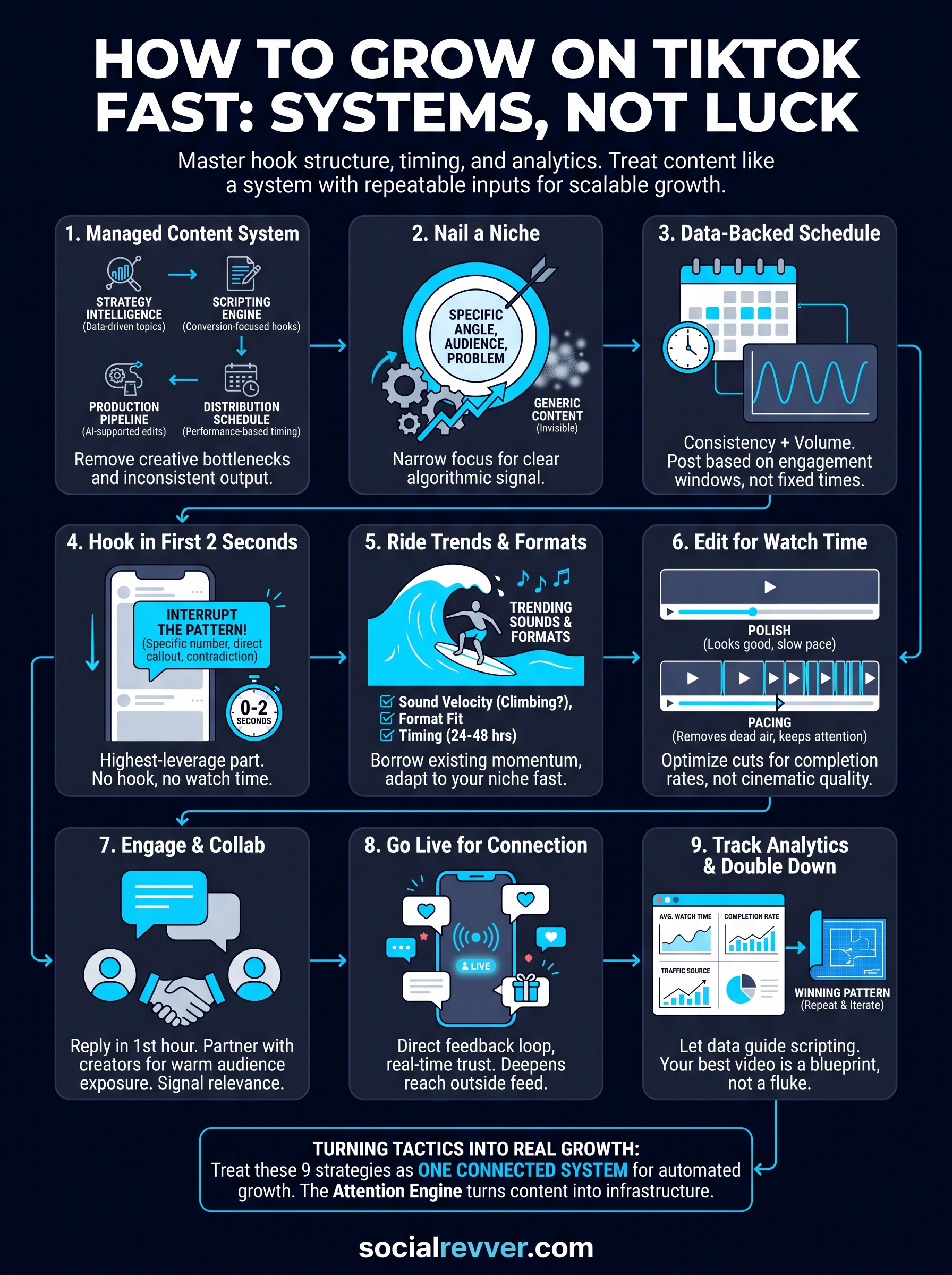
None of these nine tactics work in isolation. Sharp hooks fail without consistent posting, and consistent posting fails without analytics telling you what to repeat. The creators who actually figure out how to grow on TikTok fast are the ones who treat these tactics as one connected system, not a checklist they revisit once a month.
That's the gap most people hit: they know the tactics but lack the time or infrastructure to run them all at once, every week, without burning out. This is exactly why we built the Attention Engine, so founders and business owners get the system without becoming the bottleneck themselves.
If you want a clear plan instead of more guesswork, apply for your free 40+ slide social media strategy and see exactly how this applies to your niche.