Most YouTube Shorts fail in the first two seconds, not the last. You can have great footage, solid lighting, and a strong offer, but if the script does not earn attention immediately, none of that matters. Learning how to write scripts for YouTube Shorts is the actual bottleneck for creators and founders trying to turn views into leads, not camera gear or editing software.
This guide gives you the exact mechanics: how to open with a hook that stops the scroll, how to structure the middle so viewers stay through the payoff, and how to close with a line that drives comments, shares, or clicks. You will get word-for-word frameworks, not vague advice about "being authentic" or "posting consistently."
We built this approach after analyzing patterns across hundreds of thousands of high-performing videos, so what follows is grounded in repeatable structure, not guesswork. If you are a founder or business owner who needs content that builds authority instead of just racking up views, this is the writing process that makes that possible, step by step.
What makes a YouTube Shorts script work
A working Shorts script is not a smaller version of a YouTube video script. It behaves more like a piece of direct-response copy that happens to be spoken out loud. Every line has one job: keep the viewer from tapping away before the next line plays. Retention rate, not view count, is the metric that decides whether the algorithm pushes your video to more people, and retention is a direct output of how the script is built, not how it's filmed.
A Shorts script isn't judged by what it says. It's judged by how long people stay to hear it.
The three-part structure every Short needs
Almost every high-performing Short follows the same skeleton, regardless of niche. Consistent structure removes the guesswork and gives you a repeatable template you can reuse for every video instead of starting from a blank page each time.
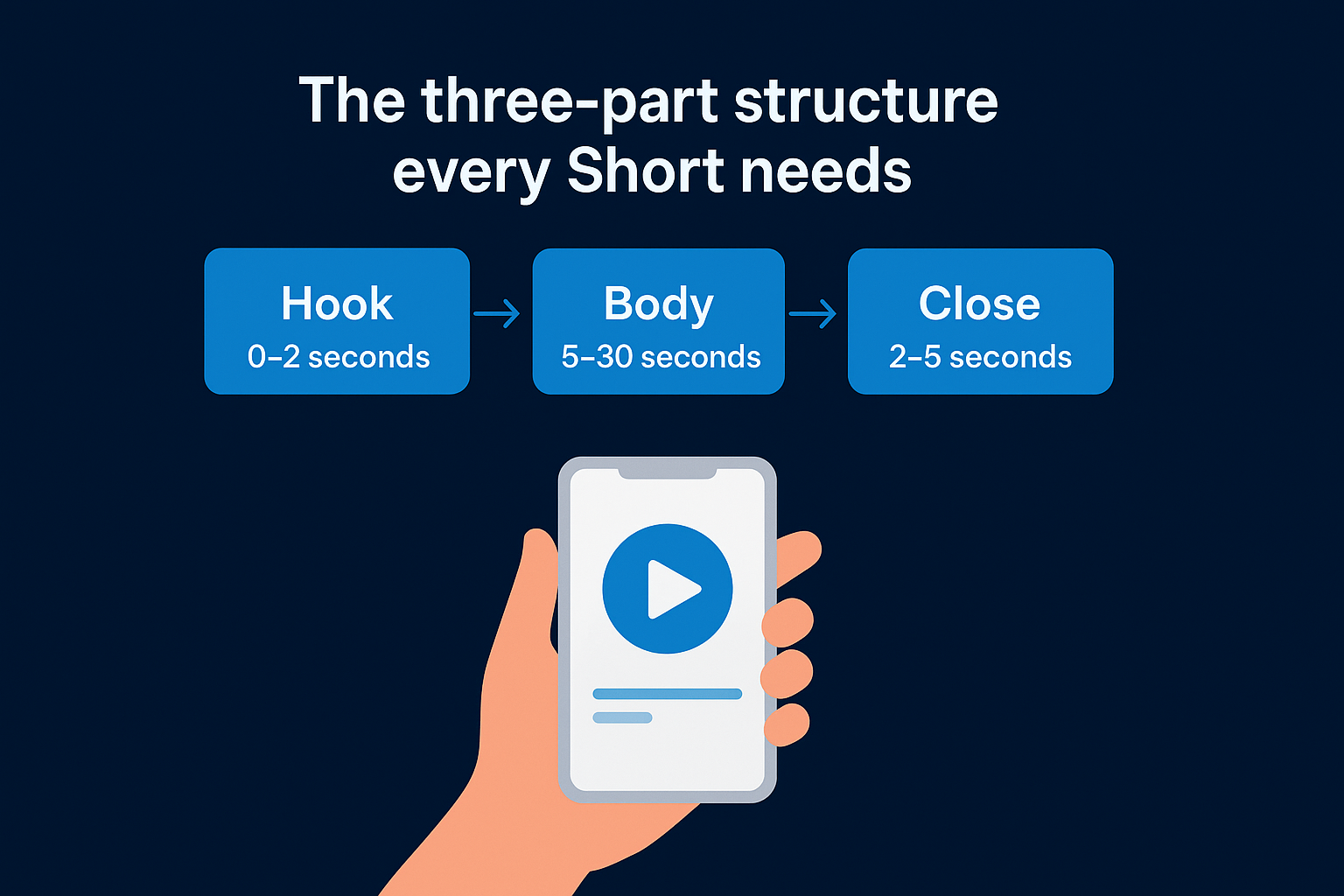
| Part | Length | Job |
|---|---|---|
| Hook | 0-2 seconds | Interrupt the scroll and create a reason to keep watching |
| Body | 5-30 seconds | Deliver one clear idea with proof, story, or steps |
| Close | 2-5 seconds | Push a specific action (comment, follow, click) |
That table is the entire architecture. If a line in your draft doesn't serve one of those three jobs, cut it.
Why retention beats production value
Business owners often assume better lighting or a nicer camera fixes weak performance. It rarely does. YouTube's own creator guidance points to audience retention as one of the strongest signals the platform uses to decide distribution, and retention is shaped almost entirely by pacing and clarity in the script, not by visual polish. You can read more about how YouTube evaluates watch behavior in its official Creator Academy resources. Founders who skip scripting and wing it on camera almost always lose viewers in the first ten seconds, even when the production looks expensive.
Compare two openers on the same topic: "Hey guys, today I want to talk about pricing strategy" versus "Your pricing page is losing you six figures a year, here's why." Same idea, wildly different retention. The second version works because it makes a specific, provable claim instead of announcing a topic.
The psychology behind pattern interrupts
Every scroll a viewer makes is a habit loop, and your script's only job in the first line is to break that loop. Scripts that work use one of a few proven interrupts: a bold claim, an unexpected visual cue described in the line, a question the viewer can't answer without watching, or a direct callout of the exact person watching. Understanding which interrupt fits your niche matters more than memorizing a single hook formula, because what stops a scroll for a founder audience differs from what stops one for consumer product buyers. The next section breaks down exactly how to build that opening line.
Step 1. Hook viewers in the first two seconds
Writing the opening line is the highest-leverage work you'll do on any script. YouTube's own data shows most Shorts lose the majority of their audience in the first three seconds, which means your hook isn't a nice intro, it's the entire gatekeeper for whether the rest of the script ever gets heard. Treat it like a headline, not a greeting, and never open with your name, your channel, or a summary of what you're about to say.
If your first line doesn't make a claim, ask a question, or create tension, you've already lost the viewer.
Five hook formulas that consistently work
Rather than freestyling every time, pull from a short list of proven openers and swap in your specifics:
- The cost claim: "This mistake is costing you [specific number]."
- The contrarian take: "Everyone tells you to [common advice]. Here's why that's wrong."
- The direct callout: "If you're a [specific role], watch this before your next [action]."
- The unfinished loop: "There's one reason your [result] isn't happening, and it's not what you think."
- The visual tease: describe an unexpected image or moment that's about to appear on screen.
Each formula forces specificity, and specificity is what separates a hook that stops a scroll from one that gets scrolled past.
Write five hooks before picking one
Don't settle for your first draft. Write out five different openers for the same idea, read them out loud, and pick the one that makes you want to keep listening even though you already know the payoff. This habit alone fixes most weak scripts, because first-draft hooks tend to explain rather than provoke. Once you've locked the opener, the next job is making sure the body of the script earns the attention you just bought.
Step 2. Outline the body around one idea
Once the hook lands, the body has one job: deliver on the promise without wandering. Single-idea scripts consistently outperform ones that try to cram in three tips or two stories, because every extra idea gives the viewer a mental exit ramp. Pick the one point that matters most, cut everything else, and save the rest for another Short. A script that tries to teach everything ends up teaching nothing, and the drop-off graph in YouTube Studio will show it plainly.
One idea, fully delivered, beats three ideas half explained.
Map the body before you write a single sentence
Before drafting full sentences, sketch the body as a sequence of beats. This forces logical flow and keeps you from burying the payoff halfway through:
- State the claim from your hook again, slightly expanded.
- Give the proof: a stat, a result, or a short story that backs it up.
- Break the idea into 2-3 concrete steps or reasons.
- Land the payoff line that closes the loop you opened.
That sequence works whether you're explaining a pricing mistake or a hiring lesson, because it mirrors how people naturally process an argument.
Keep each beat under one breath
Read your draft out loud and time each beat. If a single point takes more than one full breath to say, it's carrying too much information. Short spoken sentences keep pacing tight and match how people actually talk when they're confident about something, not when they're reading a script. Trim adjectives, cut qualifiers like "kind of" or "basically," and replace any sentence longer than 12 words with two shorter ones. This is also where pacing decisions happen, since a body that rushes through proof feels thin, while one that drags loses the retention you fought for in the hook. Once the body delivers the full idea cleanly, the script needs a close that turns that attention into action.
Step 3. Write it to sound natural on camera
A script that reads well on paper often sounds stiff the moment you say it out loud. This step in how to write scripts for YouTube Shorts is where most creators quietly fail, because they write like they're composing an email instead of talking to a friend. The fix isn't complicated, but it does require reading every line out loud before you ever hit record, not just proofreading it silently on a screen.
Read it out loud before you film
Grab your phone, read the script at normal speaking speed, and mark every spot where you stumble or take a breath mid-sentence. Those spots are almost always where the writing is too formal or too long. Spoken rhythm rarely matches written grammar, so don't be afraid to break rules: start sentences with "and" or "but," use contractions, and leave in the kind of pauses you'd naturally use when explaining something to a colleague.
If it sounds like you're reading, the viewer hears it too, and they leave.
Cut anything that sounds like writing
Swap formal phrasing for how people actually talk:
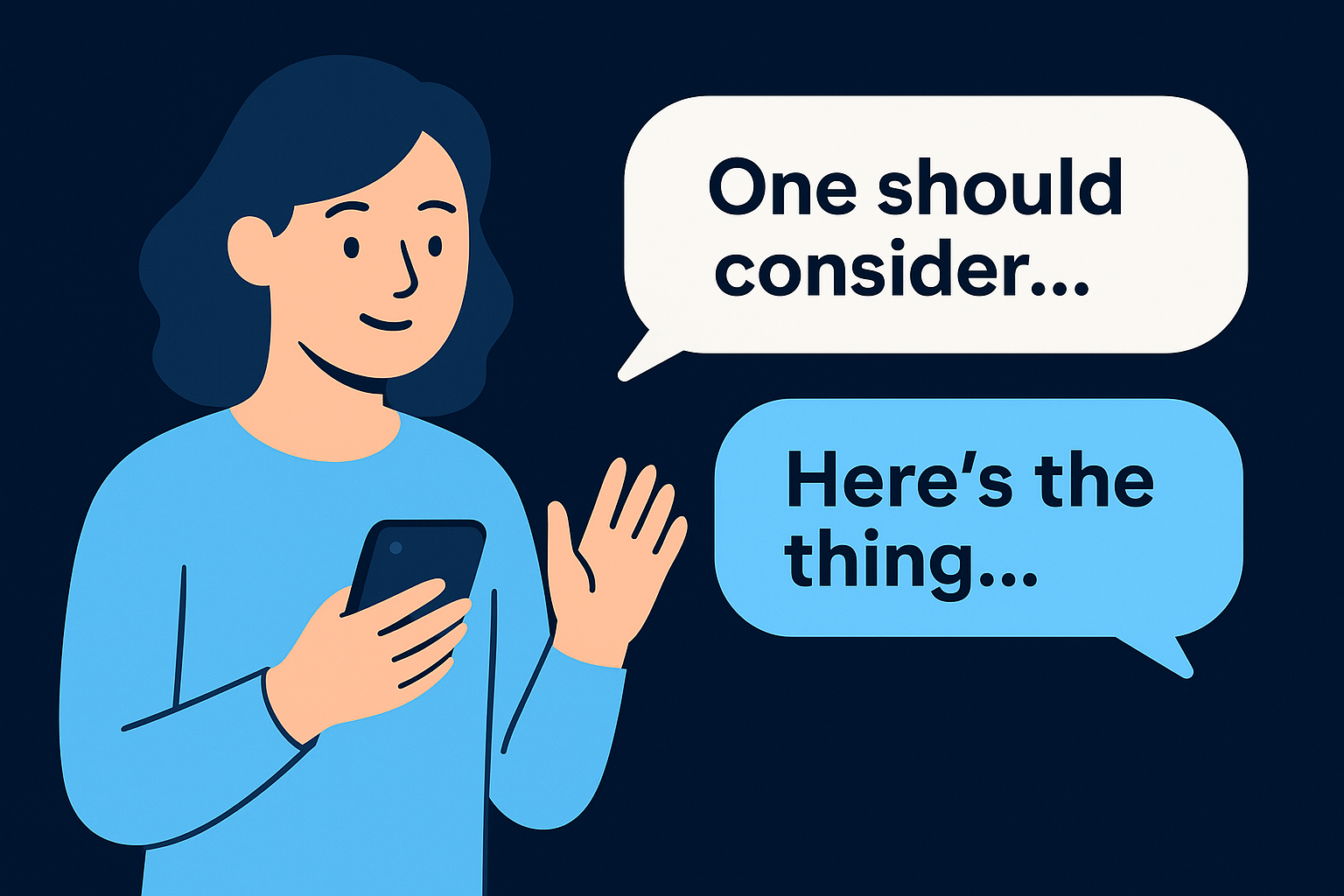
| Written version | Spoken version |
|---|---|
| "One should consider..." | "Here's the thing..." |
| "It is important to note that..." | "Quick heads up..." |
| "Subsequently, you will find..." | "Then you'll see..." |
That kind of conversational language builds trust fast, because it signals a real person talking, not a brand reading a press release. Founders especially tend to default to boardroom language on camera, which flattens delivery and kills retention even when the underlying idea is strong. Once the script sounds like something you'd actually say out loud, unscripted, you're ready to build the ending that turns that attention into a result.
Step 4. End with a call to action that sticks
Every Short needs a landing point, and too many scripts just stop instead of closing. Weak endings waste all the attention the hook and body earned, because the viewer finishes the video with nothing to do next. A strong close doesn't ask for a generic follow, it gives the viewer one specific action tied directly to the idea you just delivered.
A Short without a clear close is a conversation that just trails off.
Match the ask to the idea, not to your channel
Generic closers like "like and subscribe" get ignored because they're disconnected from what the viewer just watched. Relevant calls to action convert better because they feel like the natural next step, not an add-on. Try one of these patterns instead:
- "Comment [word] and I'll send you the template."
- "Follow if you want part two of this breakdown."
- "Save this before you make your next hire."
- "Click the link if you want the full walkthrough."
Each of these ties the action back to the value in the script, which is why they outperform a blanket request for engagement.
Give the viewer a reason to act now
Urgency matters even in a fifteen-second video. Time-bound language like "before your next launch" or "before you post again" pushes the viewer to act while the idea is still fresh, instead of scrolling away and forgetting. Pair that urgency with a single, unambiguous verb, comment, follow, save, or click, never more than one per video. Stacking multiple asks splits attention and usually results in the viewer doing none of them.
Founders building automated funnels should think of this line as the handoff point between organic content and a lead capture system, since a clear close is what makes that handoff possible in the first place. Once the ask is locked, read the full script end to end one more time to confirm the hook, body, and close all point at the same outcome before you record.
Putting your script into action
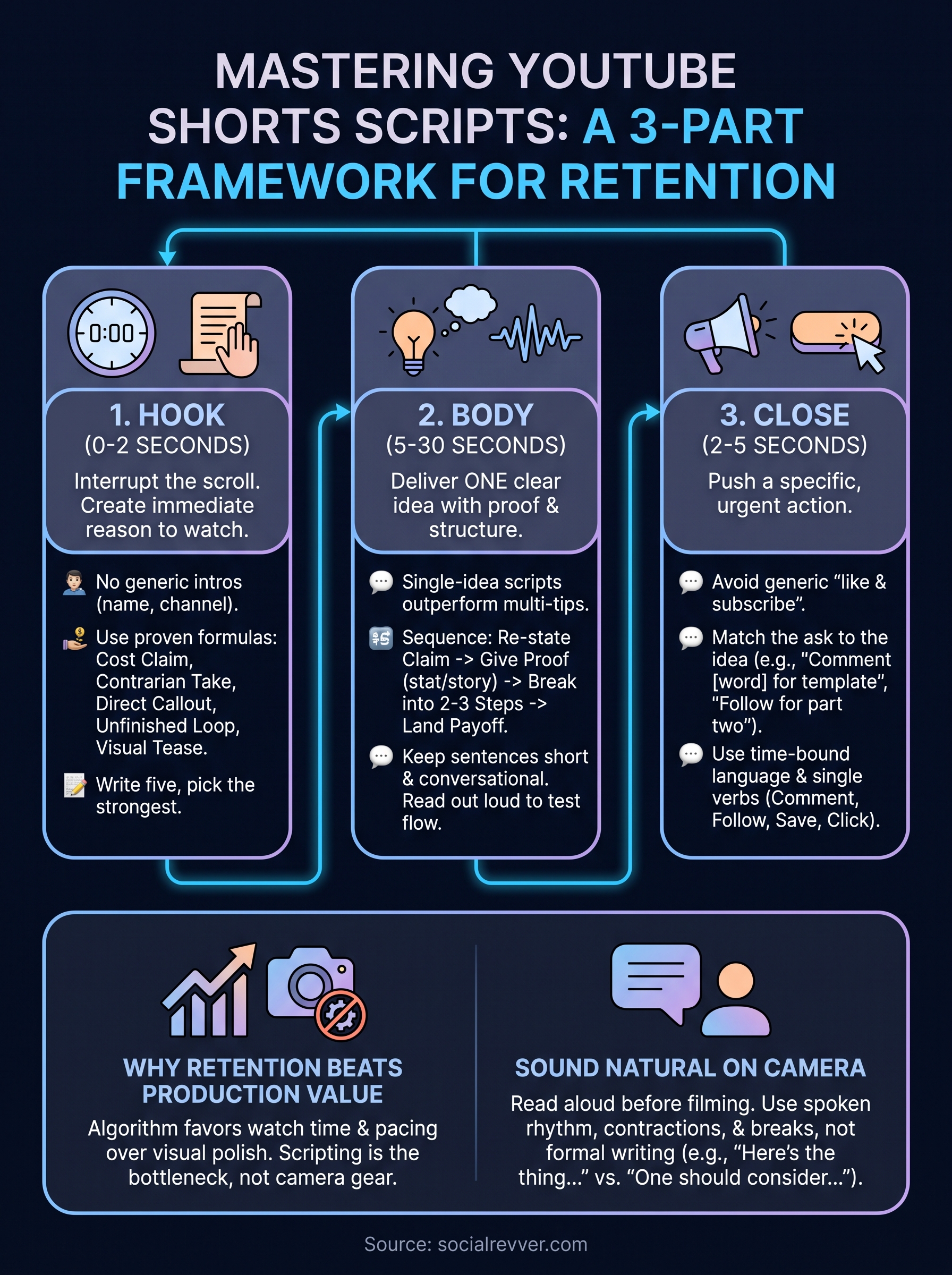
Writing scripts this way takes longer than winging it on camera, and that's the point. A repeatable framework beats improvisation every time, because it turns your Shorts from a guessing game into a process you can run weekly without burning out on ideas. Hook, body, close, in that order, every time. Test the hook formulas against each other, keep the body locked to one idea, and never end a video without a specific ask.
Most founders and business owners reading this don't have time to write, test, and refine scripts on top of running their company, and that's exactly the gap SocialRevver's Attention Engine was built to close. If you'd rather hand off the scripting, production, and distribution to a system built on data from over 750,000 videos, apply to work with our team and get a free 40+ slide strategy built around your niche.