Most companies chase paid channels, partnerships, or acquisitions to hit revenue targets. Those tactics work, until the budget dries up or the deal falls through. An organic growth strategy takes the opposite approach: scaling revenue through internal resources like content, product development, and customer retention. It's slower to start, but it compounds. And when it's built on a real system instead of guesswork, it becomes the most defensible growth lever a business can own.
The problem is that "organic growth" has become a catchall term people throw around without much structure behind it. Posting on social media three times a week isn't a strategy. Neither is hoping your SEO will eventually kick in. What actually moves the needle is applying a repeatable framework, one that connects your content, your audience psychology, and your revenue goals into a single engine. That's exactly the kind of system we build at SocialRevver: a data-driven content infrastructure that turns organic attention into predictable pipeline.
This article breaks down five proven organic growth frameworks you can use to scale revenue without relying on ad spend. Each one is actionable, backed by real business logic, and designed for founders and operators who need results they can measure, not just more content on a calendar.
1. SocialRevver Attention Engine
The SocialRevver Attention Engine is a content infrastructure system built for founders and business owners who need their organic growth strategy to run without consuming their time. It combines behavioral science, machine learning, and professional production to convert short-form content into a predictable revenue pipeline, treating the entire process as an engineering problem rather than a creative exercise.
What it is
At its core, this framework runs on a database of over 750,000 analyzed videos to identify patterns in hooks, psychological triggers, and content structure that consistently drive engagement and conversion. Every piece of content produced through this system is built on data, not intuition. You get a repeatable process that scales without requiring you to reinvent your content approach every week.
Why it drives organic growth
Short-form content is the highest-leverage organic channel available today. When you publish content that matches proven psychological patterns, your audience grows without paid amplification. The Attention Engine specifically targets the gap between views and revenue by building automated funnels that capture attention and route it directly toward your offer.
The compounding effect of consistent, system-driven content means your audience and authority grow even while you focus on running your business.
Steps to apply it
Follow this sequence to put the framework into motion:
- Strategy phase: Use pattern data to identify your niche's highest-performing content structures and psychological hooks.
- Scripting phase: Generate conversion-focused scripts tailored to your voice and specific audience.
- Production phase: Apply the AI-supported editing pipeline, including cut optimization, sound design, and branded visuals.
- Distribution phase: Post according to behavioral trend analysis and monitor real-time performance data to refine output continuously.
Metrics to track
Focus on inbound lead volume and authority signals like saves, shares, and profile visits rather than raw follower counts. Track your conversion rate from content views to funnel entries to confirm that your content is moving people toward your offer, not just generating impressions.
Common mistakes
The biggest mistake founders make is skipping the data analysis phase and going straight to production. You cannot rely on posting frequency alone to produce results. Without structured hooks and conversion architecture underneath your content, volume generates noise instead of pipeline.
2. Invest, Create, Perform Model
The Invest, Create, Perform model gives you a structured sequence for building organic growth rather than chasing random tactics. Instead of jumping straight into content or product launches, this model forces you to allocate resources intentionally across three distinct phases before expecting results.
What it is
This framework breaks organic growth into three sequential steps: investing in capabilities, creating value-generating assets, and performing in the market to capture returns. Each phase builds directly on the previous one, so skipping a step produces predictable failures.
Why it drives organic growth
Your organic growth strategy produces compounding returns only when your capabilities match your output. This model prevents the common trap of creating content or launching features before your foundational infrastructure is ready to support them.
Sustainable organic growth requires that your investment phase is solid before your creation phase begins.
Steps to apply it
- Invest: Build the data, tools, team, or systems your growth requires before producing anything.
- Create: Develop assets, whether content, products, or processes, using the capabilities you have funded.
- Perform: Deploy your assets, monitor results, and reinvest in what the data confirms is working.
Metrics to track
Track your cost per asset created and revenue attributed per asset to evaluate whether your investment phase is calibrated correctly. Watch your output quality consistency as a signal that your infrastructure is holding up under pressure.
Common mistakes
Most operators rush the investment phase and start creating before they have reliable systems in place. This produces inconsistent output that stalls growth rather than accelerating it.
3. Ansoff Growth Matrix
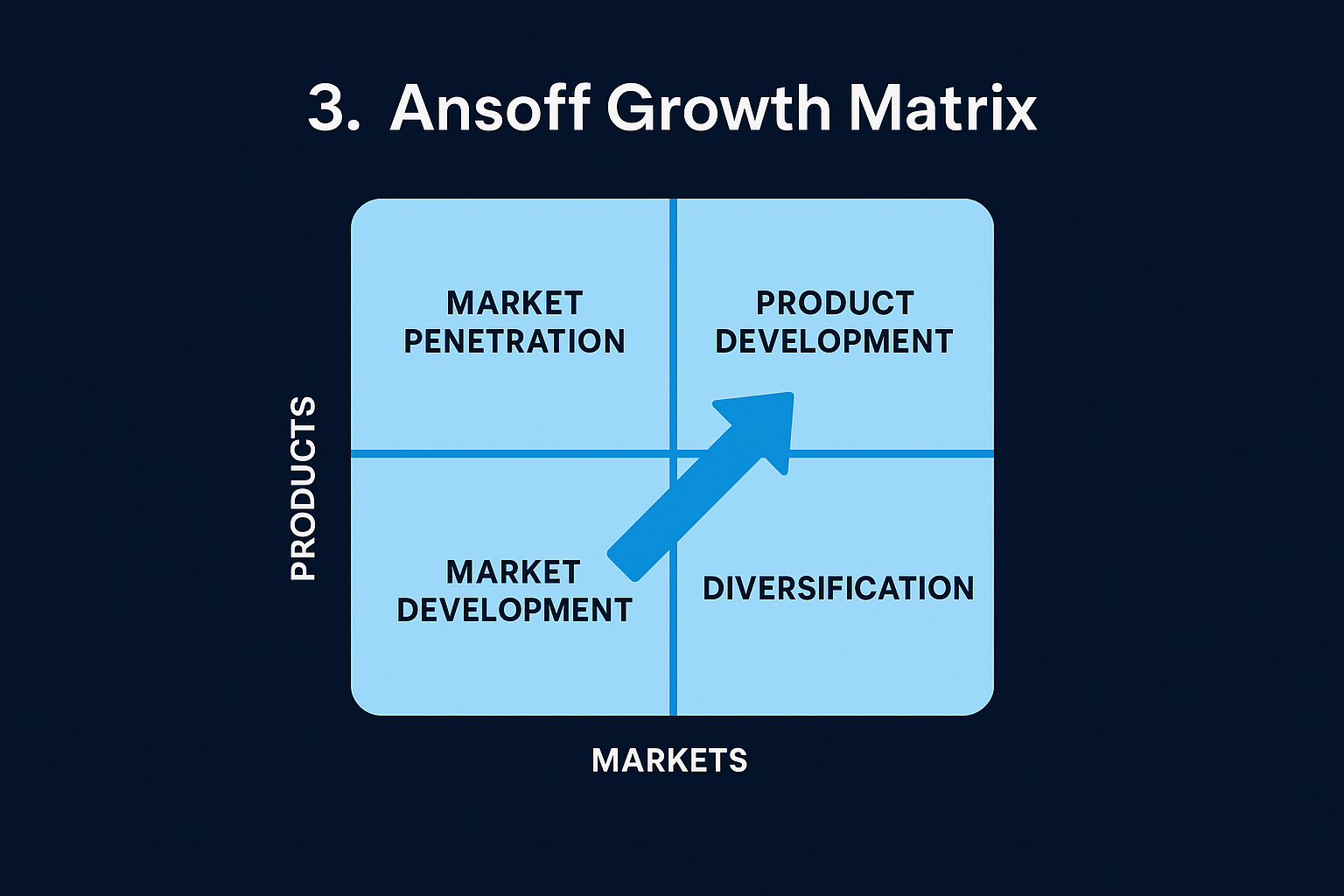
The Ansoff Growth Matrix gives you a structured decision-making tool for choosing where to direct your growth efforts. Developed by Igor Ansoff, it maps four strategic options across two dimensions: products and markets. Each quadrant carries a different risk level, which makes it especially useful when you need to prioritize growth moves without spreading your resources thin.
What it is
This framework plots four growth paths: market penetration (existing product, existing market), product development (new product, existing market), market development (existing product, new market), and diversification (new product, new market). Each path demands a different level of investment and carries a different risk-to-return ratio based on how far you move from your current position.
Why it drives organic growth
Your organic growth strategy benefits from this matrix because it forces you to sequence your moves logically rather than chasing multiple directions at once. Starting with market penetration keeps your risk low while you build traction before expanding into unfamiliar territory.
Expanding into a new market before fully capturing your existing one is one of the fastest ways to stall your momentum.
Steps to apply it
- Audit your current position: Identify which quadrant you currently operate in and how much runway remains there.
- Pick your next move: Choose the adjacent quadrant based on available resources and market data.
- Execute sequentially: Build measurable results in each quadrant before committing to a higher-risk option.
Metrics to track
Track market share growth within your existing segment and revenue per customer as primary indicators that your penetration efforts are working before you move outward.
Common mistakes
Most operators jump straight to diversification before saturating their core market. That decision spreads your resources thin and undermines the compounding returns that a focused, sequential approach produces over time.
4. Land-and-Expand Revenue Expansion
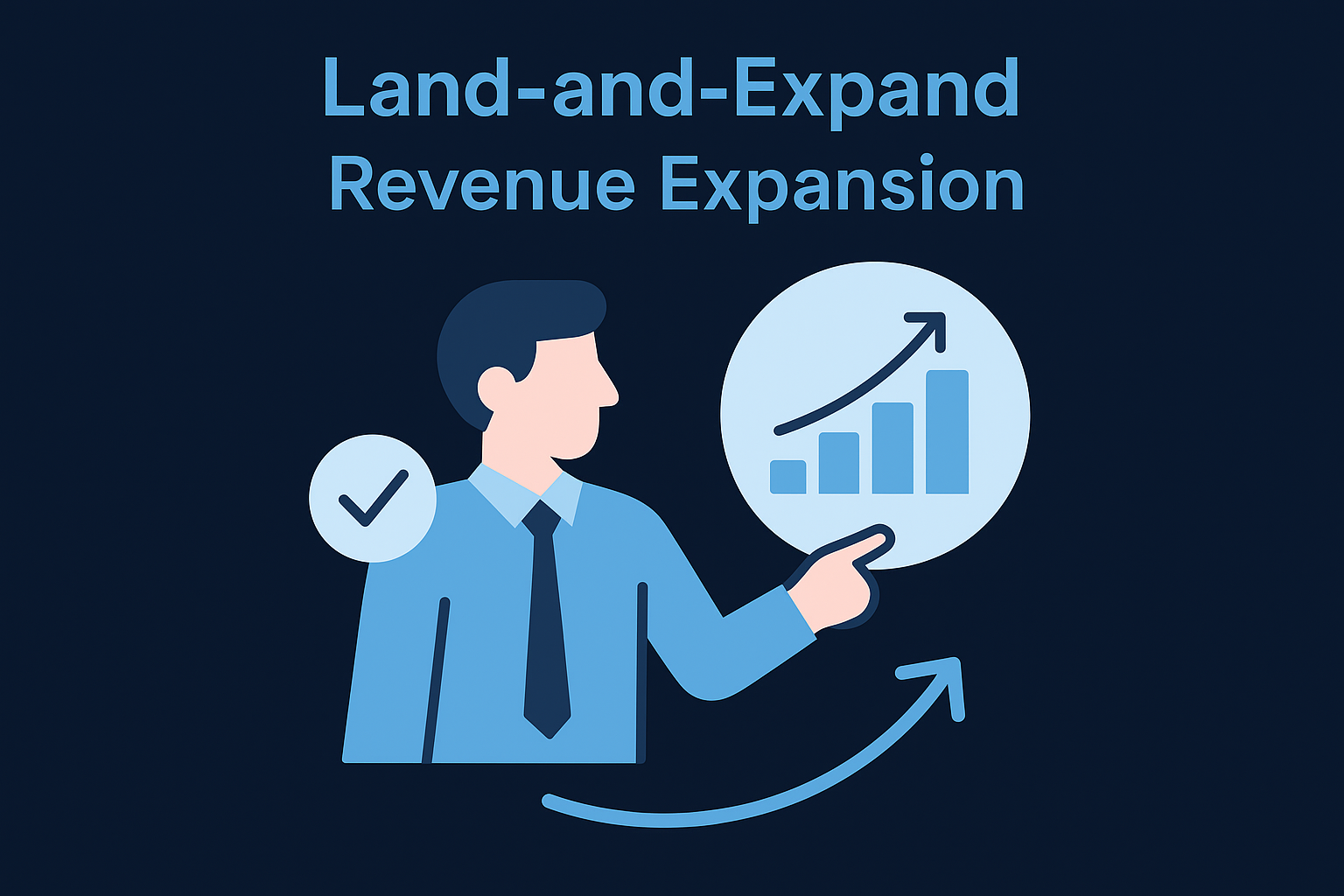
The land-and-expand model is a revenue growth framework built around entering an account or market segment with a focused, low-friction offer and then systematically growing your footprint once the relationship is established. It turns your existing customer base into a compounding revenue source rather than treating every growth target as a cold acquisition problem.
What it is
This framework works by securing a small initial commitment from a customer, proving value quickly, and then expanding into additional use cases, seats, or products over time. It reduces the barrier to entry for new clients while maximizing lifetime customer value through deliberate upsells and cross-sells built directly into your delivery model.
Why it drives organic growth
Your organic growth strategy benefits directly from this model because satisfied customers become your most reliable growth channel. When you deliver undeniable value in the initial engagement, expansion conversations happen naturally without paid acquisition costs.
The revenue you generate from expanding existing accounts costs a fraction of what new customer acquisition requires.
Steps to apply it
- Land: Close a focused, easy-to-buy entry point that delivers fast, visible results.
- Prove: Document the value delivered during the initial engagement with clear performance data.
- Expand: Present expansion options tied directly to results the customer has already confirmed.
Metrics to track
Track your net revenue retention rate and expansion revenue as a percentage of total revenue to confirm that existing customers are contributing meaningfully to your overall growth alongside new acquisition.
Common mistakes
Most operators skip the proof documentation step and pitch expansion too early, before the customer has seen enough results to justify a larger commitment. Without demonstrated ROI anchoring the conversation, expansion stalls and churn accelerates instead.
5. Growth Loops and Experiment System
A growth loop is a self-reinforcing cycle where each output feeds back into the system as a new input, creating compounding returns without proportional increases in spend or headcount.
What it is
This framework pairs closed-loop growth cycles with a structured experimentation process. Each loop connects a core growth driver to a measurable outcome that fuels the next cycle automatically.
Your experiment system sits alongside the loop to test variables systematically and confirm which inputs generate the highest return before you scale them.
Why it drives organic growth
Growth loops drive your organic growth strategy forward because they compound by design. Each cycle builds on the last, generating momentum without fresh resource injection.
The most durable organic growth comes from systems that feed themselves, not from tactics that demand constant manual input.
Steps to apply it
- Map your current loop: Identify the action that, when repeated, produces more growth inputs.
- Run controlled experiments: Test one variable per cycle to isolate what drives improvement.
- Reinvest outputs: Feed results directly back into the top of your loop.
Metrics to track
Track loop cycle time and amplification coefficient (how many new inputs each output generates) to confirm your loop is tightening rather than leaking value.
Monitor your experiment velocity and win rate to ensure your testing cadence is producing actionable decisions, not just accumulated data.
Common mistakes
Most teams run too many experiments simultaneously, which makes it impossible to isolate what is working. Commit to one loop at a time until you have clear, reliable data before expanding your test scope.
Put Your Strategy Into Motion
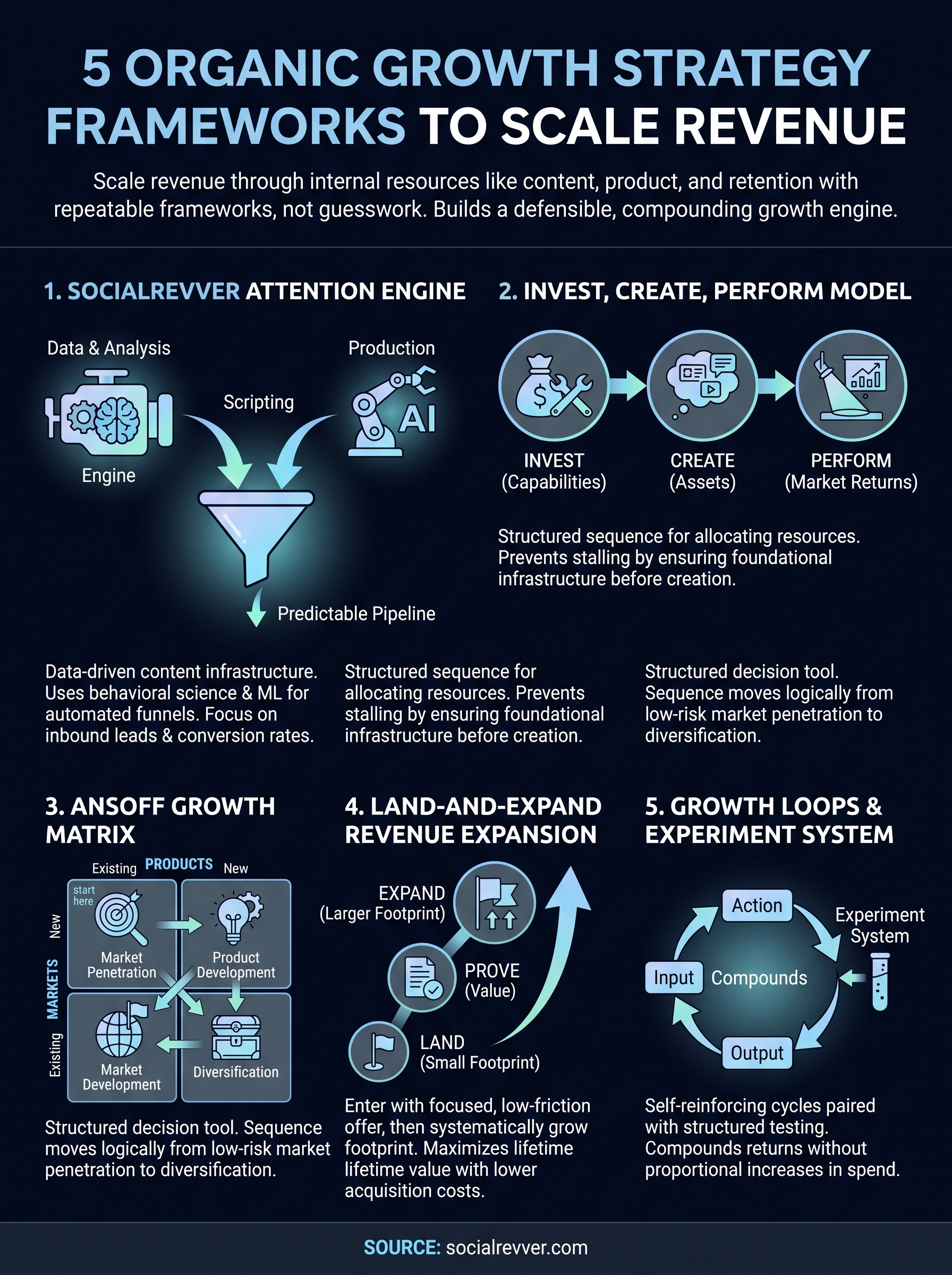
These five frameworks give you a clear, structured path from scattered content efforts to a compounding revenue system that grows even when your attention is elsewhere. Your organic growth strategy only works when you stop treating each tactic as an isolated move and start building infrastructure that connects every component to a measurable revenue outcome. The goal is not more activity. It is a tighter, more deliberate system that produces results you can track and scale.
Pick one framework, run it fully, and measure what it produces before adding another layer. The founders who scale fastest are not the ones running the most experiments simultaneously. They are the ones who commit to a single system, gather real performance data, and reinvest in what the numbers confirm is working. If you want a done-for-you content engine built on this approach from day one, apply to work with SocialRevver and get a free 40+ slide social media strategy built specifically for your market.