
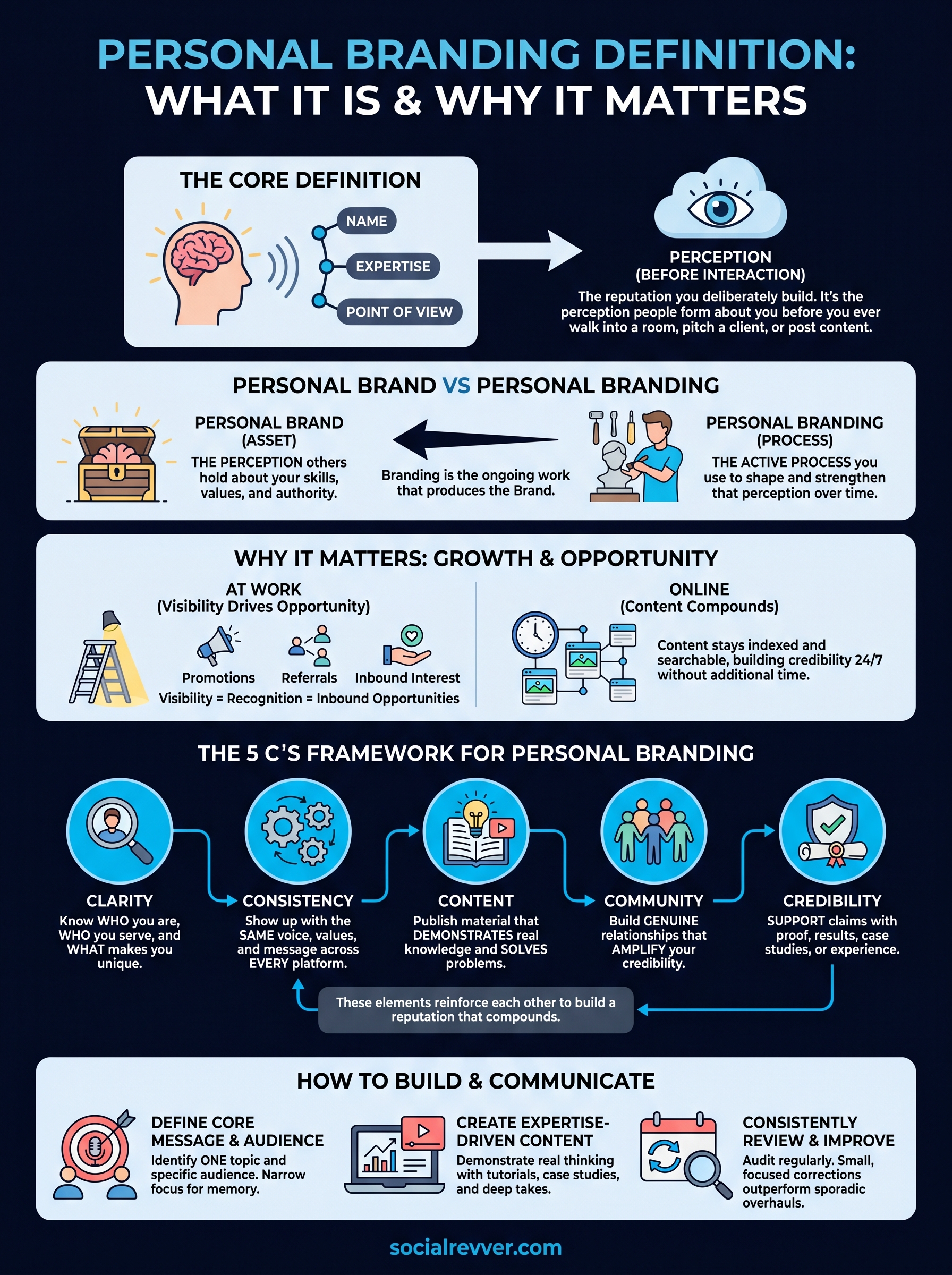
Ask ten people what "personal brand" means and you'll get ten different answers, most of them vague. The personal branding definition that actually holds up is simpler than the internet makes it sound: it's the reputation you deliberately build around your name, expertise, and point of view. Not a logo. Not a color palette. It's the perception people form about you before you ever walk into a room, pitch a client, or post a single piece of content.
Why does this matter right now? Because attention has become the first link in every growth chain, recruiting, sales, fundraising, partnerships. Founders and business owners who control their narrative attract opportunities instead of chasing them. Those who don't get defined by competitors, algorithms, or silence. That gap between intentional branding and accidental reputation is exactly what separates authority from obscurity.
At SocialRevver, we build the content systems that turn a personal brand from a concept into a functioning asset, engineered short-form content that positions you as the obvious choice in your space. This article breaks down what personal branding really is, why it directly impacts your bottom line, and the core frameworks (including the 5 C's) you need to build one that compounds over time.
Personal branding vs personal brand
These two terms get used interchangeably, but they describe different things. Your personal brand is the asset - the perception others hold about your skills, values, and authority in a given space. Personal branding is the active process you use to shape and strengthen that perception over time. One is the outcome; the other is the ongoing work that produces it. Keeping the distinction clear helps you stop treating branding as a one-time task and start treating it as a system.
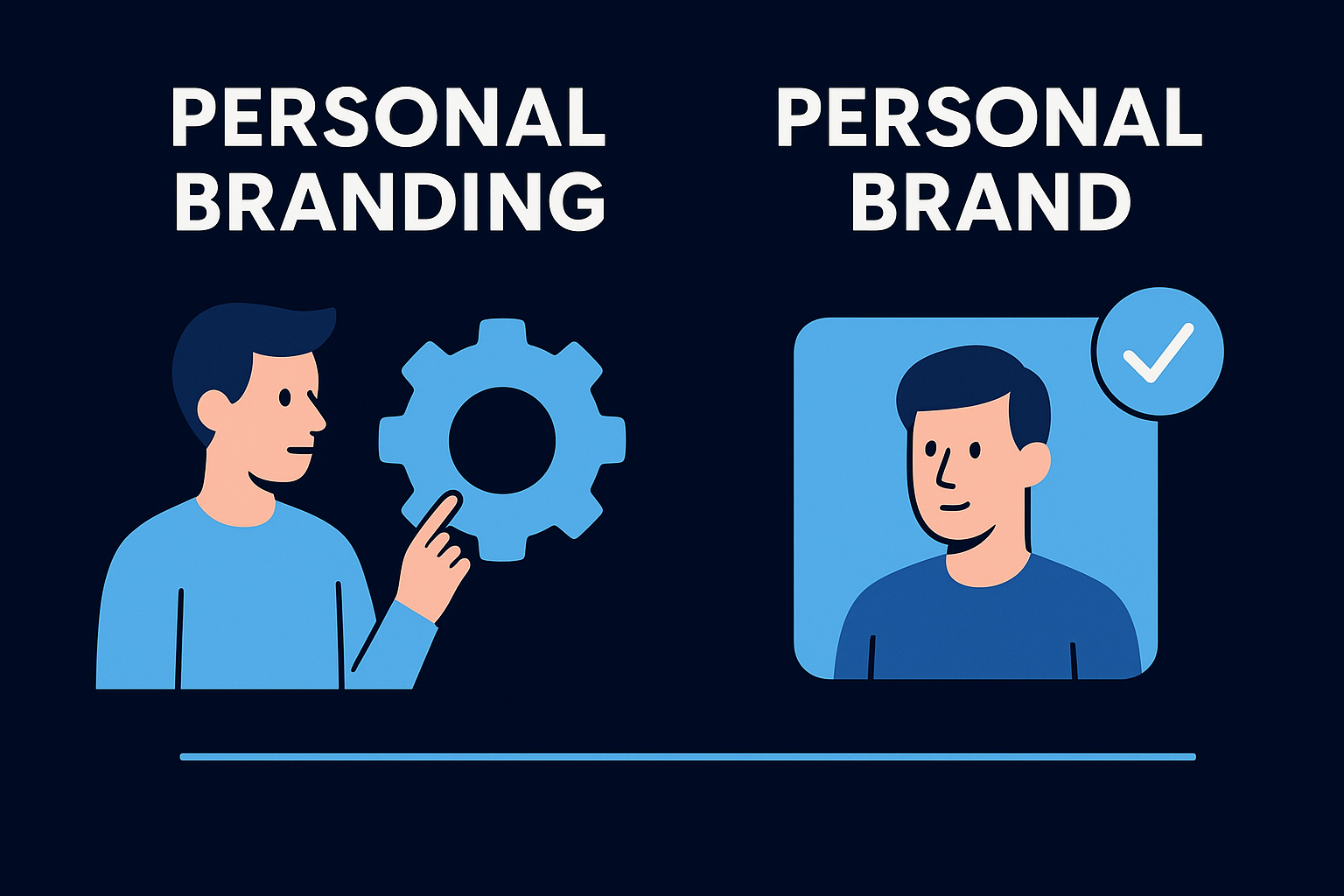
Your personal brand: what others already believe
Your personal brand exists whether you have worked on it or not. Every interaction you have, every piece of content you publish, and every result you deliver quietly accumulates into an impression in other people's minds. If you have never been intentional about it, that impression forms from incomplete information, and incomplete information rarely tells your best story.
The gap between who you are and how others perceive you is exactly what a deliberate personal brand closes.
Think of your personal brand as a standing reputation. When your name comes up in a conversation you are not part of, the reaction people have is your brand in action. That reaction is either pulling opportunities toward you or quietly pushing them away. You do not get to opt out of having a reputation - you only get to decide how much input you have in shaping it.
Personal branding: the ongoing process
This is where the personal branding definition becomes practical and action-oriented. Personal branding is the intentional, consistent effort to communicate your expertise, values, and point of view to the right audience through the right channels. It is not an exercise you complete once with a polished headshot and an updated bio.
Branding works as a compound system, not a single moment. You build it by showing up repeatedly with content that demonstrates your actual thinking, by addressing specific problems your audience cares about, and by maintaining consistency in how you present yourself across every platform you use. Each piece of content either reinforces your brand position or dilutes it.
The practical difference shapes every decision you make publicly. Personal branding is the filter you apply to speaking engagements, articles, partnerships, and content formats, checking each one against the authority position you are building. Your brand is fixed at any given point in time; your branding is always in motion.
Why personal branding matters at work and online
Your professional reputation has always shaped your career, but hiring managers, investors, and clients now run a search before they accept a meeting or sign a contract. What they find in those first few results either builds confidence or creates doubt. A strong personal brand gives you control over that moment before any conversation even starts.
The search results that appear when someone types your name are your brand's front door.
At work: visibility drives opportunity
The people who get promoted or referred are rarely the most qualified in the room - they are the most visible. Personal branding closes that gap. When you consistently demonstrate specific knowledge and a clear point of view, people start to associate your name with real value. That association produces inbound opportunities instead of forcing you to compete for every one.
Consistent personal branding at work typically leads to:
- Faster recognition in hiring and promotion decisions
- Stronger referral networks built on demonstrated expertise
- More inbound interest from clients or collaborators
Online: your content works around the clock
Online platforms amplify every element of the personal branding definition. Short-form video, LinkedIn posts, and articles stay indexed and searchable long after you publish them, which means each piece of content keeps working without additional time from you. A founder who publishes consistently on a focused topic can build more credibility in six months than years of networking would generate.
That compounding effect separates a personal brand from every other marketing channel. Every cold email, pitch, or introduction you make lands with more weight when the person on the other end has already encountered your content and formed a positive impression.
The building blocks of a strong personal brand
Before you can apply any framework, you need to understand what a personal brand is actually made of. The personal branding definition only becomes useful when you can identify its core components and see how they connect. Every strong personal brand rests on a small set of repeatable elements that, when combined, create a recognizable and trusted presence.
Without these building blocks in place, even the best content strategy will produce inconsistent results.
Clarity of identity and positioning
Knowing exactly who you are for and what you stand for is the first and most critical building block. This means identifying your specific area of expertise, the audience you serve, and the unique angle you bring to your field. Vague positioning produces a vague brand - one that blends into the background instead of standing out in a crowded space.
Your identity acts as a filter for every public decision you make, from the topics you address to the platforms you prioritize. Without a clear position, your content pulls in multiple directions and signals uncertainty rather than authority, which pushes potential opportunities away before they reach you.
Consistency across every channel
Consistency is what converts individual impressions into a lasting reputation. Every time someone encounters you on LinkedIn, watches a short-form video, or reads an article you wrote, the voice, values, and expertise on display should feel like the same person. That repetition builds recognition over time.
Inconsistency is more damaging than most people realize. When your tone, message, or positioning shifts between platforms, audiences struggle to form a clear picture of who you are, which makes it harder for them to trust you or refer you confidently.
The 5 C's framework for personal branding
The personal branding definition becomes a lot easier to apply when you have a repeatable structure behind it. The 5 C's framework gives you exactly that, turning abstract concepts like "authority" and "trust" into concrete areas you can evaluate and improve. It is one of the most widely used models for building a professional presence because it covers both the internal work (who you are) and the external work (how you communicate it to others).
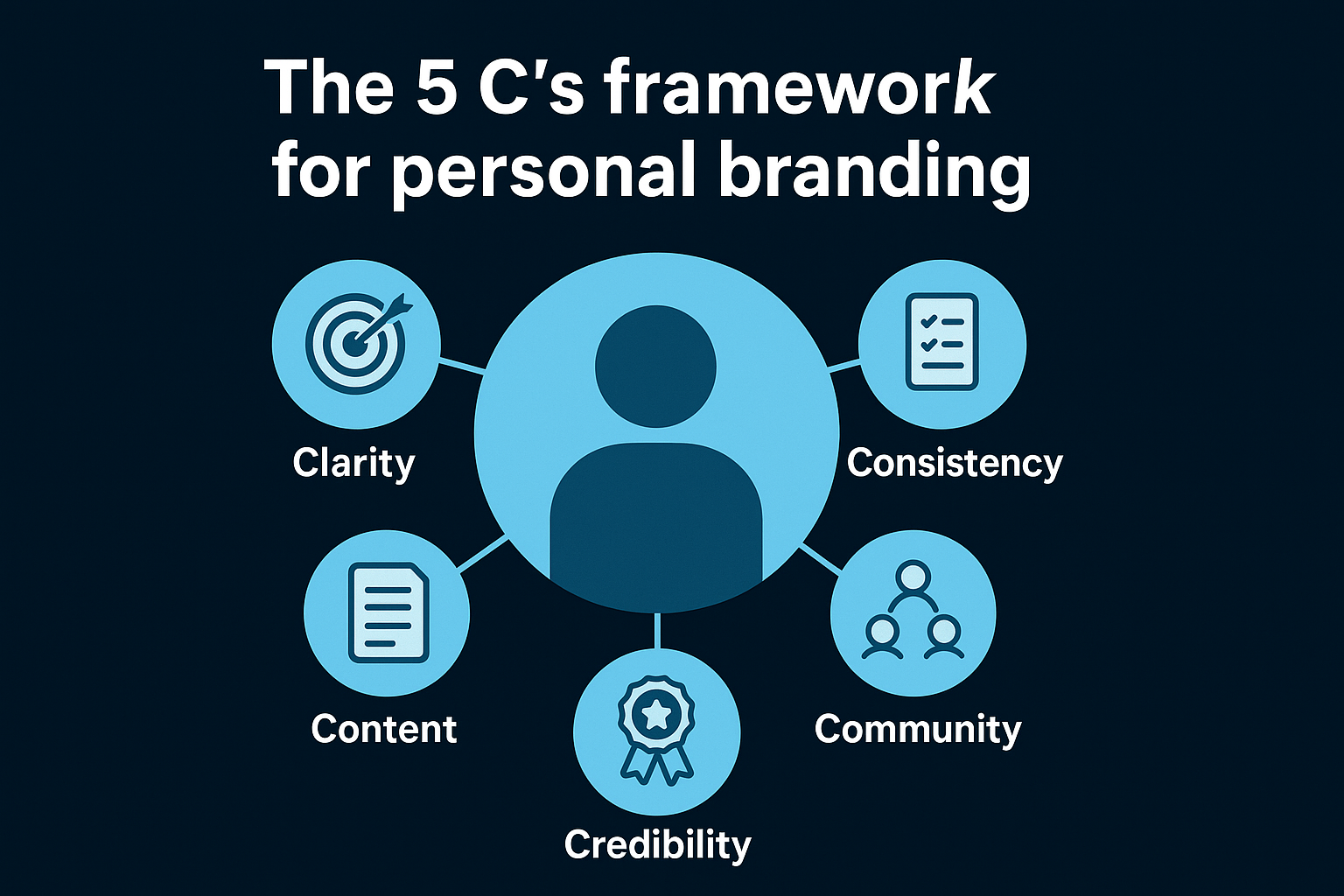
Frameworks do not replace effort - they direct it toward the things that actually move your brand forward.
What each C means for your brand
Understanding what each element does keeps you focused when you are deciding what to create, where to show up, and how to present yourself. No single C works in isolation - they reinforce each other to build a reputation that compounds over time.
- Clarity: Know specifically who you are, who you serve, and what makes your point of view different from others in your space.
- Consistency: Show up with the same voice, values, and message across every platform and interaction.
- Content: Publish material that demonstrates real knowledge and solves specific problems your audience faces.
- Community: Build genuine relationships with people in your field who can amplify your credibility over time.
- Credibility: Support every claim you make with proof, results, case studies, or demonstrated experience.
Each C also acts as a diagnostic tool. If your brand is underperforming, run through the list and identify which element is the weakest link. That gap is almost always where the work needs to go first.
How to build and communicate your personal brand
Putting the personal branding definition into practice starts with two decisions: what you want to be known for and who you want to know it. Most people skip this step and jump straight into content production, which produces noise instead of authority. Before you publish anything, write a single sentence that names your expertise, your target audience, and the specific outcome you help them achieve.
The clearest brands in any industry are built on ruthless specificity, not broad appeal.
Start with your core message
Your core message is the foundation every piece of content builds on. Identify one topic you can speak to with genuine depth, then define the specific audience that topic serves. Narrowing your focus feels counterintuitive, but it is what makes your brand memorable and referable rather than forgettable.
Once you have that message, apply it consistently across the platforms where your audience already spends time. Pick two channels maximum and show up there with focused, high-quality content before you consider expanding to others.
Create content that proves your expertise
Content is the primary vehicle for communicating your brand, and the most effective content does one thing well: it demonstrates real thinking. Tutorials, breakdowns, contrarian takes, and case studies from your own experience all signal depth that generic advice simply cannot replicate.
Publishing on a consistent schedule matters more than publishing perfect pieces. A steady stream of useful content compounds into authority over months, while sporadic bursts produce no lasting recognition. Treat your content output like a standing commitment to your audience, not a task you complete whenever inspiration happens to show up.
A simple plan to keep improving
The personal branding definition only stays useful if you treat it as a living system rather than a finished project. Pick one metric to review monthly, whether that is content engagement, inbound inquiries, or referral quality, and use it to identify what is working and what needs adjustment. A brand you audit regularly compounds faster than one you build and abandon.
Set a quarterly review where you check your positioning, your core message, and the consistency of your content output. Ask yourself whether your current output actually reflects the authority position you want to own. If it does not, identify the single biggest gap and close it before the next quarter starts. Small, focused corrections made consistently outperform large overhauls that never get finished.
If you want a system that handles the production side for you, apply for a free 40-slide social media strategy and see exactly how SocialRevver builds this engine for founders and business owners.