
Every great story, whether it's a 300-page novel, a feature-length screenplay, or a 60-second video, follows a structure. Not because creativity needs rules, but because human brains are wired to process information in patterns. A solid storytelling structure template gives you the skeleton. You bring the flesh.
The problem most writers face isn't a lack of ideas. It's a lack of architecture. You know the characters, the world, the emotional beats you want to hit, but the moment you sit down to organize it all, the blank page wins. Frameworks fix that problem by giving you a reliable sequence of decisions: what happens first, what builds tension, and what delivers the payoff. They're not shortcuts. They're blueprints that professionals actually use, from Hollywood screenwriters to bestselling novelists.
At SocialRevver, structure is the foundation of everything we build. Our content systems are engineered around proven narrative patterns, hooks, escalation, resolution, because the psychology behind a gripping short-form video is the same psychology behind a gripping story. We've studied over 750,000 videos to understand what makes people pay attention, and it always comes back to structure.
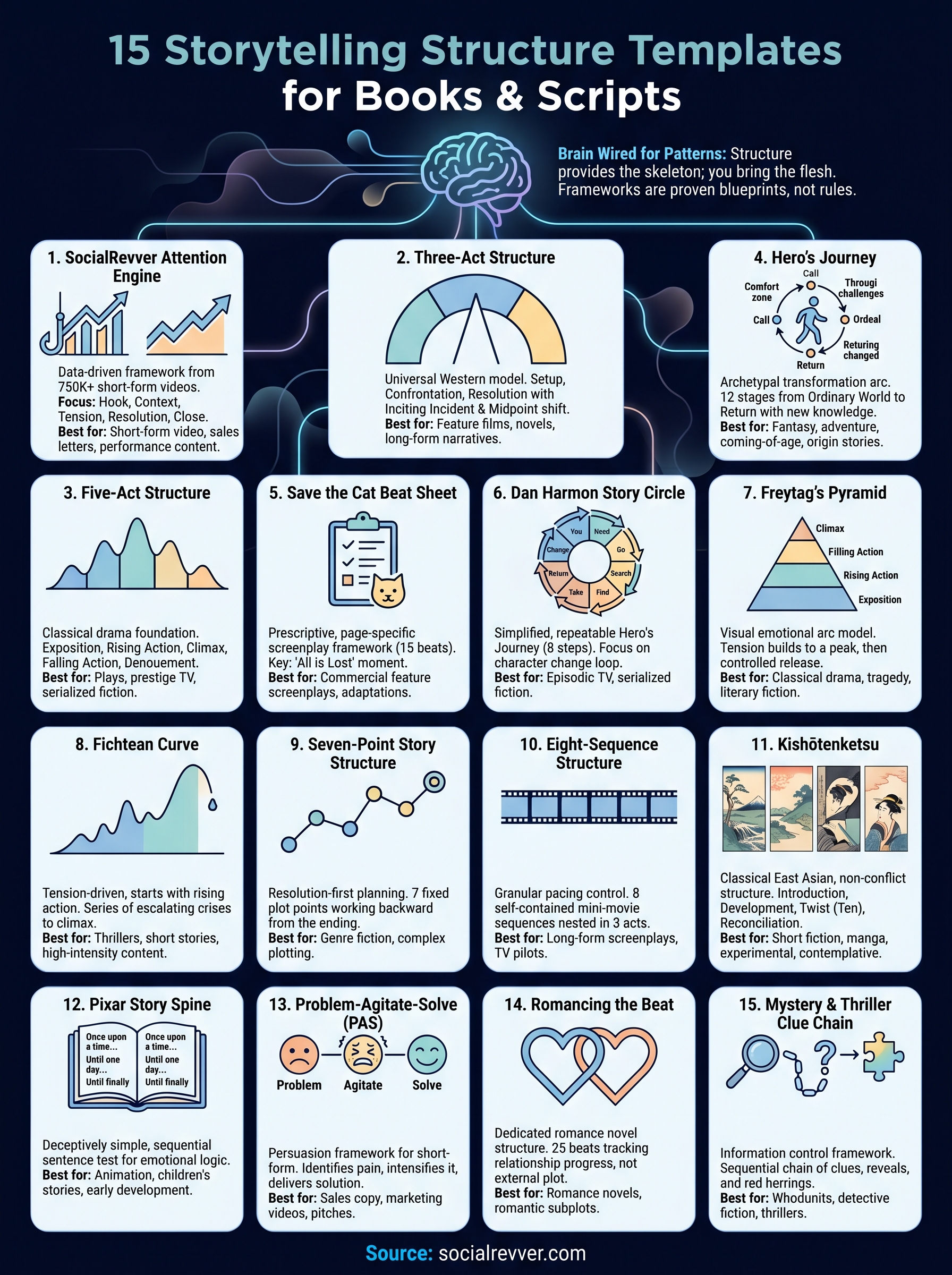
This article breaks down 15 storytelling structure templates you can use for books, screenplays, and scripts. Each one includes how it works, when to use it, and what kind of story it serves best. Whether you're outlining your first novel or restructuring a draft that isn't clicking, you'll walk away with a framework that fits your project.
1. SocialRevver Attention Engine Story Blueprint
The SocialRevver Attention Engine Story Blueprint is built from behavioral data, not tradition. After analyzing over 750,000 short-form videos, the SocialRevver team identified the specific structural patterns that consistently drive attention, retention, and conversion. This isn't a theoretical storytelling structure template pulled from a writing textbook; it's a system engineered from real-world performance data at scale.
What It Is
The blueprint is a proprietary short-form narrative framework designed to engineer viewer behavior from the first second to the final call-to-action. It maps the psychological sequence a viewer moves through when they encounter content, and it gives you a precise beat-by-beat order to follow. Every element in the sequence serves a measurable function in keeping attention locked and moving the audience toward a specific action.
Key Beats and Turning Points
The framework moves through five core beats: pattern interrupt hook, context build, tension escalation, resolution or insight, and a behavior-driving close. The hook stops the scroll within the first two seconds. Context build tells the viewer exactly why they should keep watching. Tension escalation raises the stakes. Resolution delivers real value or clarity. The close converts that value into one specific action.
The hook is the most critical beat. If the first two seconds don't interrupt the viewer's default pattern, the rest of the structure becomes irrelevant.
Best Fits and Formats
This blueprint works best for short-form video content on platforms like Instagram Reels, TikTok, and YouTube Shorts. It also applies directly to video sales letters, podcast intros, and brand story sequences. The framework is built for content that needs to produce business outcomes, not just passive entertainment.
Strengths and Tradeoffs
The primary strength is that every beat is backed by performance data across hundreds of thousands of real videos, so you're not guessing. The tradeoff is real: the framework is optimized for short-form content and requires significant adaptation before it fits long-form formats like novels or feature screenplays.
Fill-In Template Prompt
Use this to build your first draft:
- Hook: [State a surprising fact, bold claim, or provocative question about your topic]
- Context: [Explain who this is for and what problem it solves]
- Tension: [Describe what happens if the problem stays unsolved]
- Resolution: [Deliver your core insight or solution clearly]
- Close: [Direct the viewer to take one specific action]
2. Three-Act Structure
The three-act structure is the most widely used storytelling structure template in Western narrative tradition. It divides your story into setup, confrontation, and resolution, giving every scene a clear job to do within the larger arc.
What It Is
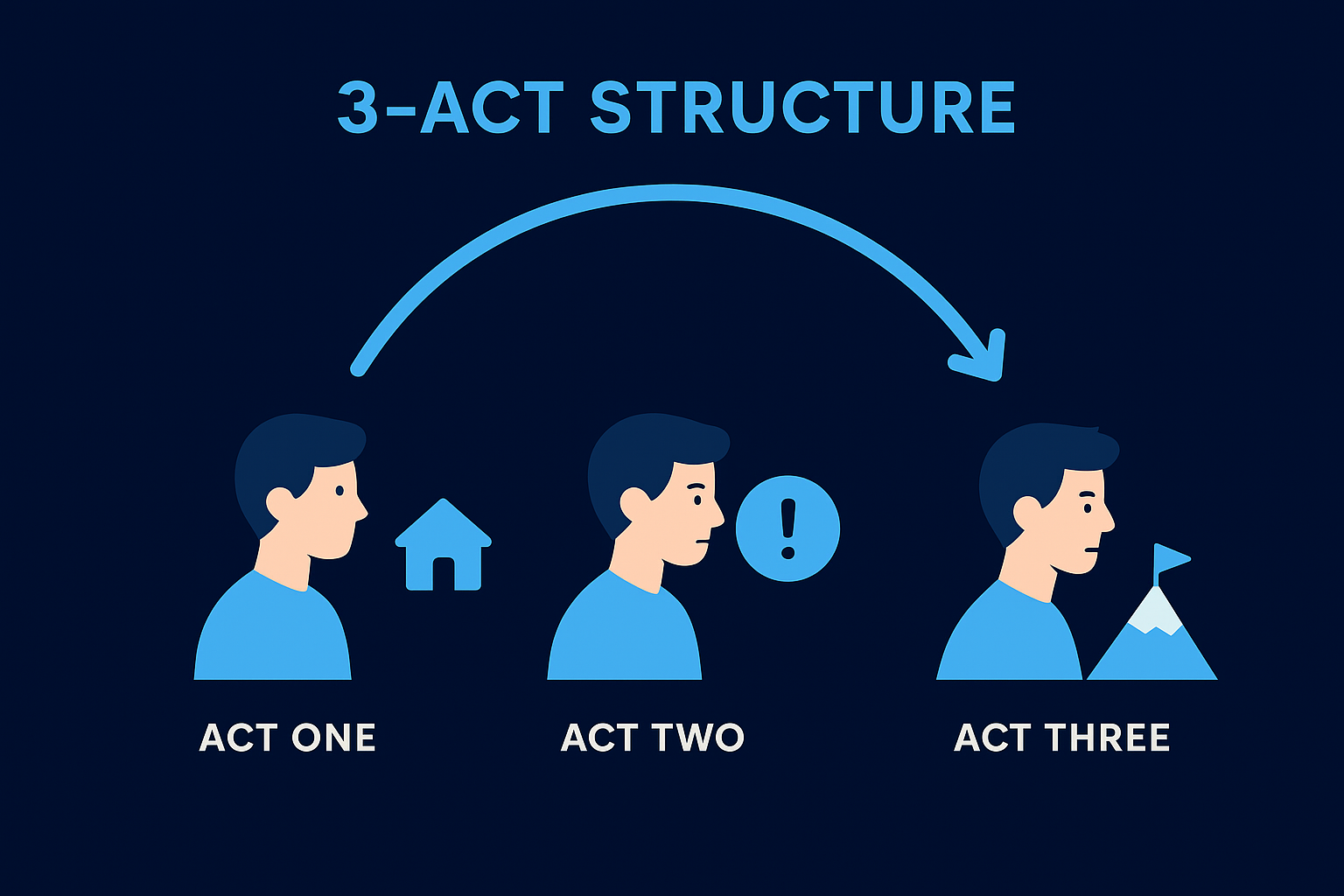
This framework splits your story into three distinct sections: Act One establishes the world and the protagonist's problem, Act Two builds conflict and raises stakes, and Act Three resolves the central tension. Aristotle first described this logic in his Poetics, and Hollywood has used a formalized version of it ever since.
Key Beats and Turning Points
Act One ends with an inciting incident that disrupts the protagonist's normal world and forces a choice. Act Two is split by a midpoint shift that either raises or reverses the stakes. Act Three opens with a dark moment before the climax, where the protagonist must confront the core conflict with everything on the line.
The midpoint is often overlooked, but it functions as a second engine. Without it, Act Two turns into one long stretch of undifferentiated tension.
Best Fits and Formats
This structure fits feature-length screenplays, novels, and long-form narrative podcasts best. It also works for brand origin stories and case study presentations where you need a clear beginning, middle, and end.
Strengths and Tradeoffs
The biggest strength is universal audience recognition. Readers and viewers process this shape instinctively. The tradeoff is rigidity: if your story resists a clean three-part division, forcing it into this mold can flatten subplots.
Fill-In Template Prompt
- Act One: [Introduce your protagonist, their world, and the inciting problem]
- Midpoint: [Shift the stakes or reverse the protagonist's situation]
- Act Three: [Force a final confrontation and deliver a resolution]
3. Five-Act Structure for Plays and TV
The five-act structure is the classical foundation behind Shakespearean drama and the dominant model for prestige television today. It extends three-act logic by inserting two additional structural pivots, giving your story more room to build complexity and deepen character change.
What It Is
This storytelling structure template organizes your narrative into five distinct acts: exposition, rising action, climax, falling action, and denouement. Shakespeare used this shape across nearly all his major plays, and modern TV showrunners apply a version of it to structure season-long arcs with natural act breaks built in.
Key Beats and Turning Points
Each act carries a specific dramatic function. Act One establishes your world and central conflict. Act Two escalates stakes and introduces complications. Act Three delivers the climax, the highest point of tension. Act Four shows the consequences of that climax. Act Five resolves the fallout and closes your character's arc.
The falling action in Act Four is where most writers rush. Slowing down here gives your audience time to absorb the climax before you close.
Best Fits and Formats
This structure works best for stage plays, prestige drama series, and serialized fiction. It also maps well onto multi-chapter business narratives or long-form documentary scripts where pacing and audience fatigue need active management.
Strengths and Tradeoffs
The biggest strength is structural depth. You get more room to develop subplots and secondary characters than the three-act model allows. The tradeoff is length: the five-act shape demands sufficient story material to fill each act meaningfully, or sections feel stretched.
Fill-In Template Prompt
- Act One: [Establish your world, protagonist, and central problem]
- Act Two: [Escalate conflict and introduce new complications]
- Act Three: [Deliver your climax and highest-stakes confrontation]
- Act Four: [Show consequences and shift the protagonist's situation]
- Act Five: [Resolve the central conflict and close character arcs]
4. Hero's Journey
The Hero's Journey is one of the most recognized storytelling structure templates in existence. Mythologist Joseph Campbell first documented this pattern in his 1949 book "The Hero with a Thousand Faces," identifying a narrative shape that appears across cultures and centuries of storytelling.
What It Is
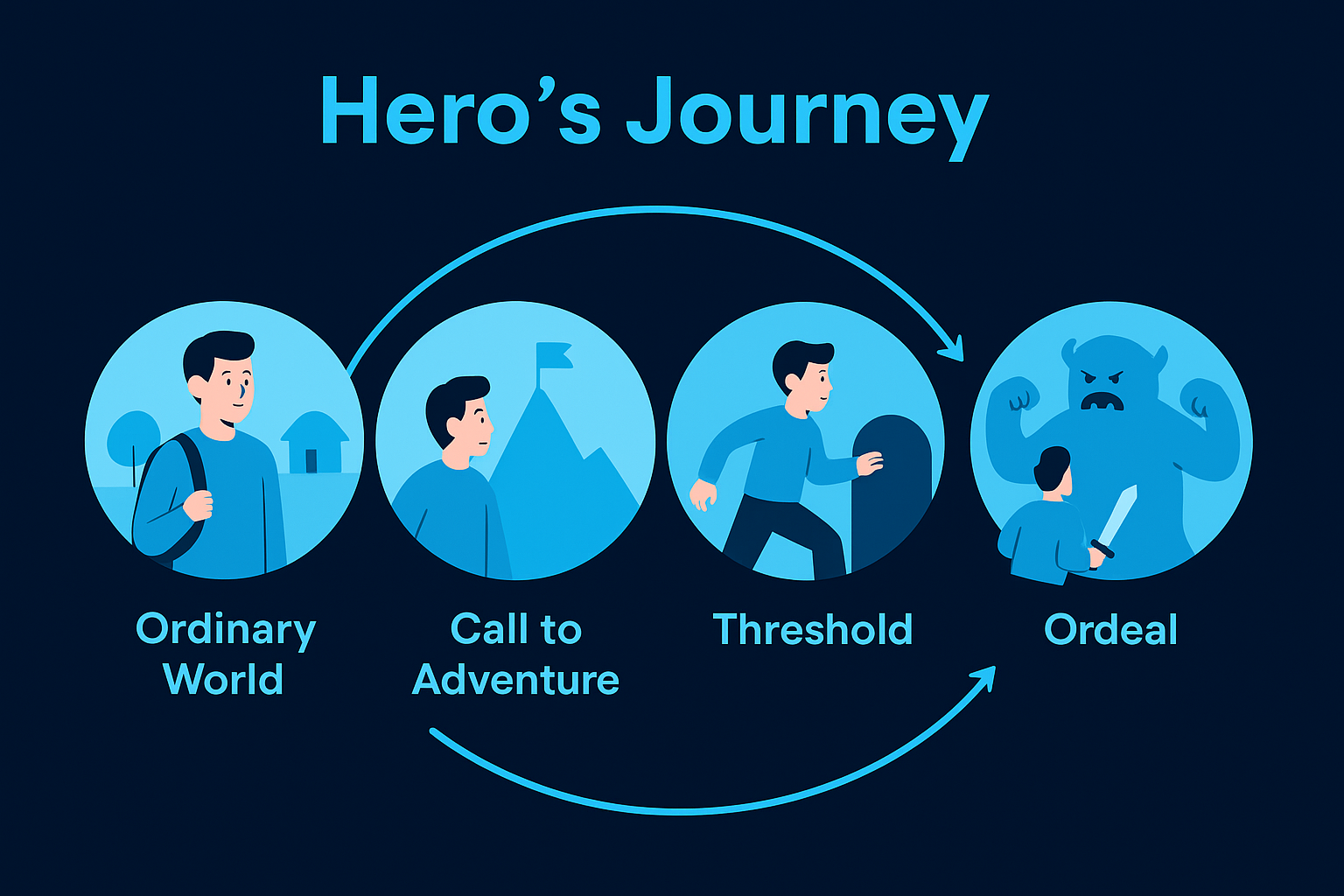
This framework tracks a protagonist through twelve archetypal stages that move from an ordinary world through a transformative challenge and back again. The structure maps both the external journey (events and obstacles) and the internal transformation (who the hero becomes as a result of those events).
Key Beats and Turning Points
The journey opens in the ordinary world, followed by a call to adventure, refusal, and a threshold crossing into unfamiliar territory. The protagonist faces trials, reaches an ordeal, seizes a reward, and makes the road back. The sequence ends with resurrection and return carrying new knowledge.
The ordeal is the structural heart of this framework. Everything before it is build-up, and everything after it is consequence.
Best Fits and Formats
This template works best for fantasy, adventure, and coming-of-age stories in novel and screenplay form. It also fits founder and brand origin stories where a clear before-and-after transformation needs to anchor the narrative.
Strengths and Tradeoffs
The universal psychological resonance of this structure is its greatest asset. Audiences connect with the transformation arc on a deep level. The tradeoff is that modern readers recognize the pattern easily, so predictable execution can feel formulaic without specific, fresh character detail.
Fill-In Template Prompt
- Ordinary World: [Establish your protagonist's life before the disruption]
- Call to Adventure: [Introduce the challenge or opportunity that forces a choice]
- Threshold: [Show your protagonist committing to the journey]
- Ordeal: [Deliver the highest-stakes crisis that forces transformation]
- Return: [Show what your protagonist brings back and how their world changes]
5. Save the Cat Beat Sheet
Blake Snyder introduced this storytelling structure template in his 2005 screenwriting book of the same name, and it quickly became one of the most practical tools available to working screenwriters. The beat sheet breaks a feature film into 15 specific beats mapped to exact page counts, giving you a precise structural target at every stage of your script.
What It Is
The Save the Cat beat sheet is a prescriptive, page-specific framework that tells you not just what needs to happen, but roughly when it needs to happen. Snyder built the system by reverse-engineering successful Hollywood films and identifying the structural moments they all share.
Key Beats and Turning Points
The sheet opens with an opening image and theme stated, followed by the setup, catalyst, debate, break into two, B story, fun and games, midpoint, bad guys close in, all is lost, dark night of the soul, break into three, finale, and a closing image.
The "all is lost" beat at roughly page 75 is the emotional hinge of the entire script. Without a genuine low point here, the final resolution lacks earned weight.
Best Fits and Formats
This framework is built specifically for feature-length screenplays, particularly in commercial genres like action, comedy, and thriller. Writers adapting novels into scripts also find the page-specific targets useful for managing pacing.
Strengths and Tradeoffs
The precision is the biggest draw. You always know exactly where you are in the story. The tradeoff is that the rigid page counts can feel constraining if your story's natural rhythm doesn't match Snyder's prescribed timing.
Fill-In Template Prompt
- Opening Image: [Show your protagonist's world before everything changes]
- Catalyst: [Introduce the event that forces your protagonist to act]
- Break Into Two: [Commit your protagonist to the new world or goal]
- All Is Lost: [Drop your protagonist to their lowest point]
- Closing Image: [Show how your protagonist's world has transformed]
6. Dan Harmon Story Circle
Dan Harmon, creator of Community and Rick and Morty, developed his story circle as a simplified adaptation of the Hero's Journey. This storytelling structure template reduces Campbell's twelve stages into eight cyclical steps, making it faster to apply and easier to repeat across episodes or chapters.
What It Is
The story circle is an eight-step loop that tracks a character leaving their comfort zone, descending into an unfamiliar world, achieving something, and returning changed. Harmon designed it specifically to be repeatable at scale, which is why it became the structural backbone for serialized television with large episode orders.
Key Beats and Turning Points
The eight steps move through: you, need, go, search, find, take, return, and change. The character starts in a zone of comfort, identifies a want, crosses into an unfamiliar situation, searches for what they need, finds it, pays a price to take it, returns to where they started, and emerges changed by the experience.
The "take" step is where real narrative cost lives. If your character gets what they want without paying for it, the change in the final step loses its credibility.
Best Fits and Formats
This framework fits episodic television, serialized fiction, and short-form video series where you need to complete a full character loop within a contained runtime or word count.
Strengths and Tradeoffs
The circular shape makes tracking character transformation intuitive and repeatable. The tradeoff is that stories requiring non-linear or multi-protagonist structures resist the single-loop format without significant modification.
Fill-In Template Prompt
- You: [Establish your character's comfort zone]
- Need: [Define what they want or lack]
- Go: [Push them into unfamiliar territory]
- Find and Take: [Deliver the goal and its cost]
- Change: [Show who they are after returning]
7. Freytag's Pyramid
German novelist and playwright Gustav Freytag formalized this storytelling structure template in 1863 by analyzing the dramatic works of Shakespeare and the ancient Greeks. The result is a visual, pyramid-shaped model that maps the emotional arc of a story from its opening through its resolution.
What It Is
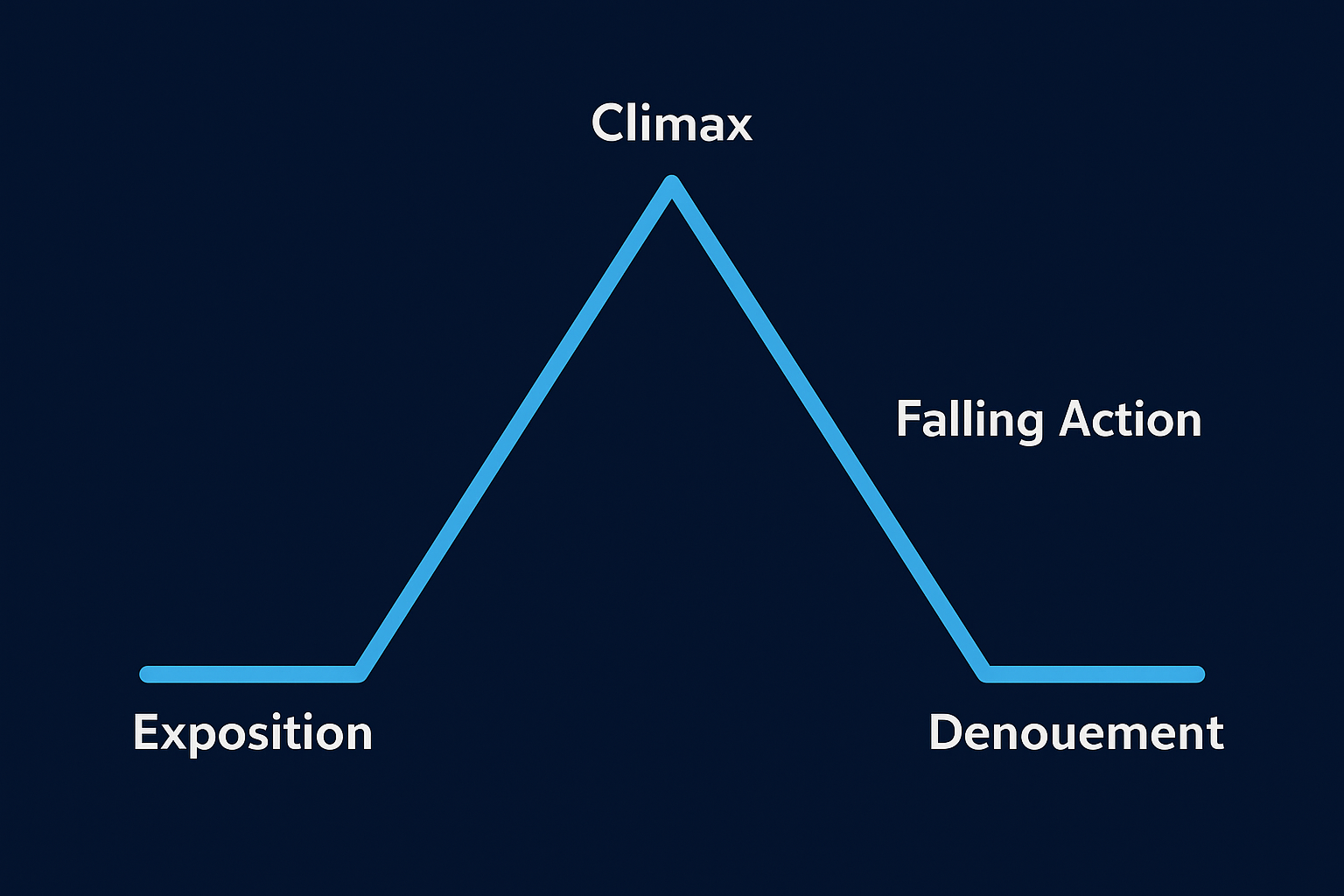
Freytag's Pyramid organizes your narrative into five labeled stages arranged in a symmetrical shape: exposition, rising action, climax, falling action, and denouement. The pyramid shape itself communicates something important: tension builds incrementally to a peak, then releases in a controlled descent toward closure.
Key Beats and Turning Points
The exposition introduces your world and protagonist. Rising action escalates conflict through a series of complications. The climax sits at the pyramid's peak, where the central tension reaches its breaking point. Falling action shows the immediate consequences of the climax. The denouement closes the story with final resolution and emotional release.
The symmetry between rising and falling action is what separates Freytag's model from simpler frameworks. Both sides of the pyramid require equal structural attention.
Best Fits and Formats
This model works best for classical drama, literary fiction, and tragedy where emotional catharsis is the intended outcome. It also applies well to long-form narrative essays and documentary scripts that follow a single subject through a complete arc.
Strengths and Tradeoffs
The pyramid gives you clear visual logic for pacing your manuscript. The tradeoff is that its symmetrical structure assumes roughly equal weight between buildup and wind-down, which can feel slow in genres where readers expect a faster resolution.
Fill-In Template Prompt
- Exposition: [Introduce your protagonist and their world]
- Rising Action: [Layer in complications that push toward crisis]
- Climax: [Deliver your story's highest point of tension]
- Falling Action: [Show the direct consequences of the climax]
- Denouement: [Close the story and release remaining tension]
8. Fichtean Curve
The Fichtean curve flips the traditional narrative arc by dropping your reader directly into rising action from the first page. Unlike frameworks that ease readers in through exposition, this storytelling structure template starts with tension already in motion and never fully releases it until the climax ends the story.
What It Is
This framework organizes your story around a series of escalating crises rather than a single central conflict. Each crisis raises the stakes higher than the last, and the story ends at or immediately after the climax, with minimal falling action or denouement.
Key Beats and Turning Points
Your story opens in medias res, meaning in the middle of action. From there, you layer in crisis after crisis, each one more intense than the previous. The protagonist resolves each smaller crisis only to face a larger one immediately after, until the final climax resolves the central conflict.
The absence of a traditional setup is what makes this structure powerful. Readers don't get a slow introduction; they get thrown into a world already under pressure.
Best Fits and Formats
This curve works best for short stories, thrillers, and literary fiction where sustained tension is the primary reader experience. It also fits flash fiction and high-intensity short-form scripts where every word has to pull weight.
Strengths and Tradeoffs
The relentless pacing keeps reader engagement high throughout. The tradeoff is that without breathing room, your audience has limited space to connect emotionally with characters before the next crisis hits.
Fill-In Template Prompt
- Opening Crisis: [Drop your protagonist into an immediate problem with no preamble]
- Escalating Crises: [Layer in two to four increasingly intense complications]
- Climax: [Resolve the central conflict at peak tension and close the story]
9. Seven-Point Story Structure
Author and writing instructor Dan Wells developed this storytelling structure template after studying the mechanics of compelling plots across multiple genres. The seven-point system works backwards from your ending, giving you a resolution-first planning method that ensures every story element serves a clear purpose.
What It Is
This framework builds your narrative around seven fixed plot points rather than act divisions. You start by identifying your ending, then work backward to define the six structural moments that lead your protagonist there. This reverse-engineering approach forces you to know where you're going before you decide how to get there.
Key Beats and Turning Points
The seven points are: hook, plot turn one, pinch one, midpoint, pinch two, plot turn two, and resolution. The hook establishes your protagonist's starting state. Plot turns one and two push the story in new directions. The two pinch points apply external pressure from your antagonist. The midpoint shifts your protagonist from reacting to actively driving the story forward.
The midpoint shift from reactive to proactive protagonist is what separates a passive middle from a story that accelerates toward its climax.
Best Fits and Formats
This framework fits genre fiction, fantasy, and science fiction novels where complex plotting requires careful coordination across many story threads. It also works for multi-episode scripts where writers need a reliable plotting tool that scales across a full season.
Strengths and Tradeoffs
Starting from your resolution gives every scene a fixed target, which makes structural decisions faster and cleaner. The tradeoff is that writers who prefer discovering their story as they write will find this backward-planning method constraining from the start.
Fill-In Template Prompt
- Hook: [Show your protagonist's world before the story begins to move]
- Plot Turn One: [Introduce the event that pulls your protagonist into the conflict]
- Midpoint: [Shift your protagonist from reacting to actively driving the story]
- Plot Turn Two: [Deliver the final piece your protagonist needs to reach resolution]
- Resolution: [Close the central conflict with the outcome you planned from the start]
10. Eight-Sequence Structure
The eight-sequence structure originated in film school curriculum and was later popularized by screenwriting professor Frank Daniel. This storytelling structure template breaks your script into eight distinct sequences of roughly 10 to 15 pages each, giving you granular control over pacing that broader act structures simply don't provide.
What It Is
Each sequence functions as a self-contained mini-movie with its own tension, turning point, and partial resolution. The eight sequences nest inside a three-act framework, so the model doesn't replace act-based thinking. It adds a finer layer of structure on top of it, giving you smaller, manageable units to draft and revise independently.
Key Beats and Turning Points
Sequences one and two build your setup and deliver the first act break. Sequences three and four escalate the conflict and push toward the midpoint. Sequences five and six deepen the stakes and drive toward the second act break. Sequences seven and eight carry the climax and deliver your resolution.
Each sequence needs its own internal question that opens at the sequence's start and closes at its end, or your scenes will lose their individual forward momentum.
Best Fits and Formats
This structure works best for feature-length screenplays and long-form television pilots where managing a 90 to 120-page document requires more precision than three-act labels alone can give you.
Strengths and Tradeoffs
The modular design makes revisions cleaner because you can rework one sequence without dismantling the entire script. The tradeoff is that the 10 to 15 page per sequence guideline can feel arbitrary if your story's natural rhythm distributes tension unevenly.
Fill-In Template Prompt
- Sequences 1 to 2: [Establish your world, protagonist, and inciting problem]
- Sequences 3 to 4: [Escalate conflict and push toward the midpoint shift]
- Sequences 5 to 6: [Raise stakes further and drive toward your second act break]
- Sequences 7 to 8: [Deliver your climax and close the central conflict]
11. Kishōtenketsu Four-Part Structure
Kishōtenketsu is a classical East Asian narrative framework with roots in Chinese poetry, Japanese literature, and traditional manga storytelling. This storytelling structure template operates without a Western-style conflict arc, making it one of the most structurally distinct frameworks on this list.

What It Is
This four-part structure organizes your story through introduction, development, twist, and reconciliation rather than through conflict and resolution. The Japanese terms for the four stages are ki, shō, ten, and ketsu. The framework builds meaning through contrast and surprise rather than escalating tension, which produces a fundamentally different emotional experience for your reader.
Key Beats and Turning Points
Ki introduces your subject and establishes the story's world. Shō develops that world and deepens the reader's familiarity with it. Ten delivers a sudden, unexpected shift or twist that reframes everything the reader understood in the first two sections. Ketsu reconciles the twist with the earlier material and closes the story.
The ten section is where the entire structure earns its power. Without a genuinely surprising pivot, the reconciliation in ketsu has nothing meaningful to resolve.
Best Fits and Formats
This framework works best for short fiction, literary essays, manga, and experimental narratives where the goal is contemplation rather than suspense. It also applies well to brand stories that want to reframe a familiar problem in an unexpected way.
Strengths and Tradeoffs
The structure produces profound emotional resonance without relying on villain-versus-hero tension. The tradeoff is that Western audiences conditioned by conflict-driven stories may find the absence of a clear antagonist disorienting on first read.
Fill-In Template Prompt
- Ki: [Introduce your subject and establish the story's world]
- Shō: [Develop your subject and deepen the reader's understanding]
- Ten: [Deliver an unexpected shift that reframes everything before it]
- Ketsu: [Reconcile the twist with your opening and close the story]
12. Pixar Story Spine
The Pixar story spine is a deceptively simple storytelling structure template that Pixar animators use to test whether a story idea has genuine emotional logic before committing to a full script. It forces you to articulate your narrative in plain, sequential sentences that expose weak cause-and-effect relationships immediately.
What It Is
This framework structures your story through six sentence starters that build a complete narrative arc from beginning to end. Originally derived from improv theater exercises developed by Kenn Adams, the spine gained widespread recognition after Pixar creatives adopted it as an early-stage story development tool across their film productions.
Key Beats and Turning Points
The six sentence starters are: "Once upon a time," "Every day," "Until one day," "Because of that," "Because of that," and "Until finally." The "Until one day" line is your inciting incident. The repeated "Because of that" lines force you to build genuine causal momentum rather than stringing disconnected events together.
If you can't fill in the "Because of that" lines with events that directly cause the next event, your plot has a logic gap that structure alone cannot fix.
Best Fits and Formats
This framework works best for children's fiction, animated scripts, and early-stage story development across any genre. Writers use it to pressure-test a concept before investing time in a full outline.
Strengths and Tradeoffs
The biggest strength is speed. You can stress-test an entire story concept in under ten minutes. The tradeoff is that the spine is a diagnostic tool, not a full production framework, so you'll need a more detailed structure to carry your draft forward.
Fill-In Template Prompt
- Once upon a time: [Establish your protagonist and their world]
- Every day: [Describe their normal routine or situation]
- Until one day: [Introduce the event that disrupts everything]
- Because of that: [Show the first consequence that forces action]
- Because of that: [Show the second consequence that raises the stakes]
- Until finally: [Deliver your resolution and close the arc]
13. Problem-Agitate-Solve
Problem-agitate-solve, often abbreviated as PAS, is a copywriting framework that translates directly into a storytelling structure template for short-form content, sales narratives, and persuasive scripts. It works by identifying your audience's core pain point, intensifying that pain until it feels urgent, and then delivering a clear solution.
What It Is
PAS is a three-step persuasion framework originally developed in the direct response copywriting world. The structure moves your reader through a deliberate emotional sequence: first recognition, then discomfort, then relief. Unlike traditional narrative frameworks, PAS prioritizes psychological momentum over plot development.
Key Beats and Turning Points
The problem stage names the issue your audience already feels. The agitate stage amplifies the consequences of leaving that problem unsolved, and the solve stage delivers the answer cleanly and directly, closing the emotional loop the agitate section opened.
The agitate stage is where most writers underinvest. Without genuine emotional pressure here, the solution lands flat.
Best Fits and Formats
This framework works best for sales scripts, marketing videos, email sequences, and short-form content where persuasion is the primary goal. It also fits pitch decks and case study narratives built around a client's before-and-after experience.
Strengths and Tradeoffs
The biggest strength is speed of execution. You can apply PAS to nearly any persuasive piece in minutes. The tradeoff is that the structure relies on negative emotional tension, which can feel manipulative if your agitate stage overstates the problem or misrepresents the stakes.
Fill-In Template Prompt
Use these three prompts to build your first draft quickly. The structure works for any persuasive format where your reader needs to feel the weight of the problem before your solution carries full impact.
- Problem: [Name the specific pain your audience already recognizes]
- Agitate: [Describe what happens if that problem stays unsolved]
- Solve: [Deliver your solution clearly and directly]
14. Romancing the Beat
Gail Carriger's "Romancing the Beat" gives romance writers a dedicated storytelling structure template built specifically for the genre's unique demands. Unlike general frameworks adapted from drama or film, this system treats the romantic relationship itself as the central plot, not a subplot running alongside another story.
What It Is
This framework is a 25-beat system designed exclusively for romance novels. Carriger published it in 2016 as a short instructional book, and it maps the full arc of two characters falling in love, with each beat tracking relational progress rather than external plot events.
Key Beats and Turning Points
The structure opens with two characters meeting and moves through attraction, resistance, deepening connection, and an "all is lost" moment where the relationship appears doomed. The final beats deliver an earned reconciliation and a Happily Ever After or Happy For Now ending that satisfies genre expectations.
Skipping the "all is lost" relationship beat is the most common structural mistake in romance. Without it, your resolution lacks emotional weight.
Best Fits and Formats
Romance novels and romantic subplots in longer genre fiction across fantasy, contemporary, and historical settings benefit most from this framework. If you're writing novellas, you'll find the beat system especially useful for compressing a full emotional arc into a shorter word count.
Strengths and Tradeoffs
The genre-specific focus means every beat serves the love story directly, which removes the guesswork of adapting general frameworks. The tradeoff is narrow scope: if your story requires a strong external plot alongside the romance, this system needs supplemental structure to cover that ground.
Fill-In Template Prompt
- Meet: [Show your two protagonists encountering each other for the first time]
- Resistance: [Establish what keeps them apart emotionally or externally]
- All Is Lost: [Break the relationship at its lowest point]
- Resolution: [Deliver the reconciliation and close the love story]
15. Mystery and Thriller Clue Chain Outline
The mystery and thriller clue chain outline is a genre-specific storytelling structure template built around information control. Where most frameworks manage emotion, this one manages what your reader knows and when they know it, making it the structural backbone for whodunits, detective fiction, and psychological thrillers.
What It Is
This framework organizes your narrative around a sequential chain of clues, reveals, and red herrings that move your protagonist and reader toward a central truth. Each plot unit advances the investigation by one step while simultaneously opening a new question, keeping forward momentum locked in place across your entire manuscript.
Key Beats and Turning Points
Your story opens with an inciting crime or mystery that demands resolution. From there, you build a clue chain where each discovery raises a new complication. A false lead or red herring sits roughly at your midpoint, sending your protagonist in the wrong direction before a critical reversal pushes toward the real solution.
The red herring needs to be genuinely convincing. If your reader sees through it immediately, the midpoint reversal loses its impact entirely.
Best Fits and Formats
This outline fits mystery novels, crime thrillers, and investigative screenplays of any length. True crime documentary scripts and serialized podcast narratives also use this structure effectively when audience retention depends on sustained unanswered questions.
Strengths and Tradeoffs
The clue chain keeps reader engagement mechanically locked because every chapter promises new information. The tradeoff is that tight information management requires careful outlining upfront. Pantsing a mystery almost always produces plot holes that revision struggles to close.
Fill-In Template Prompt
- Inciting Mystery: [Establish the crime or central question your protagonist must solve]
- Clue One: [Deliver the first piece of evidence and the question it opens]
- Red Herring: [Send your protagonist toward a convincing but false conclusion]
- Reversal: [Introduce the evidence that breaks the false lead and redirects the investigation]
- Resolution: [Deliver the truth and close every open question your clue chain created]
Next Steps
Every storytelling structure template on this list solves a specific problem. The three-act structure gives you universal narrative logic. The Fichtean curve locks in tension from page one. Kishōtenketsu builds meaning without conflict. Your job now is to pick the one that matches what your story actually needs, not the one that sounds most impressive, and start outlining with it today.
Structure thinking applies far beyond novels and scripts. If you create short-form video content to build your brand or grow your business, the same narrative principles determine whether someone keeps watching or scrolls past. At SocialRevver, we engineer content systems around proven attention patterns drawn from over 750,000 analyzed videos. The result is a predictable, data-driven approach to turning organic content into real business outcomes. If you want to see what that looks like for your brand, get your free social media strategy and find out exactly where your content can improve.