Every blockbuster film you've ever loved follows a pattern. So does every short-form video that stops your scroll. The Blake Snyder Save the Cat method is one of the most widely adopted storytelling frameworks in screenwriting history, and its principles reach far beyond Hollywood. Snyder broke down narrative structure into 15 precise beats, giving writers a repeatable blueprint for stories that connect with audiences on a deeply emotional level.
Published in 2005, Save the Cat! became an instant staple for screenwriters, novelists, and content creators alike. The book's core argument is simple: great stories aren't accidents. They're engineered. Snyder identified the structural DNA behind stories that work and packaged it into a system anyone can follow. That idea, that compelling narrative is a craft you can systematize, is exactly why this framework matters outside of film, too.
At SocialRevver, we apply this same principle to short-form content. Our Scripting Engine builds conversion-focused scripts using proven psychological structures, and Snyder's beat sheet is one of the foundational models behind effective story-driven content. Understanding how these beats work gives founders and creators a sharper eye for what makes messaging land, whether it's a two-hour movie or a 60-second video.
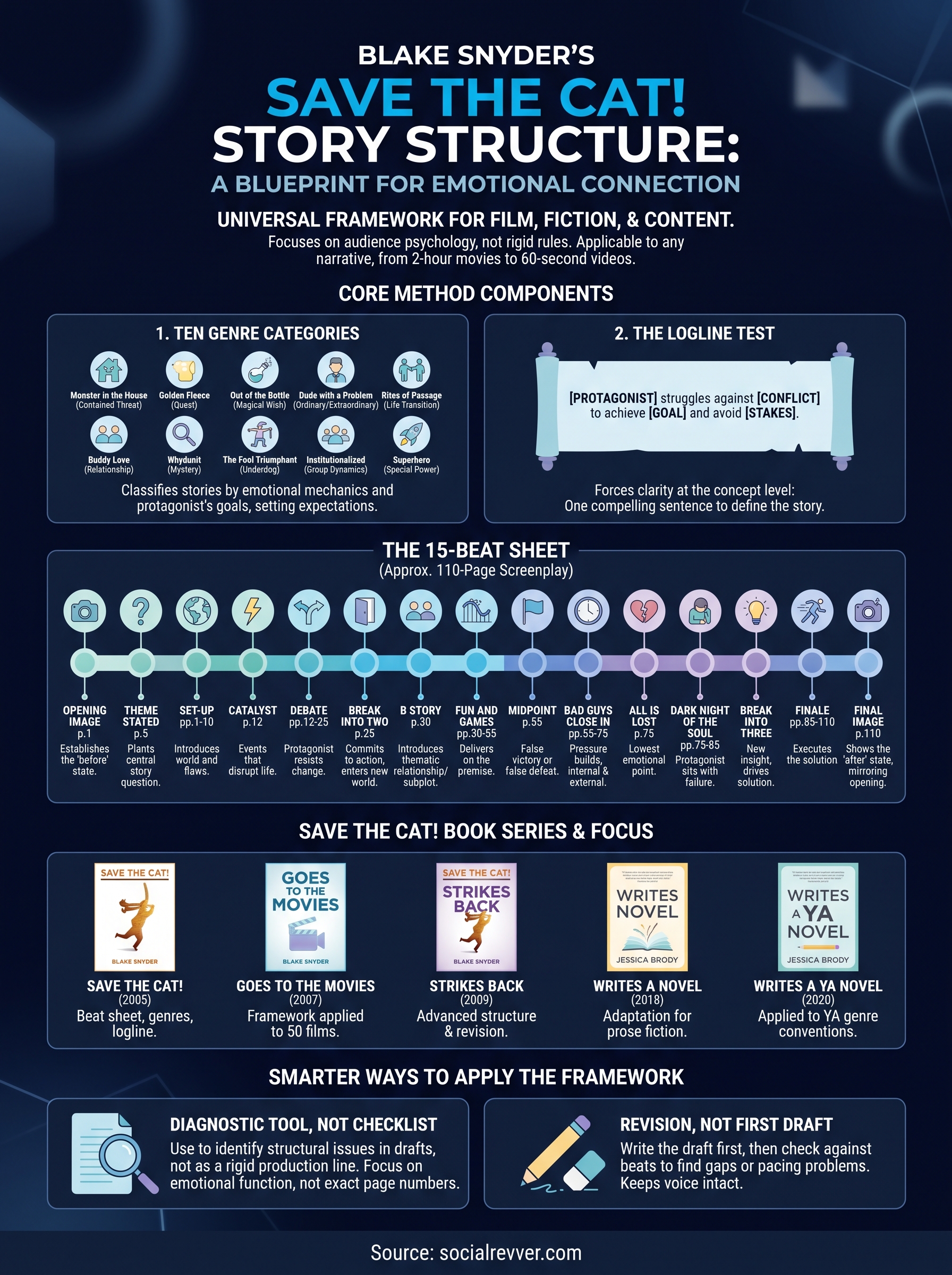
This article breaks down Blake Snyder's complete Save the Cat methodology: the beat sheet, the ten genre categories, the full book series, and practical ways to apply the framework to your own writing. If you've been looking for a clear, structured overview, you're in the right place.
Why Save the Cat still matters to writers
The blake snyder save the cat framework was published more than two decades ago, yet it still shows up in film school syllabi, screenwriting workshops, and content strategy guides. That staying power isn't accidental. Snyder gave writers something genuinely rare: a system that's both simple enough to memorize and deep enough to handle complex narratives. Most storytelling theory is either too abstract to apply or too rigid to produce original work. Snyder found a middle ground that writers keep coming back to.
A framework built on patterns, not rules
Snyder spent years reverse-engineering Hollywood hits, and his central finding was that successful stories share recognizable structural patterns. He wasn't inventing a formula so much as documenting what already worked. That distinction matters a lot. When you follow a framework grounded in observed patterns rather than invented rules, you're working with audience psychology, not against it. Readers and viewers are conditioned by decades of storytelling to expect certain emotional shifts at certain points in a narrative.
This is why the framework translates so cleanly beyond film. Whether you're writing a novel, a sales page, or a short-form video, the audience's emotional expectations don't change just because the medium does. The beat sheet gives you a map of those expectations. When you know where the emotional peaks and valleys should fall, you stop guessing and start engineering outcomes.
Audience psychology doesn't change based on medium. The beats do the same work in a 60-second video as they do in a two-hour film.
What professional writers actually use it for
Most professional screenwriters don't follow the beat sheet rigidly, line by line. They use it as a diagnostic tool. When a script feels flat or a story loses momentum, the beat sheet reveals exactly where the structural problem lives. You can identify a missing section or a weak midpoint and fix that specific issue rather than rewriting the entire piece from scratch.
Content creators and brand storytellers apply it the same way. If a video script isn't converting or a piece of long-form writing isn't holding attention, checking the structure against a proven framework gives you a clear starting point for revision. Instead of relying on gut instinct alone, you gain a reference point built on patterns observed across thousands of successful stories. That's the real reason the Save the Cat method has stayed relevant: it makes storytelling problems diagnosable, which means they become fixable on purpose rather than by luck.
What the Save the Cat method is
The blake snyder save the cat method is a story development system built on two core components: a set of genre categories that help you classify your story before you write it, and a beat sheet that maps out the structure scene by scene. Snyder believed that knowing what kind of story you're telling is just as important as knowing how to tell it. Most writers jump straight into drafting without answering that foundational question, which is why so many first drafts collapse structurally before they get anywhere near a finished product.
The ten genre categories
Snyder identified ten story types that cover virtually every narrative you'll encounter in film, fiction, or content. These aren't genres in the traditional Hollywood sense like horror or comedy. Instead, they describe the emotional mechanics of the story: what the protagonist wants, what stands in their way, and what internal transformation drives the plot. Examples include "Dude with a Problem," where an ordinary person gets thrust into extraordinary circumstances, and "Monster in the House," where a contained threat forces characters to confront something they themselves caused.
Knowing your category before you write helps you set the right expectations for your audience and avoid structural choices that work for one story type but actively undermine another.
Classifying your story before you outline it prevents the structural mismatch that kills most first drafts.
The logline test
Snyder also insisted every story should pass a logline test before you invest serious time in it. A logline is a single sentence that captures the protagonist, the conflict, and the stakes. If you can't compress your story into one clear sentence, you probably don't understand it well enough yet.
This test forces clarity at the concept level, which saves you from spending weeks on a script or piece of content that lacks a clear central tension. It's a discipline check before the real structural work begins.
The Save the Cat beat sheet explained
The beat sheet is the operational core of the blake snyder save the cat system. It divides a story into 15 specific beats, each mapped to an approximate page range in a standard 110-page screenplay. Every beat marks a structural turning point where the story shifts direction, raises stakes, or forces your protagonist to make a decision. Together, they create a precise emotional rhythm that keeps audiences engaged from the first scene to the last.
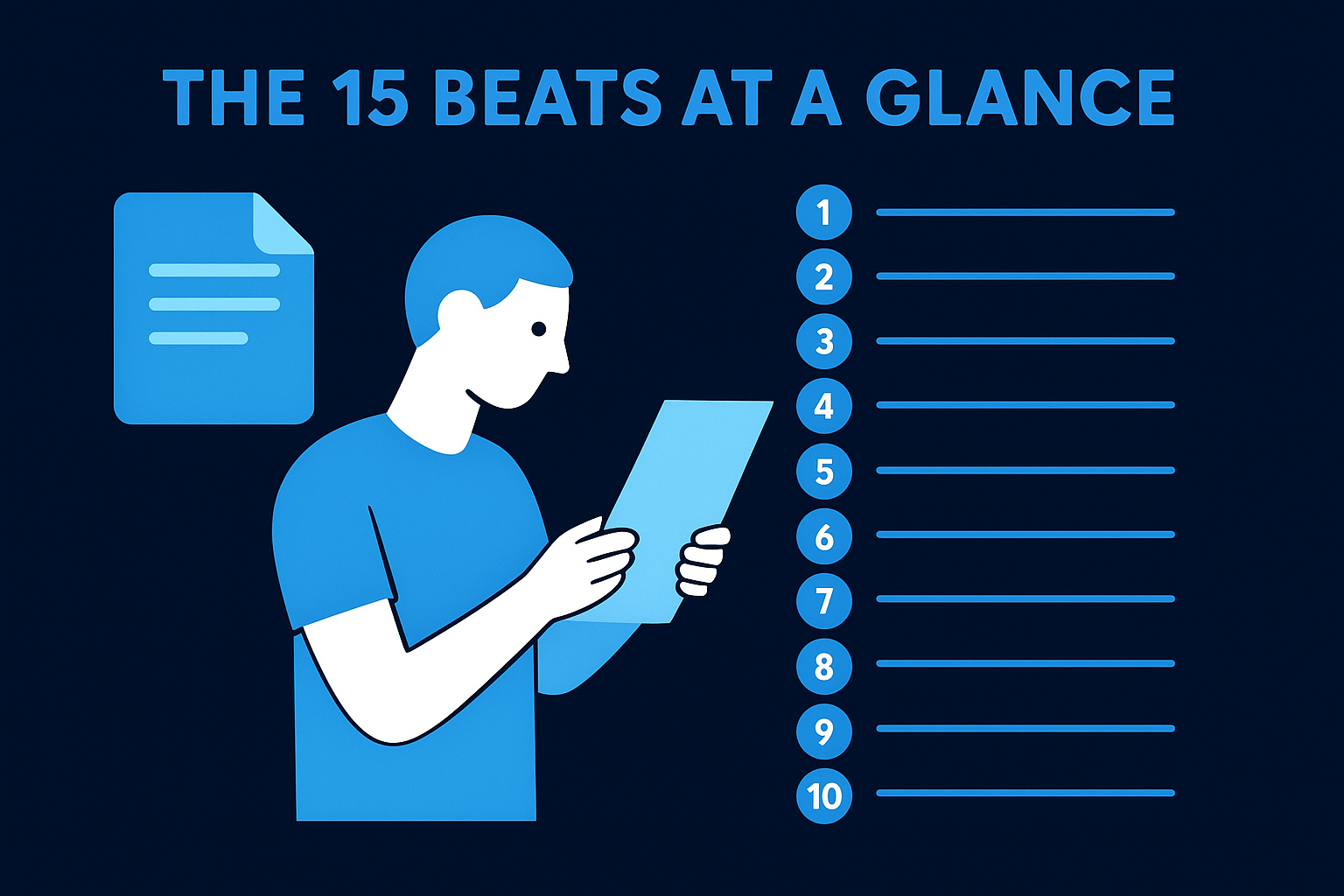
The 15 beats at a glance
Snyder gave each beat a memorable name so you can internalize the framework quickly. Each one serves a specific structural function, and knowing that function tells you exactly what has to happen at that point in your story.
| Beat | Approx. Page | Function |
|---|---|---|
| Opening Image | p. 1 | Establishes the "before" state |
| Theme Stated | p. 5 | Plants the story's central question |
| Set-Up | pp. 1-10 | Introduces the world and flaws |
| Catalyst | p. 12 | The event that disrupts ordinary life |
| Debate | pp. 12-25 | Protagonist resists the change |
| Break into Two | p. 25 | Protagonist commits to action |
| B Story | p. 30 | Introduces the thematic relationship |
| Fun and Games | pp. 30-55 | Delivers the story's premise |
| Midpoint | p. 55 | False victory or false defeat |
| Bad Guys Close In | pp. 55-75 | External and internal pressure builds |
| All Is Lost | p. 75 | The lowest emotional point |
| Dark Night of the Soul | pp. 75-85 | Protagonist sits with failure |
| Break into Three | p. 85 | New insight drives the solution |
| Finale | pp. 85-110 | Protagonist executes the solution |
| Final Image | p. 110 | Shows the "after" state |
The beats aren't arbitrary checkpoints. They reflect the emotional timing audiences have been conditioned to expect through decades of storytelling.
How the beats control pacing
Understanding where each beat falls is as important as understanding what it does. If your Midpoint arrives too early or your Break into Two lands too late, the story loses tension even when the individual scenes are well written. The beat sheet gives you a structural timeline, not just a list of events to include.
You can also apply the beats selectively to shorter content formats. The Catalyst and All Is Lost beats alone give a 60-second video the emotional arc it needs to hold attention and drive a clear action at the end.
Save the Cat books in order and what they cover
The blake snyder save the cat series spans five books and covers multiple storytelling formats, from screenwriting to prose fiction. Knowing what each title covers saves you time and points you directly to the resource that matches your current project type and skill level.
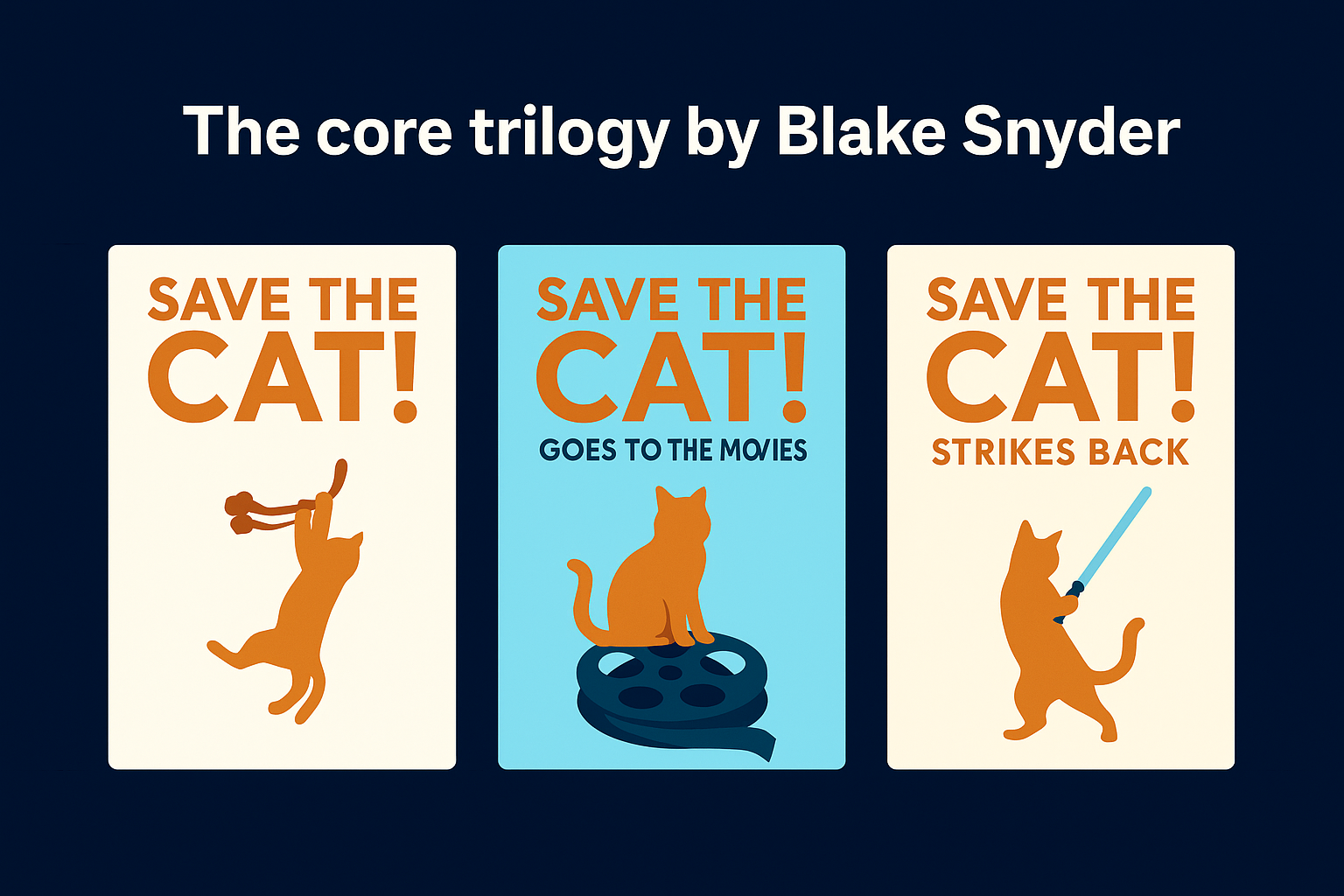
The core trilogy by Blake Snyder
Snyder wrote three books before his death in 2009, each building on the last. The first, Save the Cat! (2005), introduces the beat sheet, the ten genres, and the logline test. Read it first regardless of your format. Save the Cat! Goes to the Movies (2007) applies the framework to 50 films across all ten genre categories, giving you a concrete reference for the beats in action. Save the Cat! Strikes Back (2009) goes deeper into advanced structural problems like subplot management, character transformation, and diagnosing drafts that stall.
| Book | Year | Core Focus |
|---|---|---|
| Save the Cat! | 2005 | Beat sheet, genres, logline test |
| Save the Cat! Goes to the Movies | 2007 | Framework applied to 50 films |
| Save the Cat! Strikes Back | 2009 | Advanced structure and revision |
Start with the original, then use Goes to the Movies as a companion reference before moving to Strikes Back.
Expansions for novelists
Jessica Brody extended the framework into prose fiction with Save the Cat! Writes a Novel (2018), which is the most widely read adaptation of the method outside screenwriting. Brody translates every beat into fiction-specific language and works through concrete novel examples to show how each structural shift operates on the page rather than the screen.
Her follow-up, Save the Cat! Writes a Young Adult Novel (2020), applies the beat sheet to YA genre conventions specifically. It addresses the structural patterns unique to stories written for younger audiences and is more precise than the general novel guide if your work falls into that category.
Common pitfalls and smarter ways to use it
The most common mistake writers make with the blake snyder save the cat framework is treating the beat sheet as a rigid checklist rather than a flexible guide. When you force every story element to hit exact page counts, you end up with writing that feels mechanical rather than organic. The beats describe when emotional shifts should happen relative to each other, not the precise line where they must occur.
Mistaking structure for formula
Many writers abandon the framework after one draft because their story "didn't fit" the beats exactly. That's a misreading of the system. Snyder designed the beat sheet as a diagnostic tool, not a production line. If your Midpoint lands on page 60 instead of 55, that's not a failure. What matters is whether the emotional function of that beat is fulfilled.
The beats are also more forgiving in shorter formats. When you apply them to video scripts or articles, you compress the timeline but preserve the emotional sequence. Using the beats as structural anchors rather than precise markers keeps the writing natural while still giving you a framework that holds.
Use the beats to diagnose what's missing, not to prescribe what must appear on a specific page.
Using it as a starting point, not a ceiling
Writers who get the most value from this framework treat it as a revision tool, not a first-draft template. Write your draft without the beat sheet open. Then map what you have against the beats to find structural gaps or pacing problems. That process keeps your voice intact while giving you a targeted way to identify what's broken and fix it deliberately.
Applying this to shorter content formats works the same way. Produce your content first, then check key beats like the Catalyst and All Is Lost to see where attention might drop. You're using the framework as a quality filter, not a constraint on creative output.
Where to go from here
The blake snyder save the cat framework gives you a repeatable system for building stories that hold attention and move people toward action. Start with the original book, apply the beat sheet as a revision tool rather than a first-draft template, and use the genre categories to clarify what kind of story you're actually telling before you write a single scene. Those three steps alone will improve your writing faster than most courses or workshops will.
Storytelling structure doesn't just apply to scripts and novels. Every piece of content your brand produces follows an emotional arc, whether you've designed it intentionally or not. If you want a content system built on the same structural principles that make stories convert, with scripting, production, and distribution handled for you, get your free social media strategy from SocialRevver and see exactly how engineered content drives real growth.