Every piece of content you create, whether it's an essay, a blog post, or a short-form video script, lives or dies by its opening line. That line is your hook. Understanding the hook writing definition is essential for anyone who wants to stop losing their audience before they even get started. A hook is the first sentence or group of sentences designed to grab a reader's attention and pull them into the rest of your content. Simple concept. Hard to execute well.
At SocialRevver, hooks are the foundation of our entire content system. Our Scripting Engine analyzes high-performance patterns across 750,000+ videos to identify what makes people stop scrolling and start paying attention. We've seen firsthand how a single strong hook can be the difference between a piece of content that builds authority and one that gets ignored entirely. That experience informs everything in this guide.
This article breaks down the full meaning of a hook in writing, explains why hooks matter for both written and visual content, walks through the most effective types, and gives you real examples you can model. Whether you're writing an academic essay or scripting a 60-second video, you'll leave with a clear framework for opening strong every time.
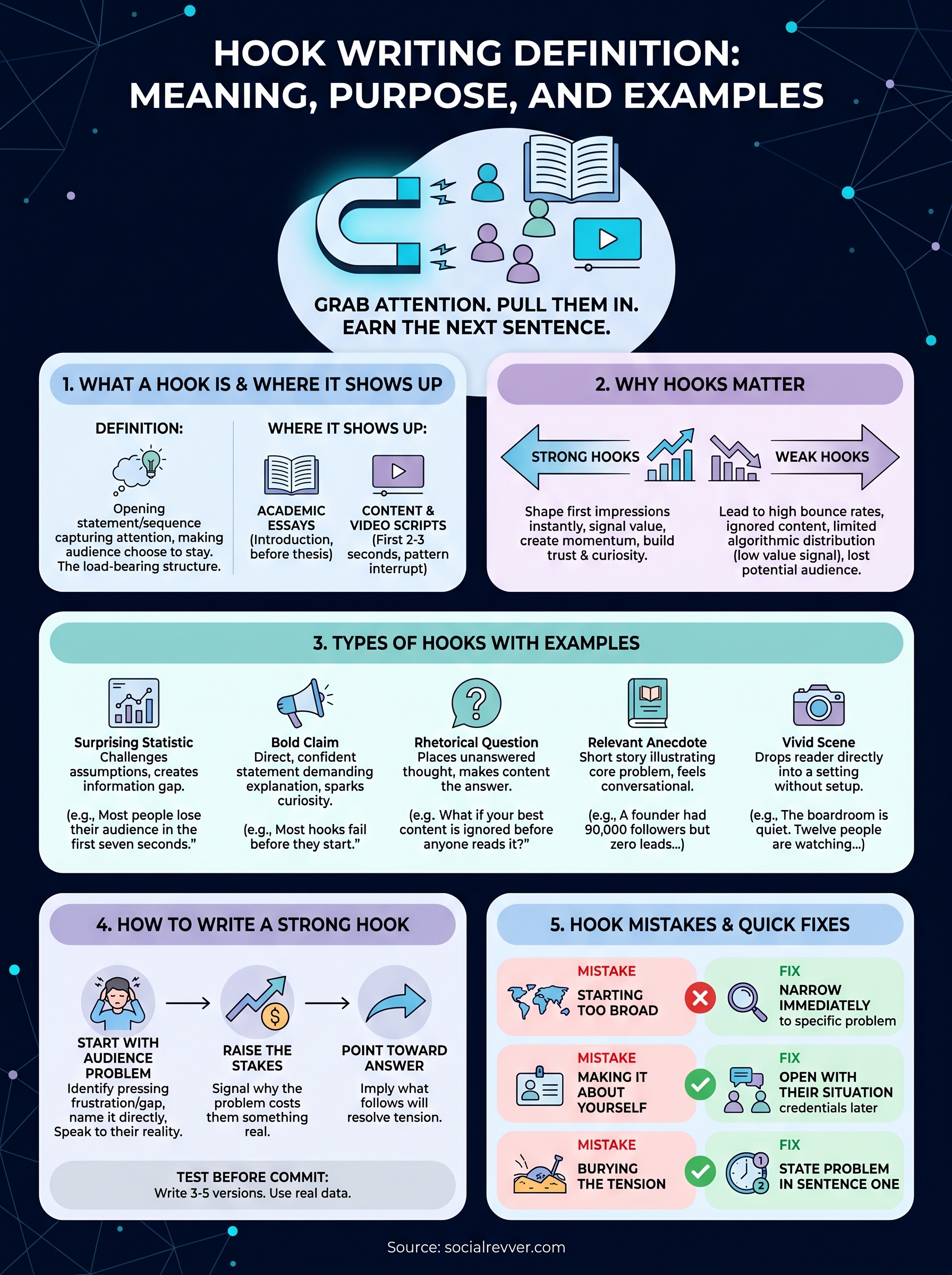
What a writing hook is and where it shows up
A hook is the opening statement or opening sequence designed to capture attention and make someone want to keep reading or watching. When you apply the hook writing definition to your own work, you're asking one focused question: what is the one thing that will make my audience choose to stay? The hook sets the tone for everything that follows. Without it, even the most well-researched content gets skipped before it has a chance to land.
Your hook is not decoration. It is the load-bearing structure of your entire piece of content.
Hooks in academic writing
In academic essays, the hook appears in the introduction, typically as the very first sentence before you transition into your thesis statement. Writers often underestimate how much this opening line shapes a reader's perception of the entire argument. A strong academic hook draws the reader in before any claims are made, giving your writing credibility and momentum from the start.
Common hook types used in academic writing include:
- A surprising statistic: A fact that challenges what the reader assumes to be true
- A bold claim: A direct, confident statement that demands an explanation
- A rhetorical question: A question the reader will instinctively want answered
- A relevant anecdote: A short story that illustrates the core problem or theme
- A vivid scene: A descriptive image that puts the reader inside a situation
Each type serves a different purpose, but they all share one function: they give the reader a reason to keep going rather than put the piece down.
Hooks in content and video scripts
In digital content, the hook operates under far more pressure than it does in academic writing. Attention spans online are short, and your audience makes a decision to stay or scroll within the first two to three seconds. Whether you're writing a blog post, a social media caption, or a video script, your hook must do heavy lifting immediately. There is no grace period built into the format.
For short-form video specifically, the hook is often a single spoken line or on-screen text that creates a pattern interrupt. This means it breaks the viewer's passive scrolling state and forces a moment of active attention. On platforms where content is distributed algorithmically based on watch time and engagement, the hook is not just a stylistic choice. It is a performance variable that directly determines how widely your content gets pushed to audiences who have never heard of you. A weak hook means the algorithm treats your content as low-value, regardless of how strong the rest of it is.
Why hooks matter
Understanding the hook writing definition goes beyond knowing what a hook is. It means recognizing that your hook controls whether any of your other work gets read at all. Content quality, argument strength, and production value are irrelevant if someone stops reading at line one. The hook is the entry point, and if it fails, the rest of the piece never gets its chance.
Hooks shape first impressions instantly
Your reader forms a judgment about your content within seconds. This is not a figure of speech. Research on reading behavior consistently shows that people decide whether to continue based on the opening lines alone. A strong hook signals that the content is worth their time. A weak one signals the opposite, and once that impression forms, it is very difficult to reverse.
The best content in the world gets ignored if the hook does not earn the next sentence.
A compelling opening line creates forward momentum that carries the reader through naturally. Each sentence becomes easier to read because the hook has already established trust and curiosity. Without that foundation, readers treat every following sentence as optional rather than necessary.
Weak hooks carry real performance costs
On social platforms, watch time and engagement rates determine how broadly the algorithm distributes your content. If viewers drop off in the first two seconds, the platform reads that as a signal to stop pushing your content further. You lose not just one viewer but every potential viewer the algorithm would have reached.
For written content, high bounce rates on blog posts or articles tell search engines that readers did not find what they expected. That pattern compounds over time and limits how your content performs in search results. A hook that sets accurate expectations and creates genuine interest reduces bounce and keeps readers moving through the full piece, which benefits both your audience and your long-term visibility.
Types of hooks with examples
Once you understand the core hook writing definition, the next step is knowing which type fits your content and your audience. Different hooks create different psychological effects. The type you choose directly affects how your reader or viewer responds in those first critical seconds.
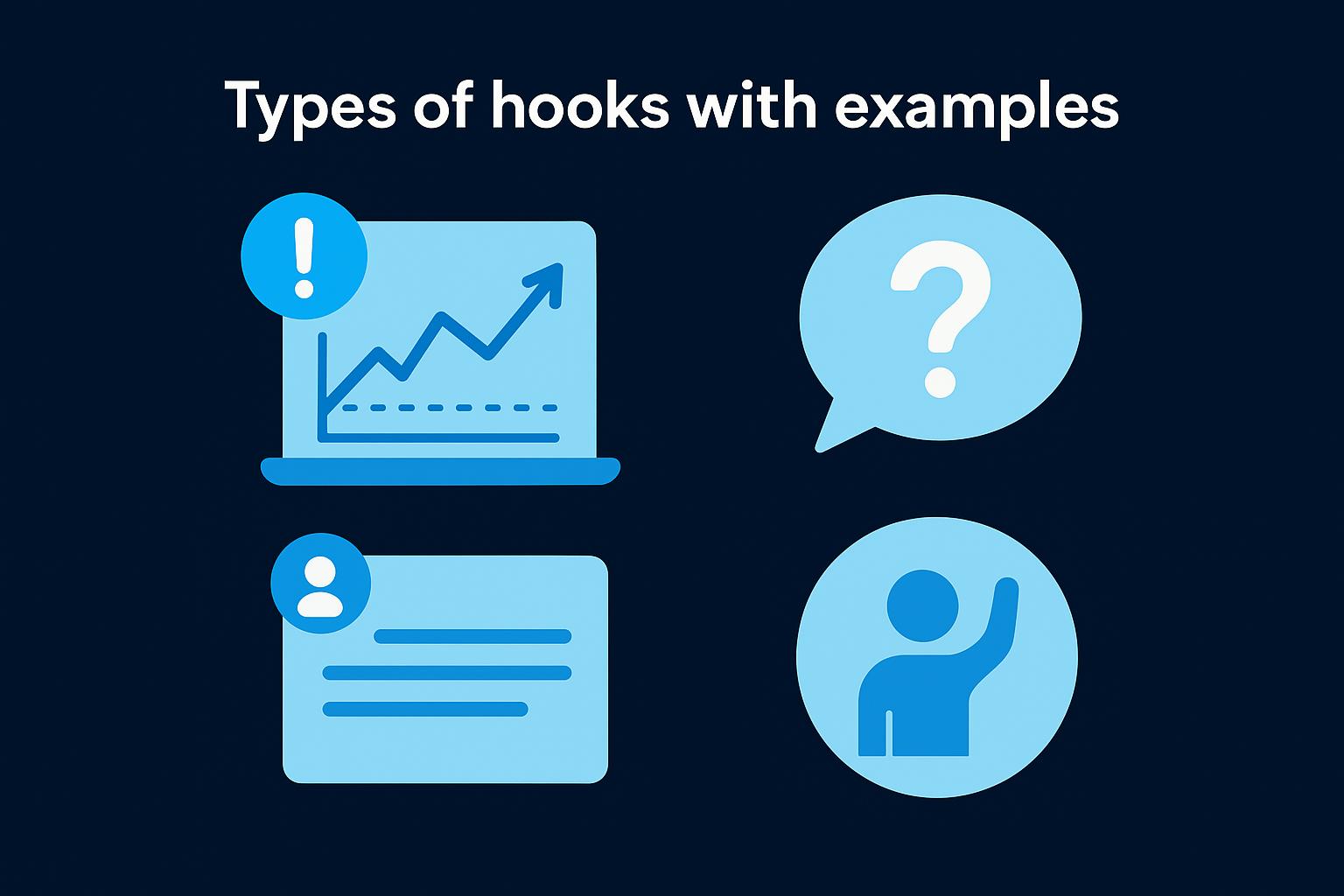
Picking the right hook type is not a stylistic preference. It is a strategic decision based on what emotion or action you want to trigger.
Fact-based and question hooks
A surprising statistic works because it disrupts what the reader already believes to be true. It creates an information gap they want to close. Example: "Most people lose their audience in the first seven seconds." A rhetorical question operates similarly by placing an unanswered thought in the reader's mind, making the rest of the content feel like a necessary answer. Example: "What if your best content is being ignored before anyone reads it?"
Anecdote and scene hooks
Short anecdotes pull the reader into a specific moment before any argument is made. They feel less like content and more like a conversation. Example: "A founder we worked with had 90,000 followers and was generating zero leads. The problem started at the first sentence." Scene hooks do the same job differently by dropping the reader directly into a setting without narrative setup. Example: "The boardroom is quiet. Twelve people are watching a pitch that nobody prepared for."
Bold claim hooks
Direct, confident statements open the door to curiosity and mild resistance, both of which keep people reading. The reader wants to know if you can back it up. Example: "Most hooks fail before they start." Provocative positions can create the same tension with more friction: "Storytelling is overrated. Specificity wins every time." Use bold claim hooks when you have the substance to support them. When you do, they consistently outperform safer openings because they force an immediate reaction from your audience.
How to write a strong hook
Applying the hook writing definition in practice means working backward from your audience, not forward from your own ideas. Before you write a single word, you need to know what your reader cares about, what keeps them up at night, and what they are actively trying to solve. Your hook earns attention by speaking directly to that need, not by showcasing your writing style or introducing yourself. The moment you make your hook about you rather than your audience, you lose them.
A strong hook makes the reader feel like you wrote it specifically for them.
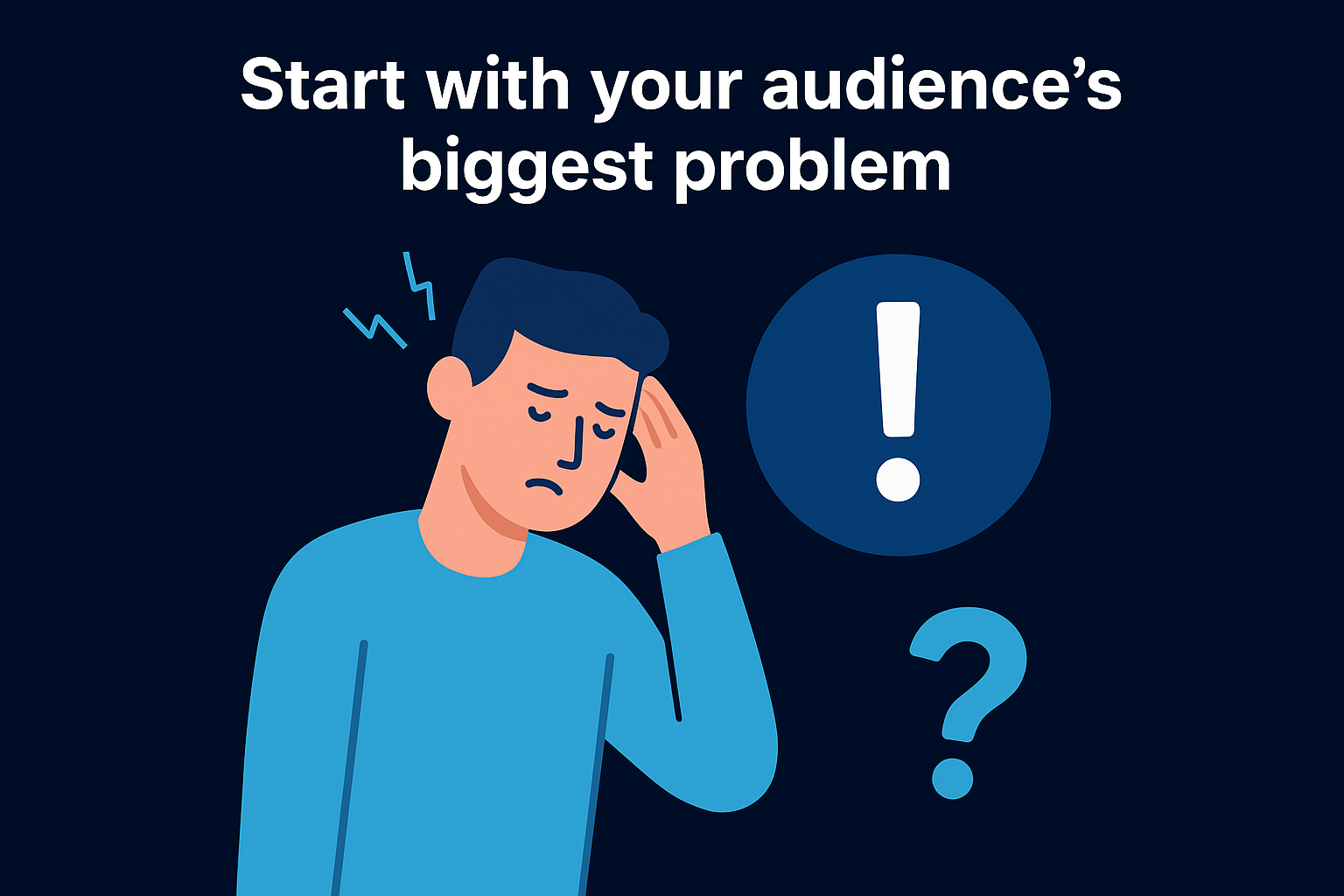
Start with your audience's biggest problem
Your strongest hook material almost always lives inside the tension between where your audience is and where they want to be. Start by identifying the single most pressing frustration your audience has, then open with a statement or question that names it directly. Readers and viewers respond to recognition before they respond to information, so your opening needs to reflect their reality back to them before you offer any solutions.
Use this simple framework to draft your hook:
- Name the problem: State the specific frustration or gap your audience faces
- Raise the stakes: Signal why this problem costs them something real
- Point toward the answer: Imply that what follows will resolve the tension
Test before you commit
Writing one hook and moving forward is the most common mistake at this stage. You should write at least three to five versions of every hook before selecting one. Vary the format across each version: try a statistic, then a bold claim, then a direct question. Read each out loud and identify which one forces you to keep reading instinctively.
Real performance data is the most reliable judge. If you publish content regularly, track which opening formats consistently generate higher engagement and use that pattern as your baseline going forward.
Hook mistakes and quick fixes
Knowing the hook writing definition helps you spot where most hooks break down. The errors are predictable, which means they are also fixable with a small adjustment in how you approach your opening. The three most common mistakes show up across every content format, and each one has a direct fix you can apply right now.
Most hooks fail because they were written for the writer, not the reader.
Starting too broad
Broad openings kill momentum before it starts. Phrases like "In today's world" signal nothing specific and give your audience no reason to stay. Your hook needs to narrow immediately to the exact problem or tension your audience already feels. Replace any wide framing with a single, concrete detail that names their specific situation.
- Replace: "Social media is changing how brands communicate."
- With: "Most brand videos get skipped in the first two seconds."
Making it about yourself
Leading with your credentials before establishing relevance is a fast way to lose your reader. Your audience's first question is "what is in this for me," not "who are you." Your background belongs later in the content, after you have already earned their attention.
Fix this by opening with their situation first. Save your credentials for when you are providing evidence, not when you are asking for initial trust.
Burying the tension
Tension is what keeps someone reading, and many writers delay it too long by stacking setup before reaching the actual point. Your opening should create a question or gap within the first two sentences. If your hook runs longer than three sentences before landing, cut it in half.
- State the problem directly in sentence one
- Imply the resolution in sentence two
Final takeaways
The hook writing definition comes down to one core idea: your opening line earns the rest of your content its chance to be read. Everything covered in this guide points back to that single truth. A hook is not an optional stylistic flourish. It is a functional tool that controls whether your audience stays or leaves within the first few seconds, and that decision shapes every performance metric that follows.
Strong hooks share three qualities. They name a specific tension, they speak directly to your audience's reality, and they create a question the reader needs answered. Weak hooks either start too broad, lead with your credentials, or bury the actual point too far down. Both mistakes are fixable once you know what to look for.
If you want a content system built around hooks that consistently drive attention and leads, apply to work with the SocialRevver team and get your free 40+ slide social media strategy.