Most brands struggle with content not because their production is bad, but because their positioning is unclear. Before you script a single video, write a homepage headline, or brief a creative team, you need to define exactly who you are, who you serve, and why it matters. That starts with knowing how to write a positioning statement, one that's sharp enough to guide every piece of content and communication your brand puts out.
A positioning statement isn't a tagline. It's not a mission statement. It's an internal strategic tool that forces clarity on what makes your offer different and who specifically should care. Get it right, and every marketing decision downstream, from ad copy to short-form content, becomes easier and more effective. Get it wrong, and you end up blending into a sea of competitors saying the same generic things.
At SocialRevver, we build content systems that turn organic attention into revenue. But that engine only works when the brand behind it has a clearly defined position in its market. It's the first thing we assess with every client because no amount of hooks, edits, or distribution strategy can compensate for a weak foundation. This guide walks you through the exact process for writing a positioning statement, complete with templates, real examples, and the framework you need to get it done right the first time.
What a positioning statement is and is not
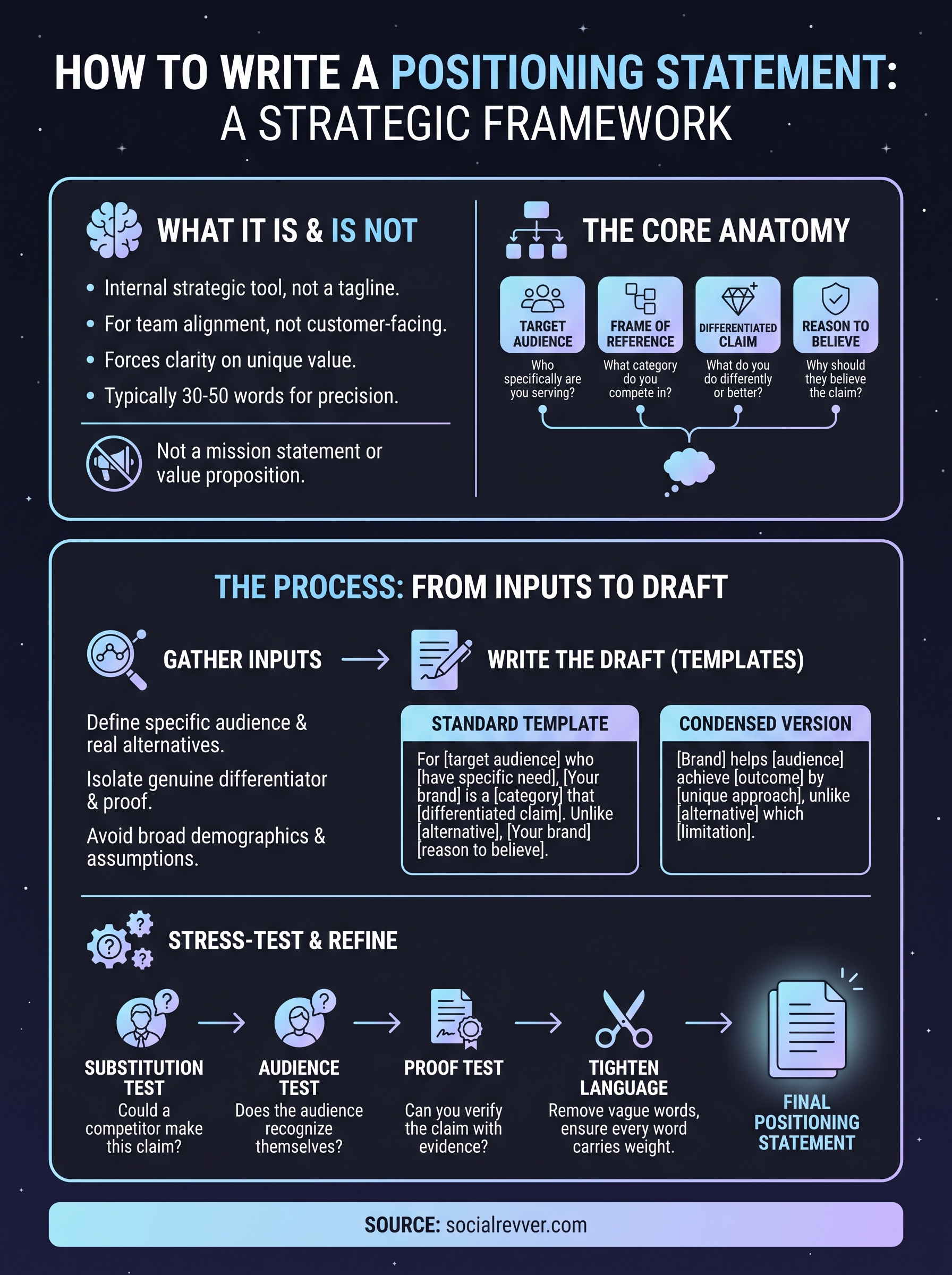
A positioning statement is a short, structured declaration that defines who your brand serves, what you offer, and why that offer is different from every alternative your audience could choose. It's an internal strategic tool, not a customer-facing message. When you understand how to write a positioning statement correctly, you stop guessing and start making deliberate, informed decisions about your messaging, content, and brand direction.
What a positioning statement actually is
Your positioning statement creates internal strategic alignment across your team. It answers three core questions in one concise statement: who is your target audience, what category does your offer belong to, and what makes it uniquely valuable compared to alternatives? Most effective positioning statements run between 30 and 50 words because the constraint forces precision. If you can't state your position in two sentences, you likely don't have a clear position yet.
Clarity is the only standard that matters here. Your positioning statement works as a filter for every downstream decision, from the hooks in your short-form content to the headline on your homepage. Every piece of messaging your team produces should trace back to it. Without it, different team members pull in different directions and your brand communication becomes inconsistent and diluted.
A positioning statement is only useful when it's specific enough to exclude. If it could apply to any brand in your category, it isn't a positioning statement.
What a positioning statement is not
Many people confuse a positioning statement with a tagline, a mission statement, or a value proposition. A tagline is an outward-facing phrase designed for audiences. A mission statement describes why your company exists. A value proposition focuses on specific product benefits. Your positioning statement does something different: it defines your place in a competitive landscape relative to real alternatives your audience is actively choosing between.
Your positioning statement also doesn't need to be published anywhere or sound polished. Its job is to be accurate and specific, not catchy or inspiring. The value is entirely in the clarity it creates for your team and your strategy, not in how it reads to an outside audience.
The core anatomy of a positioning statement
Every solid positioning statement contains four elements that work together to create something specific and defensible. Know these four components before you write a single word.
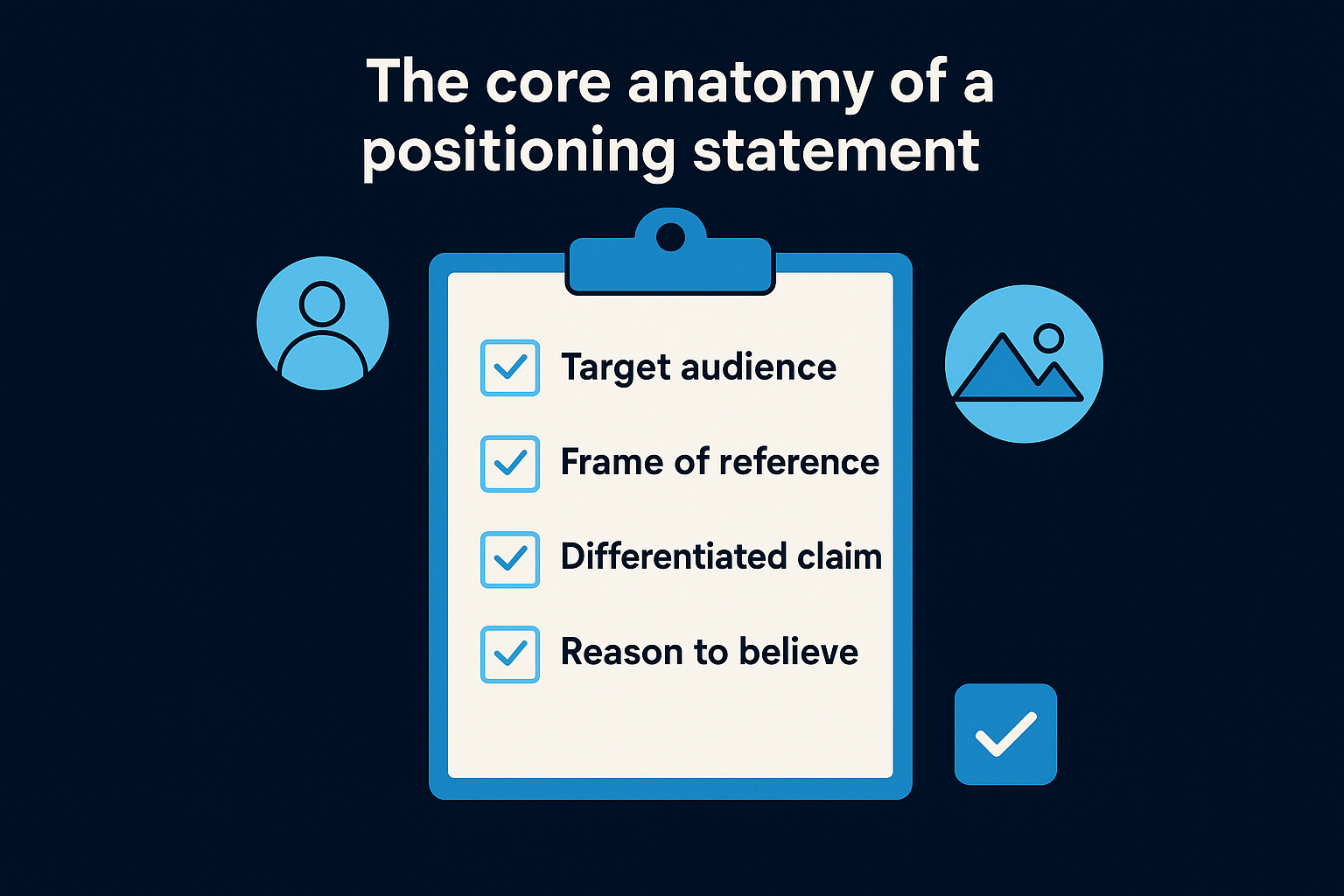
| Element | What it answers |
|---|---|
| Target audience | Who specifically are you serving? |
| Frame of reference | What category or space do you compete in? |
| Differentiated claim | What do you do differently or better? |
| Reason to believe | Why should anyone believe that claim? |
Remove any one of these elements and your statement becomes vague, generic, or unverifiable. Each one earns its place because together they force you to think about your real competitive advantage and the specific people you're actually trying to reach.
Gather the inputs before you write
Writing a sharp positioning statement on the first try is nearly impossible without collecting the right raw material first. You need specific answers to specific questions before you sit down to write. Skipping this step is the most common reason positioning statements end up generic, because writers default to assumptions instead of evidence.
Know your audience and your alternatives
Your positioning statement only works when it names a real, defined group of people, not a broad demographic like "small business owners" or "marketers." You need to identify the specific person with the most urgent problem your offer solves. At the same time, you need to list the actual alternatives they consider when they don't choose you. These could be direct competitors, workarounds, or simply doing nothing.
Before you write a single word of your statement, answer these four questions in concrete terms:
- Who is the specific person you serve, including their role, situation, and the outcome they're actively trying to reach?
- What category does your offer compete in from their point of view?
- Which alternatives do they realistically choose instead of you?
- What makes your offer different in a way that matters to them, not just in a way that's technically true?
"Founders with 5 to 50 employees losing inbound leads due to no consistent content presence" is a usable input. "Busy professionals" is not.
Identify your real differentiator
Once you have your audience and alternatives mapped out, you can isolate what genuinely separates you from the field. Your differentiator must be something your specific audience values and something your alternatives don't credibly deliver. Knowing how to write a positioning statement that holds up under scrutiny means grounding your claim in verifiable proof, whether that's a proprietary process, a measurable outcome, or a track record your competitors can't match. If your differentiator sounds like something three other brands in your space would also claim, keep digging until you find something they can't.
Write your first draft with proven templates
With your inputs in hand, you're ready to draft. The goal at this stage is to get something specific and complete on paper, not something perfect. Most people overthink the first draft because they treat it as the final output. It isn't. Use the templates below to structure your statement and fill in what you already know. Understanding how to write a positioning statement becomes much easier once you have a reliable structure to follow instead of a blank page.
The standard positioning statement template
The most widely used format comes from Geoffrey Moore's Crossing the Chasm, and it works because it forces you to address every critical element in sequence. Don't skip any field, even if your first answer feels rough, because each blank you can't fill points directly to a gap in your strategic clarity.
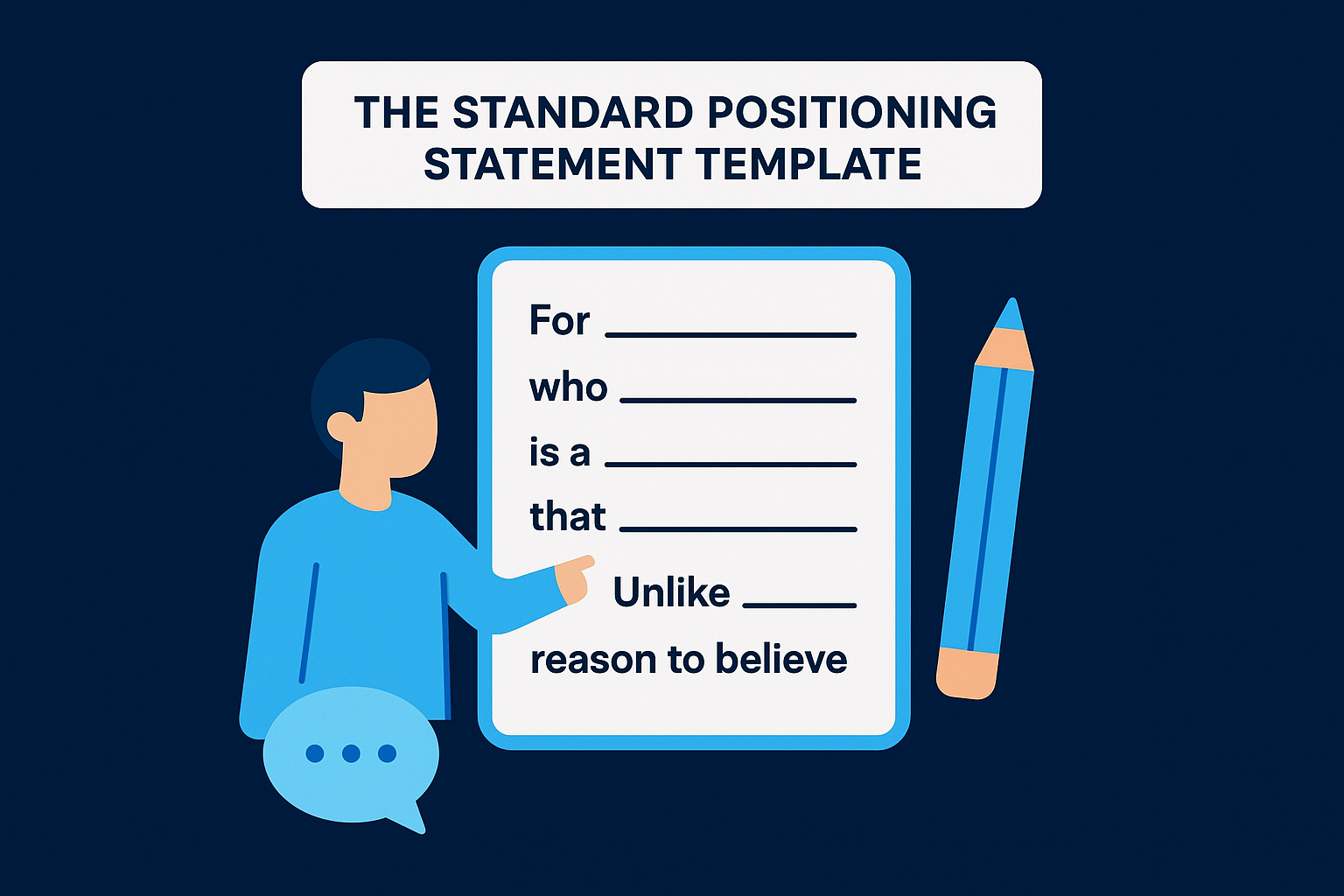
For [target audience]
who [have this specific problem or need],
[Your brand] is a [frame of reference / category]
that [key benefit or differentiated claim].
Unlike [primary alternative],
[Your brand] [reason to believe].
Fill this in with concrete language pulled directly from your input-gathering work. If a field forces vague language, that's a signal you need sharper audience research or a clearer differentiator before moving forward.
Your first draft will almost always be too broad. The goal is to start specific and get more specific, not to start broad and hope precision shows up later.
A condensed version for faster alignment
Some teams prefer a shorter format that's easier to repeat in conversations and briefs. This version trades some structural depth for speed and memorability, making it useful when you need quick internal alignment across a team.
[Brand] helps [specific audience] achieve [desired outcome]
by [unique mechanism or approach],
unlike [alternative] which [limitation].
Both templates give you a working draft you can immediately pressure-test against your real competitive landscape. Pick the one that fits your workflow and complete every field before you start editing anything.
Stress-test and refine your statement
A first draft that feels good in isolation often falls apart the moment you apply real pressure to it. Before you lock in your statement and start building messaging around it, you need to actively challenge every claim it makes. This isn't about tearing down your work; it's about catching the gaps before your audience does. Think of this phase as the quality check that separates a useful strategic tool from a sentence that only sounds like one.
Run it through three direct challenges
Put your draft through three specific tests to evaluate how to write a positioning statement that holds up in a real competitive context. Each test targets a different weakness that shows up in most first drafts.
| Challenge | Question to ask | What a weak answer signals |
|---|---|---|
| The substitution test | Could a competitor swap their name in and make the same claim? | Your differentiator is too generic |
| The audience test | Would your specific target audience immediately recognize themselves in this? | Your audience definition is too broad |
| The proof test | Can you back up the differentiated claim with verifiable evidence? | Your reason to believe is missing or vague |
If your statement passes all three tests, you have something worth building on. If it fails even one, go back to your inputs before you revise the language.
Tighten the language until it hurts
Once your statement survives all three challenges, the next step is cutting every word that doesn't carry weight. Read it aloud and flag anything that sounds like a category description rather than a specific claim. Words like "innovative," "leading," or "comprehensive" are signals that your differentiated claim has drifted into filler. Replace each vague word with something concrete, a number, a named process, a specific outcome, or a defined audience characteristic. The tighter your language, the sharper your positioning becomes when it flows into your content, briefs, and brand messaging.
Examples you can adapt fast
Reading about how to write a positioning statement is useful, but seeing real examples makes the process concrete. The examples below follow the standard template from the previous section. Use them as direct starting points for your own draft, replacing the specifics with your actual audience, differentiator, and proof.
B2B service brand
This example fits a managed service business targeting company founders who need a repeatable result without hiring in-house.
For founders scaling a B2B company with 10 to 100 employees
who lose qualified leads due to inconsistent content output,
SocialRevver is a managed short-form content system
that turns organic social presence into a predictable lead source.
Unlike hiring a freelance video team,
SocialRevver applies machine learning across 750,000+ analyzed videos
to engineer content that converts attention into inbound pipeline.
The specificity in the audience line ("10 to 100 employees") and the proof line ("750,000+ analyzed videos") is what makes this statement defensible rather than generic.
Personal brand or content creator
The format works equally well for an executive or creator building authority in a defined niche, where the primary goal is inbound partnerships and speaking opportunities rather than follower counts.
For executives in the financial services space
who want to attract high-value partnerships without cold outreach,
[Your Name] is a personal brand built around [specific expertise area]
that generates consistent inbound interest through data-backed short-form content.
Unlike general social media consultants,
[Your Name] brings [X years] of direct industry experience
and a production system that maintains output without disrupting daily operations.
Both examples give you a working draft structure you can fill in within minutes. Notice that each one names a specific outcome the audience wants, not a feature of the service. Your positioning statement lands hardest when it speaks to the result your audience is actively chasing, not the process you use to deliver it.
Final thoughts
Knowing how to write a positioning statement is not a one-time exercise. Your market shifts, your offer evolves, and the alternatives your audience chooses change over time. Treat your positioning statement as a living document you revisit at least once a year or any time your growth stalls and your messaging starts to feel off. The four-element structure, the templates, and the stress tests in this guide give you everything you need to write something specific, defensible, and genuinely useful from day one.
Clear positioning is the foundation that makes every downstream decision faster and more effective. Your content, your copy, and your brand reputation all compound on top of it. If you want a system that takes that clarity and turns it into a predictable pipeline of inbound leads, apply to work with the SocialRevver team and get a free 40+ slide social media strategy built around your brand.