Most brands throw money at influencers and hope something sticks. A handful treat it like what it actually is: a distribution strategy with measurable ROI. The difference between the two shows up fast when you look at real influencer marketing campaign examples that generated actual revenue, not just impressions on a dashboard.
The campaigns worth studying share a common thread. They pair the right creator with a clear conversion mechanism, whether that's a landing page, a discount code, or a content series designed to build trust over time. Short-form video dominates most of these plays because it compresses attention and action into seconds, which is exactly why we built SocialRevver's entire system around engineering short-form content that converts.
Below, you'll find eight campaigns that moved the needle for the brands behind them. Each one breaks down what worked, why it worked, and what you can take from it, whether you're a founder building authority, a creator negotiating bigger deals, or a business owner trying to turn organic content into a repeatable revenue channel.
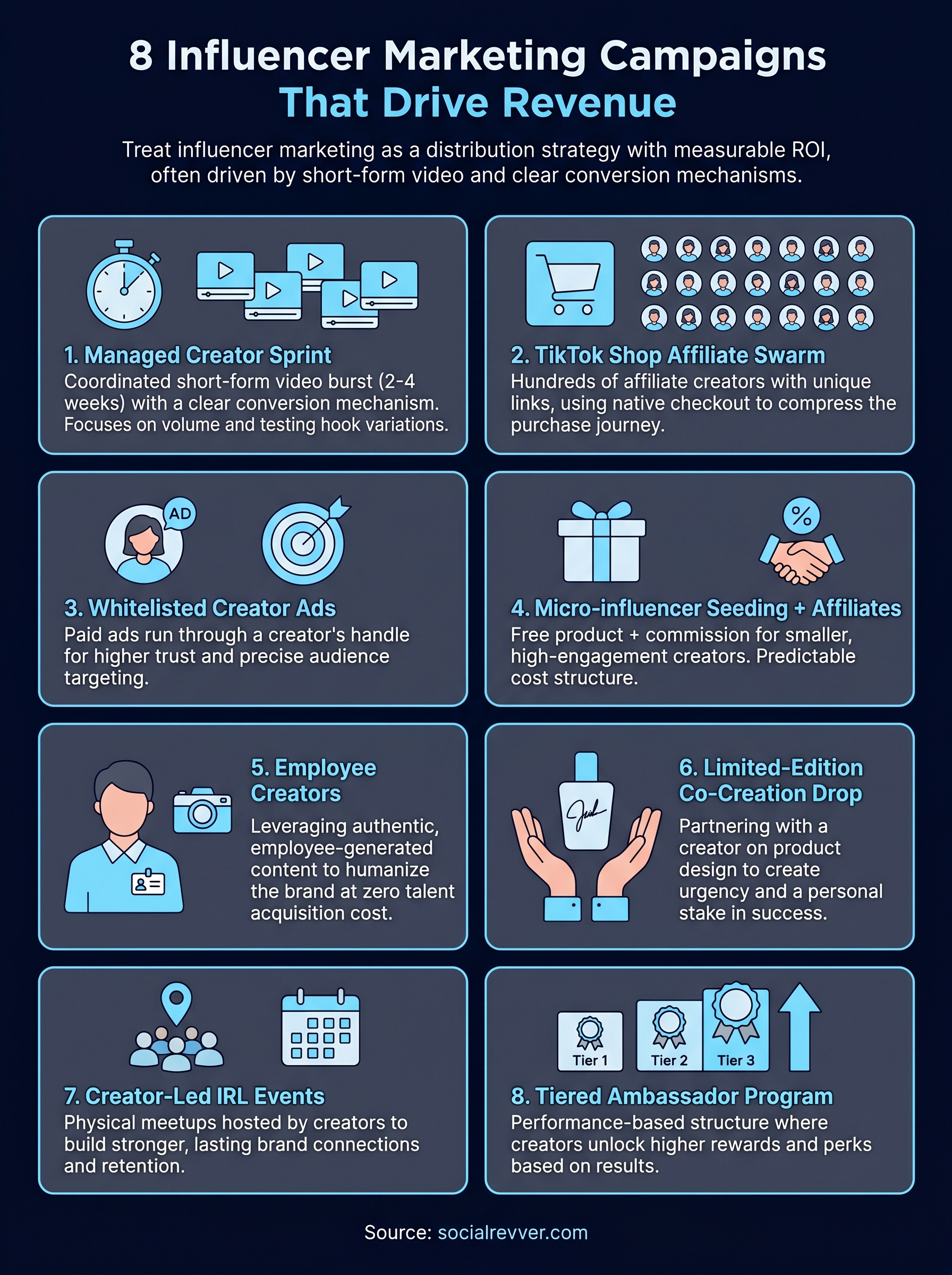
1. SocialRevver managed short-form creator sprint
This campaign model strips out the guesswork that kills most content budgets. Instead of hiring one influencer and waiting to see results, a managed creator sprint deploys a coordinated burst of short-form video content over a compressed timeframe, typically two to four weeks, with a clear conversion mechanism attached from the start.
What the campaign did
SocialRevver runs clients through a four-phase content system starting with strategy intelligence. The team analyzes a database of over 750,000 videos to identify hooks, psychological patterns, and structural formats that consistently drive engagement in a specific niche. A scripting engine then generates conversion-focused scripts tailored to the client's voice. Creators produce a high volume of short-form videos through an AI-supported editing pipeline that handles pacing, sound design, captions, and branded visuals.
Volume is the mechanism: the more content variations you test in a short window, the faster you find what actually converts.
Why it drove revenue
Short-form video compresses the buyer journey. A well-built 30-second clip can introduce a brand, establish credibility, and prompt action before the viewer scrolls away. The sprint model accelerates this by creating multiple touchpoints with a target audience inside a short window, which builds familiarity fast. When automated funnels route that attention toward a product page or lead form, content stops functioning as a branding exercise and starts working as a direct-response channel.
How to recreate it
You do not need a large team to run this type of campaign. Start with three to five scripts built around proven hook structures in your niche, produce multiple variations of each, and test them over two weeks. Cut underperformers quickly and connect every piece of content to a single conversion destination, whether that is a landing page, a lead magnet, or a product page.
Metrics and benchmarks to watch
Focus on watch-through rate and cost per lead rather than raw views. A 40% or higher watch-through rate on a 30-second video signals strong hook performance. Track which script angles produce the lowest cost per acquisition so you know exactly where to invest in your next sprint cycle.
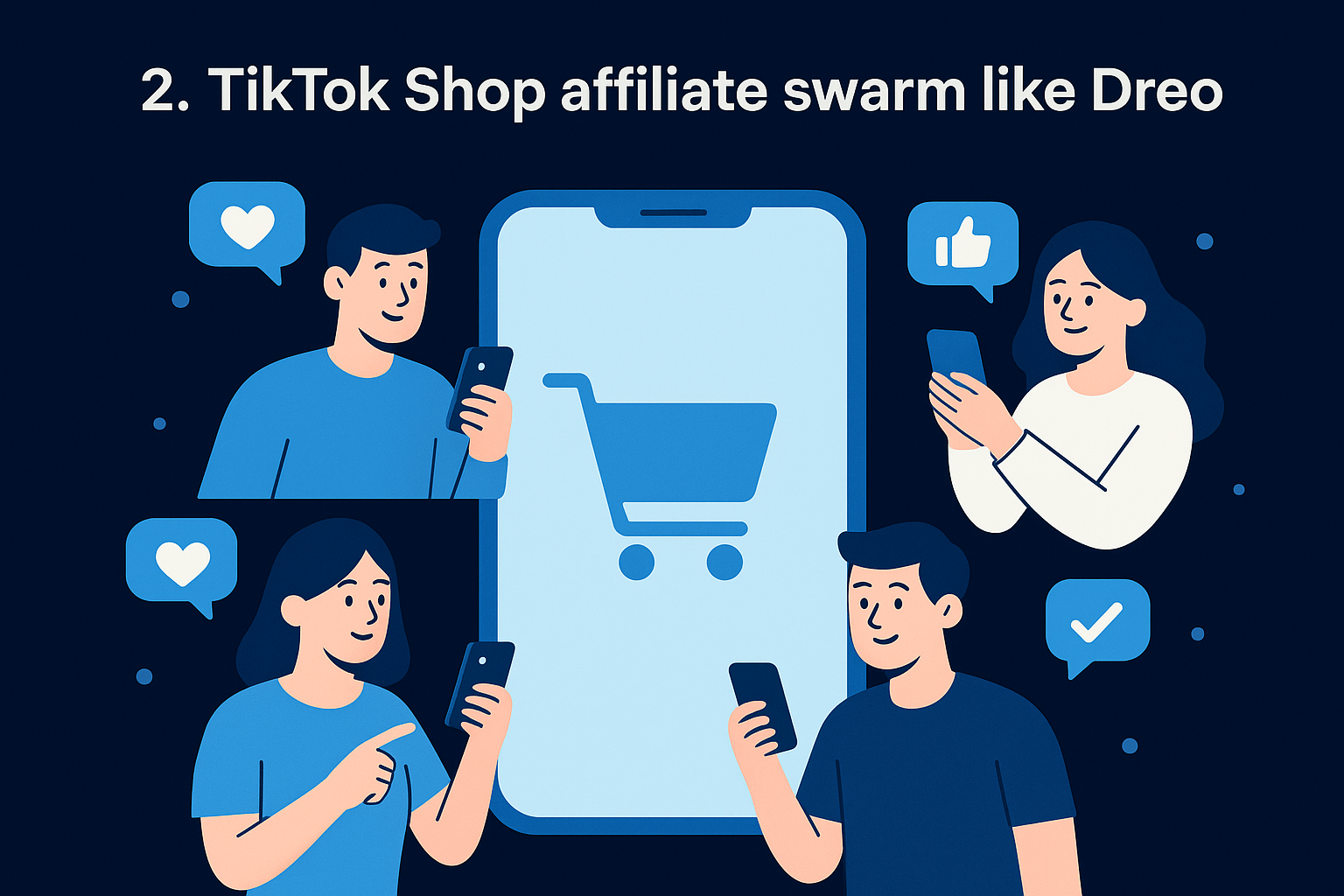
2. TikTok Shop affiliate swarm like Dreo
Dreo turned its product launch into one of the more studied influencer marketing campaign examples in the TikTok Shop era by activating hundreds of affiliate creators at once. This swarm approach floods your target audience's feed with multiple creator voices all pointing toward the same purchase destination, compressing the time between discovery and checkout.
What the campaign did
Dreo recruited creators across multiple follower tiers, from small micro-accounts to mid-size channels, giving each one product samples and a unique affiliate link. Creators produced their own organic-style short-form videos and earned a commission on every sale they drove through TikTok Shop's native checkout flow.
Why it drove revenue
The swarm model removes the single-point-of-failure risk that comes with betting your budget on one creator. Dozens of simultaneous videos mean that even when most underperform, the winners generate enough volume to move product at real scale.
TikTok Shop's native checkout eliminates the redirect step, so the distance between a viewer's impulse and a completed purchase shrinks to almost nothing.
How to recreate it
Set up a seller account in TikTok's affiliate marketplace, establish a competitive commission rate, and send product to any relevant creator who opts in. Prioritize accounts with high engagement-to-follower ratios rather than raw audience size.
Metrics and benchmarks to watch
Track gross merchandise value per creator and your video-to-purchase conversion rate. A healthy affiliate swarm typically achieves a conversion rate above 2% from video views to completed transactions.
3. Whitelisted creator ads like Midi Health
Whitelisted creator ads let you run paid media through a creator's account handle rather than your own brand page. Midi Health used this approach to promote its women's healthcare services, making sponsored content feel indistinguishable from the organic posts its target audience already trusted.
What the campaign did
Midi Health partnered with health and wellness creators, secured whitelisting permissions to their accounts, and ran targeted paid ads through those handles. The ads featured the creator's face, voice, and framing rather than a corporate aesthetic, so the content blended naturally into a viewer's feed instead of triggering the mental filter people apply to obvious brand ads.
Why it drove revenue
Trust transfers from the creator to the brand the moment a viewer sees familiar content from an account they follow. Whitelisting combines that trust with the precise audience targeting of paid media, so you reach both the creator's existing followers and cold audiences who share the same demographic profile.
Whitelisted ads consistently outperform brand-run ads on click-through rate because people engage with people, not logos.
How to recreate it
Negotiate whitelisting rights upfront as part of your creator agreement. Then build your targeting around:
- Lookalike audiences based on your existing customer list
- The creator's own follower demographics
- Interest-based segments that match your buyer profile
Metrics and benchmarks to watch
Compare your cost per acquisition from whitelisted ads against your standard brand ads running the same creative. A well-executed whitelisted campaign typically reduces cost per acquisition by 20 to 40%, which is the clearest signal that the trust transfer is working.
4. Micro-influencer seeding plus affiliates like Regal Rose
Regal Rose is a jewelry brand that built sustainable revenue by combining free product seeding with an affiliate commission structure. This pairing stands as one of the most cost-efficient influencer marketing campaign examples available to product-based businesses because it places acquisition cost at risk only after a sale is made.
What the campaign did
Regal Rose sent free products to hundreds of micro-influencers in the fashion and lifestyle space, typically accounts with 5,000 to 50,000 followers. Each creator received a personalized affiliate link and earned a commission on every sale they generated. No large upfront fees changed hands, so the brand kept its cost structure predictable from day one.
Why it drove revenue
Micro-influencers consistently produce higher engagement rates than larger accounts because their audiences are smaller, tighter, and more trusting of personal recommendations. When a creator with 20,000 loyal followers recommends a product they actually received and wear, that recommendation carries more weight than most celebrity posts.
The affiliate structure also keeps creators motivated long after the initial post because every sale continues to pay them.
How to recreate it
Build an outreach list targeting creators with engagement rates above 3% in your product category. Offer free product plus a 10 to 15% commission through a platform that tracks link-based attribution accurately.
Metrics and benchmarks to watch
Track revenue per creator and your overall affiliate conversion rate. Most successful campaigns find that 5 to 15% of seeded creators drive the majority of revenue, so identify your top performers early and invest further in those relationships.
5. Employee creators like Staples Baddie
Employee-generated content sits at the intersection of authenticity and zero talent acquisition cost. Staples leaned into this when its employee-turned-creator account went viral on TikTok, turning a standard retail job into a brand-building vehicle that most companies would have paid thousands to produce externally.
What the campaign did
A Staples employee began posting workplace humor and day-in-the-life content from inside the store, and it resonated immediately with audiences who appreciated the unfiltered perspective. The account grew quickly because it felt nothing like a corporate campaign. Staples recognized the opportunity and supported the format rather than shutting it down.
Why it drove revenue
Audiences are trained to distrust polished brand content. When a real employee speaks candidly about their workplace, that content bypasses skepticism entirely. This is one of the influencer marketing campaign examples where the creator is already embedded in your brand, so no outreach, negotiation, or onboarding is required.
Employee creators give your brand a human voice at a fraction of the cost of external partnerships.
How to recreate it
Identify employees who already post on social media and show natural on-camera comfort. Give them a content brief with loose guardrails rather than a rigid script, and connect their output to a branded account or series your company actively promotes.
Metrics and benchmarks to watch
Track organic reach per post and the ratio of brand mentions to follower growth. A strong employee creator program typically generates three to five times the engagement of brand-run accounts in the same category.
6. Limited-edition co-creation drop like Bblunt
Co-creation campaigns turn a creator from a promotional channel into a product collaborator, which changes the entire dynamic of how an audience receives the launch. Bblunt, the Indian hair care brand, partnered with beauty influencer Malvika Sitlani to develop a limited-edition product line bearing her name. The result was a campaign that drove both sell-through volume and long-term brand equity.
What the campaign did
Bblunt gave Sitlani genuine input over product formulation and packaging, then built the launch around her existing audience rather than relying solely on paid media. Her followers saw a product they trusted a familiar creator had actually shaped, which removed the skepticism that typically slows new product adoption.
Why it drove revenue
Scarcity and creator ownership combine to create urgency that standard sponsorships cannot replicate. When an audience knows a product is limited-edition and co-designed by someone they follow closely, they treat it as a collectible tied to that creator's identity rather than just another SKU on a shelf.
Co-creation gives the creator a personal stake in the campaign's success, which means their promotion carries genuine enthusiasm rather than contracted obligation.
How to recreate it
Select a creator whose audience demographics overlap tightly with your buyer profile, then give them meaningful creative control over one product attribute. Keep the run limited and time-bound to preserve urgency throughout the launch window.
Metrics and benchmarks to watch
Monitor sell-through rate within the first 72 hours and track how many purchases come directly from the creator's content versus other channels. A strong co-creation drop typically achieves 60% sell-through in the first week, which confirms the audience connection translated into purchase intent.
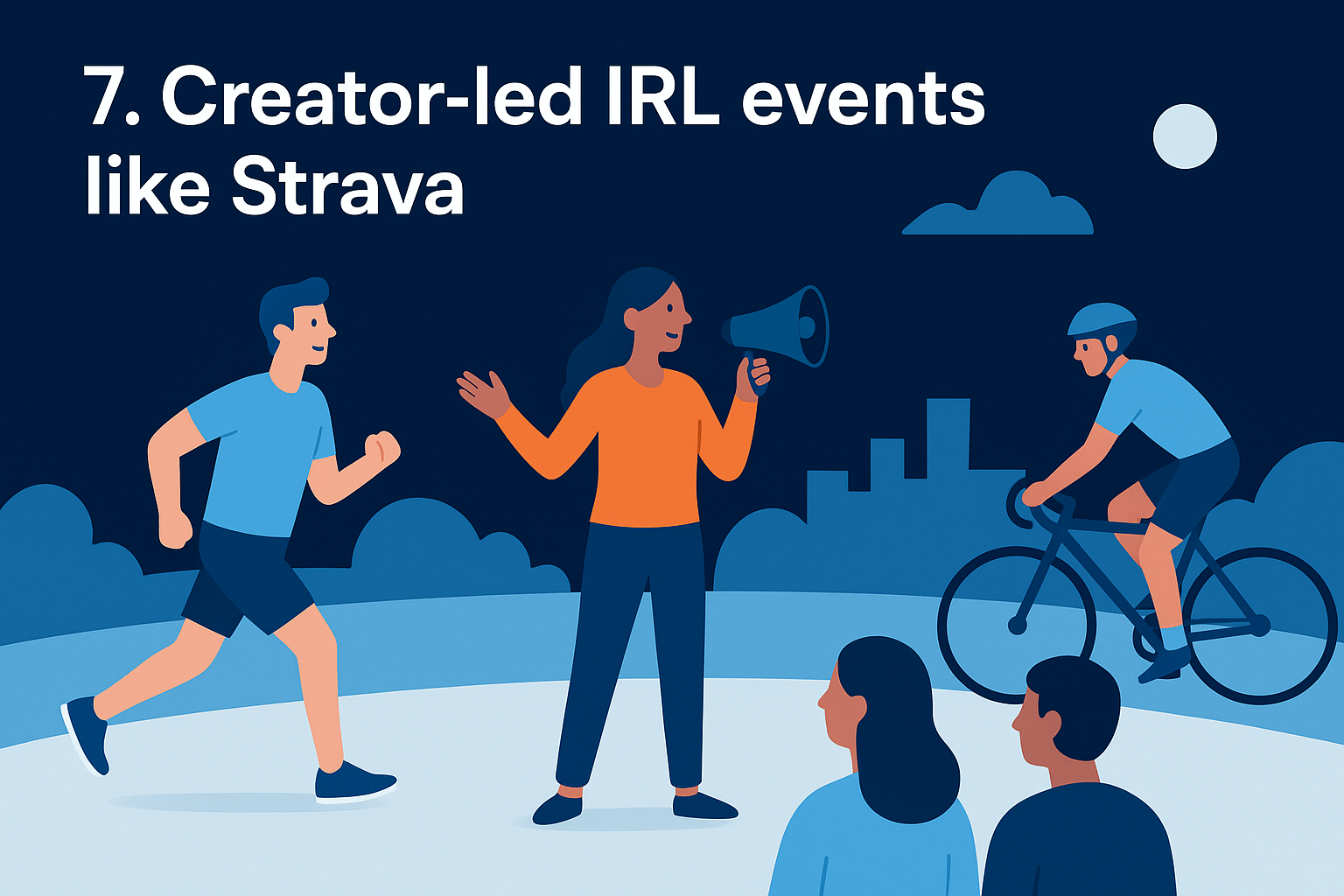
7. Creator-led IRL events like Strava
Strava built one of the more compelling influencer marketing campaign examples in the fitness space by moving creators off their phones and into real-world settings. Partnering with running and cycling creators to host local community events gave the app a physical presence that no digital campaign could replicate.
What the campaign did
The campaign put fitness creators in charge of organizing and hosting IRL running clubs, group rides, and community meetups in cities where Strava's target users already lived. Creators handled promotion through their own channels, showed up as event hosts, and documented everything on short-form video, generating pre-event hype and post-event content from a single activation.
Why it drove revenue
Physical events create memories that social content cannot manufacture. When 200 people show up to a creator-hosted run, every attendee leaves with a personal connection to both the creator and the brand. That connection translates into higher app download rates and stronger long-term retention compared to users who discover a product through a standard ad.
IRL events turn passive followers into active brand participants, which is a fundamentally different relationship than a sponsored post creates.
How to recreate it
Identify creators in your category who have concentrated local audiences in cities that match your target markets. Fund the logistics, let the creator own the experience design, and build a content capture plan into each event from the start.
Metrics and benchmarks to watch
Track new user signups attributed to each event and compare 90-day retention rates for those users against your average acquisition channels. Event-sourced users typically show 30 to 50% higher retention because their first brand experience was personal rather than passive.
8. Tiered ambassador program like Deeper Sonar
Deeper Sonar, a smart fishing device brand, built one of the more durable influencer marketing campaign examples in the outdoor sports space by structuring its creator relationships around performance tiers rather than flat sponsorship fees. The model rewards creators who convert and scales back investment in those who do not.
What the campaign did
Deeper Sonar recruited fishing and outdoor lifestyle creators across multiple audience sizes and placed them into tiers based on their performance metrics. Entry-level ambassadors received product samples and a commission link. Top-performing creators unlocked co-branded content opportunities, exclusive product previews, and higher commission rates as their sales numbers climbed.
Why it drove revenue
Tiered structures create internal competition among ambassadors, which keeps motivation high long after the initial activation period. Creators at lower tiers actively work to improve their conversion numbers because a clear, financially meaningful upgrade sits directly above them.
The program turns your creator network into a self-optimizing sales team where your best performers get rewarded automatically.
How to recreate it
Define two to three distinct tiers with specific revenue or engagement thresholds that trigger each upgrade. Keep the entry barrier low so you attract a wide pool of creators, then let performance data determine who earns deeper investment from your side.
Metrics and benchmarks to watch
Track revenue per ambassador tier monthly and measure what percentage of your total creator-driven revenue comes from your top tier. Strong programs typically see the top 20% of ambassadors generating 70% or more of total affiliate revenue.
What to do next
Every influencer marketing campaign example in this list works because it connects a creator's audience to a clear conversion mechanism. The brands that see consistent revenue from these campaigns are not guessing at hooks or posting content and hoping the algorithm rewards them. They run a system, measure what performs, and cut what does not.
Your next step is deciding which model fits your current position. If you have a product, the seeding and affiliate approach gets you moving without heavy upfront spend. If you are a founder or business owner building authority, the managed short-form sprint compresses your timeline from scattered posting to a predictable attention engine. Either way, strategy comes before execution.
If you want a data-backed content system built around your brand, audience, and revenue goals, apply to work with the SocialRevver team and get a free 40-slide social media strategy built for your specific market.