
Brands aren't going to tell you what you're worth, that's your job. And walking into a negotiation without a clear pricing structure is the fastest way to leave money on the table. A solid influencer rate card template gives you a professional document that communicates your value before a single email back-and-forth, yet most creators either guess their rates or copy someone else's numbers without understanding the logic behind them. Neither approach builds a sustainable business.
At SocialRevver, we work inside the content-to-revenue pipeline every day, building systems that turn short-form video into measurable business outcomes for creators and founders. That work has given us a front-row seat to how brands evaluate creators, what makes them say yes to a rate, and where most pricing falls apart. Your rate card is a core piece of that conversion chain, sitting right between the attention you earn and the revenue you collect.
This guide gives you a ready-to-use template along with the thinking behind every section. You'll learn how to structure your deliverables, set pricing that reflects your actual reach and engagement, and present the whole package in a format that brand partners take seriously. No guesswork, no arbitrary numbers, just a clear framework you can adapt as your audience and influence grow.
What an influencer rate card is and when to use it
A rate card is a one-page business document that lists your content offerings, associated pricing, and core terms so brands can immediately understand what they're buying. It is not a contract, and it is not a full proposal. Think of it as your pricing menu, the document you send before negotiations begin so both sides enter the conversation with shared context. Done right, a rate card does the heavy lifting of justifying your rates before you ever get on a call.
A rate card sets the professional tone for every brand deal conversation you will ever have.
The difference between a rate card and a media kit
Many creators confuse these two documents, and that confusion costs them time. A media kit is a marketing document: it highlights your audience demographics, growth trajectory, engagement metrics, and past brand partnerships. A rate card, by contrast, is a pricing document. It answers one question for the brand: "What does it cost to work with you?" Both documents serve different purposes, and you often need both, but they are not interchangeable.
Your media kit earns interest. Your rate card closes deals. When a brand reaches out and asks about your rates, sending a polished influencer rate card template with clearly defined deliverables signals that you run a professional operation. Brands work with more confidence when they can see your pricing structure upfront rather than waiting for a number you invented on the spot.
When to use your rate card
You should send your rate card at three specific moments in any outreach process. First, when a brand contacts you and asks about pricing, send it immediately in response. Second, when you pitch a brand proactively, attach your rate card alongside your media kit so they have both documents upfront. Third, use it as a reference document during live negotiations to keep the conversation anchored to your defined offerings rather than drifting into undefined scope.
Here is a simple framework for knowing which document to deploy:
| Situation | Document to Send |
|---|---|
| Brand asks about your audience | Media kit |
| Brand asks about pricing | Rate card |
| You pitch a brand proactively | Both |
| Negotiation is underway | Rate card as anchor |
What a rate card should not do
A rate card is not your final word on pricing. It is a starting position, a professional signal that you know your value and have thought through your business. You can always negotiate from it. What it prevents is the scenario where a brand asks "what are your rates?" and you name a number on the spot that is too low because you had no structure to reference. The card creates a floor so you stop undervaluing yourself in reactive moments.
Keeping it tight and readable also matters: a brand that receives a dense, multi-page pricing document is far less likely to engage than one that gets a clean, scannable one-pager. Leave the edge cases and custom requests for the negotiation stage, not the document itself.
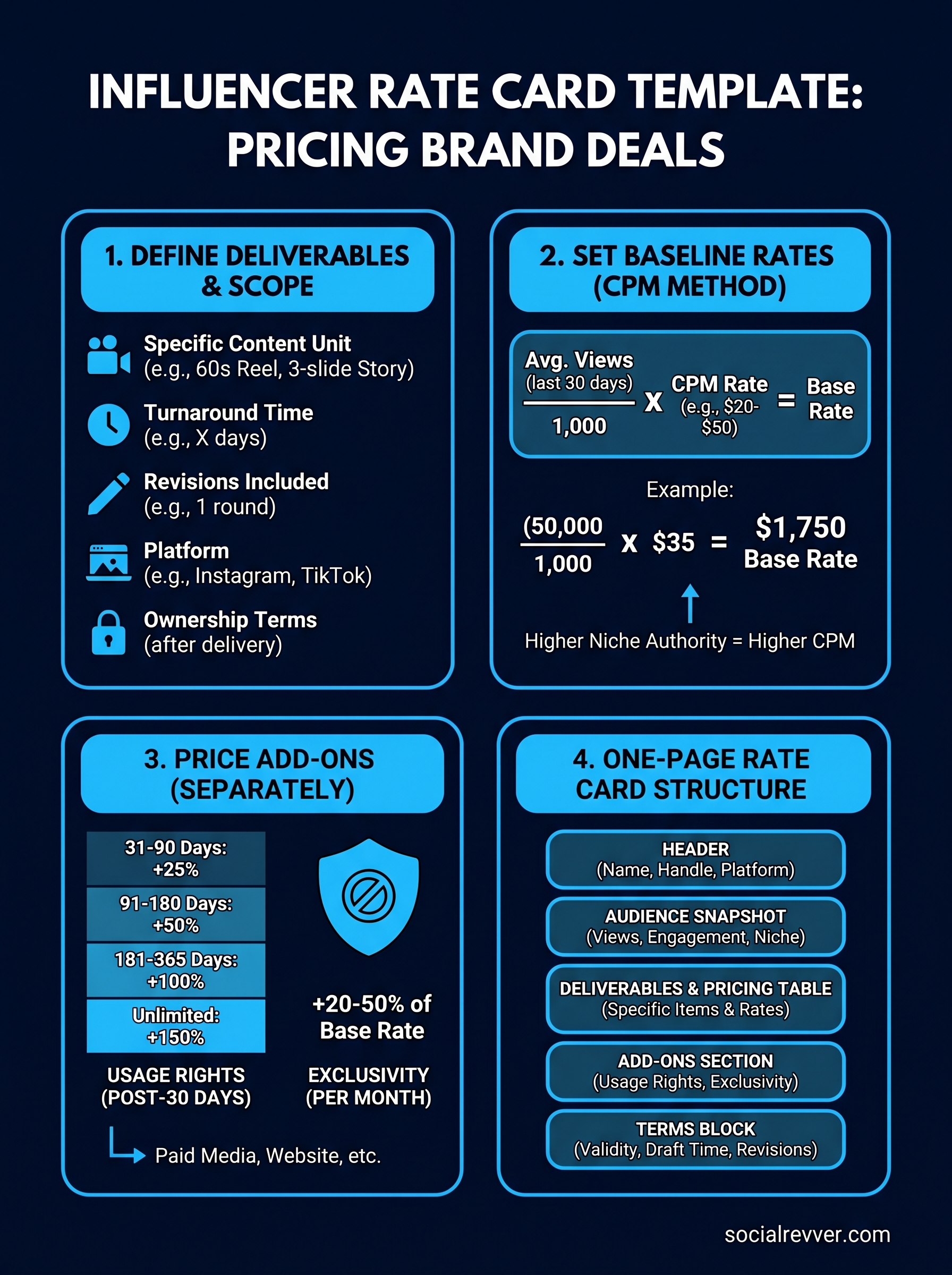
Step 1. Define deliverables, scope, and boundaries
Before you can price anything, you need to know exactly what you are selling. Vague deliverables create scope creep, disagreements, and unpaid revisions that eat into your profit. Every line item on your influencer rate card template should name a specific content unit, the platform it lives on, and what the brand receives when the work is complete.
What counts as a deliverable
A deliverable is a discrete, finished piece of content with a defined output, not "social media content" or "a campaign." Specificity protects you legally and professionally, keeping revision requests and expectations aligned on both sides. When a brand can point to exactly what they purchased, disputes disappear before they start. Common deliverable types to include on your rate card:
- Instagram Reel (60 seconds, one round of revisions included)
- TikTok video (30-60 seconds, posted to your account)
- YouTube integration (60-second mid-roll mention, one revision)
- YouTube dedicated video (full video, two rounds of revisions included)
- Instagram Story set (3-5 slides, link sticker included)
- LinkedIn post (written post with one branded visual)
Only list platforms where you actively publish. Adding platforms you rarely use dilutes your credibility and opens the door to requests you cannot execute at high production quality.
Define your deliverables before any brand conversation starts, or brands will define them for you.
Set your scope and boundaries
Scope defines what is included in the base price and what costs extra. Your rate card should state the number of revisions covered, the turnaround time for first drafts, and who owns the content after delivery. These boundaries prevent brands from treating a single paid post as an unlimited creative resource. State clearly that usage rights beyond 30 days require a separate fee, and that rush requests outside your standard posting schedule carry an additional charge. These are not negotiating tactics; they are the operating terms of a professional content business.
Step 2. Set baseline rates with a simple pricing method
Once you know your deliverables, you need numbers that you can actually defend. Random pricing based on what you've heard other creators charge will fall apart the moment a brand pushes back. Anchoring your rates to your real performance data gives you a logical foundation for every number on your influencer rate card template.
Start with your average views, not your follower count
Brands care about reach and engagement, not the size of your audience in isolation. Average views per post is the metric that tells a brand what their content investment actually buys them. Pull your last 30 days of content data from your platform analytics and calculate your average view count per video or post across your primary platform. This number becomes your pricing baseline, not your follower count.
Your average views tell a brand more about what they are buying than your total follower count ever will.
Apply a simple rate formula
The most straightforward method for short-form content is a CPM-based formula (cost per thousand views). Most brand deals in the creator space fall between $20 and $50 CPM for organic short-form content, depending on niche authority and audience quality. Use this calculation to set your floor:
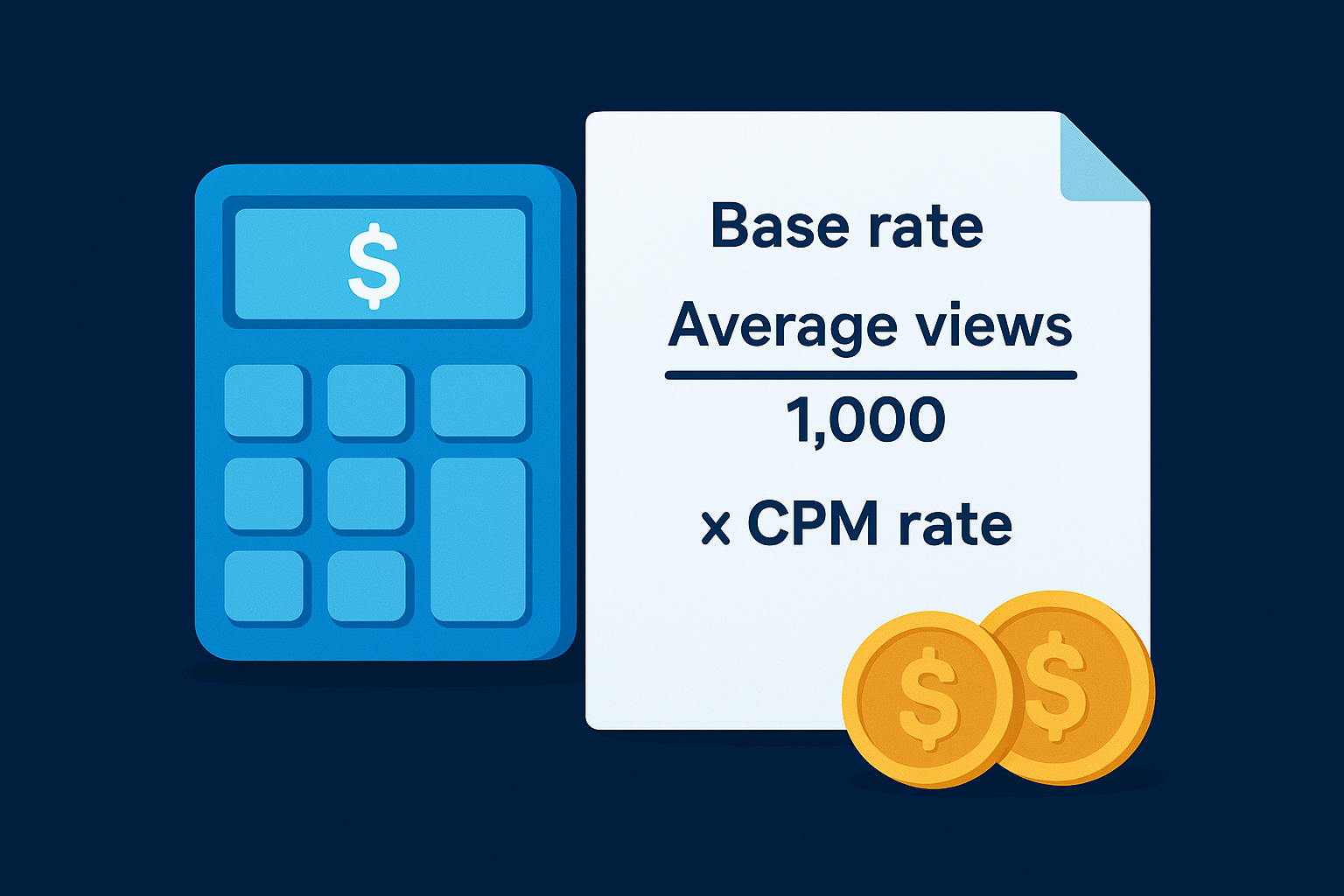
Base rate = (Average views / 1,000) x CPM rate
Here is how that formula plays out at three CPM levels for a creator averaging 50,000 views per video:
| CPM Rate | Average Views | Base Rate |
|---|---|---|
| $20 | 50,000 | $1,000 |
| $35 | 50,000 | $1,750 |
| $50 | 50,000 | $2,500 |
Niche authority justifies a higher CPM rate. A creator in finance, legal, or B2B software commands more than a creator in general lifestyle content because the audience converts at a higher rate for brands. Set your CPM based on how targeted and purchase-ready your audience is, and revisit that number every quarter as your performance data updates.
Step 3. Price add-ons like usage rights and exclusivity
Your base rate covers the creation and posting of content. It does not cover what a brand does with that content after you publish it. Usage rights and exclusivity are separate line items that can easily double or triple the value of a deal, and leaving them off your influencer rate card template means you hand over those rights for free without realizing it.
Usage rights
Usage rights define where and for how long a brand can repurpose your content after delivery. A brand that wants to run your video as a paid ad on Meta, place it on their website, or feature it in an email campaign is extracting commercial value well beyond what your organic post generates. That additional value has a price, and you should collect it.
Organic posting rights and commercial usage rights are two different products. Price them separately every time.
A straightforward way to structure usage rights fees is to charge a percentage of your base rate per time block:
| Usage Period | Additional Fee |
|---|---|
| Up to 30 days | Included in base rate |
| 31 to 90 days | +25% of base rate |
| 91 to 180 days | +50% of base rate |
| 181 to 365 days | +100% of base rate |
| Unlimited/perpetual | +150% of base rate |
Apply this structure to any paid media use, website embedding, or out-of-home placements. Print and broadcast placements warrant a custom quote rather than a percentage, since those distribution channels carry reach you cannot calculate from your own analytics.
Exclusivity
Exclusivity means you agree not to work with competing brands for a defined period. This restriction limits your earning potential directly, and brands need to pay for it accordingly. Charge an exclusivity fee on top of your base rate and usage rights, not as a replacement for either.
A standard exclusivity add-on runs between 20% and 50% of your base rate per month of restriction. A 90-day exclusivity window on a $2,000 base rate therefore adds $1,200 to $3,000 to the deal total. State the competitor category clearly in your rate card so both sides agree on what counts as a competing brand before any contract gets signed.
Step 4. Fill in a clean one-page rate card template
You have your deliverables defined, your baseline rates calculated, and your add-on pricing structured. Now you put it all into one document that a brand can read in under two minutes. Keep your influencer rate card template to a single page and organize it in the same order a brand's marketing team reviews vendor documents: who you are, what you offer, what it costs, and what the terms are. Anything beyond one page reduces the chance a brand reads it completely.
The template structure
Your rate card needs five clear sections in this exact order: a header with your name, handle, and primary platform; a one-line audience snapshot; a deliverables and pricing table; an add-ons section for usage rights and exclusivity; and a brief terms block at the bottom. This order matches how brands evaluate creator partnerships, moving from identity to value to cost to risk.
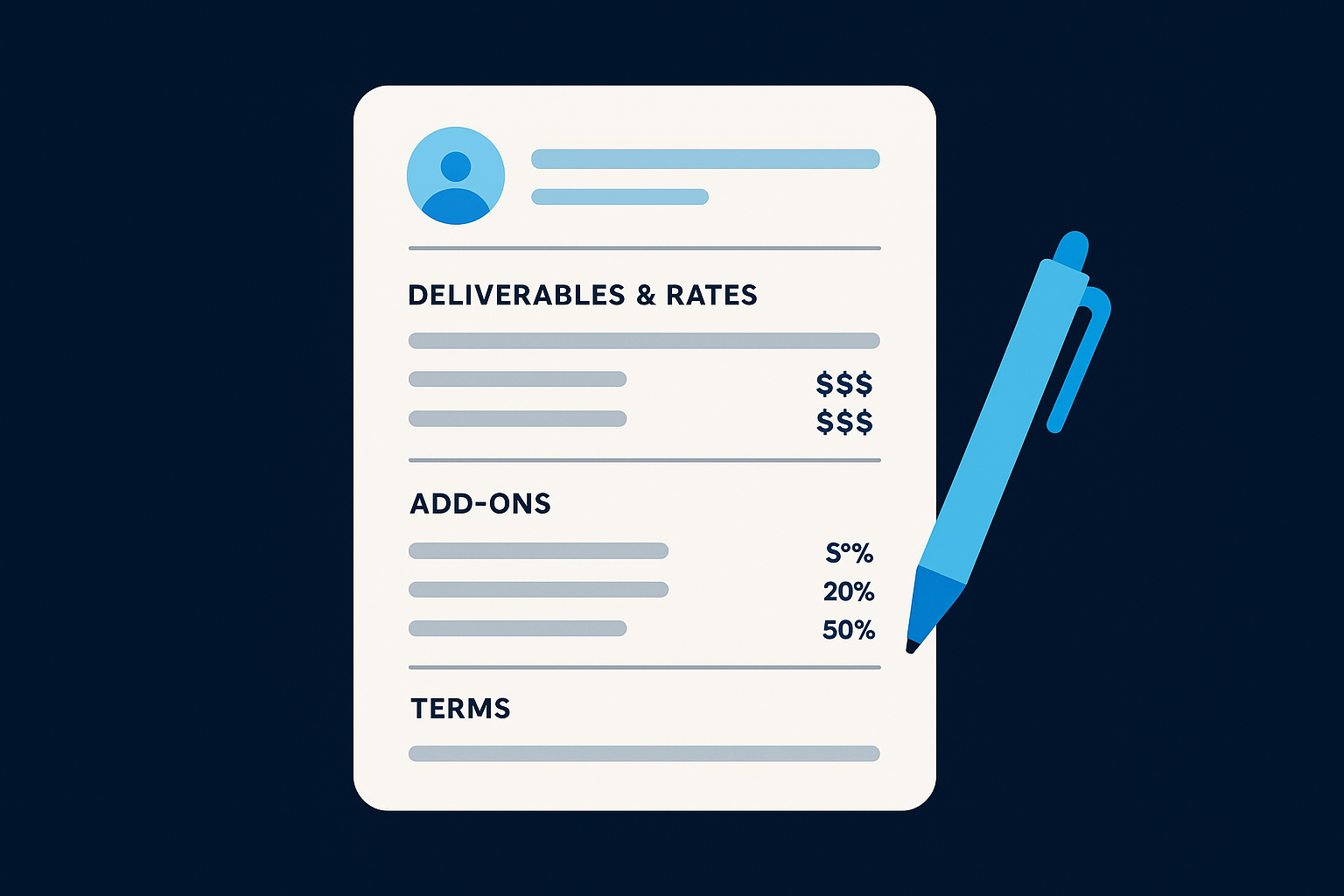
Fill in every bracketed field with real numbers before you send this to anyone.
Use the template below and replace each bracketed item with your actual information:
[YOUR NAME / BRAND NAME]
[Primary Platform] | [Handle] | [Follower Count]
Avg. Views: [X] | Engagement Rate: [X%] | Niche: [Category]

--- DELIVERABLES & RATES ---
[Platform] [Content Type] ([Length], [Revisions included])   $[Rate]
[Platform] [Content Type] ([Length], [Revisions included])   $[Rate]
[Platform] [Content Type] ([Length], [Revisions included])   $[Rate]

--- ADD-ONS ---
Usage Rights (31-90 days)            +25% of base rate
Usage Rights (91-180 days)           +50% of base rate
Exclusivity (per month)              +20-50% of base rate
Rush Delivery (<5 business days)     +30% of base rate

--- TERMS ---
Rates valid for 30 days from date of issue.
First drafts delivered within [X] business days.
[X] revision rounds included. Additional revisions at $[rate]/hr.
Content ownership transfers upon full payment.
Sending and updating your rate card
Save your rate card as a PDF so formatting stays consistent across every device and email client a brand might use. Pull fresh performance data every quarter and update your average views, engagement rate, and pricing each time, then change the "rates valid" date so brands immediately see they are looking at current numbers rather than outdated information.
Next steps
You now have every component you need to build a complete influencer rate card template: defined deliverables, a CPM-based pricing formula, structured add-ons for usage rights and exclusivity, and a clean one-page format brands can review in minutes. The next move is to pull your actual performance data, fill in the template, save it as a PDF, and put it in front of the next brand that reaches out. That single action shifts how brands perceive you before the negotiation even starts.
Pricing is one piece of a larger content-to-revenue system. If your short-form content is not generating the views that justify strong rates, your rate card will not do much work on its own. Building the audience and authority that backs up your pricing requires a strategic content system, not just better templates. If you want that system built for you, get your free 40+ slide social media strategy and see exactly what predictable growth looks like for your brand.