Most executives know they should be building a personal brand. Few actually do it well. The gap between "I should post more on LinkedIn" and a brand that generates real business outcomes, inbound deals, speaking invitations, top-tier talent reaching out, is enormous. Personal branding for executives isn't about becoming an influencer. It's about engineering credibility at scale.
The executives winning right now treat their brand like a business asset, not a side project. They have systems behind their content, data behind their messaging, and a clear strategy connecting visibility to revenue. That's exactly what we build at SocialRevver, a managed content engine that turns executive authority into predictable, measurable growth through short-form video, behavioral science, and machine learning.
This playbook breaks down the specific steps you need to take in 2026 to build an executive brand that actually works. No vague advice about "being authentic." Instead, you'll get frameworks for positioning, content production, and distribution that reflect how attention operates right now, and how to convert that attention into tangible business results. Let's get into it.
What executive personal branding means in 2026
Personal branding for executives used to mean a polished LinkedIn profile, a few thought leadership articles, and maybe a speaking slot at an industry conference. In 2026, that baseline gets you nowhere. The distribution landscape has shifted dramatically, and the executives who build real authority are the ones who show up consistently across short-form video, social content, and owned channels with a clear, data-backed message tied to measurable outcomes.
Your brand no longer grows through reputation alone. It grows through systematic content production connected to real business results. Your potential investors, clients, and hires are already forming opinions about you before any meeting or introduction happens. They watch your content, read your posts, and assess your credibility based on what they find. If you're not actively shaping that impression, you're leaving that judgment to chance.
Your brand doesn't take a day off. The content you publish today is working for or against you while you're in meetings, on a plane, or offline entirely.
The difference between visibility and authority
Most executives chase visibility. They want more followers, more impressions, more reach. But visibility without substance is just noise, and noise does not convert into deals, partnerships, or talent. Authority is what you actually want. Authority means your audience trusts your judgment, respects your point of view, and reaches out specifically because they want access to your thinking.
Building authority requires two things working together: a consistent positioning statement that people can repeat back to others, and content that proves your expertise over time. A post that reaches 8,000 CFOs and procurement leaders in your industry outperforms one that gets 400,000 views from a general audience. Quality of attention beats quantity of attention every time, and you should structure your content strategy around that reality.
How 2026 platforms reward executive content
Platforms like LinkedIn now prioritize content that drives meaningful engagement signals: saves, shares, and substantive comments that indicate real value delivered. This rewards executives who go deep on specific topics rather than broadcasting generic business advice. The algorithm is effectively filtering out surface-level content and amplifying demonstrated expertise, which means your niche focus is a competitive advantage, not a limitation.
Practically, this means you need a defined content angle, a consistent cadence, and production quality that matches the level of authority you're claiming. A shaky, poorly lit selfie video with a vague caption about leadership does not signal authority. A well-edited short-form video that unpacks a specific insight from your operational experience does. The bar for "good enough" has moved up, and your production quality now communicates as loudly as your actual words.
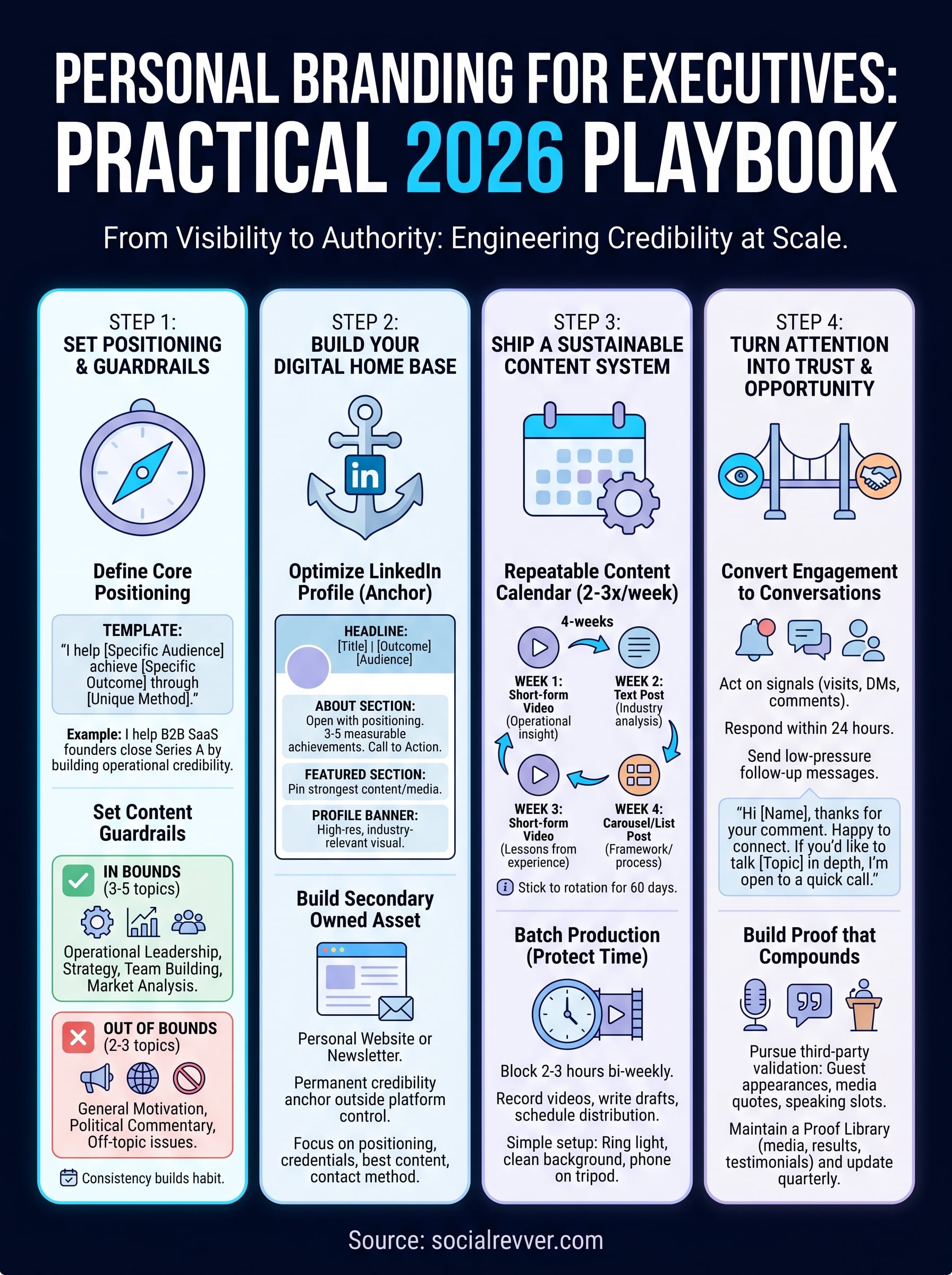
Step 1. Set your positioning and guardrails
Positioning is the foundation of personal branding for executives. Without it, your content becomes scattered, your messaging confuses people, and your audience never develops a clear sense of why they should pay attention to you specifically. Before you write a single post or record a single video, you need to answer one question precisely: what do you want to be known for, and by whom?
Define your core positioning statement
Your positioning statement is not a bio. It is a single, repeatable sentence that connects your expertise to a specific outcome for a specific audience. Use this template to build yours:
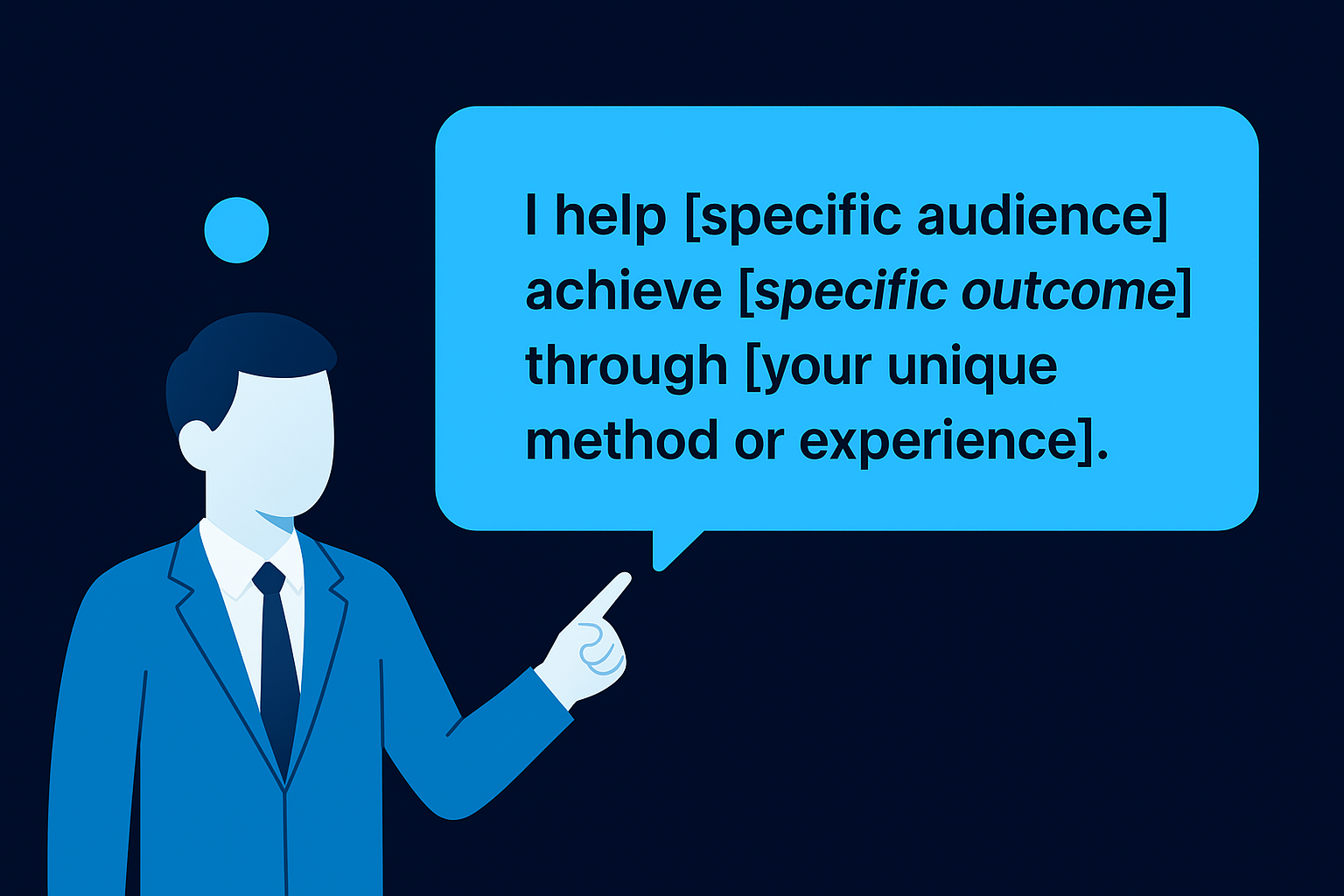
"I help [specific audience] achieve [specific outcome] through [your unique method or experience]."
For example: "I help B2B SaaS founders close Series A rounds by building the operational credibility investors look for." That sentence tells you who, what, and how. It is specific enough to be credible and broad enough to generate consistent content over time. Write three versions of your statement, test them in real conversations, and pick the one that gets the clearest, most immediate response.
Set your content guardrails
Guardrails prevent brand drift. Choose three to five topics you will cover consistently and two to three you will avoid entirely. This matters because every off-brand post dilutes the authority signal you are building with your on-brand content.
Your guardrail list might look like this:
- In bounds: operational leadership, fundraising strategy, team building, market analysis specific to your industry
- Out of bounds: general motivation content, political commentary, topics outside your direct experience
Stick to this list even when trending topics tempt you to weigh in. Consistency in topic focus is how your audience learns to anticipate your content and builds the habit of engaging with it on a regular basis.
Step 2. Build your digital home base
Your positioning only works if people can find it and verify it quickly. The goal of this step is to create two connected digital assets: a fully optimized LinkedIn profile that serves as your professional anchor, and a secondary owned channel that reinforces your authority and gives you a fallback that operates independently of platform algorithms.
Optimize your LinkedIn profile as the anchor
LinkedIn is the highest-leverage platform in personal branding for executives right now. Your headline, featured section, and About section do most of the heavy lifting before anyone reads a single post you publish. Use this structure to tighten each element:

- Headline: [Your title] | [Core outcome you deliver] | [Audience you serve]
- About section: Open with your one-sentence positioning statement. Follow with three to five specific, measurable achievements that prove it. Close with a direct call to action.
- Featured section: Pin your strongest piece of content, a media mention, or a lead magnet. This is prime real estate that most executives leave blank or waste on generic links.
Your LinkedIn profile is not a resume. It is a conversion asset, and every section should answer one question: why should this specific person pay attention to you?
Update your profile banner to reflect your positioning visually. Use a clean, high-resolution image that signals your industry and the caliber of authority you are claiming.
Build a secondary owned asset
Your second asset needs to sit outside LinkedIn's control, either a newsletter, a personal website, or both. A newsletter gives you direct, unmediated access to your audience without depending on algorithmic reach. A personal website functions as a permanent credibility anchor that surfaces in search results when investors, clients, or journalists look you up before a conversation.
Keep your website focused: a clear positioning statement, a bio with relevant credentials, links to your best content, and one contact method. You do not need complexity. You need a clean, fast, professional page that reinforces what your LinkedIn already communicates.
Step 3. Ship a content system you can sustain
The biggest mistake executives make with content is treating it as something they'll get to when time opens up. Time never opens up, and sporadic posting produces no compounding signal. A sustainable content system means you define a fixed volume, a repeatable workflow, and a production method that runs independently of how busy your week gets.
Build a repeatable content calendar
Your calendar does not need to be complex. It needs to be consistent and realistic for your schedule. Start with two to three pieces of short-form content per week on LinkedIn, built around your three to five core topics. Use a rotating structure so you're not starting from scratch each time:
| Week | Content Type | Topic Pillar |
|---|---|---|
| Week 1 | Short-form video | Operational insight |
| Week 2 | Text post | Industry analysis |
| Week 3 | Short-form video | Lessons from experience |
| Week 4 | Carousel or list post | Framework or process |
A calendar without a production workflow is just a list of intentions. Build the system around your actual schedule, not an ideal one.
Stick to this rotation for at least 60 days before adjusting. The data you collect in that window tells you which topic pillars generate the strongest engagement signals, and that informs where to put more production resources.
Batch your production to protect your time
Batching is the single most effective way to maintain content output without letting it consume your working hours. Block two to three hours every two weeks to record multiple short-form videos, write several post drafts, and queue everything for scheduled distribution. This keeps your personal branding for executives efforts from competing directly with your operational priorities.
Use a simple recording setup: a ring light, a clean background, and your phone on a tripod. Consistent framing and clear audio communicate authority on their own. You do not need a studio to look credible, you need a repeatable setup that removes friction from the process.
Step 4. Turn attention into trust and opportunities
Attention without conversion is just exposure. The final step in personal branding for executives is building a deliberate bridge between your growing content audience and the actual business outcomes that justify the investment. People who watch your videos and read your posts are warm leads, and most executives never treat them that way.
Convert engagement into conversations
Your content generates inbound signals every week: profile visits, connection requests, DMs, and substantive comments from relevant people. Most executives ignore these signals or respond too slowly to act on them. Build a simple response protocol: check LinkedIn notifications every weekday, reply to meaningful comments within 24 hours, and treat every connection request from someone in your target audience as a potential conversation worth starting.
When someone engages with your content in a meaningful way, send a short, direct follow-up message. Use this template:
Hi [Name], thanks for your comment on [post topic].
Happy to connect. If you'd ever want to talk through
[specific topic] in more depth, I'm open to a quick call.
The executives who grow fastest from content are the ones who treat inbound engagement as a signal to act on, not a metric to track.
That message is low-pressure and specific, which filters for people who are already aligned with your thinking and makes it easy for them to say yes.
Build proof that compounds
Trust accelerates when your audience sees third-party validation alongside your own content. Actively pursue podcast guest appearances, media quotes, and speaking slots within your niche. Each external mention becomes a credibility artifact you can pin to your featured section and repurpose as content.
Maintain a simple proof library, a dedicated folder holding your best media appearances, measurable results, and direct testimonials, updated every quarter. Pull from this library when refreshing your digital home base and when a new piece of validation lands. Over time, this library compounds into one of your most durable brand assets because it demonstrates authority rather than simply claiming it.
Keep your brand consistent as you grow
Personal branding for executives is not a project you complete. It is an ongoing system that requires regular calibration as your role, market position, and audience evolve. Every quarter, run a brief audit: pull your top five performing posts, check whether your positioning statement still reflects your current direction, and confirm that your profile and content stay aligned. Consistency is the compounding mechanism that turns individual pieces of content into a reputation that persists over time.
Growth will tempt you to expand your topics, chase new platforms, or overhaul your messaging after a rough week. Resist that impulse. Brands that build real authority do so by staying in their lane long enough for the signal to accumulate. If you want a system that handles the production, distribution, and optimization so you can stay focused on the work that actually runs your business, apply to work with the SocialRevver team and get a full social media strategy built for your brand.