Most professionals treat their LinkedIn profile like a digital résumé, they fill it out once and forget about it. That's a missed opportunity. Personal branding on LinkedIn is how founders, executives, and creators turn a passive profile into an active pipeline for authority, leads, and opportunities. With over a billion users on the platform, the ones who win aren't posting more, they're posting with intent.
The difference between a LinkedIn presence that generates inbound leads and one that collects dust comes down to system and strategy. Random posting doesn't build authority, a deliberate, repeatable framework does. That's the same principle we operate on at SocialRevver: treat content as an engineering problem, apply data to every decision, and build a predictable engine that turns attention into revenue.
This guide breaks down exactly how to build a personal brand on LinkedIn that positions you as the go-to name in your space. You'll get actionable steps for optimizing your profile, crafting content that earns trust, and converting visibility into real business results, without turning content creation into a second full-time job.
What personal branding on LinkedIn means in 2026
Personal branding on LinkedIn used to mean having a polished headshot and a complete work history. In 2026, it means something fundamentally different. Your LinkedIn profile is now a content-driven authority platform, and the algorithm actively distributes your ideas to people who have never heard of you. The professionals winning on this platform aren't just well-connected, they're consistently visible to the exact audience they want to influence.
The shift from profile to publishing platform
LinkedIn's feed now operates much like other social media platforms: content earns distribution, not credentials alone. If you only update your profile and never publish, you remain invisible to anyone outside your existing network. The platform rewards consistent creators with reach, which means your ability to build authority is directly tied to how often you show up with something worth reading.
In 2026, your LinkedIn content works as a top-of-funnel asset, putting your thinking in front of decision-makers before they ever search for what you sell.
This shift changes how you should approach the platform entirely. Instead of treating LinkedIn as a place to document your past, treat it as a channel to demonstrate your current thinking and expertise. Founders who post about industry challenges, executives who share lessons learned, and creators who break down their process all attract inbound attention that passive profiles never will. The profile is your landing page; the content is your traffic source.
What "brand" actually means here
Your brand on LinkedIn is not your logo or job title. It's the specific idea you own in your audience's mind. When someone in your target market sees your name and immediately connects it to a particular problem you solve or a point of view you hold, that's a brand working as it should. Most professionals skip this step entirely, which is why their content earns generic engagement but generates zero leads.
Consider this test: if someone read your last five posts without seeing your name, could they identify your niche and your position on it? If the answer is no, your brand doesn't exist yet as far as your audience is concerned. Every post you publish should reinforce the same core idea from a different angle. That consistency is what turns a feed presence into a recognizable authority over time.
Why this matters more now than it did three years ago
LinkedIn's user base has grown considerably, and so has competition for attention in any given niche. Organic reach still exists on LinkedIn in a way it doesn't on most other platforms, but it increasingly favors creators who bring a defined perspective and a consistent posting cadence. Generic career updates and congratulatory posts get buried by the algorithm. Content that educates, challenges assumptions, or offers a specific take on a niche problem earns comments, shares, and profile visits from the people who matter most to your business. Personal branding on LinkedIn in 2026 is less about broadcasting credentials and more about building a body of work that speaks for you before you ever get on a discovery call.
Step 1. Choose a clear positioning and outcome
Before you write a single post, you need to know exactly who you're talking to and what you want them to do after reading your content. Most professionals skip this step, which is why their content gets likes from colleagues but no inbound from potential clients. Personal branding on LinkedIn only works when your positioning is sharp enough that the right person immediately recognizes you as relevant to their problem.
Define who you help and what you solve
Your positioning statement is the foundation every piece of content should be built on. It tells your audience in a single sentence who you serve, what problem you eliminate, and what outcome you produce. Without it, your posts will drift across topics and never build a coherent reputation.
Use this template to draft yours:
"I help [specific audience] achieve [specific outcome] by [your method or differentiator]."
Here are three examples to show how tight this needs to be:
- "I help SaaS founders turn LinkedIn into an inbound pipeline by publishing content that speaks directly to their ideal buyer."
- "I help mid-market CFOs reduce financial reporting errors through process-first systems design."
- "I help executive coaches move from referral-only to booked out by building a 90-day content engine."
Notice that none of these are vague. If your statement could apply to 500 other people in your field, tighten it until it can't.
Set a measurable outcome before you write a single post
Your outcome drives every content decision you make. If you want inbound discovery calls, your content should lead people toward booking one. If you want inbound talent, your content should showcase your company's thinking and culture. Pick one primary outcome and let it filter what you post about.
Write your target outcome at the top of your content planning doc: for example, "Two qualified discovery calls per month from LinkedIn." That single line keeps every post pointed in the same direction instead of drifting toward whatever topic feels relevant that week.
Step 2. Build a profile that earns trust
Your LinkedIn profile is the first thing someone checks after reading one of your posts. If it doesn't immediately reinforce your positioning, you lose the visit before it becomes a connection, a follow, or a booked call. Think of your profile as a sales page, not a biography. Every section should answer one question for the visitor: "Is this person credible and relevant to my specific problem?"
Optimize your headline and about section
The headline is the most-read line on your entire profile. Most people default to their job title, which tells a visitor nothing about what you actually do for them. Instead, write a headline that mirrors your positioning statement from Step 1. Use this template:
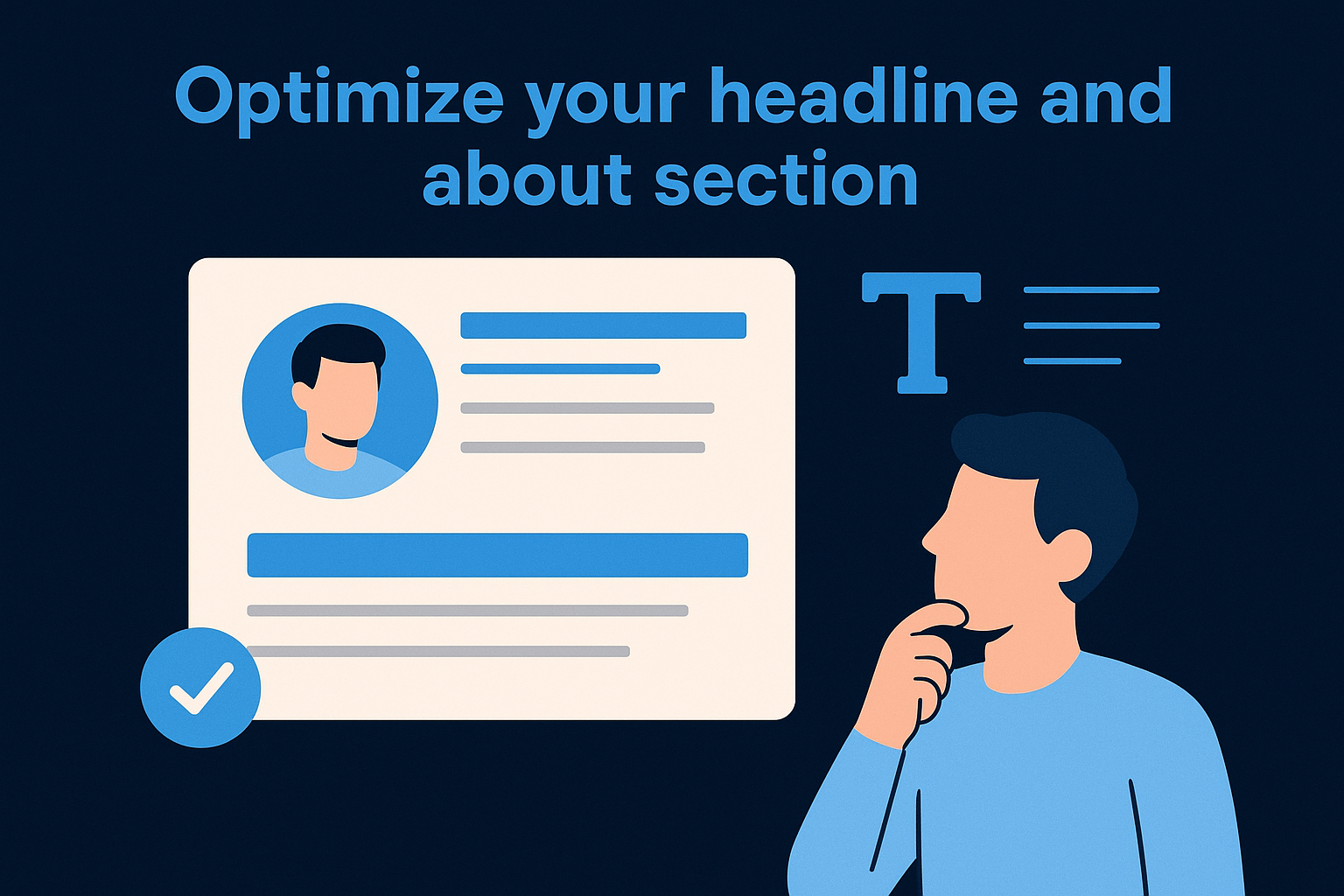
Headline formula: "[Who you help] achieve [specific outcome] through [your method or differentiator]"
Example: "I help B2B founders book inbound demos through LinkedIn content systems."
Your About section should open with a problem your audience recognizes, not your career history. Start with one sentence describing the exact frustration your target reader feels. Follow that with what you do about it, proof that it works, and a clear call to action such as a link to book a call or claim a resource. Keep the opening two lines punchy since LinkedIn collapses everything below them by default.
Use your featured section as a conversion tool
The Featured section sits near the top of your profile, but most visitors scroll past it because it defaults to generic posts. Pin one piece of content that directly supports your positioning: a lead magnet, a case study post, or a direct booking link. This is one of the few places the platform lets you guide visitor behavior, so treat it as a deliberate step in your conversion path.
Your profile photo and banner also carry real weight in the trust equation. A sharp, well-lit headshot and a banner image that restates your outcome reinforces your brand at a glance. Personal branding on LinkedIn depends heavily on first impressions, so make sure every visual element on your profile pulls in the same direction as your content.
Step 3. Publish content that builds authority
Publishing consistently is the mechanism that converts your positioning into a recognizable presence. Most professionals overthink the format and underinvest in the frequency. Three posts per week on a single topic beats seven posts per week across five different topics every time. Your goal is to occupy a specific mental space in your audience's feed, so every post should reinforce your positioning from Step 1 from a new angle.
Pick a content format and stick with it
Your audience builds a reading habit around your specific style, and LinkedIn rewards that consistency with reach. Jumping between long essays, bullet listicles, and short personal stories makes it harder for followers to know what to expect from you. Pick one or two formats that match how you naturally communicate, then sharpen those formats over time.
These are the four formats that consistently generate authority-building reach:
- Short text posts (150 to 300 words): A single sharp insight, counterintuitive take, or concrete lesson from your work
- Listicles: "5 things I learned from X" style posts that deliver quick, scannable value
- Carousels: Multi-slide breakdowns of a framework, process, or concept
- Long-form articles: Deep dives that position you as the reference point for a topic
Treat each post as one brick in a larger structure. Individually, a single post does little. Together, a consistent body of work becomes your authority.
Use a repeatable content structure
Personal branding on LinkedIn compounds when every post follows a structure that your audience learns to trust. Use this repeatable template for short text posts:
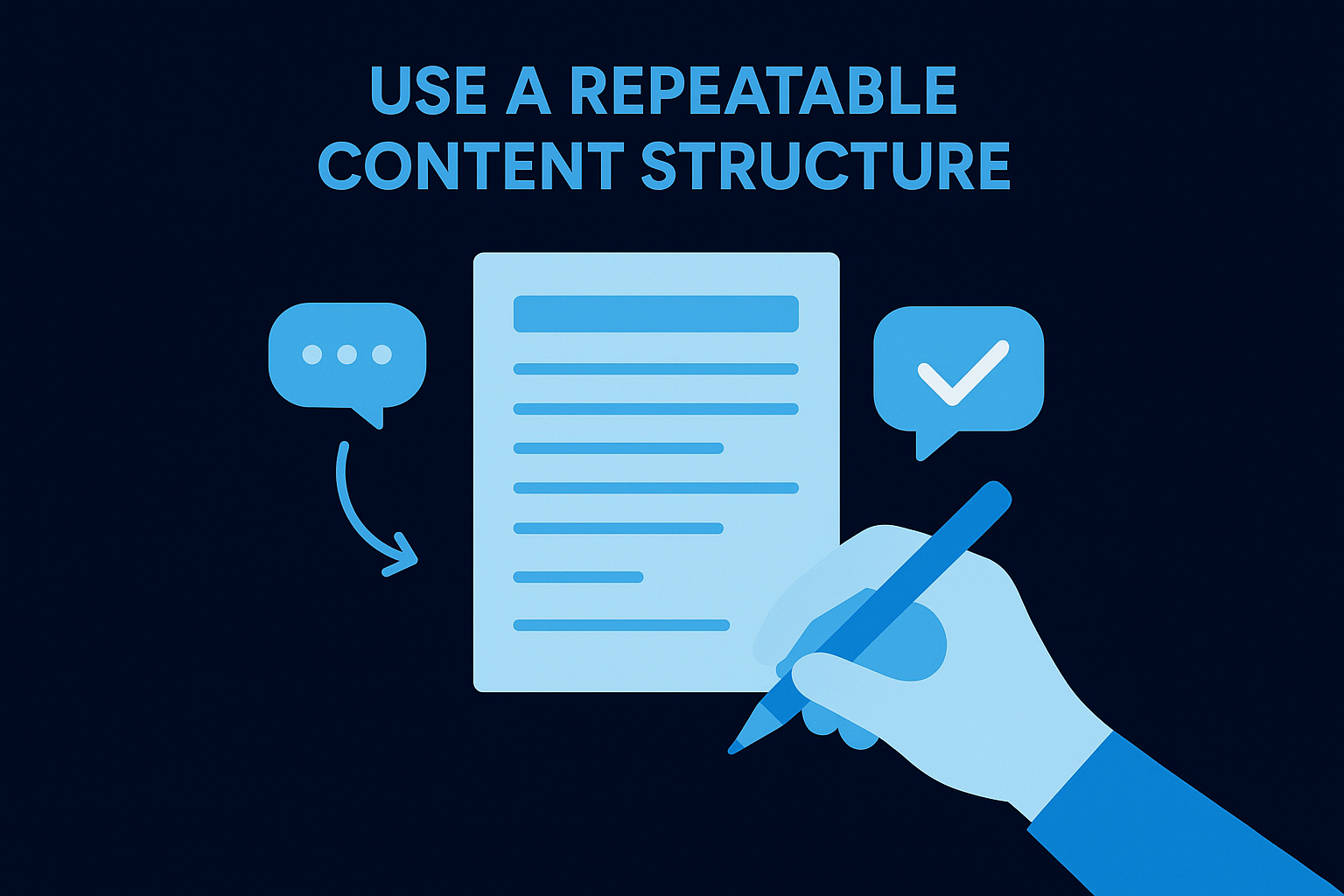
- Line 1 (Hook): One sentence that stops the scroll. Use a specific number, a bold claim, or a direct question.
- Lines 2 to 5 (Setup): Provide the context or tension that makes the hook make sense.
- Lines 6 to 10 (Payoff): Deliver the insight, framework, or takeaway your audience came for.
- Final line (CTA): Ask a specific question or point to your next step.
Repeating this structure trains your audience to expect value from you, which increases both engagement and profile visits over time.
Step 4. Turn visibility into leads and calls
Visibility without a conversion path is just vanity. Personal branding on LinkedIn builds authority, but authority only pays off when you give your audience a clear next step. Most professionals post consistently and then wonder why no one reaches out. The answer is almost always the same: there is no explicit invitation to take action, so the audience consumes the content and moves on.
Make your call to action specific and consistent
Every post you publish should end with a CTA that directly matches your outcome from Step 1. Generic CTAs like "follow for more" drive followers, not buyers, and most buyers won't reach out unless you give them a concrete reason to. If your goal is discovery calls, your CTA should point to a specific next step that removes friction from the decision.
Here are three CTA templates you can rotate across your posts:
- "If you're a [target audience] dealing with [specific problem], reply here or send me a DM and I'll share what's worked."
- "I put together a one-page framework on [topic]. Drop a comment and I'll send it directly to you."
- "If this resonates, book a 20-minute call with me [link] and let's map out what this looks like for your situation."
The CTA you repeat most consistently is the one your audience starts to associate with you, so pick one that connects directly to your primary outcome and stick with it.
Convert comments into direct conversations
Responding to every comment you receive is the fastest way to build relationships that eventually convert into calls. When someone leaves a thoughtful comment, write two to three sentences that extend the conversation and ask them a follow-up question. That exchange signals to the algorithm that your post is worth distributing further, and it signals to the commenter that you are worth talking to one-on-one. Once a back-and-forth develops in the comments, move it to a direct message with a simple line: "I'd love to dig into this more with you, mind if I send you a message?"
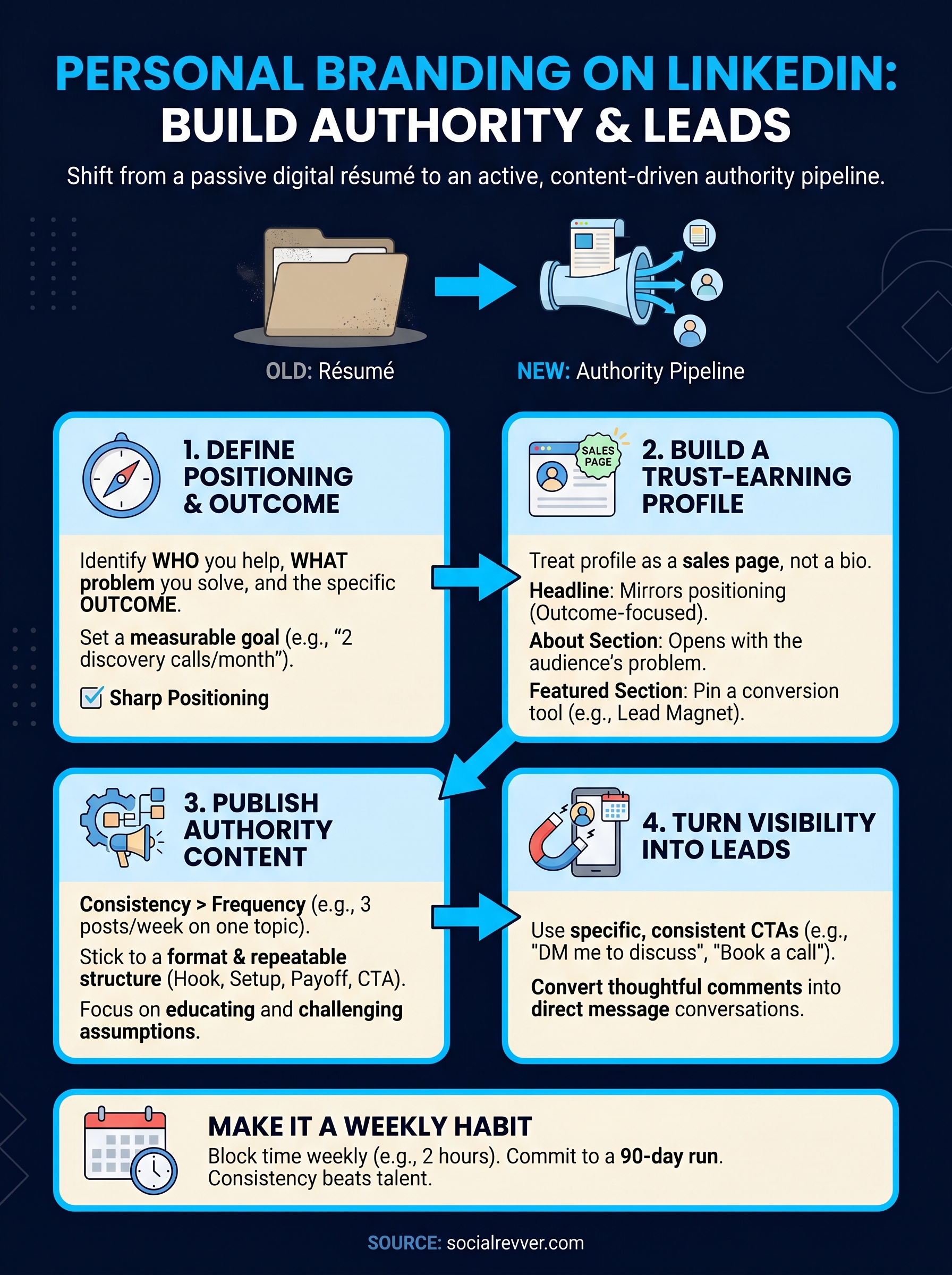
Make it a weekly habit
Personal branding on LinkedIn doesn't compound from one great post. It compounds from showing up every week with a clear point of view and a consistent next step for your audience. Block two hours each week to write your posts, respond to comments, and review which content earned the most profile visits. Treat that block as a fixed appointment, not something you fit in when you have extra time.
The professionals who build recognizable authority on LinkedIn aren't necessarily the most talented writers. They're the most consistent ones. Pick your three posting days, commit to a 90-day run before you evaluate results, and write your primary CTA somewhere you'll see it every time you open the platform. That window is long enough to see what resonates and short enough to stay focused.
When you're ready to stop guessing and start running a content system that converts, apply to work with our team and get a free 40+ slide social media strategy built specifically for your brand and goals.