
You already know your audience clicks, watches, and buys, but you don't really know why. That gap between data and decision is where most content strategies stall. Semrush Audience Intelligence exists to close it, pulling together demographic, behavioral, and psychographic signals so you can stop guessing who you're actually talking to.
In plain terms, Audience Intelligence is Semrush's tool for building detailed, data-backed audience personas from real browsing and social behavior instead of surveys or assumptions. It shows you where your audience spends time online, what other brands they follow, and how they move through the buying journey, so you can segment your market with actual evidence behind it, not a hunch about age brackets and interests.
This matters even more once you understand that audience data only pays off when it drives production, not just reporting. At SocialRevver, we treat audience insight as raw material for scripts, hooks, and posting strategy, which is exactly why a tool like this earns a spot in the toolkit. Below, we break down how the platform actually works, what data it pulls, and how to turn those audience insights into content decisions that move revenue, not just impressions.
Why audience intelligence matters for your strategy
Most brands still build content calendars around assumptions. Someone in a meeting says the audience is "millennial women interested in wellness," and that becomes the foundation for six months of scripts, ad spend, and creative direction. Semrush Audience Intelligence removes that guesswork by replacing assumptions with observed behavior, showing you the actual media diets, purchase patterns, and platform habits of the people you're trying to reach. When you know where attention already lives instead of where you think it lives, every downstream decision gets cheaper and faster.
Guessing is the most expensive part of marketing
Bad targeting doesn't just waste ad budget, it wastes production time, editing hours, and the credibility of your brand voice. A founder building investor credibility can't afford to sound like a lifestyle influencer, and a B2B software company can't afford content built for a consumer audience that never converts. Audience segmentation built on real data prevents this drift before it happens, because you're designing content around confirmed behavior rather than a persona pulled from a template.
Data-backed targeting doesn't just improve conversion, it prevents you from building the wrong brand in the first place.
Personas that predict behavior instead of describing demographics
A traditional persona tells you someone is 34, college-educated, and lives in a suburb. That tells you almost nothing about what will make them stop scrolling. Semrush's approach layers in psychographic signals, things like values, media consumption habits, and brand affinities, so the persona actually predicts what content format, tone, and hook will land. This is the difference between knowing your audience exists and knowing how to talk to them.
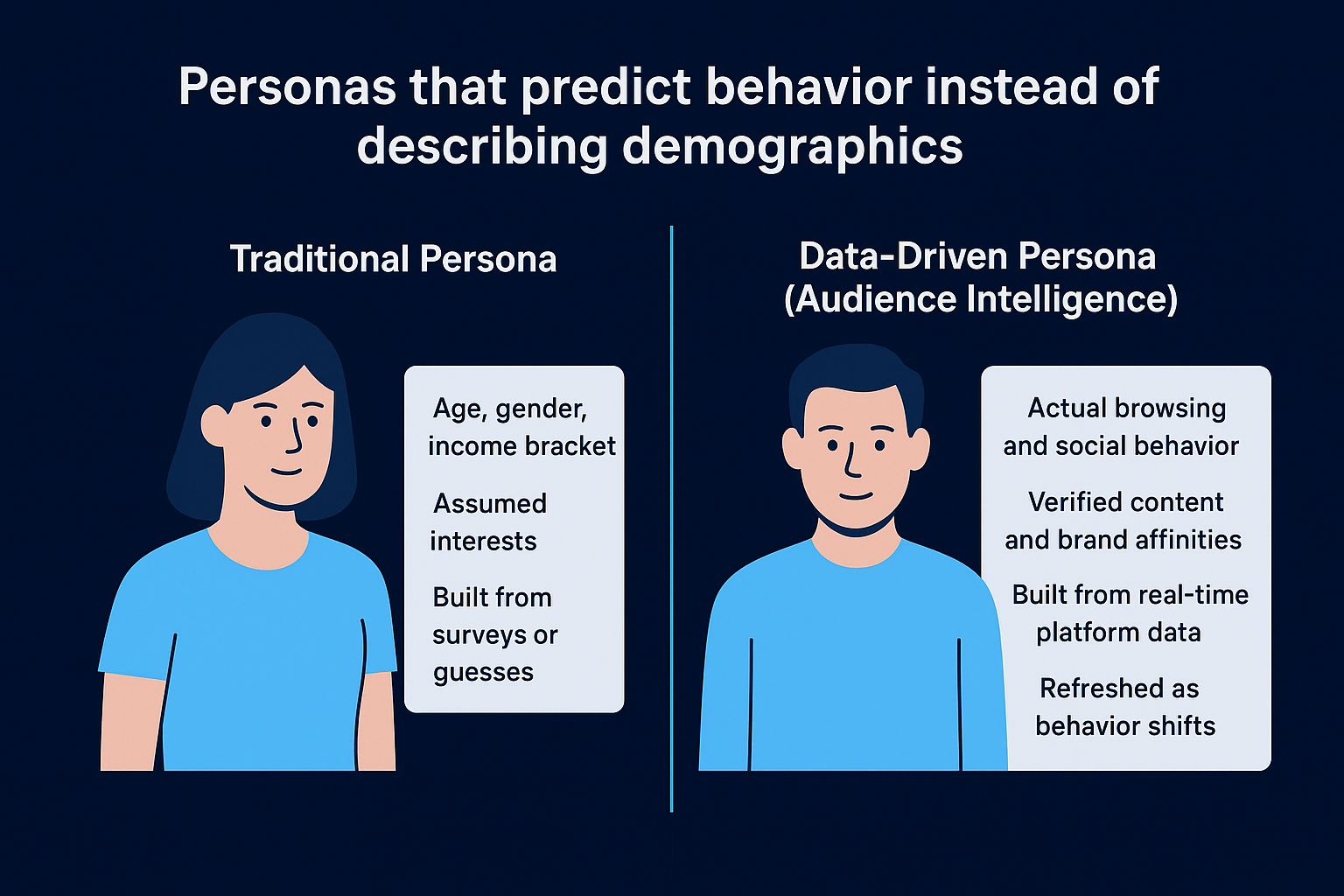
Here's a quick comparison of what changes when you move from a traditional persona to a data-driven one:
| Traditional Persona | Data-Driven Persona (Audience Intelligence) |
|---|---|
| Age, gender, income bracket | Actual browsing and social behavior |
| Assumed interests | Verified content and brand affinities |
| Built from surveys or guesses | Built from real-time platform data |
| Static, rarely updated | Refreshed as behavior shifts |
| Guides broad strategy | Guides specific hooks, scripts, and CTAs |
Content strategy stops competing on volume and starts competing on relevance
Organizations chasing follower counts often flood their feed with content hoping something sticks. That approach burns production resources without building authority. When you know the specific platforms, communities, and content styles your audience already engages with, you can concentrate effort where it actually compounds. Consistent results come from precision, not output volume, which is exactly the shift high-level founders and brand owners need if they want inbound leads instead of vanity metrics.
Competitive positioning gets sharper too
Audience data doesn't just tell you about your own followers, it reveals overlap with competitor audiences and where your positioning is genuinely differentiated versus where you're just noise in a crowded category. For a business owner trying to dominate a market category, this is the difference between competing on price and competing on authority. Seeing which brands your prospective customers already trust gives you a map for where to insert your own voice credibly.
Understanding your audience at this level also protects you from a common failure mode: creating content that performs well by vanity metrics but never moves revenue. Audience intelligence ties every creative decision back to a real person with real intent, which is the only foundation that scales past the first viral moment. That's the strategic shift worth making before you touch a single script or edit.
How to use Semrush Audience Intelligence step by step
Getting value from Semrush Audience Intelligence isn't complicated, but skipping steps leads to shallow personas that never actually change your content. The process moves from setup to segmentation to application, and each stage feeds directly into the next one.
Setting up your first audience report
Start by defining the seed audience you want to analyze, whether that's your existing followers, a competitor's audience, or a custom list pulled from your CRM. From there, the platform pulls behavioral and demographic signals to build out a full profile you can actually work with.
- Connect your source: existing social audience, competitor handle, or uploaded contact list
- Select the platforms you want analyzed, since the tool draws from major social networks and browsing behavior
- Choose the depth of segmentation, from broad demographic clusters to narrow psychographic groups
- Generate the initial report and review the summary dashboard before drilling into individual segments
Generating this first report gives you a spread of segments, not a single persona, and each one carries its own distinct behavior profile worth reviewing separately.
Reading and applying the segments
Segments only matter if you can act on them, so resist the urge to treat the report as a one-time snapshot. Identify the segments with the highest overlap with your actual buyers, not just the largest segment by raw size. Segment prioritization should follow revenue potential, not audience count alone.
The report is only useful once someone translates a segment into a script, a hook, or a posting schedule.
Exporting the findings into your production workflow should happen immediately, whether that means briefing a scriptwriter, adjusting your posting calendar, or feeding insights into an automated funnel. Waiting to "analyze more" before acting is how most teams let good data go stale on a shared drive. Rerunning the report on a regular cadence, ideally quarterly, keeps your audience personas aligned with real shifts in behavior instead of freezing your strategy around a single moment in time.
What audience data the tool actually uncovers
Once a report finishes processing, you get more than a demographic breakdown. Semrush Audience Intelligence surfaces layers of behavioral evidence that most marketers never see until a customer is already deep in the funnel, which means you can adjust your content before you've wasted a quarter chasing the wrong tone or platform.
Demographic and platform-level detail
The baseline data looks familiar: age ranges, gender split, household income, and geographic concentration. What makes it useful is pairing that with platform habits, since knowing that a segment skews toward Instagram Reels over YouTube Shorts changes your entire production plan. Platform behavior data also flags device usage and time-of-day activity, so posting schedules stop being a guess.
Brand affinities and purchase signals
This is where the tool earns its keep for anyone building authority in a crowded category. You see which brands, publications, and influencers a segment already trusts, plus purchase intent signals tied to specific product categories. A founder targeting enterprise buyers can see whether that audience actually follows finance publications or leans toward founder-led thought leadership instead, which reshapes both hook writing and guest positioning.
Knowing who your audience already trusts tells you exactly where your own voice needs to show up next.
Content consumption patterns
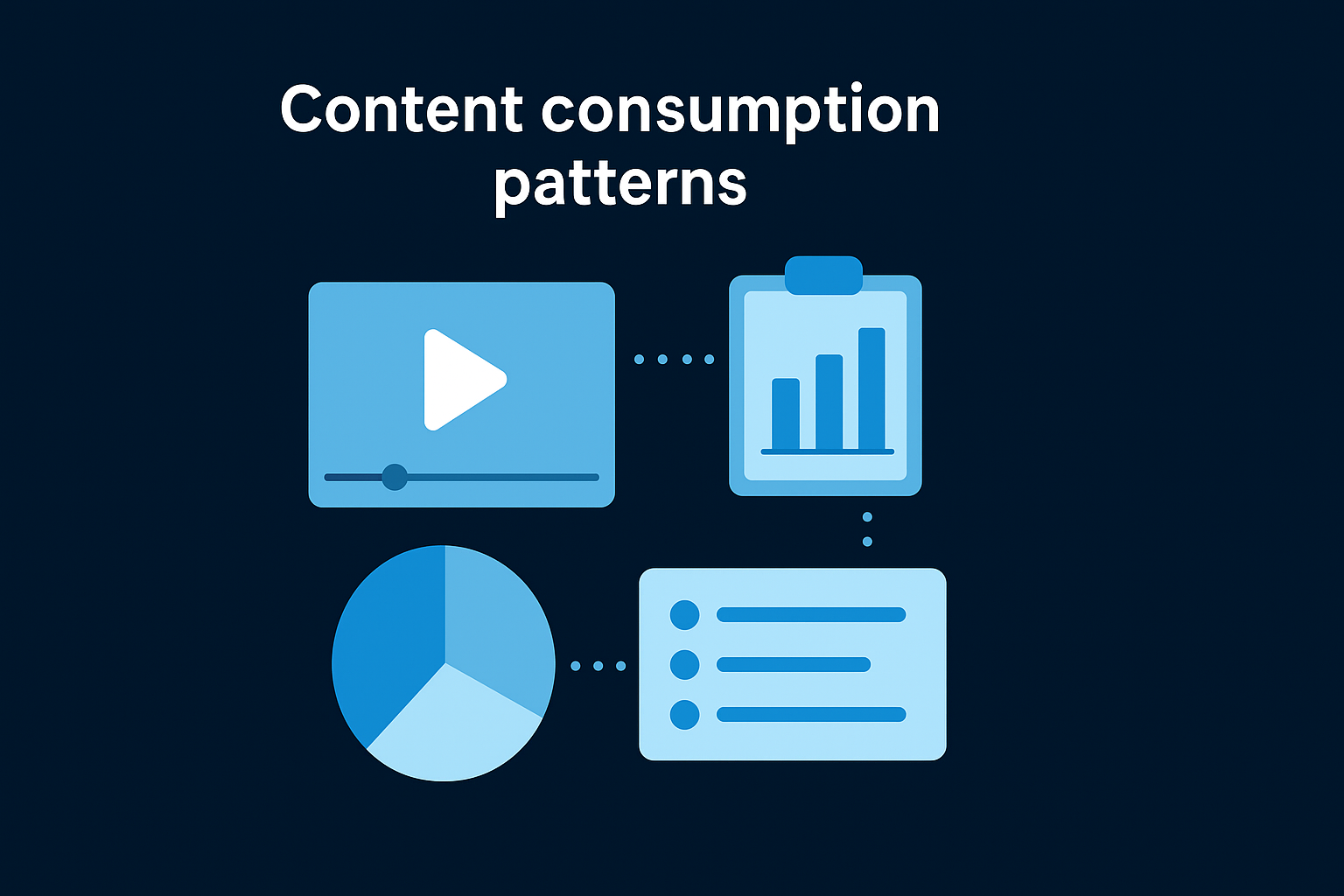
Beyond demographics and brand loyalty, the platform maps how a segment actually consumes content, including format preference, average watch time tendencies, and topic clusters that generate engagement. Here's a snapshot of the kind of consumption data you'd typically pull:
| Data Point | What It Tells You |
|---|---|
| Preferred content format | Short-form video, long-form article, carousel, live stream |
| Peak engagement windows | Best posting times by platform |
| Topic affinity clusters | Subjects that consistently drive interaction |
| Cross-platform overlap | Where the same audience shows up more than once |
| Competitor brand follows | Who already has their attention and trust |
Psychographic and behavioral layers
The deepest value sits in psychographic data: values, lifestyle indicators, and decision-making triggers that explain why someone engages with one hook and scrolls past another. Audience psychographics are what let a scriptwriter choose the right emotional angle instead of guessing between five options. Combined with purchase and platform data, this gives you a full behavioral map rather than a static snapshot, which is the entire point of running the report in the first place instead of relying on last year's persona deck.
Audience Intelligence vs Audiense: what's the difference
Anyone researching Semrush Audience Intelligence eventually runs into Audiense, a standalone platform built specifically for social audience segmentation and Twitter/X analysis. Both tools promise to turn scattered social signals into usable personas, but they solve different problems for different teams, and confusing the two leads to picking the wrong tool for your actual workflow.
Where the platforms actually overlap
Both tools build segments from real behavioral data instead of surveys, and both surface brand affinities, interests, and demographic clusters you can hand off to a content or ad team. If your only goal is social listening on a single platform, either one can get you a workable persona. Segment building is where the similarity mostly ends, though, because the depth and integration of that data diverges fast once you move past the surface report.
Where they genuinely diverge
Audiense leans heavily into social network analysis, particularly around Twitter/X communities, influencer mapping, and conversation clusters. Semrush Audience Intelligence sits inside a much larger ecosystem that already includes keyword research, competitor traffic data, backlink analysis, and content gap tools, so an audience segment connects directly to search behavior and site traffic instead of living in isolation. That connection matters if your team is building a full content system rather than running a single social campaign.
A standalone audience tool tells you who's talking. A connected platform tells you what to do about it.
| Factor | Semrush Audience Intelligence | Audiense |
|---|---|---|
| Core focus | Cross-platform audience and market data | Social network and Twitter/X community mapping |
| Ecosystem integration | Connected to SEO, competitor, and traffic tools | Primarily standalone |
| Best fit | Teams building full-funnel content strategy | Teams doing deep social listening on one platform |
| Data breadth | Demographic, psychographic, and search behavior | Social graph and conversation data |
| Workflow use | Feeds scripting, positioning, and funnels | Feeds community targeting and social ads |
Understanding this difference before you commit matters because switching tools mid-strategy wastes the exact time you're trying to save. Companies building a personal or corporate brand across multiple channels usually get more mileage from a connected system like Semrush, since the audience data ties directly back to search intent and content performance rather than sitting in a separate dashboard nobody checks after the first month.
Turning audience data into a real strategy
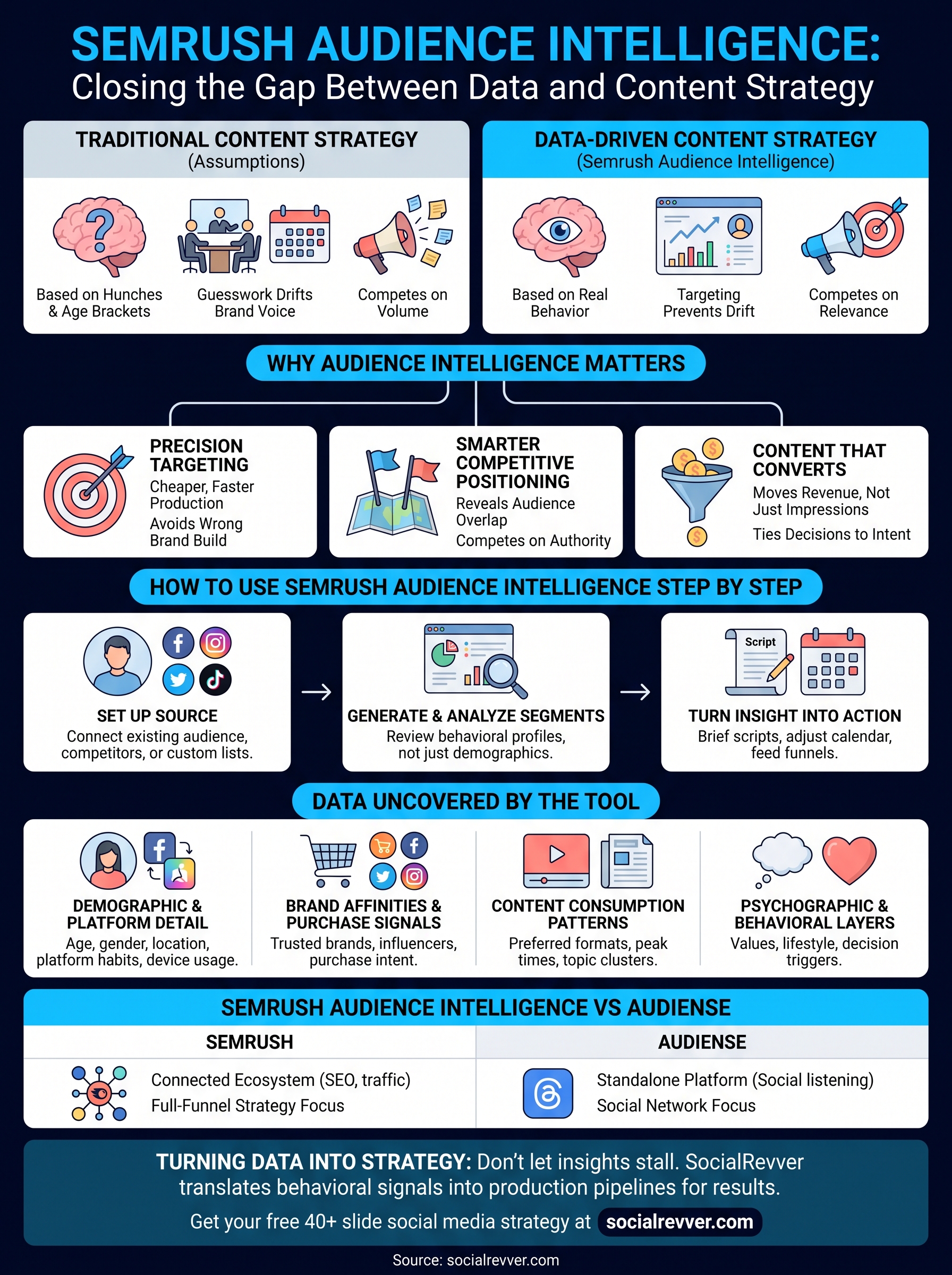
Knowing your audience's behavior means nothing if it stays trapped in a dashboard. Semrush Audience Intelligence gives you the evidence, but someone still has to translate that evidence into scripts, hooks, posting schedules, and funnels that actually convert attention into revenue. That translation step is where most teams stall, not because the data is bad, but because turning insight into production takes a system, not another spreadsheet.
This is exactly the gap SocialRevver was built to close. We take the same kind of behavioral and psychographic signals this article covers and run them through a production pipeline built for founders and brand owners who need results, not more reports. If you'd rather have a team build that system for you than piece it together yourself, get your free 40+ slide social media strategy and see what a data-driven content engine actually looks like for your brand.