
Most businesses lose attention not because their product is weak, but because their message is. They talk about themselves, bury the value, and wonder why nobody converts. The StoryBrand framework, created by Donald Miller, fixes this by forcing your brand to do one thing: make the customer the hero of the story, not your company.
The SB7 framework breaks marketing messaging into seven clear parts borrowed from classic storytelling structure. A character wants something, hits a problem, meets a guide, gets a plan, is called to action, and either succeeds or fails. When you map your brand's messaging onto this structure, you strip away the noise and speak directly to what your audience actually cares about. It's the reason some brands convert at first glance while others get scrolled past, clarity always beats cleverness.
At SocialRevver, we build content systems that turn short-form video into a predictable growth engine. But even the best production pipeline falls flat without a message that lands. That's why frameworks like SB7 matter, they give your scripts, hooks, and calls to action a backbone rooted in how people actually process information. This article walks you through all seven parts of the StoryBrand framework, explains how each one functions, and shows you how to apply them so your marketing finally says what it needs to say.
What the StoryBrand framework is and is not
The StoryBrand framework is a messaging methodology, not a branding aesthetic or a visual identity system. Donald Miller built it around one observation: human brains are wired to follow story structure, and when your marketing doesn't follow that structure, people disengage. The framework gives you a repeatable process to translate what your business does into language your audience can immediately understand and act on.
What the StoryBrand framework actually is
At its core, SB7 is a communication filter. You run your brand's messaging through seven story-based categories and come out the other side with something most businesses never achieve: a clear, consistent message that connects your product to your customer's specific problem and desired outcome. The framework draws directly from narrative theory. Every compelling story has a hero who wants something, faces a conflict, and finds resolution through action. SB7 maps that structure onto your marketing so your customer sees themselves as the hero and your brand as the guide helping them win.
The most powerful shift the framework creates is this: it moves your brand from talking about itself to talking about your customer's transformation.
Your audience doesn't buy products. They buy better versions of themselves or better outcomes for their business. When your messaging speaks to those outcomes in a structured, story-driven way, you remove the cognitive friction that causes people to click away. SB7 gives your content, website, sales scripts, and ads a shared narrative spine so every touchpoint pushes your audience toward the same decision rather than creating confusion at each step.
What the StoryBrand framework is not
The first thing to clear up is that SB7 is not a copywriting formula like AIDA or PAS, although it can inform how you write copy. Those formulas tell you how to structure a single piece of writing. The StoryBrand framework tells you how to think about your entire brand's positioning. The difference matters because a framework shapes strategy, while a formula shapes output. You can use both together, but conflating them leads to shallow application that misses the deeper clarity work the model demands.
SB7 is also not a guaranteed sales script you deploy once and forget. Many businesses read Miller's book, fill out the BrandScript, and then let it sit in a folder. That's not how it works. The framework is only useful when it actively shapes your marketing language across every channel. It's also not a substitute for genuine product-market fit. No messaging framework can sell something people don't actually need. What it does is remove the language friction that stops people from recognizing why they need what you already offer.
Finally, SB7 is not a tool exclusive to large marketing teams or big-budget brands. Small businesses and solo founders benefit from it just as much, sometimes more, because they typically lack the budget to blast through confusion with volume. When your message is clear from the start, every piece of content, every email, and every short-form video does more work per dollar spent. That's why operators who build content systems around video need this framework active before production ever starts. Without it, you're producing noise at scale instead of a message that compounds with every piece you publish.
Why SB7 makes marketing messages clearer
Most marketing messages fail because they force the reader to do too much work. When your audience lands on your website or watches your video, they give you a few seconds to answer one question: "What's in it for me?" If your message doesn't answer that immediately, they leave. The StoryBrand framework solves this by giving you a structure your audience's brain already recognizes, because they've absorbed it through every story they've ever encountered, from childhood films to the last book they finished.
The brain filters for survival, not for your pitch
Your customers process roughly 100,000 words of information each day. To manage that load, the brain operates on a constant efficiency filter, discarding anything that doesn't clearly connect to a goal, a problem, or a threat. Most marketing copy gets filtered out because it leads with company history, product features, or vague mission statements. None of those things trigger the brain's attention mechanism the way a clear problem-and-resolution structure does.
Story structure bypasses that filter because it mirrors how the brain naturally organizes experience: a problem that needs solving, a path forward, and a resolution.
When you reframe your message so it starts with your customer's problem rather than your company's credentials, you give the brain an immediate signal that this information is relevant. That's the core mechanism behind why SB7 produces clearer messaging. You're not just writing better sentences; you're aligning your communication with how attention actually works at a cognitive level, which is a structural advantage no amount of clever writing alone can replicate.
Clarity compounds across every channel
A single clear message does more than improve one landing page. When your entire team works from the same story-based framework, every piece of content, every email, and every short-form video reinforces the same narrative. Your audience starts to recognize the pattern, and recognition builds trust faster than any individual tactic can.
This consistency is especially valuable for video content. Short-form videos give you seconds to establish relevance and guide the viewer toward a next step. When your hook, body, and call to action all pull from the same story logic, each video functions as a chapter in a larger narrative rather than a standalone piece competing for attention on its own terms. SB7 gives you the structural backbone that makes that consistency achievable without starting from scratch each time you sit down to create.
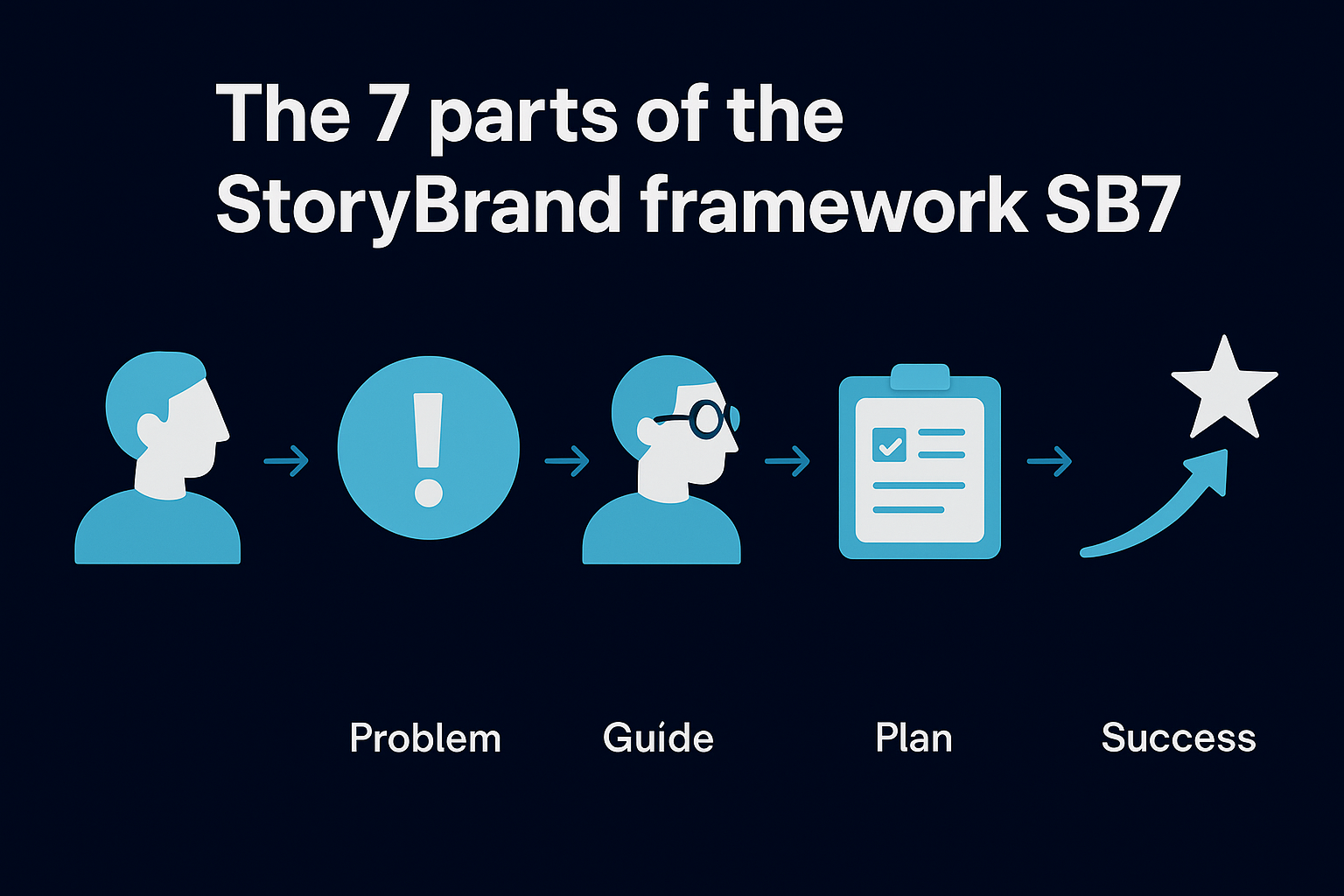
The 7 parts of the StoryBrand framework SB7
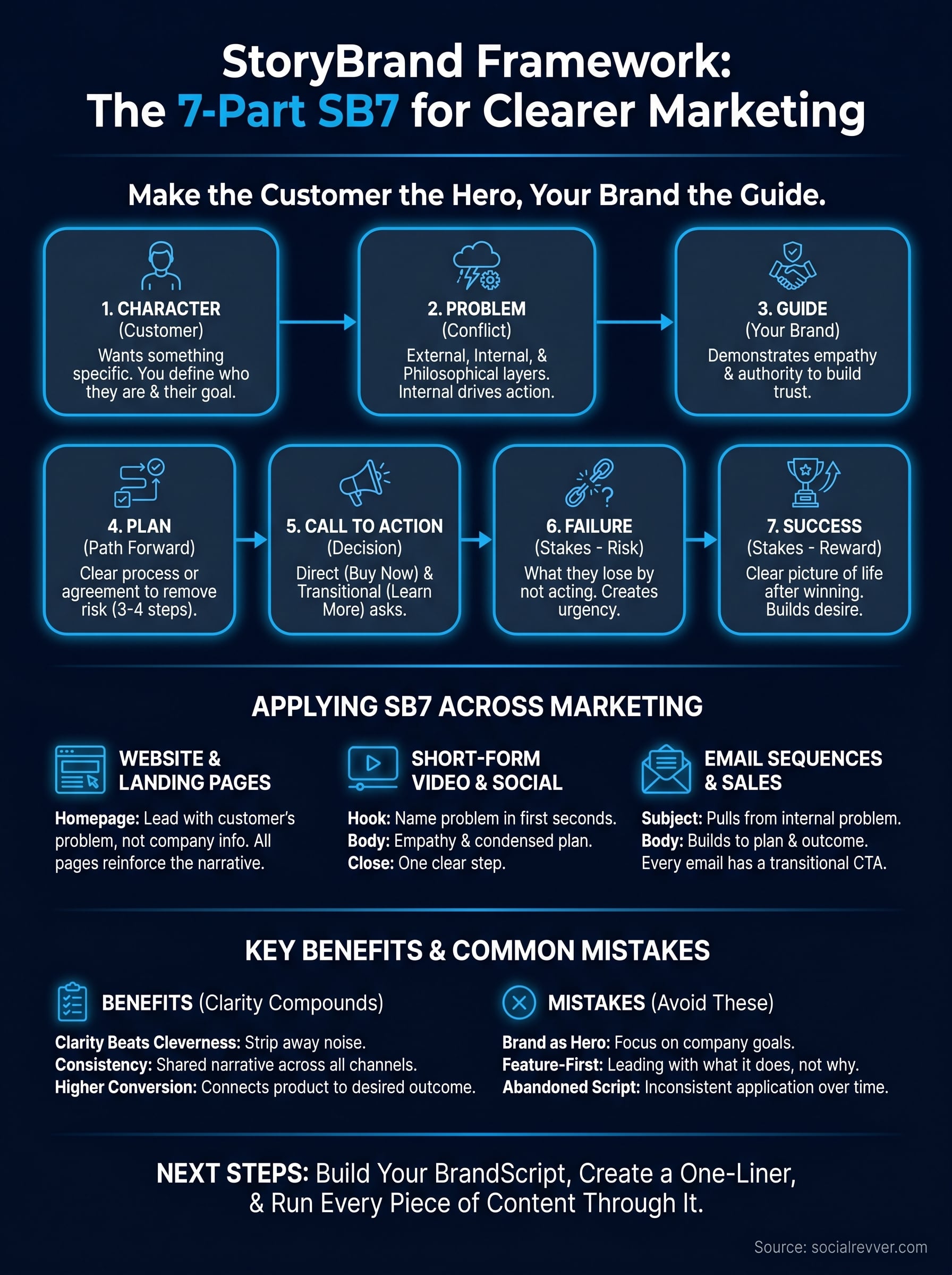
The storybrand framework maps your brand message onto seven sequential narrative elements that mirror the structure of every story your audience has ever encountered. Each part builds on the last, and skipping or misplacing any one of them creates the exact friction you're trying to eliminate. Understanding what each part demands of your messaging is the first step toward building something that converts.
Parts 1 and 2: The character and the problem
Your customer is the character, not your brand. This single distinction separates businesses that connect from businesses that confuse. SB7 asks you to define exactly who your customer is and what they want in the most specific terms possible. The more precisely you name their desired outcome, the faster they recognize that you understand them.
The problem operates on three layers: external, internal, and philosophical. The external problem is the surface-level issue your product solves. The internal problem is the frustration your customer carries because of it. Most businesses only address the external layer, but the internal layer drives purchase decisions. People buy to resolve feelings, not features.
When you name your customer's internal problem in your own messaging, they stop scrolling and start reading.
Parts 3 and 4: The guide and the plan
Your brand enters the story as the guide, not the hero. The guide demonstrates two things: empathy and authority. Empathy shows you understand what your customer is experiencing. Authority shows you've helped others through it before. Together, they establish the trust your audience needs before they take any action.
The plan removes the risk of moving forward. Once your customer trusts you, they still hesitate if the next step feels unclear. SB7 asks you to give them either a process plan (the steps they'll follow) or an agreement plan (the commitments you make to reduce their fear). Three to four clear steps are enough to make the path feel manageable rather than overwhelming.
Parts 5, 6, and 7: Action, failure, and success
The call to action is where most brands go soft. SB7 separates direct calls to action (buy, book, sign up) from transitional ones (download, watch, learn more). Both have a role, but without a direct ask, you leave conversions unclaimed.
Failure and success function as emotional stakes. Naming what your customer risks by not acting creates urgency. Painting a clear picture of their life after working with you gives them a reason to move forward. When both appear in your messaging, you build the tension that turns passive readers into buyers.
How to build a BrandScript that guides buyers
The BrandScript is the working document where you translate the storybrand framework into actual language for your brand. It's a single-page template that captures all seven story parts as they apply to your specific business. Once you fill it out completely, it becomes the reference your entire team pulls from whenever they write a headline, record a video, or draft an email. Without this document, your messaging stays inconsistent because different people on your team default to different interpretations of what your brand actually says and who it serves.
Start with one customer, one problem
Most businesses serve more than one audience, but you write one BrandScript per customer type. Trying to address multiple audiences in a single script muddies every message it produces. Pick your most valuable customer segment, define what they want, and name the external and internal problem that stands between them and that outcome before you write anything else.
The internal problem almost always matters more than the external one, because that's the frustration that pushes someone to take action.
Fill in each section before moving on
Work through the BrandScript sequentially, not randomly. Each section builds direct context for the next. Your guide positioning only makes sense after you've defined the character's problem. Your plan only lands after you've established empathy and authority as the guide. Filling sections out of order produces disconnected language that won't hold together when you apply it across real marketing.
Follow this sequence to keep your thinking organized:
- Define the character and their single most important goal.
- Name the external, internal, and philosophical problems.
- Write two or three sentences that show empathy, then list your proof of authority.
- Draft a three-step process plan your customer will follow.
- Write your direct call to action and one transitional option.
- State the cost of inaction in one clear sentence.
- Describe the specific outcome your customer reaches after working with you.
Turn the script into a one-liner
Once your BrandScript is complete, compress it into a one-liner: a two-to-three sentence statement that captures the character, the problem, your solution, and the result. This is not a tagline. It's a functional summary you use to open sales conversations, anchor your website homepage, and lead every short-form video hook. When your team memorizes the one-liner, your messaging stays consistent without anyone having to reference the full document every time they create something new.
How to apply SB7 across your marketing assets
Once your BrandScript is complete, the work shifts from strategy to execution. The storybrand framework only produces results when it shapes the actual assets your audience encounters, and that means applying it consistently across your website, video content, and email. Every touchpoint you own is an opportunity to reinforce the same story or create confusion, and which one happens depends entirely on whether your team is pulling from the same source.
Website and landing pages
Your website homepage is the highest-stakes place to apply SB7. Visitors arrive with almost no patience, so your above-the-fold section needs to answer three questions immediately: what do you offer, how does it improve their situation, and what should they do next. Map that first section directly to the character and problem, then walk the rest of the page through empathy, the plan, and stakes before closing with a direct call to action.
If your homepage currently leads with your company name or a tagline about your values, restructure it around your customer's problem first.
Every subsequent page on your site, including service pages, about pages, and pricing, should pull from the same BrandScript so visitors feel a consistent narrative rather than a collection of disconnected content. Each page reinforces the story or dilutes it.
Short-form video and social content
Short-form video follows the same story logic but at a faster pace. Your opening hook should name the customer's problem or desired outcome within the first two seconds. The body delivers empathy and a condensed version of the plan, and the final frame closes with one clear next step. When every video pulls from the same BrandScript, each one builds on the last rather than competing with it for coherence.
Structure each short-form piece around these checkpoints:
- Hook: Name the problem or outcome your viewer cares about
- Body: Show empathy and authority in two to four focused points
- Close: State one direct or transitional action your viewer can take
Email sequences and sales conversations
Email gives you more room to develop the story elements you can only hint at in a short video. Your subject line pulls from the internal problem, the body builds toward the plan and outcome, and each message in a sequence advances the story one step rather than repeating the same pitch. Repetition without progression signals to your reader that you have nothing new to offer, and they stop opening.
Add one transitional call to action in every email so readers who are not ready to buy still have a low-friction next step that keeps them engaged with your content until they are.
Common mistakes, fixes, and quick FAQs
Most businesses that try the storybrand framework and see no results didn't fail because the model is flawed. They failed because they applied it incorrectly. The three patterns below cover the most common errors and what to do instead.
Making your brand the hero instead of your customer
This is the most frequent mistake, and it shows up everywhere from homepage headlines to video scripts. You solve it by auditing every sentence for company-first language and replacing it with language that centers your customer's outcome. Run a quick check: if the first line on your homepage describes your company rather than your customer's problem, rewrite it immediately. Your brand should appear as the guide helping someone else win, not the main character pursuing its own goals.
The moment you shift from "we help companies grow" to "you'll finally have a system that brings in leads consistently," the message transforms.
Leading with features instead of naming problems
Features describe what your product does. Problems describe what your customer feels. When you lead with features, you force your audience to connect the dots themselves, and most won't. The fix is to anchor every product description to a specific external or internal problem first, then explain how your feature resolves that problem for them. This sequencing makes your offer feel relevant instead of abstract, which is the difference between a reader who stays and one who bounces.
Filling out the BrandScript once and abandoning it
Many teams complete the BrandScript during a strategy session and never reference it again. This destroys consistency across channels, which is exactly where the compounding value of the framework lives. Treat your BrandScript as a working reference. Review it whenever you launch new products, enter new markets, or shift your target audience. Keep it visible in your content production workflow so every video, email, and landing page checks against the same source.
Quick FAQs
Does SB7 work for B2B? Yes. The internal problem layer is especially relevant in B2B because buyers inside companies worry about professional credibility and personal risk, not just business outcomes. Naming those fears in your messaging builds trust faster than any case study alone.
How long does a BrandScript take to build? A focused team can complete a solid first draft in two to three hours. The real clarity work happens in the iteration after, when you test your one-liner in real conversations and refine based on what actually resonates with your audience.
Next steps to put SB7 to work
The storybrand framework gives you a structure that removes guesswork from your marketing and replaces it with a repeatable system. You now have every part of SB7, a process for building your BrandScript, and a clear method for applying it across your website, videos, and email. The work from here is straightforward: build your BrandScript, compress it into a one-liner, and run every piece of content you publish through it before it goes live.
Start with your most valuable customer segment and your most pressing problem. Write the first draft of your BrandScript today, even if it takes two passes to get the language right. Clarity compounds, and every piece of content you produce from a clear message does more work than anything you've published without one. If you're ready to pair this messaging foundation with a content system built to scale it, apply to work with SocialRevver and get a free 40-plus slide social media strategy.