You have probably typed content calendar meaning into Google because someone on your team mentioned one, or because your own posting schedule feels like guesswork. That confusion is normal. Most founders and creators know they need consistency, but nobody ever explained what this tool actually is or why it matters beyond "post more often."
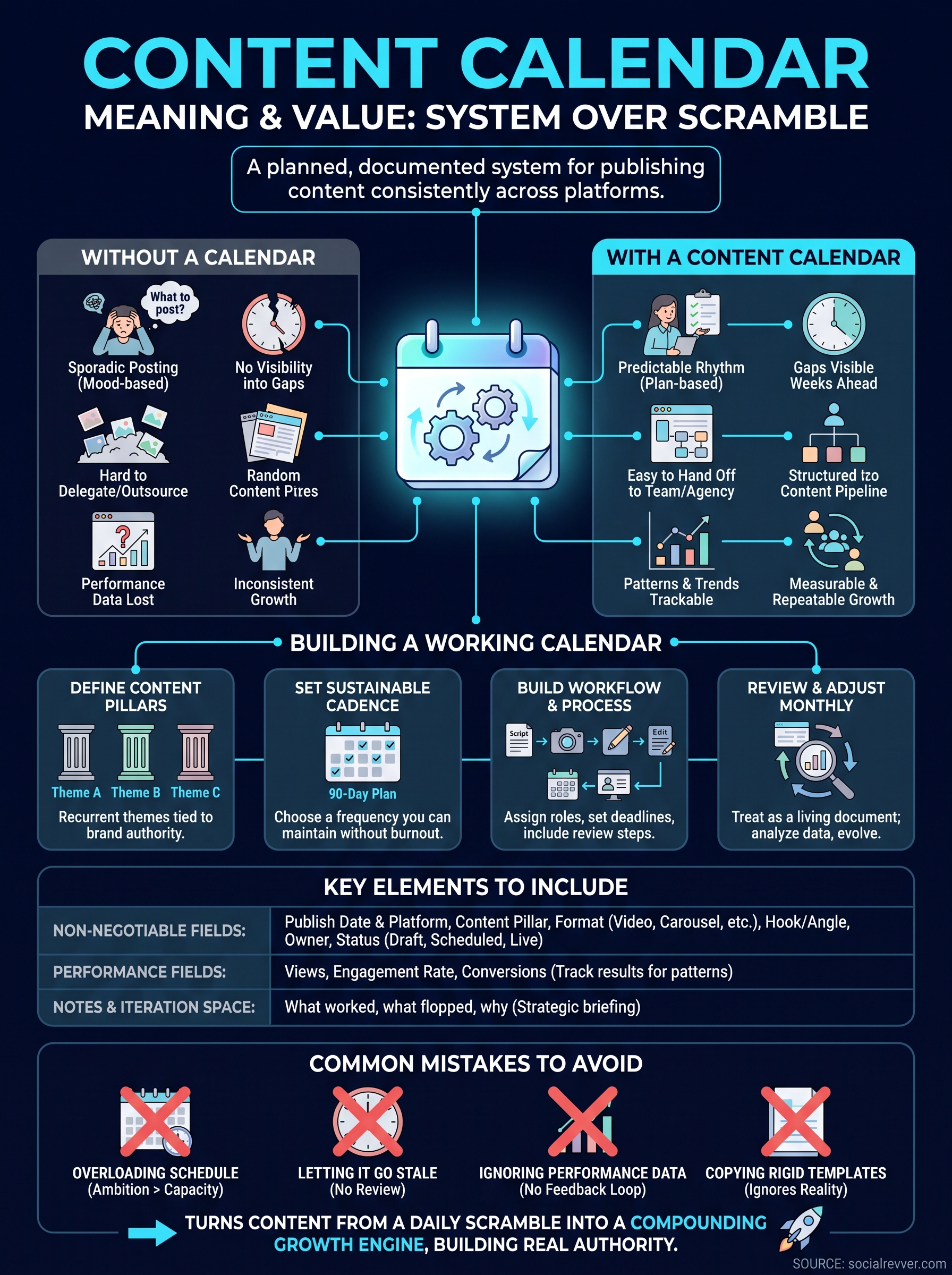
At its core, a content calendar is a planned schedule that maps out what you publish, where, and when, across every platform you use. It turns content from a daily scramble into a documented system you can review, adjust, and hand off to a team. It answers the who, what, and when of your publishing, so nothing gets created on a whim and nothing important gets missed.
In this article, we break down exactly what a content calendar includes, how it differs from a simple posting schedule, and why brands scaling their authority treat it as infrastructure rather than an afterthought. You will also see how a structured calendar connects directly to the kind of predictable, data-driven growth that separates professional operations from accounts that post randomly and hope something sticks.
Why a content calendar matters for your growth
Skip the calendar and you get what most brands live with: a feed that reflects whoever had time to film something that week. That inconsistency shows up in your numbers before it shows up anywhere else. Platforms reward accounts that publish on a predictable rhythm, because their algorithms are built to test and re-test content over time, not judge a single lucky post. A calendar gives you that rhythm without relying on memory or motivation.

From guesswork to a repeatable system
Once you write your posting plan down, you stop reacting and start operating. You can see gaps two weeks out instead of realizing at 9pm that nothing is scheduled for tomorrow. You can also spot patterns, like which content pillar keeps underperforming, something impossible to catch when everything lives in your head or a scattered group chat.
A content calendar turns content from a daily scramble into a system you can measure, adjust, and scale.
Why founders and creators treat it as infrastructure
For business owners building investor credibility or creators chasing higher-paying brand deals, sporadic posting signals a sporadic operation. A calendar is proof, even internally, that your brand runs on process rather than mood. It also makes delegation possible. You cannot hand off content production to an editor, a VA, or an agency if the plan lives only in your head.
| Without a calendar | With a content calendar |
|---|---|
| Posting depends on your mood or schedule | Posting depends on a fixed plan |
| No visibility into content gaps | Gaps are visible weeks ahead |
| Hard to delegate or outsource | Easy to hand off to a team or agency |
| Performance data gets lost | Patterns and trends are trackable |
| Growth is inconsistent | Growth becomes measurable and repeatable |
Growth compounds when your output is consistent enough for an audience, and an algorithm, to learn what to expect from you. Random posting resets that learning curve every time you go quiet. A structured pipeline protects the momentum you already built, which is exactly why agencies that treat content as an engineering problem, rather than a creative mood, build the calendar before they touch a camera.
How to build a content calendar that works
Building a working calendar starts with a decision, not a template. Pick your core platforms and commit to a realistic posting cadence before you open any spreadsheet or tool. Most brands fail here because they copy someone else's five-times-a-day schedule instead of building one their production capacity can actually sustain.
Start with your content pillars
Define three to five recurring themes tied to your brand's authority, not random trending topics. These content pillars become the categories you slot into every week, so you never stare at a blank calendar wondering what to post next.
Set a cadence you can sustain
Choose a frequency you can maintain for 90 days without burning out your team. A realistic cadence beats an ambitious one you abandon by week three.
The best content calendar is the one you can actually maintain for months, not the most ambitious one you build for a single week.
Build the workflow around the calendar
Once the plan exists, attach a process to it:
- Assign who scripts, films, edits, and posts each piece
- Set deadlines several days before the publish date, not the same day
- Build in a review step to catch quality issues early
- Schedule a recurring time to plan the next stretch of content
Review and adjust monthly
Treat the calendar as a living document. Pull performance data every few weeks and swap out pillars or formats that stall, keeping the structure intact while the content itself evolves.
Key elements every content calendar should include
A calendar that actually works needs more than dates in boxes. Every entry should tell you what the piece is, where it lives, and why it exists, so nobody has to guess the intent behind a post six weeks after you scheduled it.
The non-negotiable fields
Build your calendar around a consistent set of fields, not whatever feels convenient that week. At minimum, track:
- Publish date and platform for every piece
- Content pillar or theme it belongs to
- Format (short-form video, carousel, story, long-form post)
- Hook or angle you are testing
- Owner responsible for scripting, filming, and posting
- Status (drafted, filmed, edited, scheduled, live)
A calendar without status tracking is just a wish list, not a working system.
Performance and feedback fields
Beyond scheduling, your calendar should hold a place for results. Log views, engagement rate, and conversions next to each entry so patterns become visible instead of anecdotal. Skip this step and you repeat the same underperforming format for months without noticing.
Notes and iteration space
Leave room for short notes on what worked, what flopped, and why. This is where a calendar becomes strategic instead of administrative. Founders scaling their authority use these notes to brief editors and strategists without a single meeting, because the reasoning already lives in the document. That written history is what separates a calendar from a to-do list, and it's the piece most teams skip until they wish they hadn't.
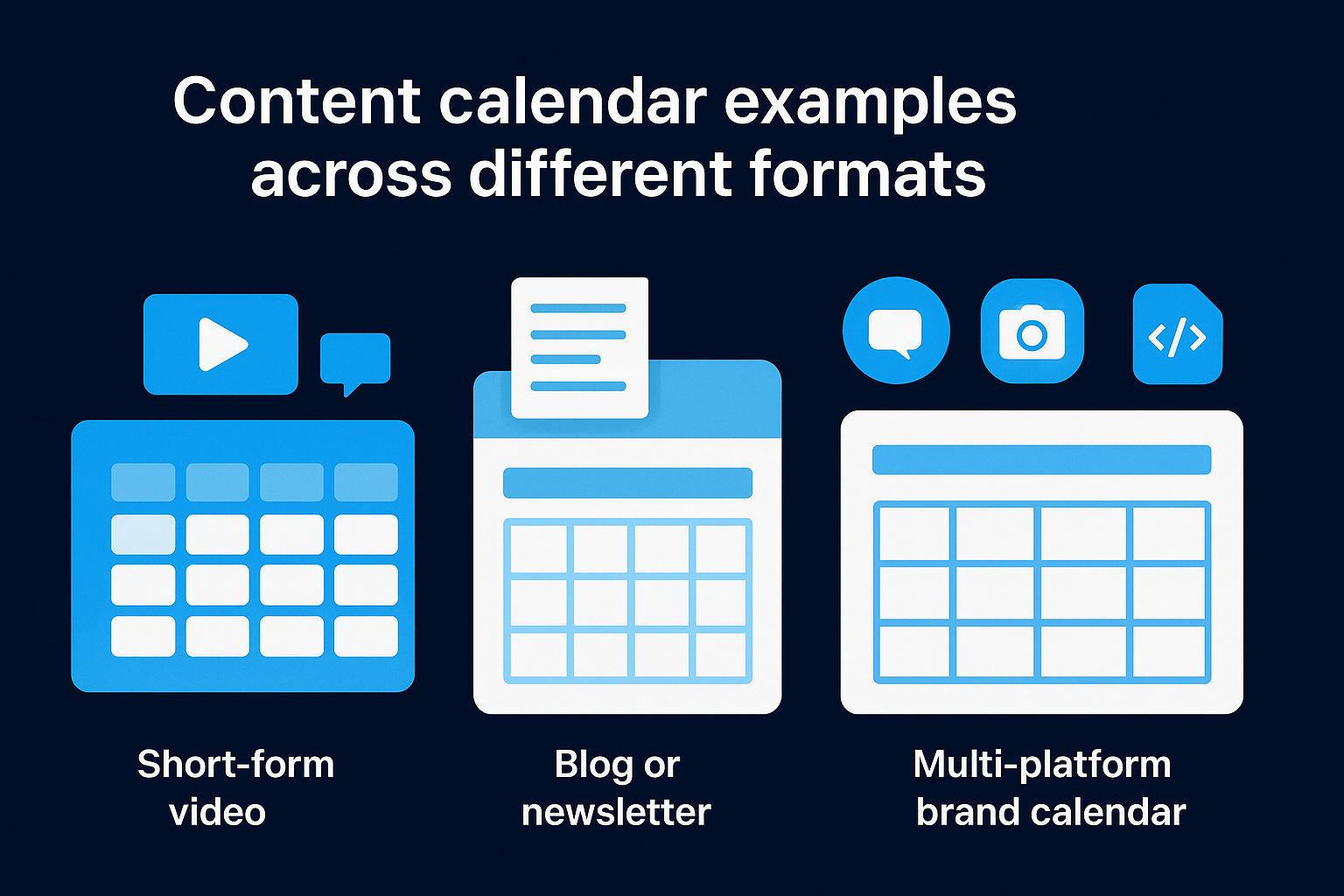
Content calendar examples across different formats
A content calendar looks different depending on your channel mix, and forcing every platform into one rigid template usually backfires. What works for a short-form video schedule rarely fits a newsletter or a long-form blog plan, because the production timelines and review steps are not the same.
Short-form video calendar
For creators and brands leaning on Instagram Reels, TikTok, or YouTube Shorts, the calendar centers on hooks and cadence rather than long lead times. A typical row might include the publish date, platform, pillar, hook angle, and status, since daily or near-daily posting demands a tighter feedback loop than other formats.
Blog or newsletter calendar
Longer content needs more lead time, so the calendar usually tracks draft deadlines, SEO target keywords, and internal linking notes weeks in advance. Here, the editorial calendar functions more like a production timeline than a daily schedule.
Multi-platform brand calendar
Business owners running content across several channels at once often build a master view that shows how one idea gets repurposed. A single interview might turn into a short-form clip, a carousel, and a newsletter recap, each tracked separately but linked to the same source asset.
The best calendar format matches your production reality, not someone else's template.
| Format | Typical cadence | Lead time needed |
|---|---|---|
| Short-form video | Daily to 5x/week | 1-3 days |
| Blog post | 1-2x/week | 1-2 weeks |
| Newsletter | Weekly | 3-5 days |
| Multi-platform repurpose | Ongoing | Varies by source asset |
Common mistakes that undermine your calendar
Even a well-built calendar fails when teams treat it as a one-time project instead of a working tool. Watching for these traps early saves you from rebuilding the whole system three months in.
Overloading the schedule
Most brands set a posting frequency based on ambition, not production capacity. You plan seven videos a week, hit that pace for ten days, then quietly stop updating the calendar altogether. Build cadence around what your team can sustain every week, not the busiest week you can imagine.
Letting the calendar go stale
A calendar nobody opens after the first month is worse than no calendar at all, because it creates false confidence that a plan exists. Set a recurring review session, weekly or biweekly, where someone actually updates statuses and logs results.
A calendar that isn't reviewed regularly stops being a system and becomes decoration.
Ignoring performance data
Teams often fill in dates and formats but skip logging outcomes, so the same underperforming hook gets recycled for months. Without feedback fields, your calendar tracks activity instead of results.
Copying someone else's template
A schedule built for a five-person editing team rarely fits a solo founder, and vice versa. Borrowing a rigid template without adjusting for your own production reality is why so many calendars get abandoned within weeks. Build yours around your actual capacity, then adjust as that capacity grows.
Turning your calendar into a growth engine
Now you know the content calendar meaning goes far beyond a list of dates. It's the difference between reacting to content every day and running a system that compounds week over week. Pillars, cadence, fields, and review sessions turn scattered posting into something you can measure and hand off, which is exactly what separates brands building real authority from accounts still guessing.
Building that system yourself takes time most founders don't have, and copying a template rarely accounts for your actual production capacity. If you'd rather skip months of trial and error, get your free 40+ slide social media strategy built around your niche, audience, and goals. It's the calendar and the engine behind it, done right from day one.