
Every story that grips you, whether it's a 60-second reel or a full-length film, follows a pattern. The Dan Harmon Story Circle is one of the clearest maps of that pattern ever put on paper. Harmon, creator of Community and co-creator of Rick and Morty, distilled Joseph Campbell's mythic structure into eight simple steps that any storyteller can use, regardless of medium or experience level.
The framework works because it mirrors how humans actually process change. A character starts in comfort, encounters a problem, struggles through unfamiliar territory, and returns transformed. That arc isn't just for TV writers. It's the same psychological loop that makes short-form content stop the scroll, which is exactly why we study narrative frameworks like this one at SocialRevver. Our scripting engine and content systems are built on the principle that attention follows structure, not luck. Understanding the Story Circle gives you a serious edge in any format where you need to hold someone's focus and move them toward a decision.
This guide breaks down all eight steps of the Dan Harmon Story Circle with concrete examples and practical applications. You'll learn what each stage does, why it matters, and how to use the framework in your own writing, whether you're crafting a screenplay, a brand narrative, or a 30-second video that needs to hit hard. Let's get into it.
Why the story circle works
The Dan Harmon Story Circle doesn't just organize a plot; it maps the way human brains process experience. Every time you watch a story unfold, your brain runs a prediction engine in the background, constantly anticipating what comes next and measuring whether those predictions land. When a story follows a recognizable structure, that engine stays engaged. When the structure breaks down, attention does too. Harmon built his circle on this reality, which is why the framework produces results across formats as different as a 22-minute sitcom episode and a 15-second video hook.
The psychology behind the loop
Psychologists have studied narrative comprehension for decades, and the findings consistently point to one thing: people are wired for change-based stories. A character in a stable state doesn't trigger emotional investment. The moment that stability breaks, your brain activates what researchers call a "situation model," a mental simulation of the story world that updates in real time as new information arrives. The Story Circle feeds that simulation exactly what it needs at each stage. Each step corresponds to a shift in the character's situation, which keeps your mental model updating and keeps you watching.
Structure doesn't limit creativity. It gives creativity a framework that the audience's brain can track and reward.
This is why stories that feel "off" often can't be fixed with better dialogue or sharper visuals. If the underlying loop is broken, if the character never truly leaves their comfort zone or never pays a real cost for what they gained, the audience senses something is missing without being able to name it. The circle closes those structural gaps by giving you a clear benchmark for every phase of the emotional journey.
The change loop and why it resonates universally
Human beings experience life as a series of disruptions and recoveries. You start somewhere familiar, something pulls you out of that state, you struggle, and then you return changed. That pattern shows up in everything from early childhood development to how adults process major career shifts. Harmon's circle works because it reflects that lived experience back at the audience in compressed, dramatized form. When a story hits all eight steps, it doesn't just entertain; it feels true.
This universality is what makes the framework applicable far beyond screenwriting. Brand storytelling, sales narratives, and short-form social content all live or die by the same loop. A product demo that shows a person frustrated with their current situation, then forces them into new territory by introducing a solution, and finally returns them to a new normal is running the circle whether the creator knows it or not. Understanding the mechanics lets you run it deliberately, every single time.
Why emotional stakes drive attention
Attention follows investment, and investment follows stakes. The Story Circle forces you to establish what your character wants and what they stand to lose before they ever step into the unknown. That setup does critical work. It gives the audience a reason to care about what happens next. Without clearly defined stakes early in the story, even a technically well-structured narrative loses its grip halfway through.
When you apply the Dan Harmon Story Circle to short-form content specifically, the stakes function as your hook. You establish a character's desire or problem in the first few seconds, and that creates an open loop in the viewer's mind. Open loops demand closure. The human brain is deeply uncomfortable leaving questions unanswered, which is exactly why "find out what happens" holds attention better than "here is some information." Every step of the circle either opens a new loop or closes an existing one, and that rhythm is what separates stories that feel alive from content that lands flat.
What the story circle is in plain English
The dan harmon story circle is a circular storytelling framework built from eight numbered steps that track a character's journey from a comfortable starting point, through chaos, and back to a new version of that starting point. Harmon drew heavily from Joseph Campbell's concept of the monomyth, but he stripped the academic layer off it and turned it into a practical tool that writers could actually use in a writers' room. The result is a framework simple enough to sketch on a napkin but deep enough to structure every episode of a prestige TV series.
The circle as a visual map
You draw it as a literal circle, divided into eight equal segments. The top of the circle is the character's ordinary world, the comfortable, known environment they occupy at the start. As you move clockwise, each step represents a new phase of the character's experience. The character dips below an imaginary horizontal line roughly halfway through, which represents crossing into the unfamiliar or the unconscious, the territory where real change happens.
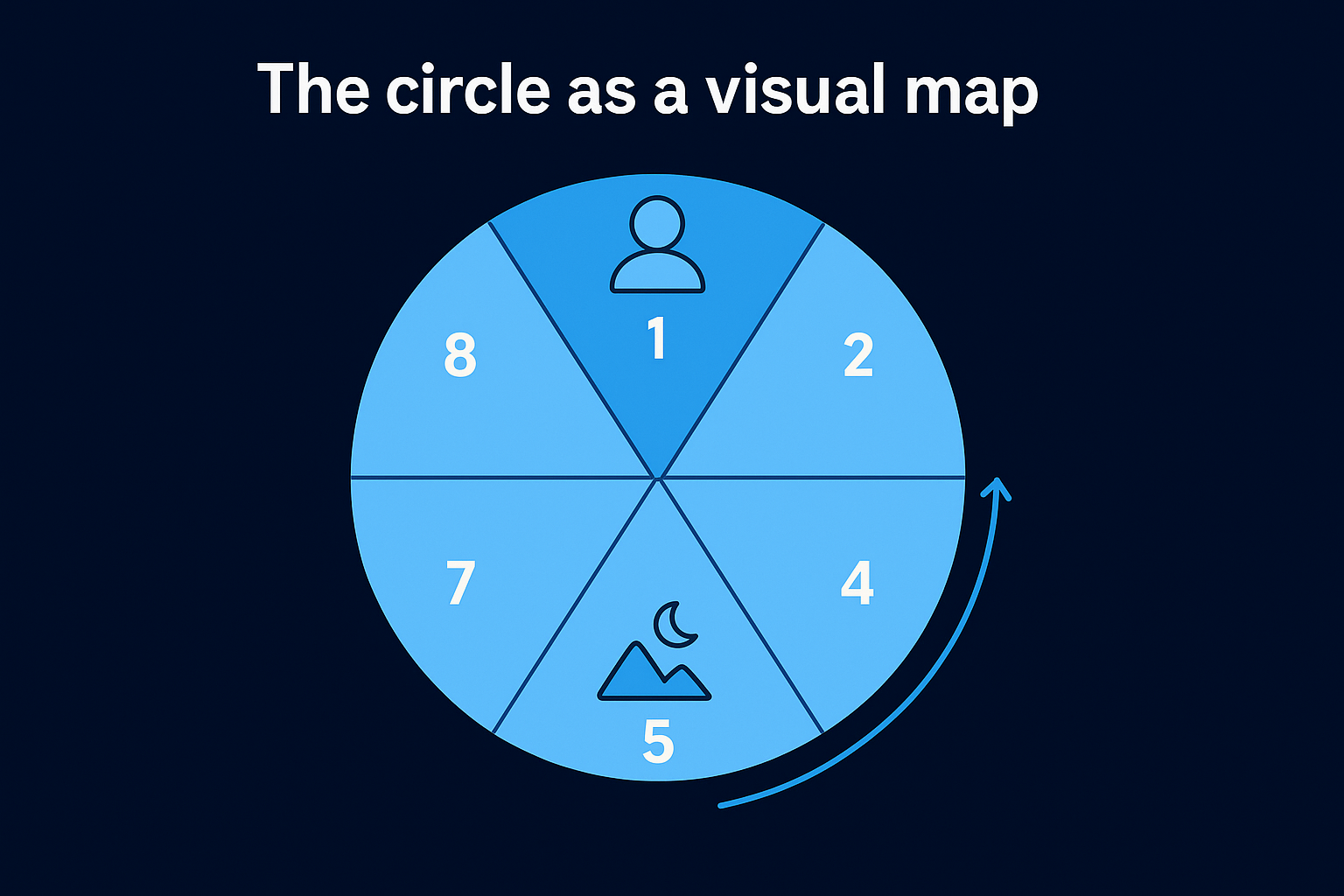
The circle isn't a metaphor. It's a diagram you can draw, label, and use to stress-test any story in about ten minutes.
The bottom of the circle is where the stakes are highest and the character is furthest from safety. Moving back up the right side of the circle represents the character returning, changed, to the world they came from. That return closes the loop. Everything the character learned or lost below the line shapes who they are when they arrive back at the top.
What makes it different from a straight line
Most people learn storytelling as a straight line: beginning, middle, end, or setup, confrontation, resolution. That structure works, but it leaves a lot of gaps. A linear model doesn't specify what kind of change must happen at each phase or how the character's internal state connects to the external plot. Harmon's circle ties those two threads together by design. Every external event corresponds to an internal shift, and every step asks a specific question about where the character stands emotionally and situationally.
The circular shape also reinforces a key idea: the character never truly returns to the same place. The world at step eight looks like the world at step one, but the character sees it differently. That gap between where someone starts and where they end up is the story. Once you understand that the circle is fundamentally a map of transformation rather than just events, you'll start seeing it everywhere, in films, in ads, in speeches, and in the short-form content that performs best on any platform.
The 8 steps explained
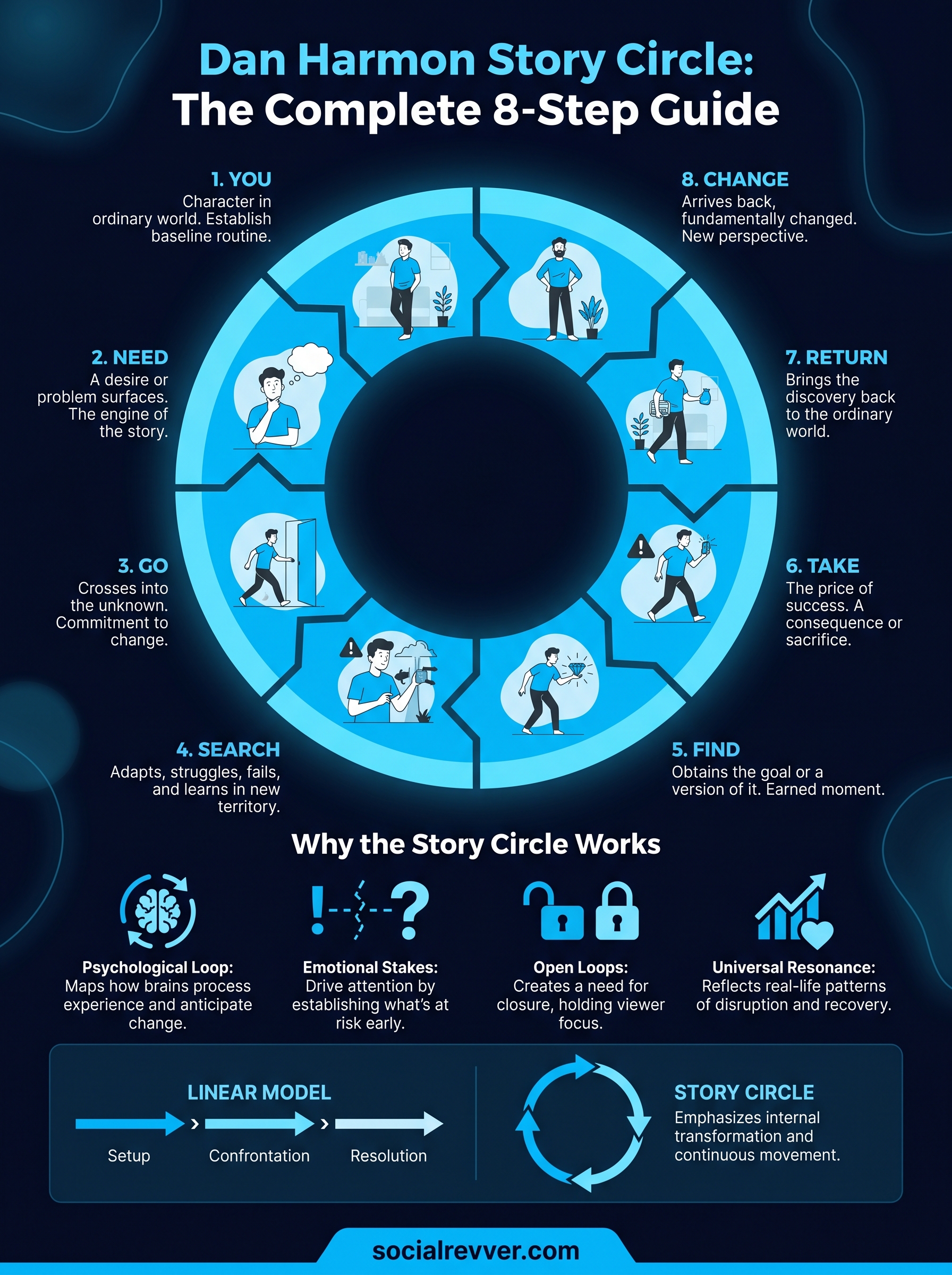
The dan harmon story circle labels each step with a short phrase that describes the character's situation at that point in the loop. Harmon's original language is deliberately simple because the goal is function, not poetry. Each step gives you a specific question to answer about your character before you move to the next one. If you can't answer that question, the step isn't ready yet.
Steps one through four: the descent
These first four steps move your character out of safety and into the unknown. Each step increases the pressure and the distance from the familiar.
- You -- Establish the character in their ordinary world. The audience needs to see who this person is before anything disrupts them. Show their routine, their relationships, or their default state.
- Need -- Give the character a desire or an itch they can't ignore. This can be external (they want something) or internal (something feels wrong). The need is the engine that pulls the character forward through every step that follows.
- Go -- The character crosses a threshold and enters unfamiliar territory. This is the moment they commit, voluntarily or not, to leaving what they know. The story truly starts here.
- Search -- The character adapts, struggles, and looks for what they need in this new space. This step is often the longest because real learning only happens through repeated failure.
If your character reaches step four without a clear need established in step two, the audience won't understand why anything they're doing matters.
Steps five through eight: the return
The second half of the circle brings the character back, but the cost of the journey is what makes the return meaningful.
- Find -- The character gets what they were looking for, or at least a version of it. This moment should feel earned, not handed to them.
- Take -- Getting what they wanted comes with a real consequence or sacrifice. This is the pivot of the entire circle. Without a price, the transformation has no weight.
- Return -- The character carries what they found back into the ordinary world. The journey out and the journey back are structurally mirrored, which is what gives the circle its satisfying shape.
- Change -- The character arrives back where they started, but they are not the same person. The world looks identical; the character's relationship to it is fundamentally different.
How it compares to the hero's journey
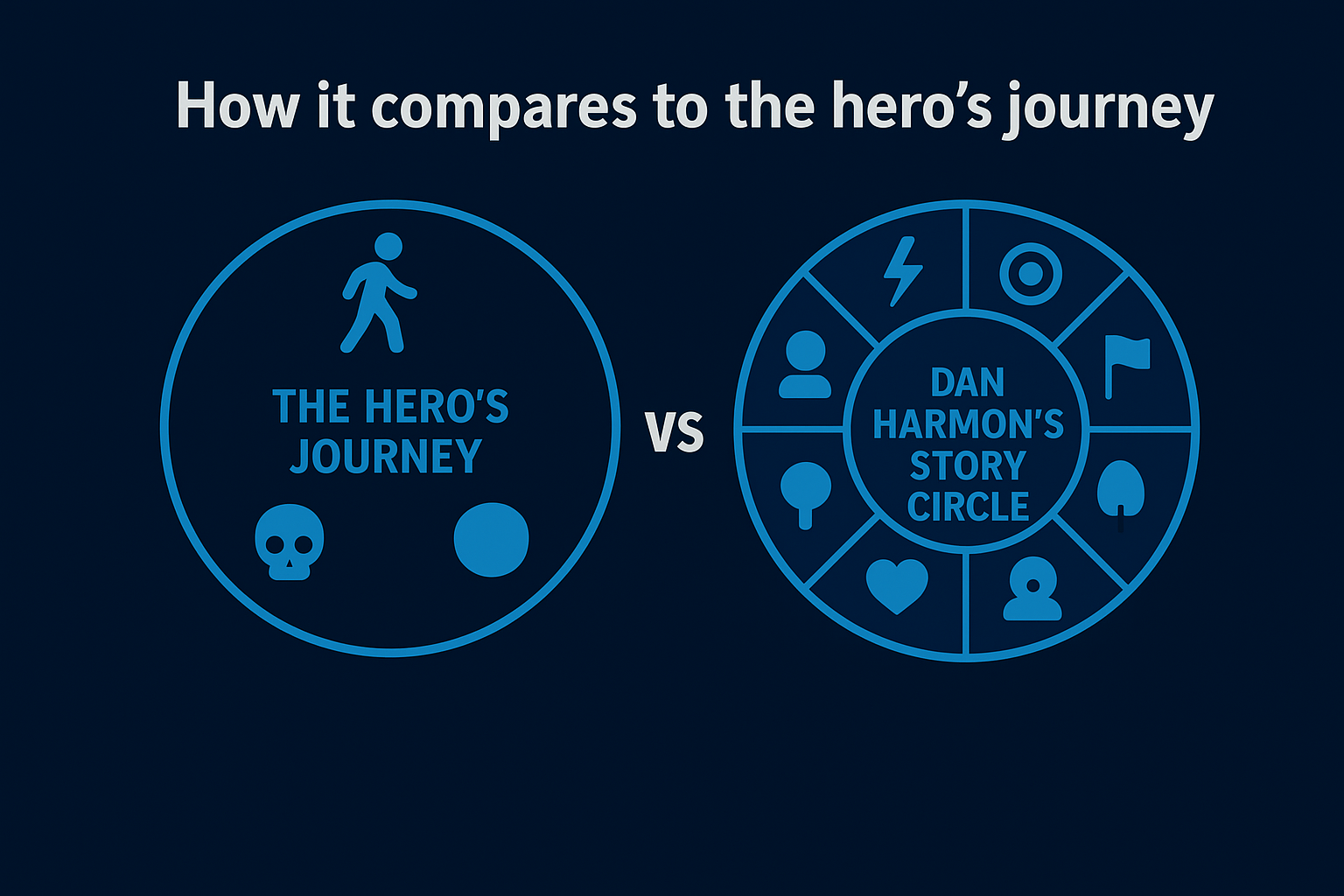
The dan harmon story circle didn't come out of nowhere. Harmon built it directly on top of Joseph Campbell's monomyth, which Campbell laid out in his 1949 book The Hero with a Thousand Faces. Both frameworks describe the same fundamental loop: a protagonist leaves their known world, survives a gauntlet of challenges, and returns transformed. Understanding where these two systems overlap and where they split tells you a lot about what Harmon actually invented and why his version became the go-to tool for working writers.
The hero's journey: the source material
Campbell's monomyth identifies 17 distinct stages spread across three acts: departure, initiation, and return. Those stages cover everything from the "Call to Adventure" to the "Road of Trials" to the "Return with the Elixir." The framework is comprehensive, even exhaustive, and it drew from hundreds of mythological traditions across cultures and centuries. That breadth is its strength and its limitation. A scholar can use it to map The Odyssey and the Mahabharata side by side. A TV writer on a tight deadline cannot quickly stress-test a 22-minute script against 17 moving parts.
Campbell described the pattern that already exists in stories. Harmon built a tool that lets you build it from scratch.
What Harmon stripped away
Harmon took Campbell's 17 stages and compressed them into 8 functional checkpoints, removing the mythological terminology and anything that didn't apply to modern storytelling formats. Campbell's framework is primarily descriptive, meaning you use it to analyze stories that already exist. Harmon's circle is prescriptive by design, giving you a blank structure you fill in before you write a single scene. That shift from analysis to production is the core difference between the two frameworks.
Harmon also made the internal emotional journey explicit in a way Campbell's framework doesn't force you to do. Each step of the circle asks where the character stands emotionally, not just physically or situationally. Campbell's stages track events. Harmon's steps track transformation, which is why writers who use the circle tend to produce characters that feel psychologically real rather than just narratively functional.
Choosing the right framework for your work
If you're studying mythology or analyzing existing stories across cultures, Campbell gives you more granularity and academic depth. If you're writing, whether that's a screenplay, a brand story, or a short-form content script, Harmon's circle gives you something you can actually put to work in a single sitting. Both systems describe the same underlying human truth about how change-based stories operate. The circle just makes that truth faster to apply.
How to outline a story with the circle
Outlining with the dan harmon story circle is faster than most writers expect, because the framework gives you eight specific questions to answer rather than a blank page to fill. You don't need to know every scene before you start. You need to know where your character stands at each checkpoint, and the scenes will follow from those answers naturally. Most writers can produce a working outline in under an hour using this method.
Start with your character, not your plot
Before you touch the circle, lock in your character's starting state. Write two or three sentences describing who they are in their ordinary world, what they want on the surface, and what they actually need underneath that. The gap between the surface want and the deeper need is often where your best story lives. Once you have that foundation, every step of the circle gives you a test: does this event move the character closer to or further from understanding what they actually need?
Your character's internal need drives the circle. The plot is just the pressure that forces them to confront it.
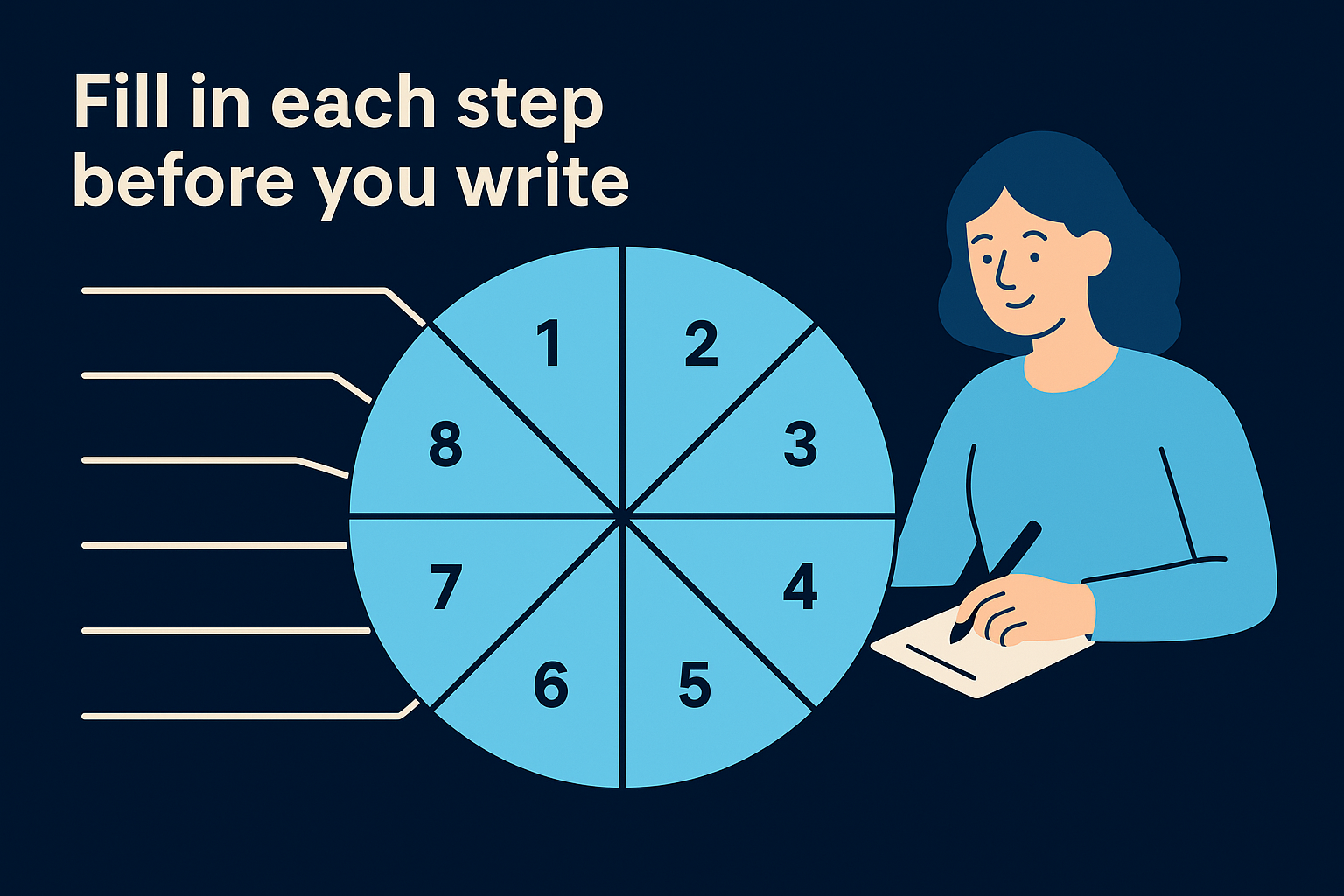
Fill in each step before you write
Work around the circle in order and answer one question per step. You don't need long answers. A single sentence per step is enough to build a solid outline. Here's the set of questions to move through:
- You: What is your character's normal life and default behavior?
- Need: What do they want, and what do they actually need?
- Go: What forces or compels them to leave the familiar?
- Search: What do they try, and how does it fail or complicate things?
- Find: What do they discover or obtain?
- Take: What does getting it cost them?
- Return: How do they bring what they found back?
- Change: How are they different from who they were at the start?
Fill every slot before you write a single scene. Gaps in this outline always become structural problems in the final draft, and catching them now costs you one sentence instead of a full rewrite.
Test the circle before you commit
Once you have all eight steps filled in, read them aloud in sequence. A working circle should feel like one continuous movement, where each step makes the next one feel inevitable. If a step feels disconnected or arbitrary, the problem usually lives in the step before it. Check whether the character has a clear enough need in step two and whether the cost in step six is proportional to what they gained in step five. Fix those two points first, and most structural issues will resolve themselves.
Common mistakes and fixes
Most writers who struggle with the dan harmon story circle make the same handful of errors. The problems rarely show up as obvious plot holes; they surface as a vague sense that something in the story isn't landing, even when the scenes themselves are well-written. Identifying the pattern behind those failures is faster than diagnosing them scene by scene.
Skipping the internal need
Many writers define what their character wants but never identify what they actually need underneath that surface goal. When step two only covers the external desire, the entire circle loses its emotional core. The character moves through events without any psychological pressure driving them, and readers disengage because they sense there's nothing at stake beneath the plot. Fix this by writing two versions of step two: one sentence for what the character wants and one sentence for what they actually need. If those two sentences are identical, dig deeper until they diverge.
The gap between what a character wants and what they need is where the real story lives.
Treating the cost as optional
Step six, the Take, is the hinge of the entire circle. Writers who soften this step or skip it entirely destroy the transformation that every previous step has been building toward. If your character gets what they want in step five without losing anything meaningful in step six, the return in steps seven and eight carries no emotional weight. The fix is direct: whatever your character gains in step five, identify the one thing they can least afford to lose and make that the price they pay.
Starting too late
Some writers skip step one entirely and open the story at step three, the Go. The logic feels reasonable because opening with action seems more immediate. In practice, readers who never see the ordinary world have no baseline for measuring how much the character has changed by the end. You don't need a long setup. You need enough of step one to establish what the character's life looks and feels like before it breaks apart. Even a single scene or a few seconds of footage can do that job if you choose the right details.
Telling the change instead of showing it
Step eight fails most often when writers describe the character's transformation through dialogue or narration rather than observable behavior. Stating that a character "finally understood what mattered" costs nothing and proves nothing to the audience. Showing the character make a concrete decision they would never have made at step one is what actually closes the circle and makes the transformation land as something real.
Examples you can map in minutes
The fastest way to internalize the dan harmon story circle is to map stories you already know. When you can trace the eight steps through a film or a short video in under ten minutes, the framework stops being abstract and starts functioning as a tool you reach for automatically. Two examples below cover different formats, showing you how the circle scales without changing its core structure.
Finding Nemo as a complete circle
Finding Nemo is one of the cleanest real-world examples of all eight steps in a single feature film, and mapping it takes about five minutes once you know what to look for:
| Step | What happens in the film |
|---|---|
| You | Marlin lives a safe, controlled life in his anemone, driven by fear of losing Nemo |
| Need | He needs to learn that protecting someone and trusting them are not the same thing |
| Go | Nemo is taken by a diver and Marlin leaves the reef |
| Search | Marlin struggles across the ocean with Dory, failing repeatedly |
| Find | Marlin locates Nemo in the Sydney dentist's tank |
| Take | He believes Nemo is dead and gives up completely |
| Return | Nemo finds Marlin and they swim home together |
| Change | Marlin lets Nemo leave on the school trip, trusting him to handle the world |
Remove any single step from that table and the transformation at the end stops making sense.
A short-form content example
You don't need a feature film to run the circle. A 60-second video for a business owner can hit all eight steps with enough compression. Picture a founder who starts on camera looking exhausted (You), describes the gap between their output and their results (Need), commits to testing a new content system despite skepticism (Go), shows early attempts failing before the strategy clicks (Search), sees views and inbound leads spike (Find), acknowledges the time and money spent before it worked (Take), shares the system publicly (Return), and closes by saying they now trust process over instinct (Change).
Each step compresses into a few seconds, but the emotional arc lands because the loop is complete. When you build your own short-form scripts with this structure underneath them, you give your audience a narrative their brain can follow all the way to the end.
Where to go next
The dan harmon story circle gives you a complete structural foundation for any story you need to tell. You now know what each of the eight steps does, why the psychological loop works, how it compares to the Hero's Journey, and how to apply it from a rough outline to a polished final draft. Structure removes the guesswork from the part of content creation that most writers consistently get wrong, regardless of how long they've been writing.
If you create short-form content to grow a brand or business, the circle is one piece of a larger system. Consistent, high-performing content requires strategy, scripting, production, and distribution all working together in sequence. At SocialRevver, we build that entire system for founders and business owners who want predictable growth without managing every moving part themselves. If that sounds like what you need, apply for your free social media strategy and we'll map out exactly what your content system should look like.