
You've heard the term thrown around in writing rooms, screenwriting courses, and now short-form content strategy: story beats. But when someone asks you to define one, the answer gets fuzzy fast. Is it a scene? A plot point? A moment of emotional shift? The confusion isn't your fault. Most explanations either stay too abstract or bury the concept in screenwriting jargon that doesn't translate to how stories actually get built.
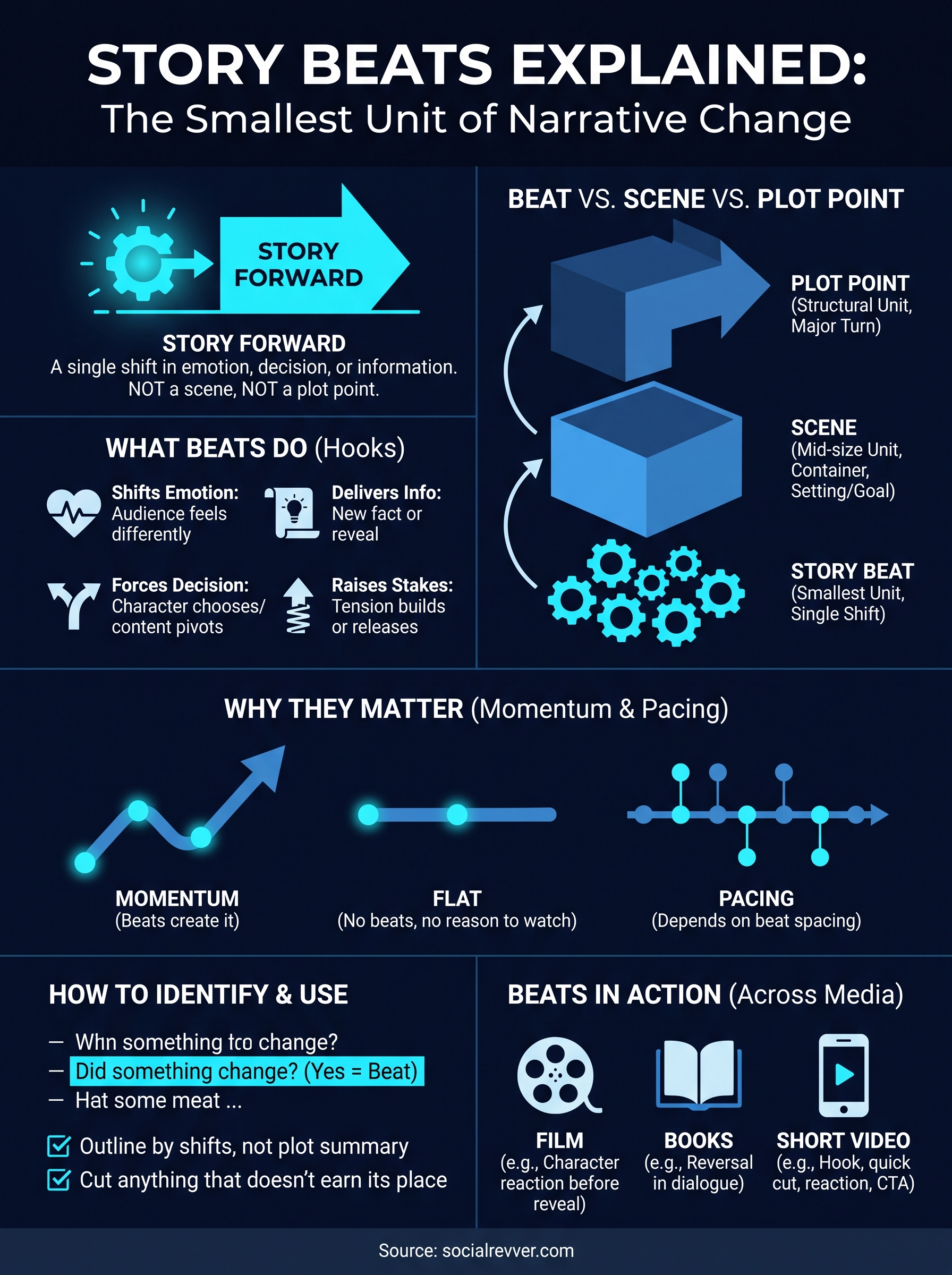
Here's the direct answer: a story beat is the smallest unit of change in a narrative, a single shift in emotion, decision, or information that pushes the story forward. Beats are not scenes (a scene can contain several beats) and they're not plot points (which are the bigger, structural turns a story is built around). Understanding this distinction is what separates writers who structure content on instinct from those who can engineer it deliberately.
In this article, we'll break down exactly what story beats are, how they function inside a scene or script, and how they relate to plot points and scene structure. If you create content for a living or are building a brand that depends on holding attention, this is the foundational skill behind every hook that actually works.
Why story beats matter in a well-told story
A story lives or dies on momentum, and story beats are the mechanism that creates it. Every beat is a small promise to your audience: something just changed, so keep watching. Remove the beats and you get a flat sequence of events with no reason to care what happens next. This is why a technically well-shot video can still bore people, and why a rough clip filmed on a phone can hold attention for a full minute. The difference almost always comes down to beat density and placement, not production value.
A story without beats isn't a story. It's just a list of things that happened.
Beats also give a narrative its emotional rhythm. Pacing depends on how beats are spaced, not just what happens in them. Stack too many low-stakes beats in a row and the audience checks out. Space major beats too far apart and you lose people in the gap. Writers who understand this stop asking "what happens next in the plot" and start asking "what changes in the next five seconds." That shift in thinking is the entire skill.
Here's what a beat actually does inside a piece of content, whether that's a screenplay, a novel chapter, or a 45-second video script:
- Shifts emotion: a character (or your audience) feels differently than they did ten seconds ago
- Delivers new information: a fact, reveal, or piece of context changes what the audience understands
- Forces a decision: a character chooses, or the content pivots direction
- Raises or lowers stakes: tension builds or releases
- Creates or resolves a question: curiosity opens or closes
Every one of those functions is a hook opportunity. This is where screenwriting theory overlaps directly with short-form content strategy. A script for a 30-second video isn't structured around one big idea, it's structured around a chain of beats, each one buying the next three seconds of attention. Miss a beat, and the viewer scrolls. This is also why algorithms reward well-beated content: retention graphs are, in a very literal sense, a visual record of where your beats landed and where they didn't.
Writers who skip this step tend to write scenes that feel busy but go nowhere. Directors who understand beats can take a static two-person conversation and make it gripping, because they know exactly where the emotional turn sits inside the dialogue. The takeaway is the same across mediums: strong stories are built beat by beat, not scene by scene. Master that unit and the larger structure, from plot points to full acts, becomes much easier to control.
How to identify and use story beats in your writing
Spotting a beat is easier than most new writers expect once you know what to look for. Read through a scene or script line by line and ask a single question at every exchange: did something just change? If the answer is yes, you've found a beat. If three lines pass with no shift in emotion, information, or decision, you're looking at filler, and filler is exactly what gets cut in a tight edit or skipped in a scroll.
Spotting beats in a draft
Go through your draft with a highlighter, literally or digitally, and mark every point where something turns. You'll likely notice they cluster unevenly, some sections dense with change, others flat for paragraphs at a time. That unevenness is useful data. Uneven beat spacing is usually the first thing to fix before you touch dialogue or visuals.
If you can't point to what changed in a line, cut the line.
Building beats on purpose
Once you can spot beats, start planning them before you write. Outline a scene not by summarizing the plot but by listing the shifts you want the audience to feel, in order:
- Open on a question or tension
- Introduce information that complicates it
- Force a small decision or reaction
- Raise the stakes
- Land a turn that sets up the next beat
This is the same logic our team at SocialRevver applies when we build conversion-focused scripts for short-form video. You're not writing a story for its own sake, you're engineering a sequence of changes that a viewer can't look away from. Treat every line as a candidate beat, and cut anything that doesn't earn its place.
Story beats vs. scenes and plot points
Confusing these three terms is the fastest way to misdiagnose a weak script, so story beats explained side by side with scenes and plot points clears up a mix-up that trips up even experienced writers. A scene is a container, defined by location or time, and it usually holds several beats stacked back to back. A plot point is a structural landmark, the kind of event that redirects the whole narrative, like a reveal or a reversal. A beat sits underneath both, the actual unit of change that makes the scene move and eventually builds toward the plot point.
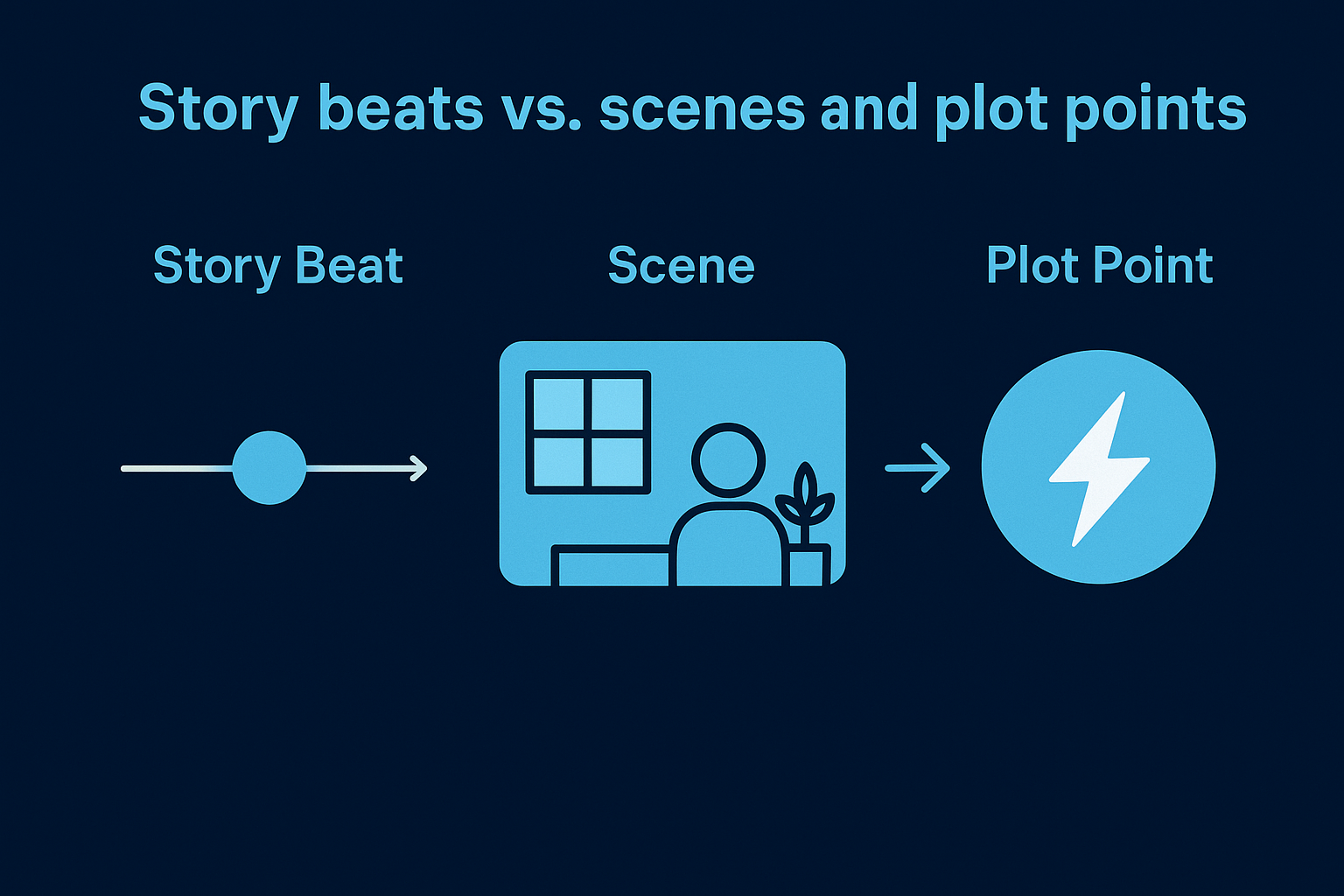
Scenes are where beats live, and plot points are what beats build toward.
Scale is the real difference
Grasping the difference gets easier with a side-by-side view of scope and function.
| Element | Scope | Function | Example |
|---|---|---|---|
| Story beat | Smallest unit | Single shift in emotion, info, or decision | A character hesitates before answering |
| Scene | Mid-size unit | Groups beats around one setting or goal | A negotiation in a boardroom |
| Plot point | Structural unit | Major turn that redirects the story | The negotiation collapses, changing the whole plan |
Think of it as a nested structure: multiple beats build a scene, and multiple scenes build toward a plot point.
Why the distinction matters practically
Knowing where you're operating changes what you fix. If a scene drags, the fix is almost never a bigger plot point, it's a missing beat. Writers who confuse the two tend to add explosive events to fix pacing problems that actually needed a small, well-placed emotional shift three lines earlier. Fixing beats first, then checking scene structure, then confirming plot points still land, is the order that actually works.
Story beats in action across films, books, and video
Watching for beats in finished work is the fastest way to internalize the concept, because recognizable examples make an abstract idea concrete. Pixar's story department is famous for building entire films from beat sheets before a single frame gets drawn, listing every emotional shift a scene needs before dialogue gets written. Novelists do the same thing with less formal language, often calling it a "turn" or a "reversal," but the function is identical: something changes, and the reader keeps reading.
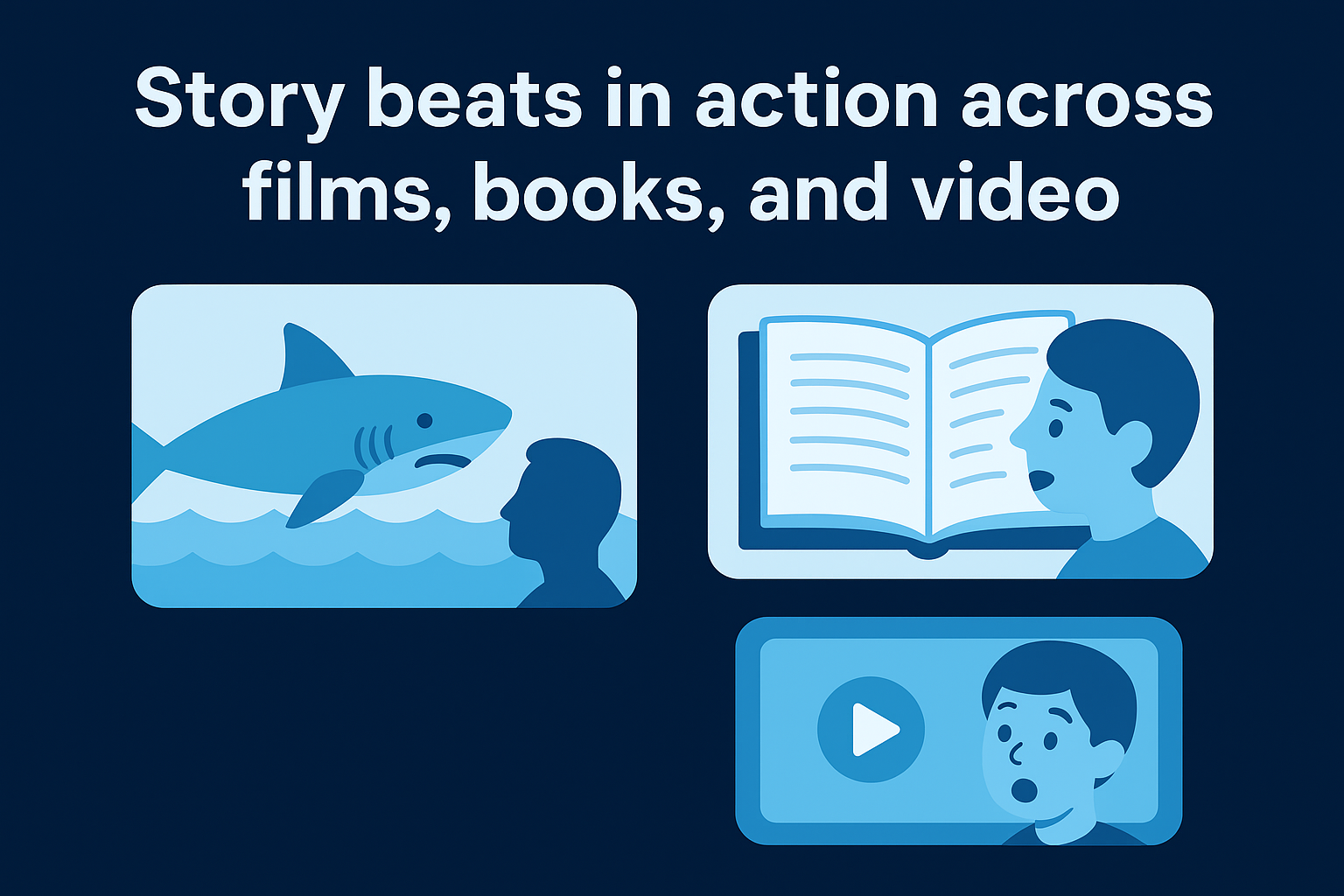
The best-known scenes in film and fiction aren't remembered for their plot, they're remembered for the beat that hit hardest.
Feature films and novels
Consider the shark reveal in Jaws. The beat isn't the shark itself, it's the shift from suspicion to certainty on the character's face half a second before the audience sees it. In novels, a single line of dialogue often carries the same weight, forcing a character to react before the next paragraph even explains why. Genre fiction leans on this constantly, stacking small reversals every page or two to keep readers turning pages past midnight.
Short-form video beats
Apply the same lens to a 30-second product video and the pattern holds. A hook line creates a question, a quick cut delivers new information, a close-up captures a reaction, and a final line resolves the tension with a call to action. Short-form video compresses beats into seconds instead of minutes, but the mechanics don't change. Whether you're studying a Pixar script, a bestselling thriller, or a client's Reel, the beats doing the actual work are always the smallest ones.
Bringing beats into your next story
You now know story beats explained in a way most writing guides never bother to clarify: the smallest shift in emotion, information, or decision, distinct from scenes and separate from plot points. That distinction alone changes how you write. Instead of outlining plot, you'll start outlining change, line by line, until every second of a script earns its place.
Apply this the next time you draft a scene or a script. Ask what shifted in the last five seconds, cut what didn't earn its spot, and watch pacing problems disappear without touching a single plot point. Deliberate beat placement is the difference between content people scroll past and content they finish.
If you'd rather have a team engineer that structure for you, get a free 40+ slide social media strategy built on the same beat-driven principles behind every script we produce.