
Every piece of content that holds attention, whether it's a 60-second reel or a feature-length film, follows a structure. Knowing how to structure a story isn't just an academic exercise for novelists. It's the difference between content that gets scrolled past and content that stops someone mid-thumb and keeps them watching until the end.
Most founders and creators skip this step entirely. They jump straight into production without a blueprint, then wonder why their content feels flat or forgettable. But story structure is engineering, not art. It's a repeatable system of tension, payoff, and emotional sequencing that can be learned, applied, and scaled. That's exactly how we approach content production at SocialRevver, our scripting engine is built on the same narrative principles covered in this guide, reverse-engineered from hundreds of thousands of high-performing videos and adapted for short-form content that converts.
This article breaks down five proven plot frameworks, from the classic three-act structure to less conventional models like the Story Circle and Fichtean Curve, so you can pick the right one for your next script, video, or long-form project. You'll walk away with a clear understanding of each framework, when to use it, and how to apply it to stories that actually move people to act.
What story structure does and why it works
Structure isn't a constraint on creativity. It's the invisible framework that makes your creativity land. Every story your audience has ever loved, whether it was a film, a book, or a two-minute social video, followed a recognizable pattern of setup, tension, and resolution. Those patterns aren't accidents. They're the result of thousands of years of human storytelling filtered through what consistently works across cultures, formats, and generations.
Structure mirrors how the brain processes experience
Your audience's brain is constantly predicting what comes next. When you deliver a story with clear cause-and-effect sequences, rising stakes, and a satisfying resolution, you're working with that prediction machinery rather than against it. Research on narrative processing shows that structured stories trigger neural coupling, a phenomenon where a listener's brain activity begins to mirror the storyteller's. That synchronization drives comprehension, emotional response, and memory retention simultaneously.
The brain doesn't remember information. It remembers stories, and only the ones that follow a pattern it can track.
Understanding how to structure a story starts with recognizing that your audience isn't passively receiving content. They're actively building a mental model of where the story is going. When your structure breaks down, their model collapses and they disengage. When your structure holds, they stay locked in because their brain is rewarded every time a prediction pays off with a correctly sequenced beat or earned emotional moment.
Structure creates the tension that keeps people watching
Tension is not drama for its own sake. Tension is unresolved expectation, and it's the single most powerful tool you have to hold attention across any format. Structure creates tension by design. You establish something your audience wants to see resolved, a question, a conflict, a goal, and then you deliberately delay that resolution while escalating the difficulty of reaching it.
Without a defined structure, most content creators either resolve tension too early, killing suspense before it can build, or never establish it in the first place, producing content that feels purposeless and forgettable. A solid framework gives you specific structural moments to introduce conflict, raise stakes, and deliver payoffs. Your audience feels the rhythm of those beats even if they can't consciously name them, and that felt rhythm is what keeps them watching.
Structure is what separates repeatable results from lucky breaks
Most creators who produce compelling content consistently aren't more talented than those who don't. They're more systematic about how they sequence their stories. They use structure as a production tool rather than a creative afterthought. That's why frameworks like the three-act structure or the Hero's Journey have survived for centuries. They aren't formulas that make stories feel generic. They're scaffolding that holds the narrative together while freeing you to focus on voice, specificity, and the details that make your content feel original.
When you apply a proven structure to your content, you stop gambling on whether a piece will land. You build predictability into your creative process from the start. For a founder or content creator producing at volume, that predictability is the difference between a content strategy and a content lottery. Each framework covered in this guide gives you a different set of structural tools: some built for tight, plot-driven narratives, others designed for deep character transformation arcs, and each one translates cleanly across formats, from long-form scripts to short-form videos optimized for social platforms.
Step 1. Define your story in one clear sentence
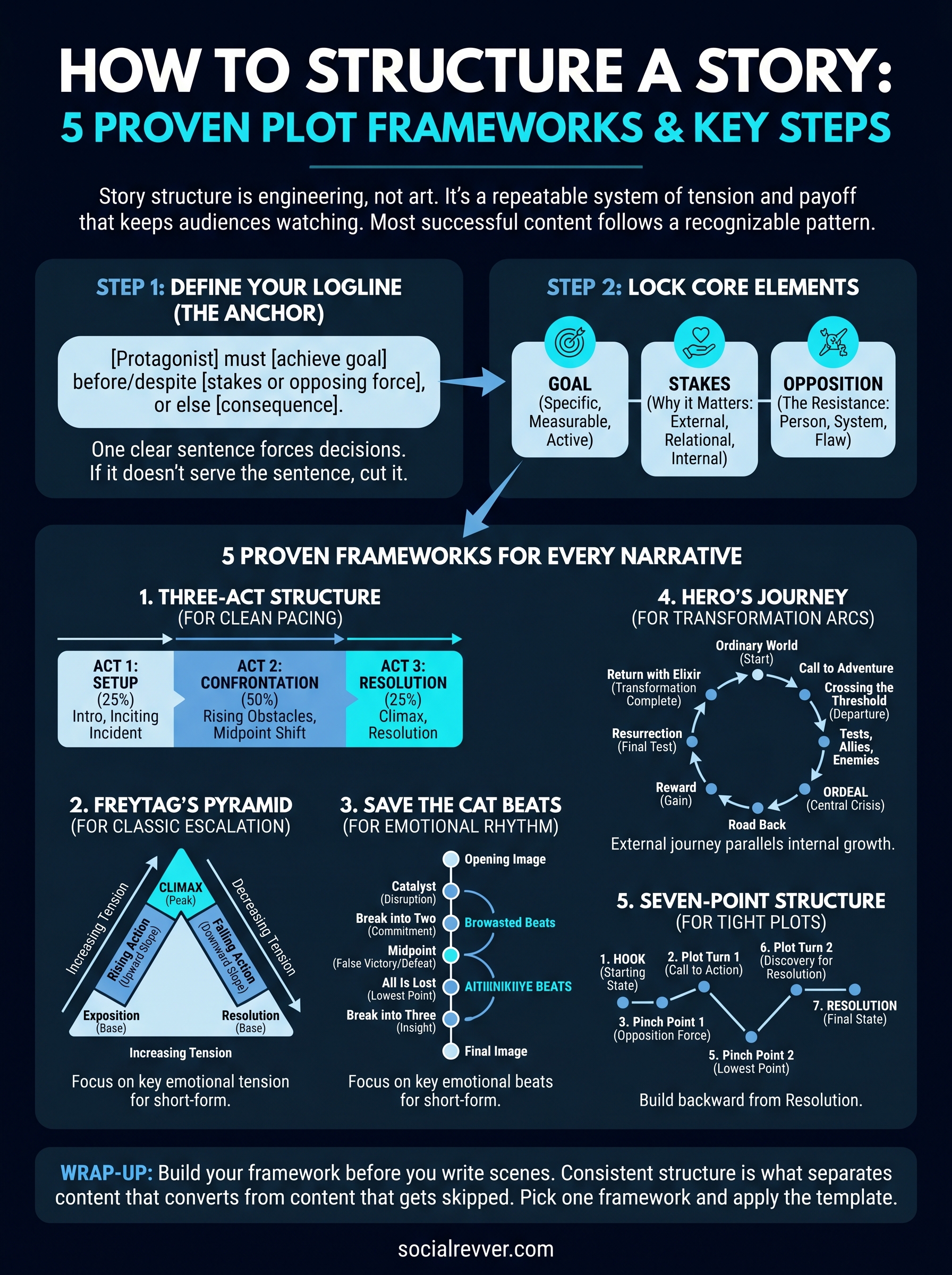
Before you pick a framework, before you map acts or beats, you need to be able to say what your story is in a single sentence. This is called a logline, and it's the most reliable diagnostic tool available when learning how to structure a story. If you can't summarize your story in one clear sentence, you don't have a story yet. You have a collection of ideas that haven't been shaped into anything coherent enough to build from.
Why one sentence forces clarity
A single sentence forces you to make decisions. You can't be vague or sprawling in one sentence, which means you have to commit: who this story is about, what they want, and what's in the way. Most structural problems in content, scripts, and narratives trace back to a fuzzy or missing logline. The creator hadn't resolved those three things before they started writing, so the story wanders.
A story without a clear logline is a story without a spine. Everything else you build will shift unless you anchor it first.
When you write your logline before anything else, you give every scene, beat, and turning point a test it has to pass. If a scene doesn't serve the sentence, it doesn't belong in the story. That filter alone will cut more dead weight from your content than any editing pass after the fact.
How to write your logline
A usable logline follows a simple structural pattern. You don't need to be poetic. You need to be precise.
Use this template:
[Protagonist] must [achieve goal] before/despite [stakes or opposing force],
or else [consequence].
Here are three examples across different formats:
| Format | Logline |
|---|---|
| Short-form video | A burned-out founder must rebuild his business in 90 days without outside funding, or lose his team permanently. |
| Brand narrative | A first-generation immigrant must convince a skeptical market her product belongs at the premium tier, before a well-funded competitor takes the shelf space. |
| Long-form script | A mid-career engineer must expose a systemic safety flaw in a billion-dollar infrastructure project, despite a company determined to bury the evidence. |
Each of these gives you a protagonist, a goal, and a force creating resistance. That's all a logline needs to do. Once you have one that's this specific, you can test any framework against it and immediately see where your turning points should land. Your logline becomes the anchor for every structural decision you make from this point forward.
Write yours before you move to the next step. If it takes more than two sentences, cut it down.
Step 2. Lock the protagonist goal, stakes, and opposition
Your logline gives you a one-sentence anchor. Now you need to develop the three structural elements it contains into something concrete enough to build a full story around. Goal, stakes, and opposition are not just story concepts. They are the load-bearing pillars of your narrative, and if any one of them is weak or vague, your entire structure will feel unstable no matter which framework you apply when learning how to structure a story.
Define the goal with precision
A goal is only useful structurally if it is specific and measurable. "Wants a better life" is not a goal. "Needs to close a $500K contract in 30 days to keep the company solvent" is a goal. The difference is that your audience can track progress toward the second one. They know when your protagonist is closer to it and when they're further away, and that tracking is what creates narrative momentum throughout your story.
Your goal should also be active. The protagonist must be pursuing something, not just reacting to events around them. Write the goal as a single declarative statement using an action verb.
Goal template:
[Protagonist] needs to [specific, measurable outcome] by [deadline or condition].
Set the stakes that make the goal matter
Stakes answer the question your audience is always asking: why should I care if this succeeds or fails? Without clear stakes, even a well-defined goal feels weightless. Stakes come in three layers, and the strongest stories use at least two of them simultaneously.
| Layer | What it threatens | Example |
|---|---|---|
| External | Status, livelihood, physical safety | Losing the company, being fired, public failure |
| Relational | A key relationship | Losing a partner's trust, alienating a team |
| Internal | Identity or self-belief | Proving they were never capable of leading |
The more your audience can see what the protagonist stands to lose, the more invested they become before the first obstacle even appears.
Build an opposition that creates real resistance
Opposition is not a villain. It is anything that makes the goal harder to reach, and it works best when it reflects or challenges something core to the protagonist. A structural opponent can be a person, a system, a deadline, a personal flaw, or a combination of all four.
What matters is that your opposition is strong enough to create genuine doubt about whether the protagonist will succeed. If your audience can see the outcome from the first scene, there is no tension to sustain. Lock your opposition before you write a single scene, and make sure it can credibly block the goal at every stage of your structure.
Step 3. Map your key turning points before you write scenes
With your goal, stakes, and opposition locked, you have everything you need to map the key turning points of your story before you write a single scene. A turning point is any moment that permanently changes the direction of your narrative, forcing your protagonist to make a decision or take an action that closes off one path and opens another. Mapping these in advance is one of the most efficient ways to understand how to structure a story because it shows you the full shape of your narrative before you invest time writing scenes that may not serve it.
What a turning point actually is
A turning point is not a scene. It is a structural hinge that the scenes around it rotate against. Most stories carry between four and seven major turning points depending on their length and format. Each one should raise the stakes, shift the protagonist's situation, or force a meaningful choice with real consequences. If a moment in your story doesn't do at least one of those things, it is probably not a turning point. It may be a scene detail or backstory that belongs somewhere else.
A turning point that doesn't change something permanently is just a plot event. Only real consequences create real narrative momentum.
The clearest way to test a turning point is to ask: what is different after this moment compared to before it? If the answer is "not much," the moment is not load-bearing and your structure has a gap that will surface as a pacing problem later.
How to map your turning points before you draft
Start with a blank document or a set of index cards and build a turning point map using this template:
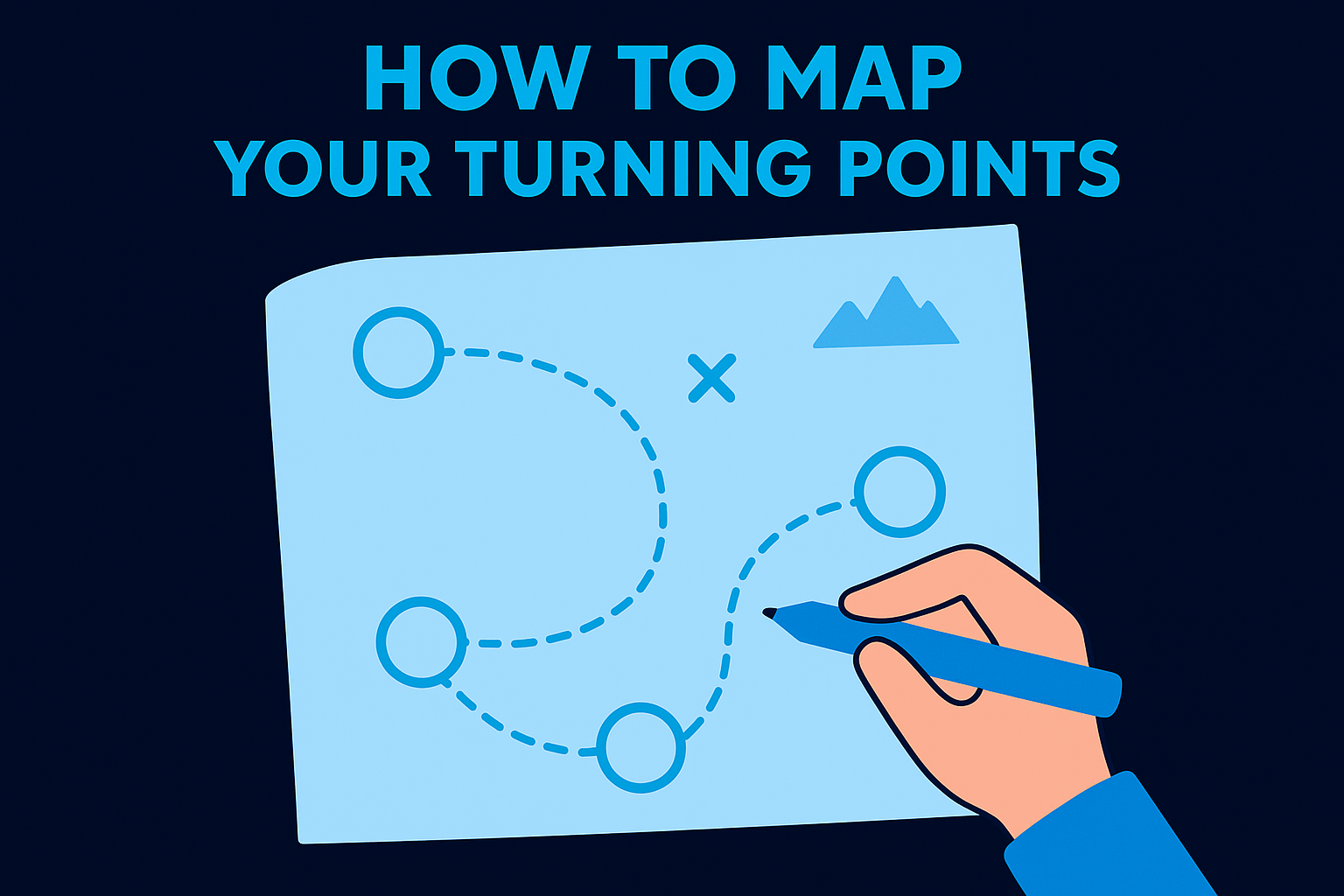
Turning Point [#]
Before: [Protagonist's situation, goal status, and emotional state]
Event: [What happens that forces a change]
Decision: [What the protagonist chooses or is forced to do]
After: [How the situation, goal, and stakes have shifted]
Consequence: [What is now impossible that was possible before]
Work through a minimum of four turning points before you start writing scenes. You don't need full scene descriptions at this stage. You need enough specificity that each turning point clearly changes the trajectory of your story and connects logically to the next one.
Here is a concrete example built around a short-form brand narrative:
| Turning Point | Event | Consequence |
|---|---|---|
| 1 | Founder loses biggest client overnight | Must rebuild revenue with no existing pipeline |
| 2 | New strategy fails publicly | Team confidence collapses |
| 3 | Data reveals a missed opportunity | Forces a complete pivot in approach |
| 4 | Pivot wins a larger client | Original loss reframed as the necessary catalyst |
Once your turning point map is complete, every scene you write has a clear structural job: move the story from one hinge to the next without losing momentum.
Framework 1. Use the three-act structure for clean pacing
The three-act structure is the most widely used framework for organizing narrative content across film, television, and long-form writing. If you're learning how to structure a story for the first time, this is the model to start with. It divides your story into a setup, a confrontation, and a resolution, and each act carries a specific structural function that keeps pacing consistent and purposeful from the first beat to the last.
What the three acts contain
Each act has a clear job in the narrative. The first act establishes your protagonist, their world, and the central problem. The second act is where the protagonist actively pursues the goal while opposition escalates. The third act delivers the climax and resolution. Most scripts and long-form content allocate roughly 25 percent of total length to Act 1, 50 percent to Act 2, and 25 percent to Act 3.
The second act is where most stories collapse because writers treat it as filler between the setup and the ending, rather than the engine that drives the whole structure.
| Act | Function | Approximate length |
|---|---|---|
| Act 1 (Setup) | Introduce protagonist, establish world, trigger inciting incident | 25% of total |
| Act 2 (Confrontation) | Escalate obstacles, raise stakes, force midpoint shift | 50% of total |
| Act 3 (Resolution) | Deliver climax, resolve central conflict, close character arc | 25% of total |
How to apply the three-act structure to your content
To apply this framework to your next script or narrative piece, start by assigning your turning points to the act boundaries rather than writing from start to finish. The transition from Act 1 to Act 2 is your inciting incident, the moment that locks your protagonist into the central conflict. The transition from Act 2 to Act 3 is your darkest moment or major reversal, where the protagonist faces the consequences of the midpoint decision and must make a final commitment.
Use this template to map your three acts before drafting any scenes:
ACT 1 (Setup)
- Opening state: [Who is the protagonist and what is their world?]
- Inciting incident: [What disrupts the status quo?]
- Act 1 exit: [What forces the protagonist into the central conflict?]

ACT 2 (Confrontation)
- Rising obstacles: [What three challenges escalate the difficulty?]
- Midpoint shift: [What changes the protagonist's approach at the halfway mark?]
- Act 2 exit: [What is the lowest point or major reversal?]

ACT 3 (Resolution)
- Climax: [What is the final confrontation or decision?]
- Resolution: [How does the conflict end and what has changed?]
Filling out this template before you write a single scene will expose any gaps in your pacing and give you a complete structural map to write against.
Framework 2. Use Freytag's Pyramid for classic escalation
Freytag's Pyramid is a five-stage narrative model developed by German playwright Gustav Freytag in 1863. Where the three-act structure optimizes for clean pacing, Freytag's model is built around deliberate escalation, making it especially useful for stories where emotional intensity is the primary driver. If you're working on a brand narrative, a long-form script, or any content where you want your audience to feel the story building toward something inevitable, this framework gives you a clear structural path for how to structure a story with maximum dramatic effect.
What Freytag's Pyramid contains
The pyramid moves through five sequential stages, each carrying a specific structural job. The shape of the model is not accidental: the stages form a visual arc, rising sharply through the middle and then resolving on the descending slope. Understanding what each stage does keeps you from compressing or skipping the parts of the structure that actually create tension.
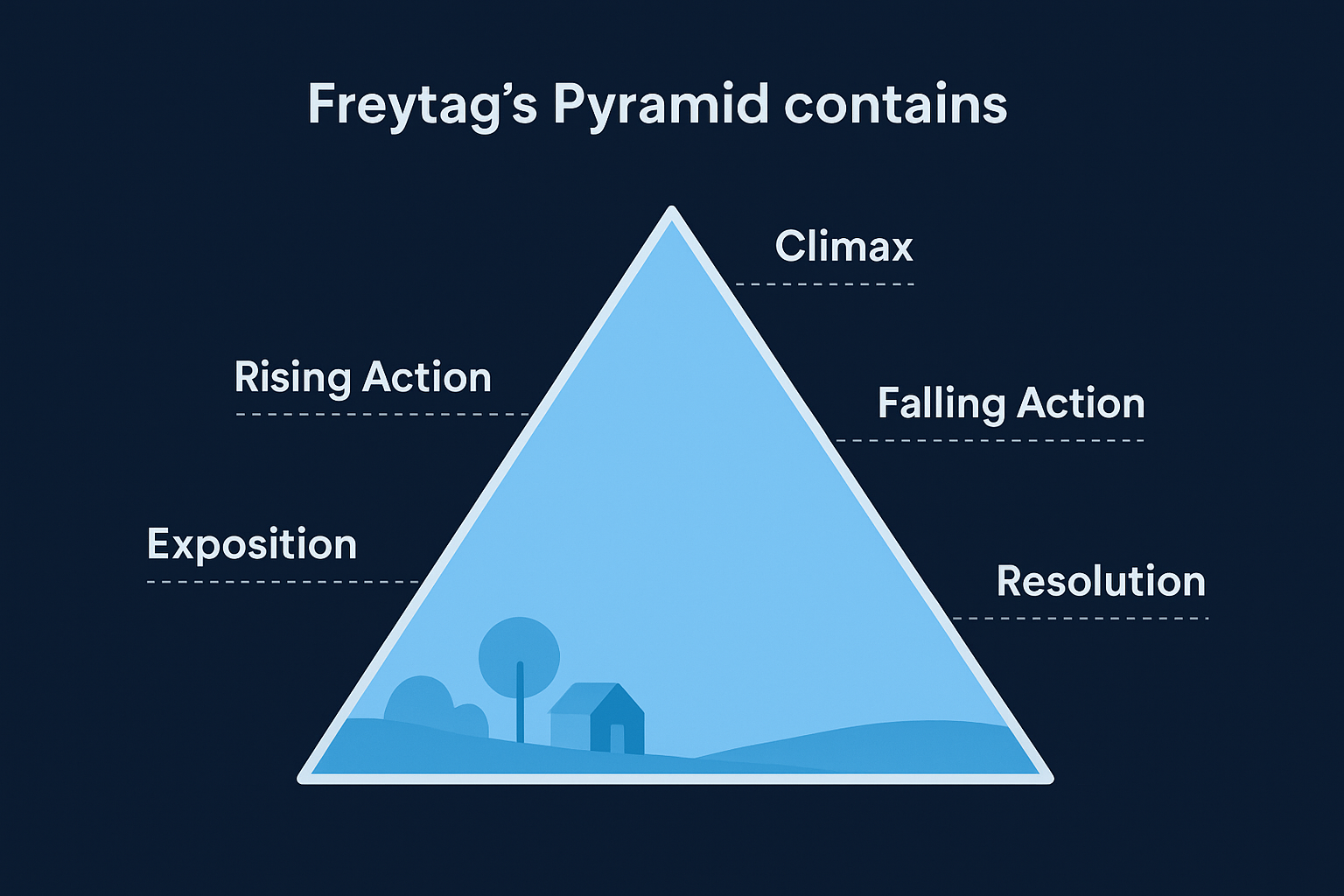
| Stage | Function | What it contains |
|---|---|---|
| Exposition | Establish the world and protagonist | Background, setting, initial situation |
| Rising Action | Build conflict and escalate obstacles | Complications that push toward crisis |
| Climax | Peak moment of maximum tension | The decisive confrontation or turning point |
| Falling Action | Show consequences of the climax | The protagonist dealing with the outcome |
| Resolution | Close the arc and restore order | Final state of the protagonist and world |
The climax in Freytag's model is not the ending. It is the peak of the pyramid, and the falling action and resolution are just as structurally essential as everything that came before them.
How to apply Freytag's Pyramid to your content
Use this template to map each stage against your logline before you write any scenes. Fill in each field with one to three specific sentences describing what happens at that point in your story.
FREYTAG'S PYRAMID MAP

Exposition:
- World state: [Describe the protagonist's situation before conflict begins]
- Audience hook: [What draws the audience in from the first moment?]

Rising Action:
- Obstacle 1: [First complication that raises difficulty]
- Obstacle 2: [Second complication that raises stakes further]
- Obstacle 3: [Third complication that forces a critical decision]

Climax:
- Peak moment: [Highest tension point and what the protagonist must choose]

Falling Action:
- Consequence 1: [First result of the climax decision]
- Consequence 2: [Secondary fallout that shapes the resolution]

Resolution:
- Final state: [How the protagonist's world and identity have changed]
This framework works best when your rising action contains at least three distinct obstacles, each carrying higher stakes than the last. If your escalation feels flat when you fill in the template, add a concrete consequence to each obstacle so your audience can track the mounting cost of each failure along the arc.
Framework 3. Use Save the Cat beats for clear story beats
Blake Snyder's Save the Cat framework breaks a story into 15 specific beats that map out every major structural moment from the opening image to the final frame. Where other frameworks give you broad acts or stages, this system gives you named checkpoints with clear functions, making it one of the most actionable tools for anyone learning how to structure a story at the scene level. It was developed for screenwriting, but its beat-by-beat precision translates directly to short-form scripts, brand narratives, and long-form content.
What the Save the Cat beats contain
Each beat has a specific structural job, and the sequence is not arbitrary. Snyder designed the beats to mirror the emotional rhythm audiences expect from a well-paced story, which is why the framework produces content that feels instinctively satisfying even when viewers can't articulate why.
The power of this framework is not in following it rigidly but in understanding what each beat is trying to accomplish so you can adapt it to your format.
The 15 beats and their functions are:
| Beat | Function |
|---|---|
| Opening Image | Establish the protagonist's world before change |
| Theme Stated | Hint at what the story is really about |
| Set-Up | Introduce protagonist, stakes, and status quo |
| Catalyst | The event that disrupts the protagonist's world |
| Debate | The protagonist hesitates before committing |
| Break into Two | Protagonist enters the new situation or world |
| B Story | Secondary relationship or subplot introduced |
| Fun and Games | Protagonist explores and tests the new world |
| Midpoint | False victory or false defeat raises the stakes |
| Bad Guys Close In | Opposition intensifies and pressure mounts |
| All Is Lost | The lowest point in the protagonist's arc |
| Dark Night of the Soul | Protagonist processes failure before the final push |
| Break into Three | The protagonist finds the insight needed to act |
| Finale | Protagonist applies the lesson and resolves the conflict |
| Final Image | Mirror of the opening image showing how the world has changed |
How to apply Save the Cat beats to your content
You don't need to use all 15 beats in every piece of content. For short-form video, focus on five core beats: Opening Image, Catalyst, Break into Two, All Is Lost, and Final Image. These five carry the emotional arc that makes a short-form narrative feel complete. For longer scripts or brand narratives, use the full sequence as a pre-writing checklist to confirm every structural function is covered before you start drafting scenes.
Use this condensed template for short-form application:
SAVE THE CAT (SHORT-FORM TEMPLATE)

Opening Image: [Show the protagonist's world before anything changes]
Catalyst: [Identify the disruption that forces change]
Break into Two: [Define the moment the protagonist commits to action]
All Is Lost: [Name the lowest point before the final push]
Final Image: [Show how the world has shifted from the opening]
Fill in each field with one specific sentence before you write a single line of your script.
Framework 4. Use the Hero's Journey for transformation arcs
Joseph Campbell's Hero's Journey is the most character-focused framework on this list, and it's the right choice when the core of your story is not what happens but who your protagonist becomes because of what happens. Originally documented in Campbell's 1949 work The Hero with a Thousand Faces, the model identifies a pattern that appears across myths, religions, and cultures worldwide. For anyone working out how to structure a story built around personal transformation, a brand origin, or a founder's journey, this framework gives you a structural path that makes the character's internal shift feel earned rather than asserted.
What the Hero's Journey contains
The framework moves through 12 stages organized around a central departure and return. Your protagonist leaves a familiar world, faces escalating trials in an unfamiliar one, and returns transformed. The external journey and the internal arc run in parallel, which is what separates this framework from plot-driven models. The stages most critical to the transformation arc are the Ordeal, the Reward, and the Road Back, because those three together define what your protagonist loses, gains, and chooses to carry home.
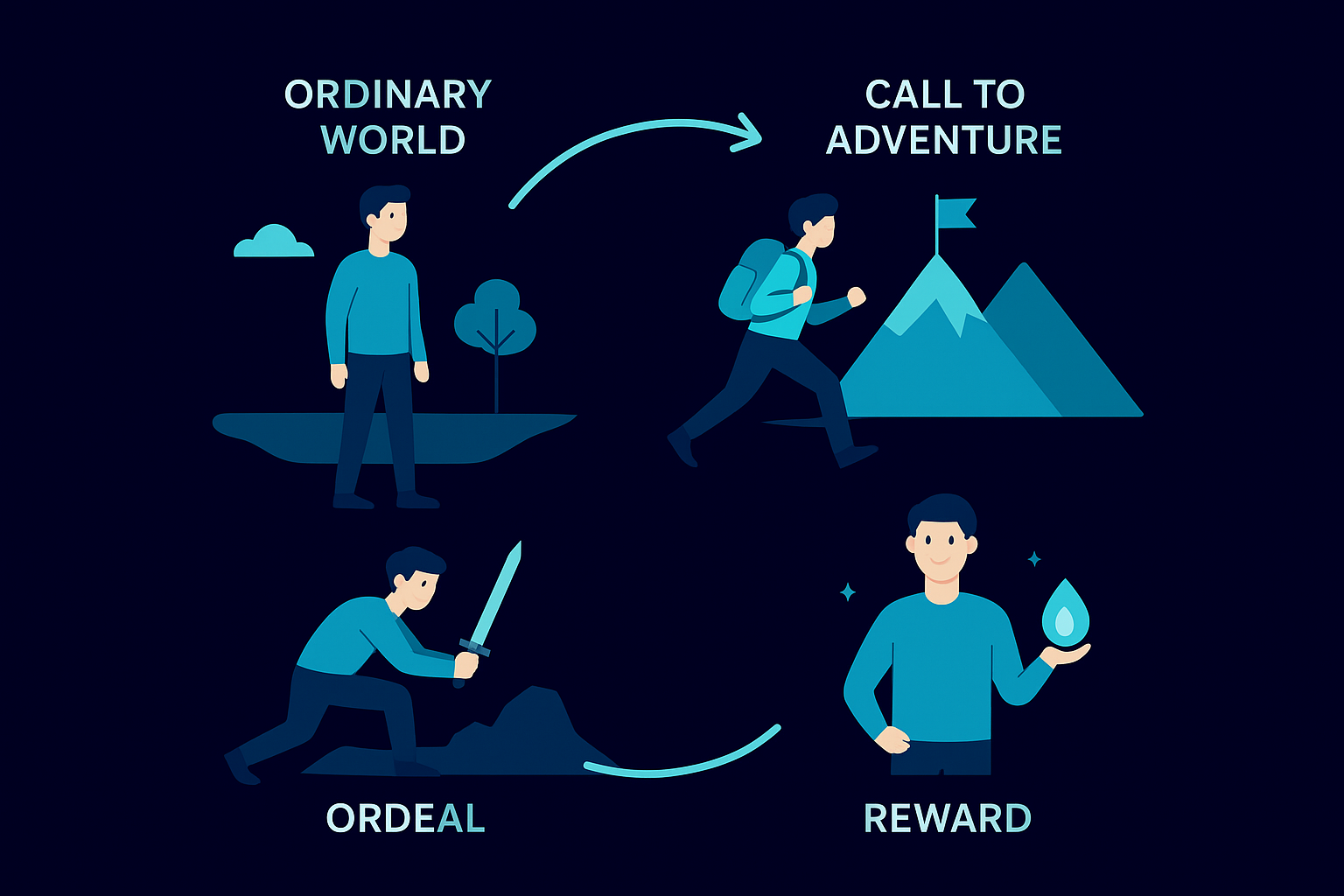
The Hero's Journey works because the protagonist who returns is not the same person who left, and your audience needs to feel that gap clearly to experience the transformation as real.
| Stage | Function |
|---|---|
| Ordinary World | Establish who the protagonist is before the call |
| Call to Adventure | Introduce the disruption or opportunity |
| Refusal of the Call | Show the protagonist's resistance or fear |
| Meeting the Mentor | Provide guidance, tools, or belief |
| Crossing the Threshold | Protagonist commits and enters the new world |
| Tests, Allies, Enemies | Build competence and opposition through trials |
| Ordeal | The central crisis that forces the deepest cost |
| Reward | What the protagonist gains from surviving the ordeal |
| Road Back | The choice to return and face remaining consequences |
| Resurrection | Final test that confirms the transformation is complete |
| Return with the Elixir | Protagonist brings the earned insight back to their world |
How to apply the Hero's Journey to your content
You don't need to use all 11 stages in every piece of content. For short-form brand narratives, collapse the journey into five anchor stages: Ordinary World, Call to Adventure, Ordeal, Reward, and Return with the Elixir. This five-stage version preserves the transformation arc while fitting the constraints of shorter formats.
Use this template before drafting any scenes:
HERO'S JOURNEY (CONDENSED TEMPLATE)

Ordinary World: [Who is the protagonist before the disruption?]
Call to Adventure: [What forces them out of their comfort zone?]
Ordeal: [What is the hardest moment and what does it cost them?]
Reward: [What do they gain or learn from surviving it?]
Return with the Elixir: [How has the protagonist changed and what do they bring back?]
Fill in each field with one specific sentence tied directly to your logline before you write a single scene.
Framework 5. Use the seven-point structure for tight plots
The seven-point structure, developed by author Dan Wells, is the most plot-mechanics-focused framework on this list. Where the Hero's Journey prioritizes internal transformation and Save the Cat maps emotional rhythm, this model is built for precision and compression. Every point serves a specific structural function, and nothing exists between them by accident. If you're working out how to structure a story that needs to move fast, stay tight, and keep your audience tracking plot momentum from the first scene to the last, this is the framework to use.
What the seven points contain
The framework is built around a direct line between your opening state and your resolution, with five structural points in between that force escalating change at regular intervals. Wells designed it to work backward: you start by defining your resolution, then your hook, and then you fill in the middle. That reverse-engineering approach is what makes this model uniquely useful for plot-driven content because it forces you to know where you're going before you decide how to get there.
Knowing your resolution before you write your hook is the fastest way to build a story that feels inevitable rather than improvised.
| Point | Function |
|---|---|
| Hook | Establish the protagonist's starting state, opposite to the resolution |
| Plot Turn 1 | Introduce the call to action that locks the protagonist into the conflict |
| Pinch Point 1 | Show the opposition in full force for the first time |
| Midpoint | The protagonist shifts from reacting to actively pursuing the goal |
| Pinch Point 2 | Opposition strikes again, harder, forcing the protagonist toward the lowest point |
| Plot Turn 2 | The protagonist discovers the final piece needed to resolve the conflict |
| Resolution | The protagonist acts on that discovery and closes the arc |
How to apply the seven-point structure to your content
Start by writing your resolution first, then write your hook as its direct opposite. If your resolution shows a founder who has built a loyal team and a scalable system, your hook should show them isolated and operating without a repeatable process. That contrast is what makes the resolution feel earned. Once those two endpoints are fixed, fill in the five middle points using the template below.
SEVEN-POINT STRUCTURE TEMPLATE

Hook: [Opening state, opposite of where the story ends]
Plot Turn 1: [Event that pulls the protagonist into the central conflict]
Pinch Point 1: [First direct display of opposition's full strength]
Midpoint: [Moment protagonist stops reacting and starts pursuing]
Pinch Point 2: [Opposition forces the protagonist to their lowest point]
Plot Turn 2: [Discovery or shift that makes resolution possible]
Resolution: [Final state, opposite of the hook]
Fill in each point with one concrete sentence before you write any scenes. If any point feels vague when you complete the template, the story has a structural gap that will show up as a pacing problem later.
A simple way to wrap it up
Learning how to structure a story comes down to one consistent habit: build your framework before you write your scenes. Start with a logline. Lock your goal, stakes, and opposition. Map your turning points. Then choose the framework that fits what your story needs most, clean pacing, escalating tension, beat-level clarity, transformation, or tight plot mechanics. Each of the five frameworks in this guide gives you a different structural tool, and none of them require you to sacrifice voice or originality to use them.
You don't need to master all five at once. Pick one, apply the template to your next piece of content, and build from there. Consistent structure is what separates content that converts from content that gets skipped. If you want a team that applies these same narrative principles at scale, using data from hundreds of thousands of high-performing videos, get your free social media strategy and see exactly how it works.