
Every piece of content that holds attention, a 60-second reel, a founder's origin story, a product launch video, follows a pattern. That pattern is story arc structure, and it's the reason some content gets watched all the way through while the rest gets swiped past in under two seconds. It's not about production quality or trending audio. It's about how the narrative moves.
A story arc is the sequence of emotional and logical beats that pulls a viewer from curiosity to commitment. It applies to novels, screenplays, keynote speeches, and yes, short-form video content. The structure gives your audience a reason to stay, a reason to care, and a reason to act. Without it, you're just talking at people. With it, you're building something they feel.
At SocialRevver, story arc structure is baked into every script our system produces. Our Scripting Engine doesn't generate random hooks and hope for the best, it builds conversion-focused narratives rooted in the same psychological frameworks you'll learn about in this article. Understanding these principles gives you a serious edge, whether you're creating content yourself or evaluating what a team produces for you.
This guide breaks down the five core stages of story arc structure, explains what each one does, and shows you how to apply them. By the end, you'll understand exactly why some stories land and others fall flat, and how to engineer that difference on purpose.
What story arc structure means
Story arc structure is the underlying framework that gives a narrative its shape. Think of it as the spine of any piece of storytelling, whether that's a three-hour film, a product launch video, or a 30-second social clip. The arc describes how tension builds and releases over the course of a story, creating the emotional momentum that keeps an audience engaged from the first second to the last. Without this framework, content feels random. With it, every beat serves a purpose.
Where the concept comes from
The idea of a story arc isn't new. Aristotle identified it in his "Poetics" over 2,300 years ago when he described drama as having a beginning, a middle, and an end. Later, 19th-century German playwright Gustav Freytag formalized the concept into a pyramid model that mapped five key movements of a dramatic narrative: exposition, rising action, climax, falling action, and resolution. What Freytag called a "dramatic arc" is what we now recognize as the foundational model used across every form of storytelling media.
The shape of a story has remained consistent for over two millennia because it maps directly onto how the human brain processes information and emotion.
These stages weren't invented arbitrarily. They reflect the natural rhythm of human attention and emotional response patterns. When content follows this rhythm, audiences feel it pull them forward. When content ignores it, audiences leave.
What the arc actually describes
At its core, a story arc describes the journey of change. Something begins in a state of relative stability. A tension or problem enters that world. The story escalates as that tension grows. A peak moment forces a decision or revelation. Then the tension resolves, and a new state of stability emerges. This cycle, from equilibrium to disruption to resolution, is the fundamental engine of all storytelling.
Your audience isn't consciously aware of this cycle when they consume content. But their brain is tracking it the entire time. The arc creates a psychological contract with the viewer: stay until the resolution and the tension will pay off. Every hook that works, every video that gets watched to completion, every brand story that converts, keeps that contract.
Why the arc goes deeper than plot
Most people confuse story arc with plot. Plot is the sequence of events. A story arc is the emotional and structural logic that connects those events and gives them meaning. You can have a plot with no arc: a series of things that happen in order, with no sense of rising tension or earned resolution. That's a timeline, not a story.
A well-built story arc structure makes the audience care about what happens next. It creates stakes, positions the viewer to feel something at the climax, and delivers satisfaction at the resolution. Plot answers the question "what happened?" The arc answers "why did it matter?" That distinction separates content people remember from content they scroll past in under two seconds.
Recognizing the arc in content you consume daily is the first step toward building it intentionally into everything you create. Once you understand the structure at this level, you stop guessing what makes content work and start engineering it with precision.
Why story arc structure matters
Understanding story arc structure isn't just useful for novelists or screenwriters. Every piece of content you publish competes for attention against thousands of other posts, videos, and messages hitting your audience at the same moment. The structure of your narrative determines whether someone watches to the end or abandons your content in the first three seconds. That decision happens almost entirely below the viewer's conscious awareness, which is precisely why getting the structure right matters far more than any single piece of creative execution.
It determines whether people finish your content
Platforms like TikTok, Instagram, and YouTube measure watch time and completion rate as primary signals of content quality. When your video gets watched all the way through, the algorithm pushes it to more people. When viewers drop off early, distribution stalls. Story arc structure directly shapes these numbers because a well-built arc creates a psychological pull that makes stopping feel unnatural. You're not just telling a story; you're engineering the viewer's decision to keep watching.
A story without a clear arc doesn't just underperform, it trains your audience to expect nothing from you.
The difference between a 15% completion rate and a 75% completion rate often comes down to whether the content has a clear escalation toward a payoff. Viewers won't articulate this preference out loud, but they feel it. The brain expects tension to resolve, and that expectation is what keeps people watching until it does. Structure gives you a reliable way to trigger that expectation on demand.
It connects attention to business outcomes
Attention on its own is not a business asset. Converting attention into trust, authority, and consistent inbound leads is the actual goal, and story arc structure is the mechanism that makes that conversion possible. When your content follows a clear arc, you position yourself as someone who delivers on what they promise, and that perception transfers directly to how your audience thinks about your brand.
Content that builds through a proper arc also carries emotional weight at the resolution. Viewers who reach the end of a well-structured story are far more likely to follow, share, or click through than viewers who drifted away mid-scroll. The arc doesn't just keep people watching; it primes them to act. For founders and business owners using content to generate leads and build authority, that priming is the entire strategic point of publishing in the first place.
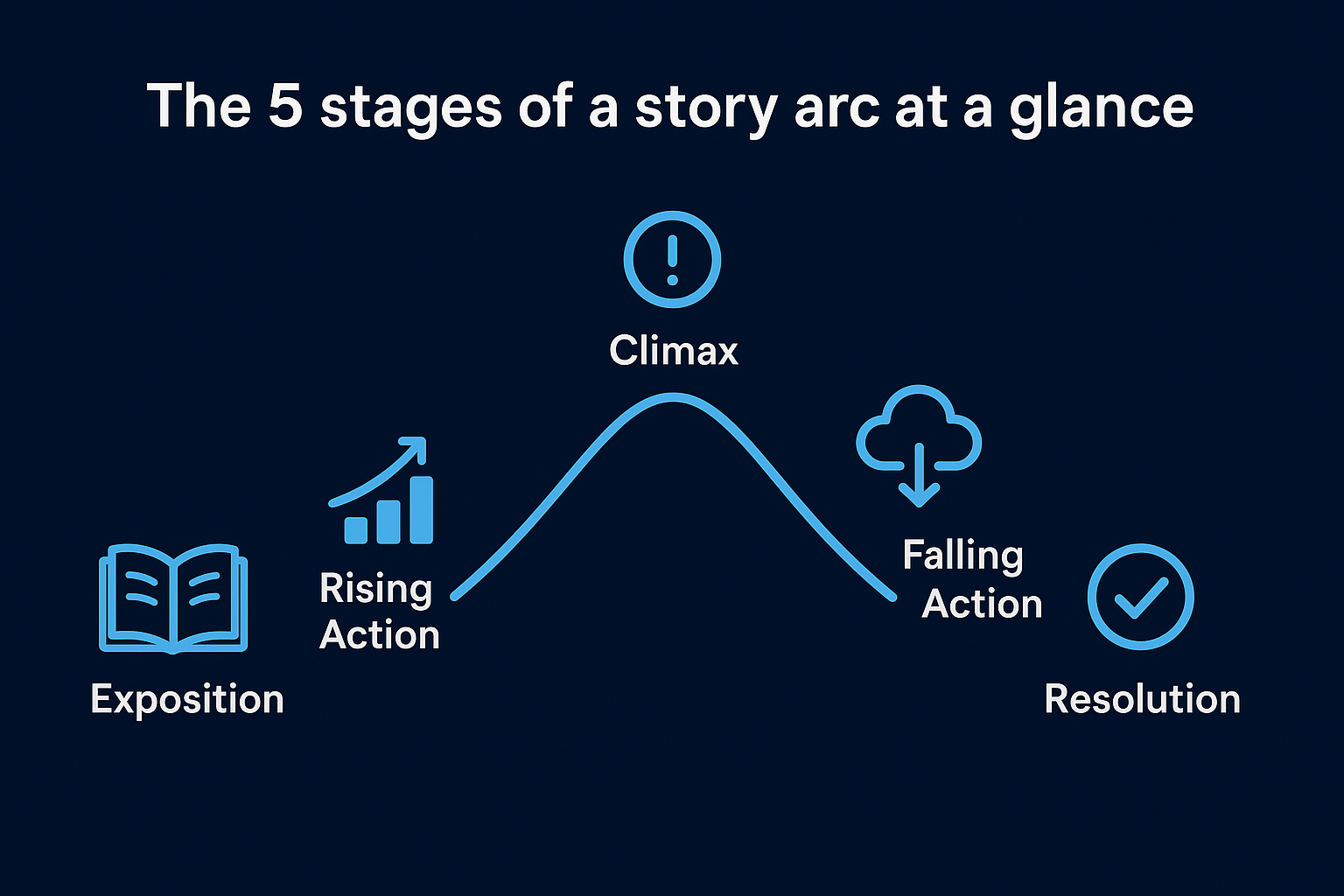
The 5 stages of a story arc at a glance
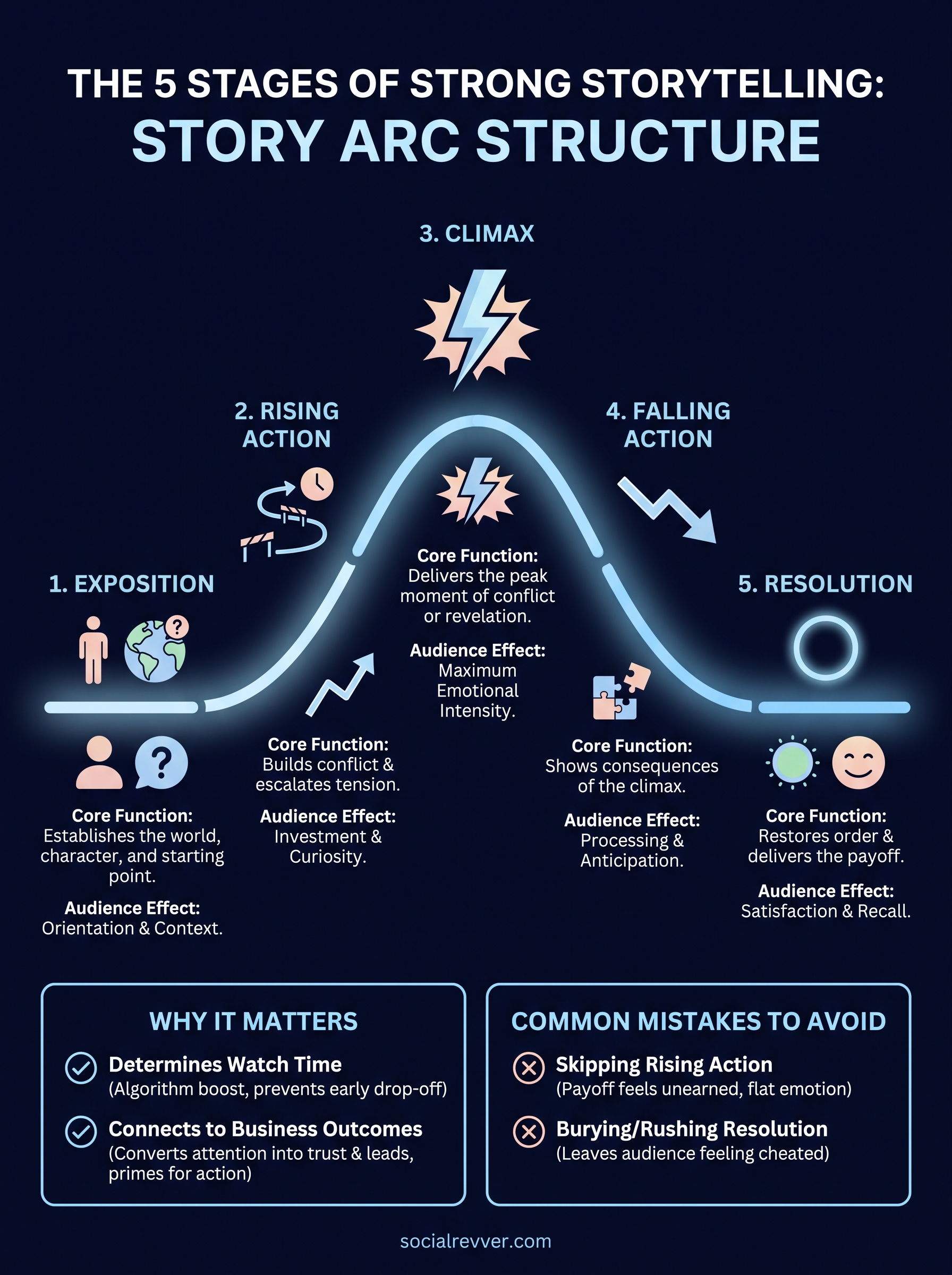
Every story arc structure follows the same five-stage sequence, and recognizing each stage gives you a repeatable framework for building content that holds attention from start to finish. These stages work across every format, from a three-minute YouTube video to a 30-second reel. The table below maps each stage to its core function and the specific effect it produces on your audience.
| Stage | Core Function | Audience Effect |
|---|---|---|
| Exposition | Establishes the world, character, and starting point | Orientation and context |
| Rising Action | Builds conflict and escalates tension | Investment and curiosity |
| Climax | Delivers the peak moment of conflict or revelation | Maximum emotional intensity |
| Falling Action | Shows the consequences of the climax | Processing and anticipation |
| Resolution | Restores order and delivers the payoff | Satisfaction and recall |
The buildup: exposition and rising action
Exposition sets the scene. It answers your audience's first three unspoken questions: who is this, what is happening, and why should I care? In short-form content, you have two to three seconds to complete this stage before a viewer leaves. Rising action follows immediately and is where most content actually fails. This is the stage that builds tension, introduces obstacles, and raises the stakes. Without a clear escalation here, your audience has no structural reason to stay.
Rising action should feel like a ratchet, each beat tightening the tension one notch further. Every element you introduce in this phase should point toward the climax and create a sense of forward momentum. Think of it as laying a series of pressure points, each one building on the last until something has to give.
The turn and resolution: climax through resolution
The climax is the single highest-stakes moment in your story, the point where tension peaks and the central conflict forces a decision or revelation. Everything in the first two stages exists to make this moment land with full weight. After the climax, falling action handles the consequences. It shows what changed and gives your audience a beat to process before the final stage arrives.
The resolution is not just an ending; it is the emotional payoff your audience agreed to wait for the moment your hook worked.
Resolution closes the loop. It delivers the answer, the transformation, or the outcome your story promised at the start. When the resolution lands cleanly, audiences feel satisfied, and that satisfaction is what drives shares, follows, and genuine trust in your brand.
How to use the 5 stages to outline a story
Knowing the five stages is one thing. Applying them before you write a single word is where the real advantage lives. Most content creators skip the outlining step entirely and start from a vague idea, which is exactly why so much content stalls in the middle with no clear destination. Treating story arc structure as a planning tool rather than a post-production analysis changes how efficiently you build content and how consistently it performs across every format you publish in.
Start with the resolution and work backward
Your resolution is the promise your content makes to the audience. Define exactly what your viewer will walk away knowing, feeling, or deciding, and write that down first. Once your endpoint is locked, every other stage becomes easier to build because you know where each beat needs to point.
The clearest story arc you will ever build starts with the end and works its way back to the beginning.
Working backward from a fixed resolution forces you to answer one critical question at every stage: does this beat move the audience toward the final payoff? If a piece of content doesn't pass that test, cut it. This approach eliminates filler and keeps your narrative tight by design rather than by accident.
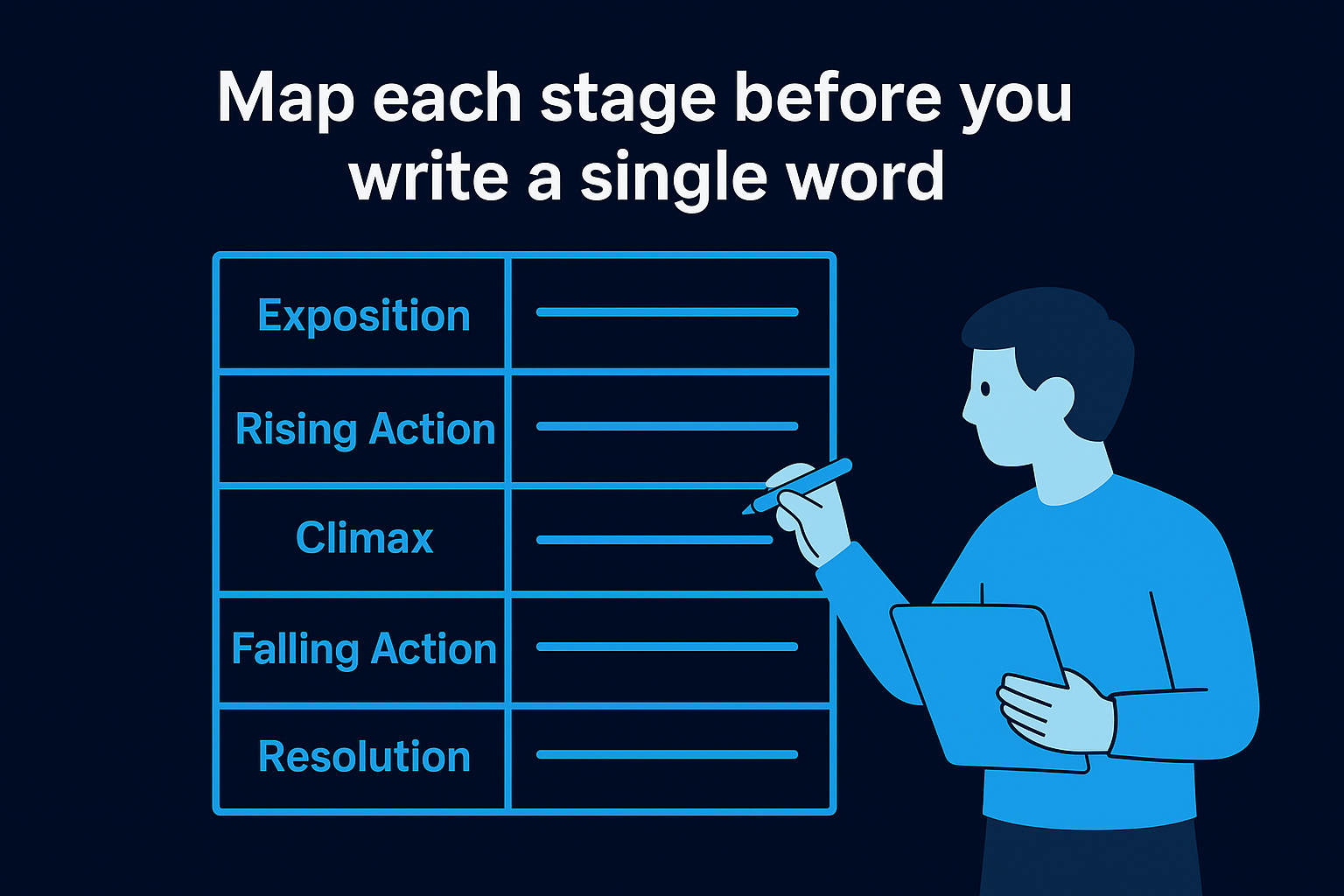
Map each stage before you write a single word
Use a simple five-row framework to block out your content before you draft it. Each row represents one stage, and your job is to fill in the specific element that serves that stage in your piece. Here is what that looks like in practice:
| Stage | What to define |
|---|---|
| Exposition | Who is involved and what is the starting situation |
| Rising Action | What conflict or tension escalates toward the climax |
| Climax | The single highest-stakes moment or revelation |
| Falling Action | What changes immediately after the peak |
| Resolution | The payoff, answer, or transformation you deliver |
Completing this table before you write keeps you from wandering off-structure mid-draft. It also makes the editing process faster because you can check each finished section against its assigned function and remove anything that doesn't serve it. When your outline is this specific, the draft becomes a fill-in exercise rather than a guessing game, and your content will show that clarity the moment someone hits play.
Common story arc mistakes and how to fix them
Even creators who understand the five stages of story arc structure consistently make the same structural mistakes. These errors don't announce themselves in the draft; they show up in your completion rates, follower growth, and the silence where engagement should be. Identifying the patterns behind poor-performing content is the fastest way to stop repeating them and start building narratives that actually hold attention.
Skipping the rising action entirely
The most common mistake in short-form content is jumping straight from the hook to the payoff. Creators assume that getting to the point fast equals being engaging, but cutting the rising action removes the tension that makes the payoff feel earned. Without escalation, your climax lands flat because the audience has no emotional investment in the outcome.
A payoff without buildup is just information, and information alone doesn't hold attention.
The fix is deliberate: force yourself to identify at least two escalating beats between your opening and your peak moment before you write anything. Each beat should raise the stakes or deepen the conflict. In a 60-second video, this might be two rapid sentences that tighten the tension. In a longer format, it might be two distinct scenes. The format changes, but the structural rule does not.
Burying or rushing the resolution
The second most damaging mistake is treating the resolution as an afterthought. Creators who spend 90% of their content on setup and then close with a rushed one-liner leave their audience feeling cheated, because the resolution determines whether your content actually delivered on what your hook promised.
Some creators make the opposite error and bury the resolution under qualifications, disclaimers, or unnecessary context that should have appeared earlier. Both versions break the emotional contract with your audience. The viewer who stayed through the rising action and climax gets robbed of the payoff they waited for.
Fixing this starts in your outline, not your edit. Check that your resolution receives roughly the same structural weight as your exposition and that it directly answers the central tension your rising action created. If your ending feels thin, the problem is usually that your climax wasn't strong enough to justify the payoff you attempted to deliver. Rebuild the climax first, and the resolution will follow naturally.
Variations on the classic arc you should know
The five-stage model gives you a reliable foundation, but not every effective story follows a straight line from exposition to resolution. Once you understand the classic story arc structure, learning its most useful variations gives you more tools for matching format to audience. Different content types, audiences, and platforms respond differently to narrative pacing, so knowing when to deviate from the standard progression is a genuine skill worth developing.
The in medias res approach
Some of the most effective short-form content drops viewers directly into the middle of the action rather than starting from exposition. The Latin phrase "in medias res" means "into the middle of things," and this variation works by opening at the peak of tension, then building context as the narrative unfolds. Your hook becomes the climax, and the story works backward to explain how you got there.
Opening in the middle of action creates immediate curiosity, because the audience has to keep watching just to understand what they are already seeing.
This approach works especially well for creator origin stories and case study content, where the dramatic outcome is visible from the first frame and the value comes from the explanation that follows.
The non-linear arc
Non-linear storytelling rearranges the classic five stages in a deliberate sequence that creates suspense or irony through contrast. You might open with the resolution, flash back to the exposition, and rebuild the rising action in reverse. This structure gives your audience the answer upfront and then invites them to care about how you got there.
Careful editorial control is essential here because the emotional logic still needs to hold even when the chronological order doesn't. Used carelessly, this structure just feels confusing. Used precisely, it turns the "why" into the engine of the entire narrative instead of the "what," and that shift can make your content significantly more memorable.
The mini-arc
Short-form platforms reward content that contains a fully resolved arc within a very short window. A mini-arc compresses all five stages into 30 to 60 seconds by collapsing falling action and keeping exposition to a single sentence. Every word carries structural weight because you have almost no room for anything that doesn't directly serve one of the five stages.
Applying mini-arc thinking to your content forces a level of precision that improves every format you produce. When you can build a complete arc in under a minute, building one across a longer format becomes significantly easier because the core discipline is already instilled in how you draft.
Story arc examples you can map in minutes
Seeing story arc structure applied to real content formats makes the five stages much easier to use in your own work. The fastest way to internalize the framework is to take content you already know and map each beat to its corresponding stage. Once you do this a few times, the structure becomes something you recognize automatically, and building it into your own content starts to feel instinctive rather than mechanical.
A founder origin story
Founder content follows the five-stage arc almost perfectly when it works. Your exposition establishes where you were before the problem appeared, typically a career situation or belief you held that turned out to be wrong. Rising action introduces the friction: the failure, the realization, or the moment the old approach stopped working. The climax is the turning point where you made a decision that changed direction. Falling action shows the immediate aftermath, and the resolution lands on who you became and what your audience can take from that shift.
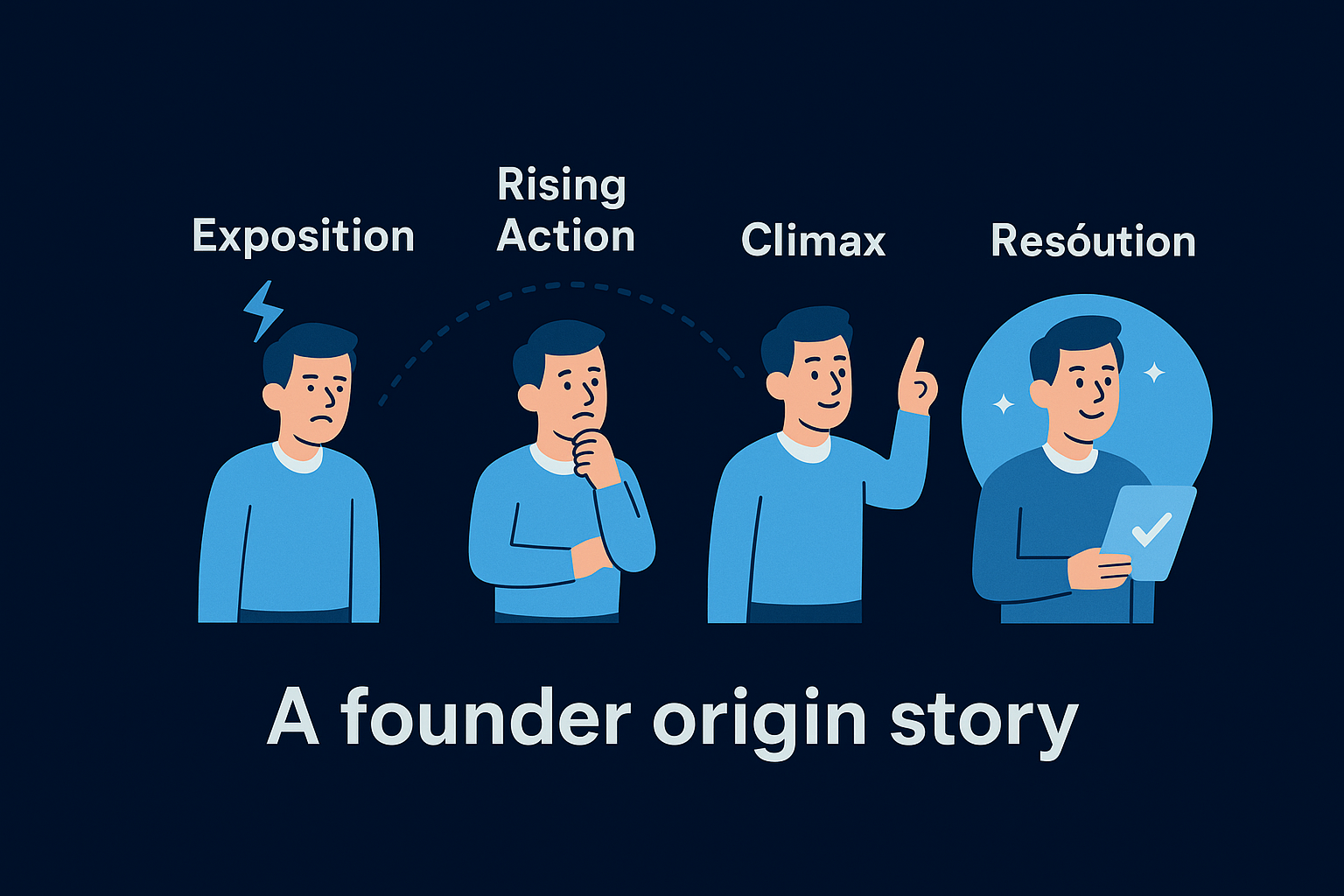
The origin story that converts attention into authority is the one where the transformation belongs to the founder but the lesson belongs to the viewer.
A product demonstration video
Product demos frequently fail because they skip straight from exposition to resolution and present features as their own payoff. A demo that follows the arc opens with the problem your viewer already recognizes in their own work. Rising action shows exactly how that problem creates friction, cost, or failure in a real scenario. The climax is the moment your product is introduced as the pivot point, not as a feature list but as the answer to a specific escalated tension. Falling action shows the immediate relief or result, and the resolution delivers the concrete outcome your viewer now associates with your brand.
A short-form case study
Case study content gives you a ready-made arc because the client's before-and-after situation provides the exposition and resolution automatically. Your job is building the rising action, which means showing what specifically was failing and why it was getting worse rather than just stating that a problem existed. Map the five stages against your case study using this structure:
| Stage | What to include |
|---|---|
| Exposition | Client's starting situation and goal |
| Rising Action | Specific friction points and failed attempts |
| Climax | The decision to change approach |
| Falling Action | First signs of the result appearing |
| Resolution | The measurable outcome and what it means |
Filling in this table with actual client details before you script your case study video keeps every beat purposeful and removes the vague language that makes most case study content forgettable.
Final takeaway
Story arc structure is not a creative luxury reserved for screenwriters and novelists. It is the fundamental engineering principle behind any piece of content that holds attention, builds authority, and drives action. You now have the five stages, the common mistakes, the variations, and the real-world examples you need to build narratives that work on purpose rather than by accident.
Apply what you have learned here to your next piece of content before you write a single word. Map your stages, lock your resolution first, and build every beat deliberately toward that payoff. The difference between content that converts and content that gets ignored almost always comes down to structure, and structure is something you can learn and apply consistently. If you want a team that builds this entire system for you at scale, get your free 40-slide social media strategy and see exactly how we engineer content that moves your audience from attention to action.