You recorded a podcast episode, wrote a blog post, or filmed a keynote, and then it sat there. One format, one platform, one shot at attention. If that sounds familiar, you're leaving reach and revenue on the table. So, what is content repurposing, and why does it matter? It's the practice of taking a single piece of content and transforming it into multiple formats designed for different platforms and audiences. Instead of starting from scratch every time you need to post, you extract more value from work you've already done.
For founders, business owners, and creators who don't have hours to spend producing content from zero every day, repurposing is the most efficient path to consistent visibility without constant output. It's also the core principle behind what we build at SocialRevver, a managed content system that turns your existing ideas, footage, and expertise into a steady stream of short-form content engineered to drive authority and inbound leads.
This article breaks down exactly how content repurposing works, walks through real examples across formats and platforms, and covers the strategies and tools that make the process repeatable. Whether you're sitting on a library of unused content or just starting to think about scaling your brand's presence, you'll walk away with a clear framework to put every piece of content to work harder.
What content repurposing is and is not
The simplest way to understand what content repurposing is: it's the process of taking one piece of content and adapting it into different formats for different platforms, without rebuilding something new from scratch every time. You already invested time, research, and energy into producing something valuable. Repurposing lets you extract that value multiple times rather than letting the original work go quiet after a single publish date.
What repurposing actually means
When you repurpose content, you change its format, its length, or its delivery mechanism while keeping the core idea or insight intact. A 60-minute podcast episode can become a blog post, a series of short-form video clips, a newsletter, a set of pull quotes, and a LinkedIn carousel, all from the same source material. The idea stays the same. The format, platform, and audience entry point shift to match how people actually consume content in each place.
The goal isn't to copy and paste the same content everywhere. It's to translate the same insight into whatever format works best for each specific platform and audience.
Here's a concrete example of what one piece of source content can produce:
| Source Content | Repurposed Format | Platform |
|---|---|---|
| Long-form YouTube video | 3-5 short clips (60 sec) | TikTok, Instagram Reels |
| Podcast episode | Written summary + key quotes | Blog, Newsletter |
| Blog post | Slide carousel | |
| Keynote presentation | Quote graphics | Instagram, X |
| Interview transcript | FAQ-style article | Website |
This is also why repurposing is fundamentally different from cross-posting. Cross-posting means taking the same piece of content unchanged and publishing it on multiple platforms. Repurposing requires intentional adaptation so the content fits how people consume media in each specific context. A 2,000-word article doesn't belong in a TikTok caption, but the central argument inside that article absolutely can fuel a tight 60-second video script.
What repurposing is not
Repurposing is not about flooding every channel with watered-down versions of the same post. That approach produces diminishing returns and trains your audience to tune you out because everything starts to sound like a cheap copy of something they've already seen. Effective repurposing means understanding what each platform rewards and then translating your content to match that format and behavior specifically.
It also isn't a shortcut that removes the need for strategic thinking. You still need to decide which content is worth repurposing, which formats align with your goals, and what each platform's audience actually responds to. Without that thinking, you end up with a lot of content that fills a calendar but does nothing for your authority or inbound pipeline.
Finally, repurposing isn't reserved for large teams or organizations with big production budgets. A solo founder with one strong long-form video can build weeks of short-form content from a single recording session. The constraint is almost always process and clarity, not resources. Once you have a repeatable system for adapting content into the right formats, your output scales without requiring proportionally more time or effort on your end.
Why content repurposing matters for marketing and SEO
Every piece of content you create takes time, energy, and often money to produce. When you publish it once and move on, you're essentially spending a full dollar to earn a dime. Understanding what is content repurposing and applying it consistently is how you flip that ratio: you invest once and collect returns across multiple platforms, formats, and audience segments for weeks or months after the original publish date.
The reach advantage of multiple formats
Different people discover content in completely different ways. Some spend their time on short-form video, others read long-form articles, and others prefer audio while commuting. If you only show up in one format, you're invisible to everyone outside that single channel, no matter how strong the original content is. Repurposing lets you meet your audience across the channels they already use, which compounds your reach without requiring entirely new ideas.
Reaching more people isn't about being everywhere at once. It's about showing up in the right formats where your specific audience already spends their attention.
Your authority also builds faster when people encounter your ideas across multiple touchpoints. A founder who publishes a blog post, then surfaces related short clips on LinkedIn and Instagram, then references those same ideas in a newsletter looks like a consistent, credible voice in their space, not someone who posts occasionally and disappears. That repeated exposure shapes how your audience perceives your expertise over time.
How repurposing supports SEO
From an SEO standpoint, repurposing generates multiple indexable assets from a single idea. A detailed blog post, a YouTube video, and an embedded transcript can all rank independently for related search terms, which expands your total footprint in search results. Google's guidance on helpful content emphasizes depth and genuine value, and repurposing done correctly reinforces both because you're building on a core idea across formats rather than producing thin, disconnected pages.
Each repurposed asset also creates natural opportunities for internal linking, which distributes authority across your site and helps search engines understand how your content connects.
What to repurpose first with a simple content audit
Before you start converting content into new formats, you need to know which content is actually worth repurposing. Not everything you've published deserves a second life. A quick content audit helps you identify the pieces that already have proven value, so you spend your adaptation effort on material that's most likely to perform.
Find your highest-value existing content
Your best candidates for repurposing are pieces that already demonstrate strong engagement or evergreen relevance. These are blog posts that still pull organic traffic months after publishing, videos with high watch time or share rates, podcast episodes your audience referenced or quoted back to you, and presentations that generated real conversations. You're looking for content where the core idea resonated, not content that simply exists.
If a piece of content worked once, a different format will often let it work again with a completely new audience.
Run through your existing library and flag content that meets at least one of these criteria:
- Still generates traffic, views, or listens without active promotion
- Covers a topic your audience asks about repeatedly
- Contains a specific framework, process, or opinion that is uniquely yours
- Performs well in search results for a relevant keyword
Score content by effort and reach potential
Once you have your flagged list, rank each piece by two simple factors: how much effort it takes to repurpose and how much reach the repurposed version could generate. A 45-minute recorded interview that already contains 12 distinct insights is a high-value, lower-effort candidate because the raw material does most of the work for you. A short social post with a single sentence of value requires more building than it's worth.

Understanding what is content repurposing from a strategic standpoint means recognizing that the goal isn't volume, it's leverage. You want to feed your repurposing system with pieces that carry the highest return on adaptation, and a short audit like this gives you a prioritized list before you ever open an editing tool or write a single new word.
How to repurpose content step by step
Once you understand what is content repurposing and which pieces to prioritize, you need a repeatable process for actually doing the work. A clear step-by-step workflow removes the friction that keeps repurposing permanently on a to-do list instead of becoming a consistent system. The steps below give you a practical sequence you can apply to any piece of source content.
Pick your anchor content and set a clear goal
Start with the single piece of source content you flagged in your audit and get specific about what you want repurposing to accomplish. Your goal shapes which formats you choose and how much adaptation each one needs. Are you trying to reach a new audience on a platform where you're currently underrepresented, or are you extending the shelf life of something that already performed well?
Repurposing without a clear goal produces more content, not necessarily better results.
Setting the goal first also prevents you from spreading across too many formats at once. Pick one or two target platforms to start, validate the approach, then expand from there.
Break the source content into discrete units
Most long-form content contains multiple distinct ideas, not just one central point. A 40-minute recorded interview may carry six separate insights that each stand alone. Pull them apart and list each one individually before you adapt anything. Each unit then becomes a candidate for its own repurposed asset, whether that's a short clip, a blog section, a pull quote, or a slide.
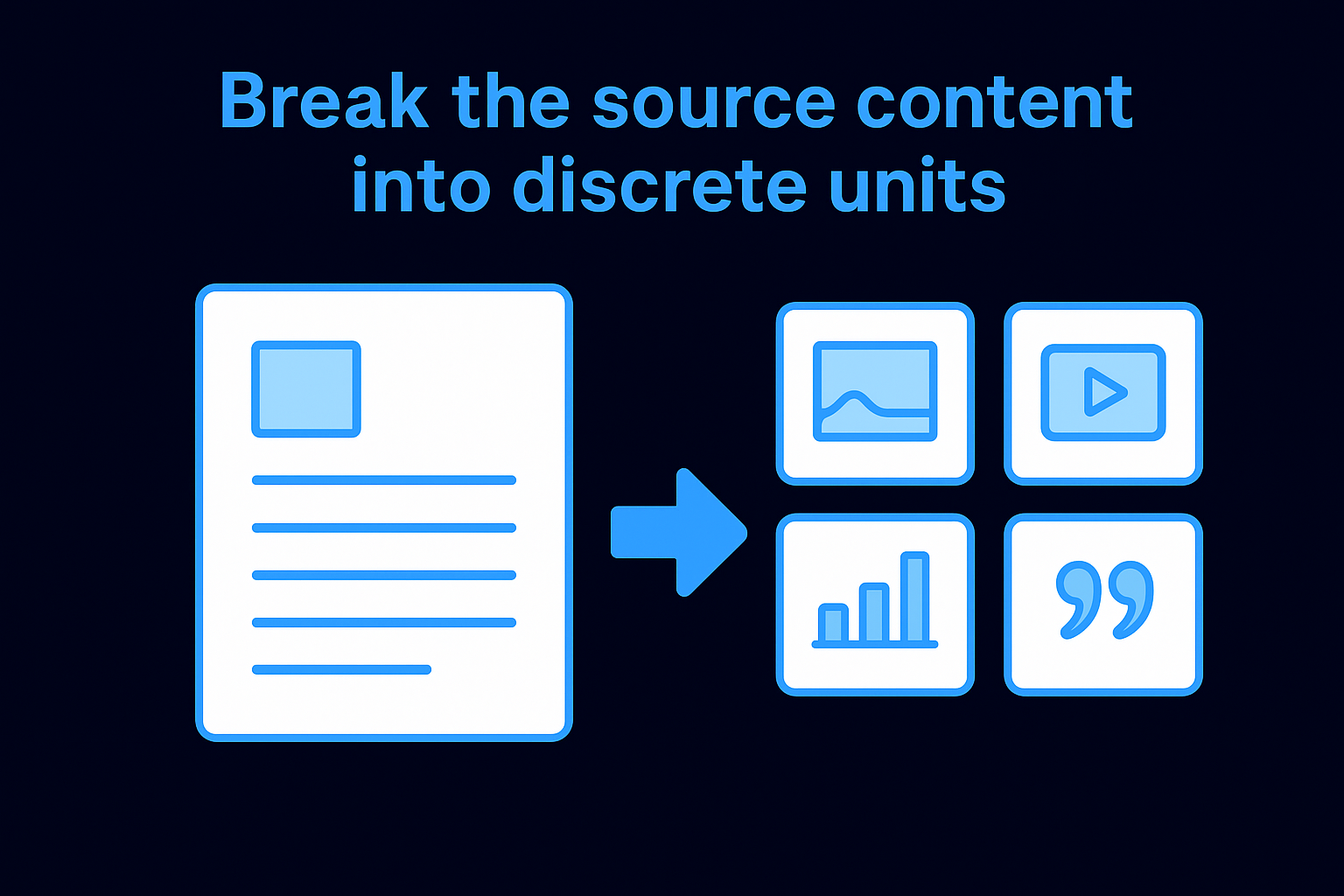
Here's how to quickly map source units to repurposed formats:
| Source Unit | Repurposed Format | Platform |
|---|---|---|
| Framework or process | Carousel or blog post | LinkedIn, website |
| Strong opinion or insight | Short-form video | TikTok, Instagram Reels |
| Data point or stat | Graphic or newsletter pull | Instagram, email |
| Full interview or talk | Summary article + clips | Blog, YouTube Shorts |
Adapt, publish, and measure performance
Once you match each unit to a format, adapt the language and structure to fit how that platform's audience actually reads or watches. A tight video script needs a fast hook in the first two seconds. A LinkedIn post needs a direct opening line that stops the scroll. After you publish, track watch time, click-through rates, and engagement patterns so you know what's working. Feed those results back into your next repurposing cycle to make the system sharper, not just busier.
Content repurposing examples by channel and format
Knowing what is content repurposing is one thing; seeing it applied across real channels makes the concept concrete. The examples below show how specific source formats map to specific outputs, so you can spot the repurposing opportunities already sitting inside your existing content library.
Long-form video to short-form clips
A single recorded interview or tutorial video is one of the most versatile source assets you can work with. Pull the sharpest 60-90 second moments, add captions and a tight hook, and publish those clips to TikTok, Instagram Reels, and YouTube Shorts. Each clip targets a slightly different angle from the original conversation, which means each one can attract a different viewer who may never have found your long-form content otherwise.
Short-form clips from long-form video consistently outperform standalone short-form content because the ideas were already tested and refined in a longer format.
Written content to social formats
Most blog posts contain far more reusable material than people recognize. The core argument becomes a LinkedIn carousel. A key statistic becomes a standalone graphic. A step-by-step process becomes a numbered list post. Your newsletter highlights the strongest single insight from the article with a link back to the full piece. Each format serves a different reader behavior without requiring a new idea from scratch.
Here's a quick reference for matching written content to output formats:
| Source | Output Format | Platform |
|---|---|---|
| Blog post | Carousel slides | |
| Research section | Stat graphic | |
| How-to section | Short video script | TikTok, Reels |
| Full article | Newsletter summary |
Podcast audio to written assets
Your podcast episodes carry dense, searchable information that most listeners never find because audio does not rank in search the way text does. A full episode transcript becomes a blog post. The strongest three takeaways become a newsletter. A single compelling exchange between host and guest becomes a short quote-driven social post. This format shift moves your spoken expertise into channels where search engines and new audiences can actually discover it.
Next steps
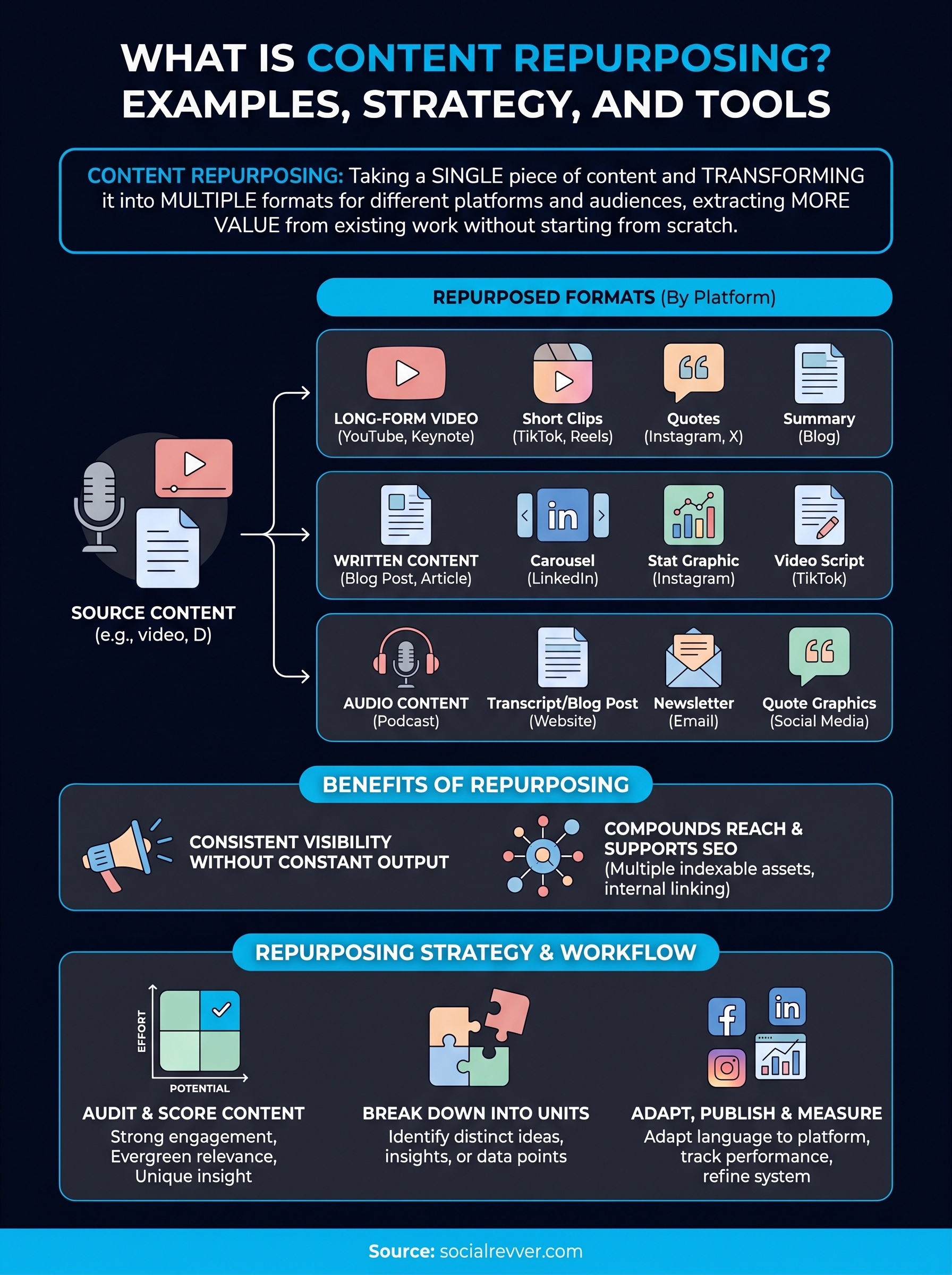
You now have a complete picture of what is content repurposing and how to apply it: audit what you have, identify the highest-value source material, break it into discrete units, adapt each unit to fit the platform, and measure what works. The framework is straightforward. The part most people struggle with is making it a consistent system rather than a one-time project.
That's exactly where a managed content infrastructure changes the equation. Instead of figuring out which clips to pull, how to script them, and when to post, you hand off the entire process to a system built around behavioral data and production workflows designed to convert your existing expertise into short-form content that drives authority and inbound leads. If you're ready to stop treating content like a manual task and start treating it like an engine, apply to work with our team and get a free 40-slide social media strategy built around your brand.