Brands spent an estimated $24 billion on influencer partnerships in 2024, and that number keeps climbing. But strip away the buzzword, and most people, including many business owners, still struggle to explain what influencer marketing actually is, how it operates under the hood, and why it consistently outperforms traditional advertising channels.
Here's the short version: influencer marketing is a strategy where brands partner with individuals who hold trust and attention within a specific audience, then leverage that trust to drive real business outcomes, leads, sales, and authority. It's not about paying someone with a big following to hold up your product. At least, not anymore.
At SocialRevver, we build the content systems that turn founders, creators, and business owners into the influential voices brands want to partner with. We see both sides of this equation daily, the creators building authority and the brands looking to tap into it. That perspective shapes everything in this guide.
Below, you'll get a clear breakdown of how influencer marketing works, the different types of influencers, the measurable benefits worth paying attention to, and a practical starting point if you're considering it for your brand or positioning yourself as the influencer others want to collaborate with.
Why influencer marketing matters now
Advertising has a trust problem. Banner blindness, ad blockers, and skip buttons have trained audiences to filter out branded messages before they even register. At the same time, people still make purchasing decisions every day, and they increasingly make those decisions based on recommendations from voices they already follow. That gap between distrust of ads and trust in people is exactly where influencer marketing operates, and it keeps growing wider each year.
Traditional advertising is losing its grip
Television spots, display ads, and even paid search have seen declining engagement rates across the board over the past decade. Consumers don't avoid ads because they dislike brands. They avoid them because the format signals interruption. When an ad breaks your experience, your brain categorizes it as noise before it can process the message.
Influencer content sidesteps this problem entirely because it arrives inside the feed, the podcast, or the video that the viewer chose to consume. The delivery mechanism doesn't feel like advertising, so the audience doesn't treat it as advertising. That single distinction separates influencer partnerships from nearly every other paid channel a brand can invest in.
Audiences now follow people, not channels
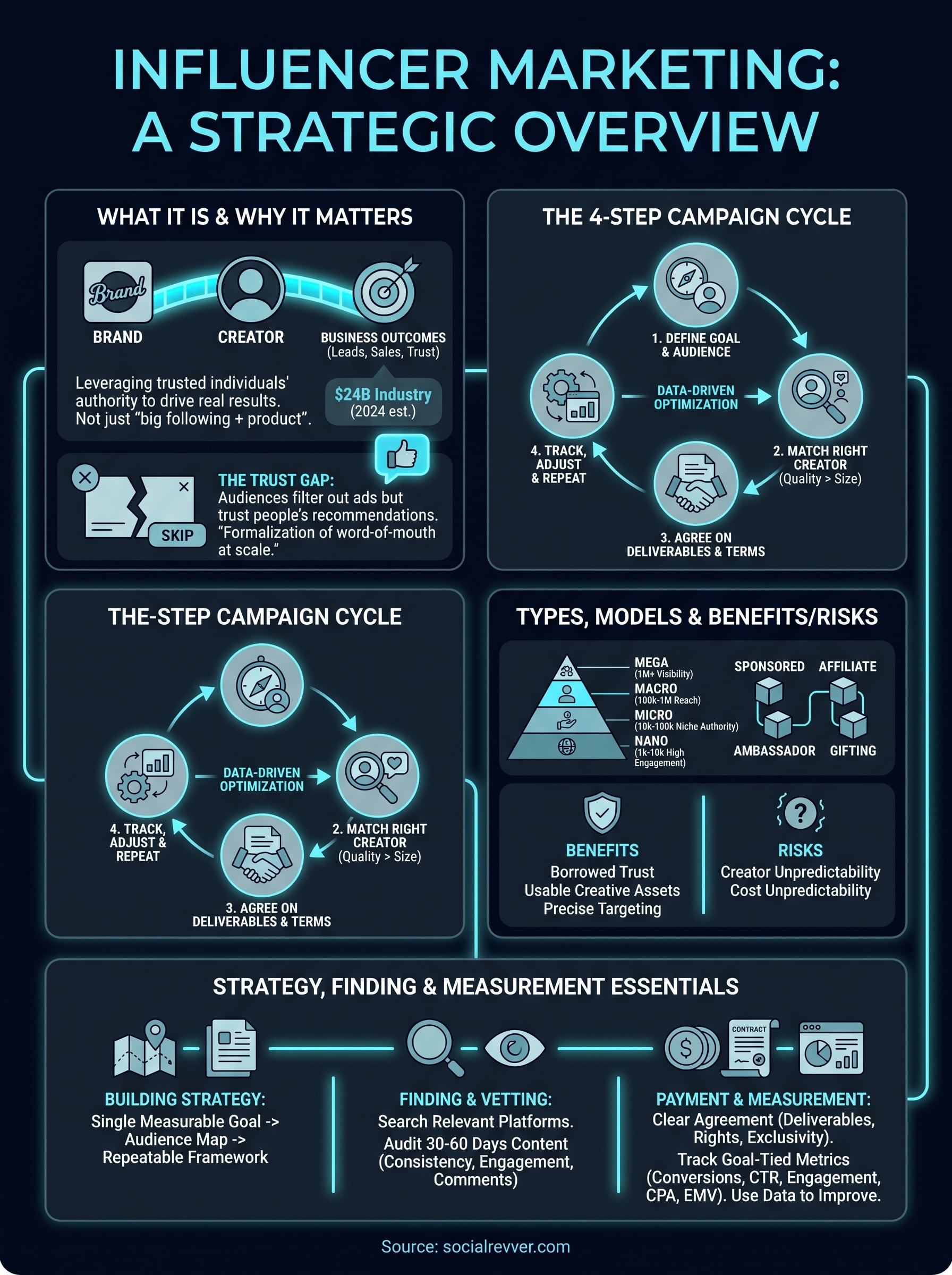
Think about how you actually discover new products today. If you're honest, a significant portion of your purchases trace back to someone you watch, listen to, or read regularly, even if you've never met them in person. This is the structural shift that explains what is influencer marketing at its core: it's the formalization of word-of-mouth at scale. Platforms like YouTube, Instagram, and TikTok have made it possible for individual creators to build audiences larger than most cable channels, and those audiences pay close attention to what those creators recommend.
When content feels like a natural recommendation rather than a paid placement, conversion rates follow almost automatically.
Younger buyers in particular operate with a different trust hierarchy than previous generations did. Brand reputation matters far less than peer and creator validation. A niche founder with 200,000 engaged followers can move more product than a national print campaign because their audience arrived voluntarily and returns intentionally.
The data makes the case clearly
The influencer marketing industry grew from roughly $1.7 billion in 2016 to an estimated $24 billion by 2024. That growth didn't happen because marketers chased trends. It happened because the channel consistently delivers measurable returns when the right creator, audience, and offer are matched properly.
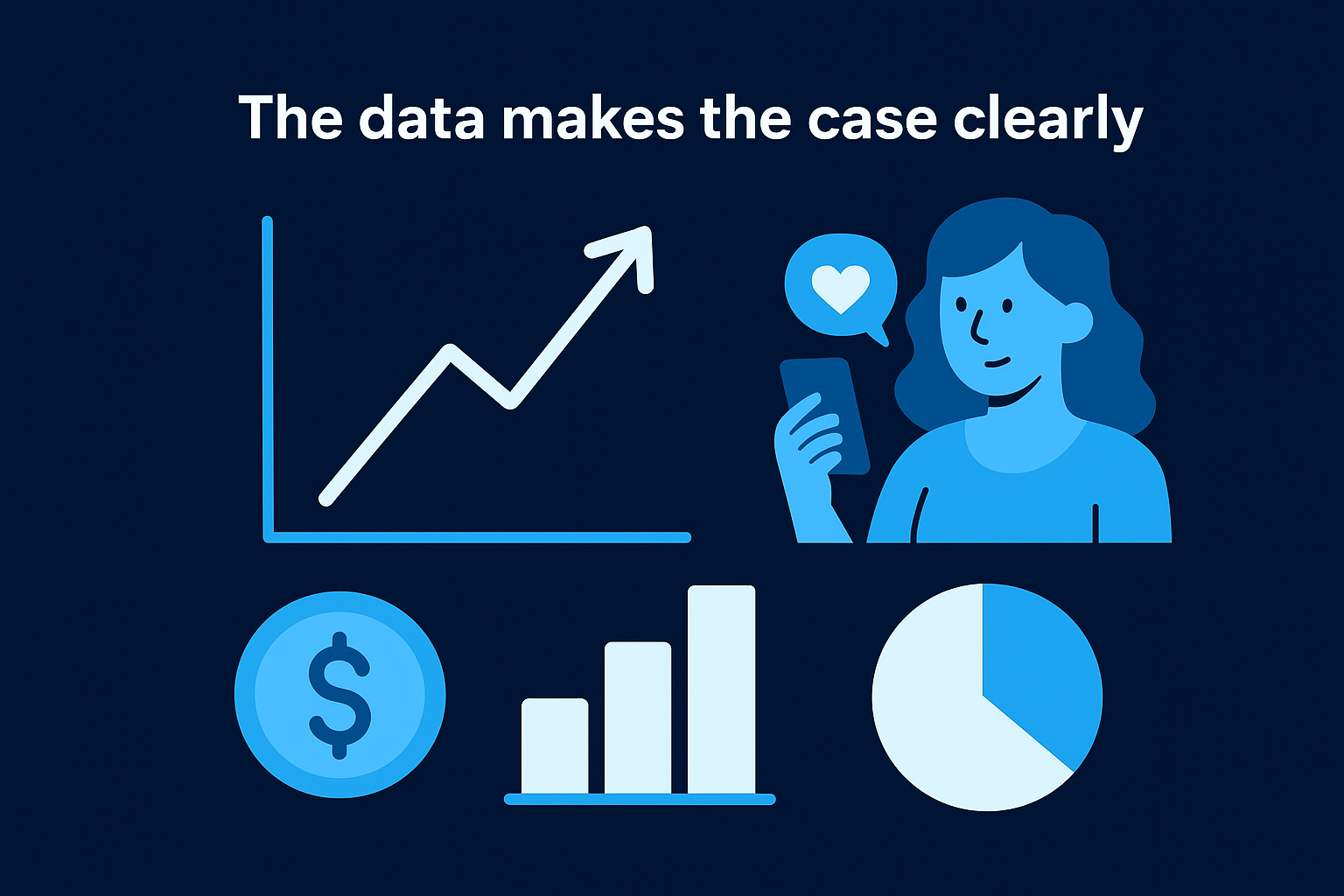
Here's what campaign data reveals across the industry:
- Earned media value from influencer posts averages approximately $5.78 for every $1 spent
- Micro-influencers with 10,000 to 100,000 followers routinely generate higher engagement rates than accounts with millions of followers
- Short-form video partnerships outperform static brand content in both reach and conversion rate by a consistent margin
- Niche creator audiences convert at higher rates because the creator has already built category authority with that specific group
The pattern here is consistent across verticals and campaign sizes. When a brand aligns with a creator whose audience already trusts them, the barrier between attention and action shrinks considerably. That's not a temporary trend. It's a structural change in how people process commercial information, and brands that ignore it are actively ceding ground to competitors who don't.
How influencer marketing works step by step
Understanding what is influencer marketing in theory is useful, but seeing how a campaign runs from start to finish makes it far easier to execute. At its core, the process follows a logical sequence: define a goal, find the right creator, set clear terms, and measure what happens. Each step builds on the one before it, and skipping any one of them creates problems you'll notice quickly.
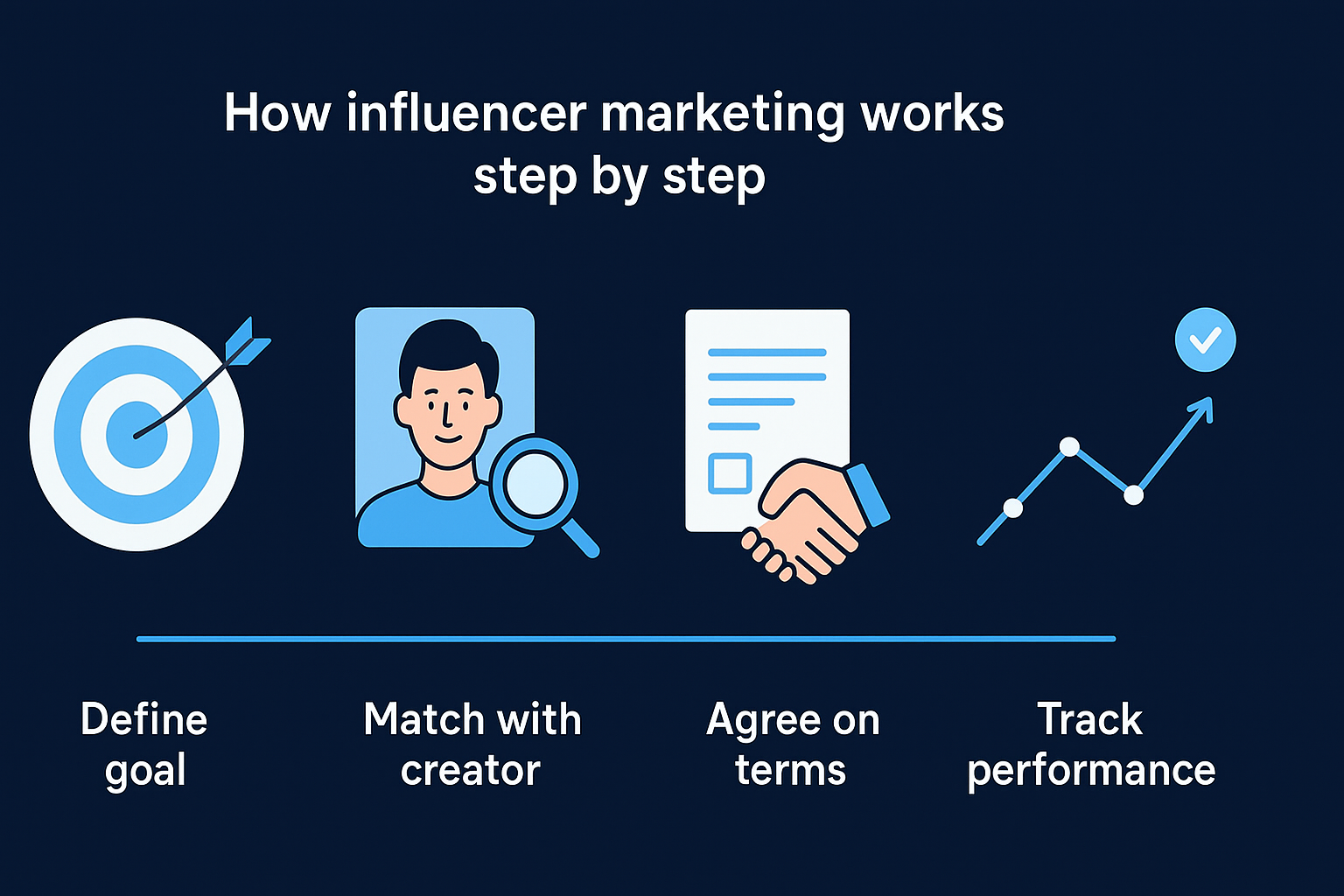
Step 1: Define the goal and the audience
Before you approach a single creator, you need a specific, measurable objective for the campaign. Are you driving product sales? Building brand awareness in a new market? Generating leads for a service? Your goal shapes every decision that follows, including which creators you target, what content format you request, and how you measure success. Without a defined outcome, you'll spend budget producing content that generates views but moves nothing.
Step 2: Match with the right creator
Once your goal is clear, you look for creators whose audience matches your ideal customer profile, not just in demographics but in intent and behavior. A fitness coach with 80,000 engaged followers who regularly ask product questions is more valuable to a supplement brand than a celebrity with 5 million passive viewers. Audience quality consistently outperforms audience size when purchase intent is the goal.
The right creator isn't the most famous one available; it's the one whose audience already wants what you're selling.
Step 3: Agree on deliverables and terms
This step is where most campaigns either succeed or stall. You and the creator need a written agreement that covers content format, posting schedule, usage rights, and compensation. Ambiguity here leads to missed deadlines, off-brand content, and disputes after the fact. Clear briefs that outline the core message without scripting every word give creators room to maintain their authentic voice while keeping your brand objectives intact.
Step 4: Track performance and adjust
After content goes live, you monitor the metrics that connect directly to your original goal: clicks, conversions, reach, or saves, depending on what you set out to achieve. Data from the first campaign round tells you who to work with again, what format performed best, and where your budget should shift. That feedback loop is what separates a one-off experiment from a repeatable, scalable strategy.
Types of influencers and partnership models
One of the most practical things to understand about what is influencer marketing is that it isn't a single format. The category spans a wide range of creator sizes and partnership structures, and the right combination for your brand depends entirely on your budget, goals, and the audience you're trying to reach. Picking the wrong tier or the wrong structure is one of the fastest ways to burn through budget without seeing results that tie back to revenue.
Influencer tiers by audience size
Creators are typically grouped into four tiers based on follower count, and each tier carries a distinct cost-to-engagement tradeoff you should understand before committing any budget.
| Tier | Follower Range | Key Strength |
|---|---|---|
| Nano | 1,000 – 10,000 | Highest engagement rates, strong community trust |
| Micro | 10,000 – 100,000 | Niche authority, strong conversion potential |
| Macro | 100,000 – 1,000,000 | Broad reach with moderate engagement |
| Mega / Celebrity | 1,000,000+ | Maximum visibility, lower engagement rate |
Nano and micro creators consistently outperform larger accounts on engagement rate and purchase intent, which makes them the default choice for brands with targeted products and modest budgets. Macro and mega influencers work best when your primary goal is top-of-funnel awareness across a broad audience rather than driving direct conversions from a specific buyer group.
Audience size tells you how many people a creator can reach; audience quality tells you whether those people will actually act on what they see.
Partnership models that drive results
Beyond follower count, you also need to choose the right collaboration structure for your campaign objective. The most common models include:
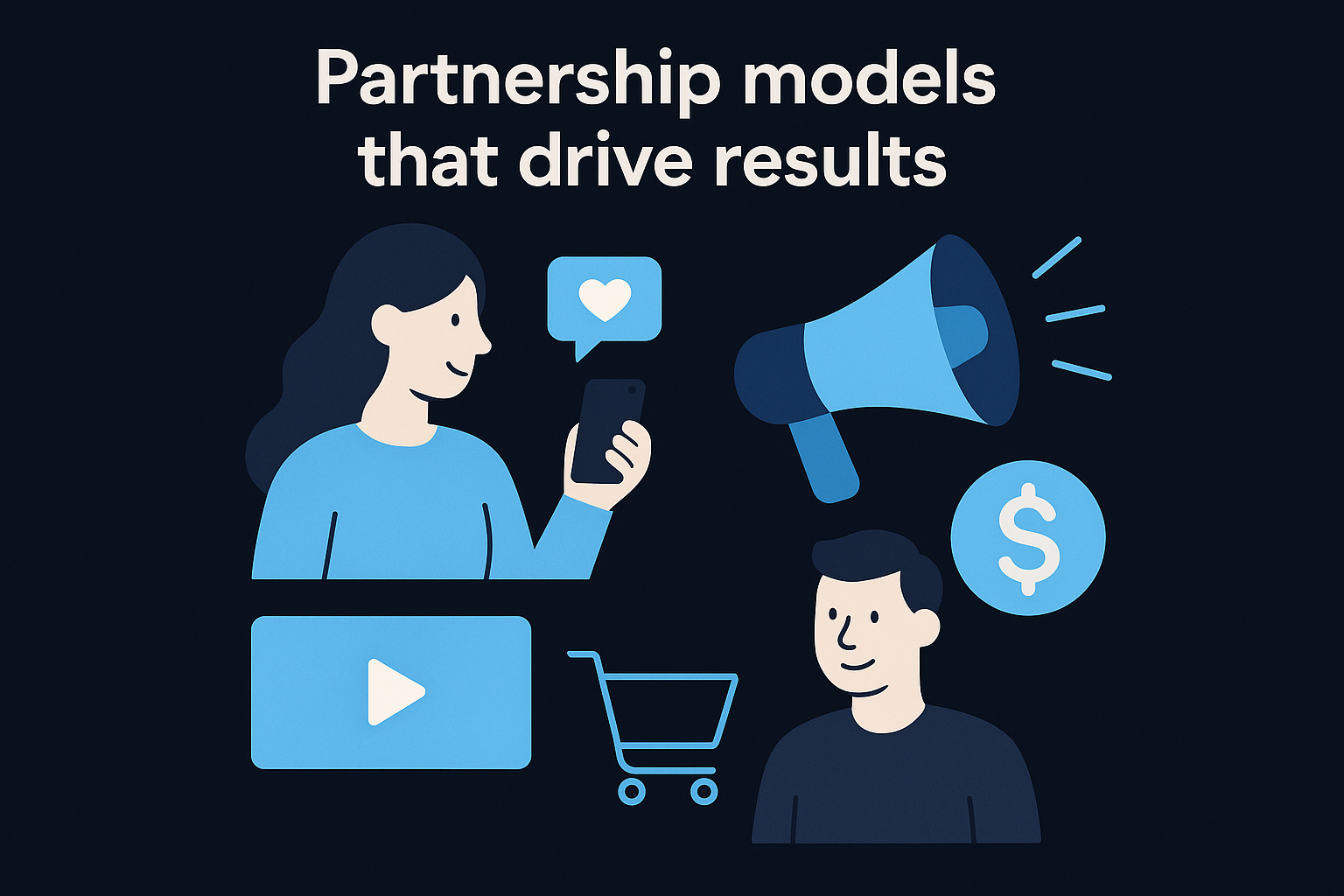
- Sponsored content: You pay a flat fee for the creator to post about your brand in their own voice on their own channel.
- Affiliate partnerships: The creator earns a commission on each sale they drive, which aligns their incentive directly with yours.
- Brand ambassador programs: You work with one creator consistently over several months, building deeper association and trust with their audience.
- Product gifting: You send free product in exchange for organic coverage, though this model carries no content guarantee and performs better with smaller, highly engaged creators.
Each structure carries different risk and return profiles depending on your timeline and budget. Affiliate deals reduce upfront cost but require a creator with a highly responsive audience. Ambassador programs take longer to build but generate compounding authority that single sponsored posts rarely match. Match the model to your objective, not to whichever option feels most comfortable to spend on.
Benefits and trade-offs for brands
Understanding what is influencer marketing at a tactical level means you also need to understand what it delivers and where it falls short. The channel offers genuine advantages that most paid advertising formats can't replicate, but it also comes with risks that can cost you budget and credibility if you don't account for them before you start.
The real advantages worth paying attention to
The most significant benefit influencer marketing delivers is borrowed trust. When a creator recommends your brand to their audience, that audience applies the same trust they have in the creator to your product. Building that level of credibility from scratch through traditional advertising takes years and far more budget. A single well-matched partnership can compress that timeline dramatically, especially in niche markets where a creator has spent years establishing authority with a specific group.
Trust borrowed from a creator converts faster than trust built through brand advertising because the audience already did the work of deciding to believe the source.
Beyond trust, influencer content also gives you usable creative assets. When a creator produces a video or post about your product, you often retain rights to repurpose that content across your own channels, paid ads, and landing pages. That extends the return on your original spend without additional production cost.
- Audience precision: you reach buyers already interested in your category instead of broadcasting to a general population
- Higher engagement rates: creator content consistently outperforms branded content on organic reach and interaction
- Content at scale: partnerships with multiple creators generate diverse, authentic material your internal team couldn't produce alone
Where the model creates real risk
The same quality that makes influencer marketing effective, the creator's independent voice, is also the primary source of risk. You can't control how a creator presents your brand once the brief is submitted, and if their behavior, values, or public image shifts after you've signed an agreement, your brand is associated with whatever happens. That's not a hypothetical scenario; brand-creator fallouts happen regularly and tend to generate more attention than the original partnership ever did.
Cost unpredictability is the other friction point. Creator fees vary widely and often don't correlate with measurable ROI until you've run several campaigns to benchmark performance. You'll likely overpay on early partnerships while you build the data needed to negotiate effectively.
How to build an influencer marketing strategy
Understanding what is influencer marketing as a concept is only the starting point. Turning that understanding into a working strategy means connecting every campaign decision back to a specific business goal, whether that's generating leads, converting buyers, or building authority in a new market. Without that thread running through your choices, you end up with content that performs well on vanity metrics and contributes nothing to revenue.
Start with a single, measurable goal
Most brands that struggle with influencer marketing start with the wrong question. They ask "which influencers should we work with?" before they've answered "what does success actually look like for this campaign?" Your goal determines your creator tier, your content format, and your measurement framework. Here are the most common campaign goals and what they require:
- Direct conversions: a creator with a highly responsive, purchase-intent audience and a trackable offer
- Brand awareness: broad reach in a new category where impressions and new-audience growth matter more than click-through rate
- Lead generation: a creator who regularly drives audience action through calls-to-action, not just passive views
- Authority building: long-term ambassador relationships that associate your brand with a trusted voice over time
Your campaign goal is the filter every other strategy decision runs through; get it wrong and the entire system points in the wrong direction.
Map your audience before you pick creators
Before you open any influencer discovery platform, write a clear description of the buyer you're trying to reach: their age range, the platforms they use most, and the problems they're actively trying to solve. This profile becomes your matching criteria when you evaluate creators. A misaligned audience is the single most common reason influencer campaigns underperform, and it's entirely avoidable if you complete this step first.
Build a repeatable campaign framework
One-off campaigns rarely generate the data you need to improve. Instead, structure your strategy around repeatable cycles: pick a creator, agree on deliverables, run the campaign, measure results, and use what you learn to refine the next round.
Document what worked in each cycle, which formats drove clicks, which creators generated the most qualified leads, and which offers converted. That documentation becomes your competitive advantage because it compounds across every campaign you run going forward.
How to find and vet influencers
Once you have a strategy in place, the next practical challenge in understanding what is influencer marketing is knowing where to actually locate creators worth working with and how to confirm they're the right fit before you spend anything. Most brands skip the vetting step or rush through it, which is why so many campaigns deliver reach without revenue. The discovery and evaluation process is where you protect your budget and set the campaign up to perform.
Where to search for creators
Your first instinct might be to use a dedicated influencer platform, and those tools do help at scale, but they aren't the only reliable approach. Start inside the platforms where your target audience already spends time and search by hashtag, category, or keyword related to your product. Look at who shows up consistently in those search results and whose content earns real comment threads rather than just passive likes.
The creators your target customers already follow are the most valuable ones you can work with, because the audience match is already proven.
You can also look at your existing customers and brand advocates before searching externally. Someone who already buys from you and creates content in your niche is a more credible partner than a stranger with a larger following, and they're far easier to approach.
How to vet before you commit
Finding a creator with the right follower count is only the first filter. Before you reach out, spend time auditing their last 30 to 60 days of content to assess posting consistency, comment quality, and whether their audience asks questions or makes purchase-related statements. A comment section full of genuine conversation tells you more about audience quality than any follower number does.
Check their engagement rate independently by dividing average likes and comments by total followers. For micro-influencers, anything above 3 to 5 percent signals a responsive audience. Below that, even a large following rarely produces the conversion volume brands expect. Also review any previous brand partnerships they've done, paying attention to whether those posts generated real audience interaction or just disappeared into their feed. Past campaign behavior predicts future campaign performance more reliably than pitch decks or media kits ever will.
How to pay influencers and set terms
One part of understanding what is influencer marketing that brands consistently underestimate is the payment and contracting process. Getting the compensation structure wrong costs you either budget efficiency or creator goodwill, and unclear contracts produce exactly the kind of ambiguity that derails campaigns before content is even posted. Before you send a single brief, you need a clear payment model and a written agreement that both sides actually understand.
Payment structures that match your campaign type
The three most common compensation models are flat fees, performance-based pay, and product gifting, and each fits a different campaign scenario. Flat fees work best when you need predictable cost and guaranteed content delivery; you pay a fixed amount for a specific deliverable regardless of how it performs. Performance-based structures, typically affiliate commissions tied to sales or clicks, align creator incentives with your revenue goals but only work when the creator has an audience that takes consistent action.
Paying for performance sounds attractive until you realize that most creators won't prioritize your campaign if it competes with guaranteed-fee opportunities elsewhere.
Product gifting sits at the low end of the cost spectrum, but it carries no content guarantee unless you explicitly negotiate one. Reserve gifting for nano and micro creators who regularly feature products organically, and treat any coverage you receive as a bonus rather than a deliverable you can count on.
What to put in your agreement
A written contract protects both parties and removes the ambiguity that causes most creator disputes. Every agreement should specify the deliverables, including content format, platform, number of posts, and required posting dates. Without those details in writing, you have no grounds to push back if the creator delivers late or produces something off-brief.
Your contract also needs to address content usage rights and exclusivity. If you plan to repurpose the creator's video in paid ads or on your website, you need explicit written permission for that use. On the exclusivity side, decide whether you want the creator to avoid promoting competing brands during or after the campaign, and state that window clearly in the agreement. A straightforward document that covers deliverables, payment terms, usage rights, and exclusivity handles the vast majority of situations you will encounter.
How to measure results and improve ROI
The final piece of understanding what is influencer marketing at a practical level is knowing how to measure whether your campaigns actually worked. Tracking the right metrics separates brands that improve with each campaign from brands that repeat the same guesswork indefinitely. Measurement isn't a post-campaign formality; it's the mechanism that tells you where your budget should go next.
Metrics that connect to real business outcomes
Not all metrics carry the same weight, and chasing the wrong ones wastes your budget on campaigns that look impressive in a report but contribute nothing to revenue. Match each metric directly to the goal you defined at the start of the campaign. Here are the measurements that actually matter, organized by campaign objective:
- Conversions and sales: track through unique discount codes, UTM-tagged links, or affiliate dashboards tied to each creator
- Click-through rate: measures how often your audience moved from the creator's post to your site or offer page
- Engagement rate: divides total interactions by total reach to show how responsive the creator's audience actually was
- Cost per acquisition: divides your total campaign spend by the number of customers or leads the campaign generated
- Earned media value: estimates the equivalent paid advertising cost for the organic reach the partnership produced
The metric that matters most is the one tied directly to your original campaign goal, not the one that looks best in a screenshot.
How to use data to improve future campaigns
Once your campaign data is in, review it against your original objective before drawing any conclusions. A campaign that generated strong engagement but few conversions isn't necessarily a failure; it may mean the creator's audience needs more touchpoints before they act, or the offer itself needs adjustment. Separate creator performance from offer performance when you analyze results, because conflating the two leads to incorrect decisions about who to work with again.
Build a simple tracking document that records each creator's deliverables, total spend, and the specific results they drove for every campaign you run. After three to four campaign cycles, patterns emerge clearly: which creators drive action, which formats generate the most qualified traffic, and which offers convert at the lowest cost. That accumulated data becomes the foundation of a genuinely repeatable, improving system rather than a series of disconnected experiments.
Next steps
Now you know what is influencer marketing, how campaigns run from goal-setting to measurement, and what separates partnerships that drive revenue from ones that just generate noise. The framework is clear, and the patterns that predict success are repeatable once you build the right system around them.
The piece most brands and creators still get wrong is the content infrastructure underneath the strategy. Consistent, high-quality short-form content is what positions you as the authority that brands want to partner with, and it's what keeps your audience engaged between campaigns. Without that foundation, even a well-structured influencer strategy stalls.
If you want to build that content system without doing it manually, SocialRevver helps founders, creators, and business owners turn their social presence into a predictable growth engine. Apply for your free 40-slide social media strategy and see exactly where your content can go.