
Most brands don't have a content problem. They have a brand positioning framework problem. They publish consistently, show up on every platform, and still get ignored, because there's nothing distinct anchoring what they say or how they say it. Without a clear position in your market, content becomes background noise, no matter how well it's produced.
A positioning framework gives you the foundation that every piece of content, campaign, and sales conversation builds on. It's the reason one founder commands authority in a crowded niche while ten others with similar credentials blend together. It defines who you're for, what you stand for, and why your audience should choose you over every alternative, including doing nothing.
At SocialRevver, we see this play out daily. Our content systems are engineered to turn organic attention into revenue, but the clients who scale fastest are the ones who nail their positioning before a single video goes into production. The scripting, the hooks, the distribution, all of it performs better when it's built on top of a sharp, differentiated brand position.
This guide walks you through a complete, step-by-step framework for defining yours. You'll get the methodology, the exercises, and the strategic thinking required to carve out a market position that actually holds up under competitive pressure. No vague brand theory. No filler worksheets. Just a structured process you can execute this week.
What a brand positioning framework includes
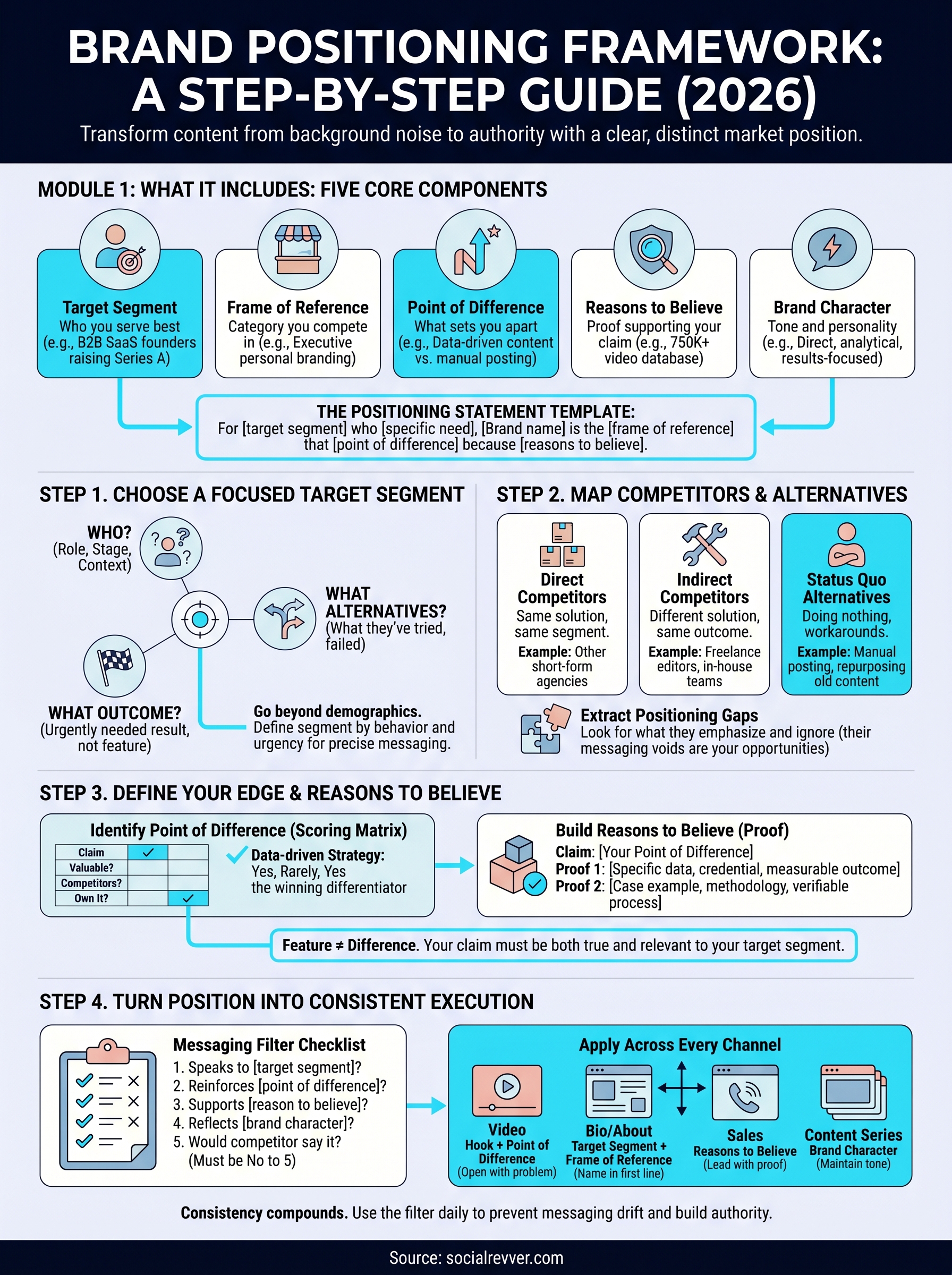
A brand positioning framework is not a tagline or a mission statement. It's a strategic document that answers the most fundamental competitive questions about your brand: who it's for, what problem it solves, how it differs from alternatives, and why anyone should believe that claim. When you have a complete framework in place, every downstream decision, from content strategy to sales messaging, gets faster and sharper because you're working from a single source of truth rather than improvising with each new campaign or piece of content.
Most brands skip building this document entirely. They jump straight to tactics, pick a visual style, write some social copy, and call it branding. The result is a brand that looks polished but communicates nothing distinctive. A proper positioning framework forces a series of concrete decisions that most founders and business owners avoid because those decisions require saying no to audiences, use cases, and messages that feel like lost revenue.
The five core components
Every complete brand positioning framework is built on five interconnected components. Each one narrows your focus and locks in a specific competitive choice.
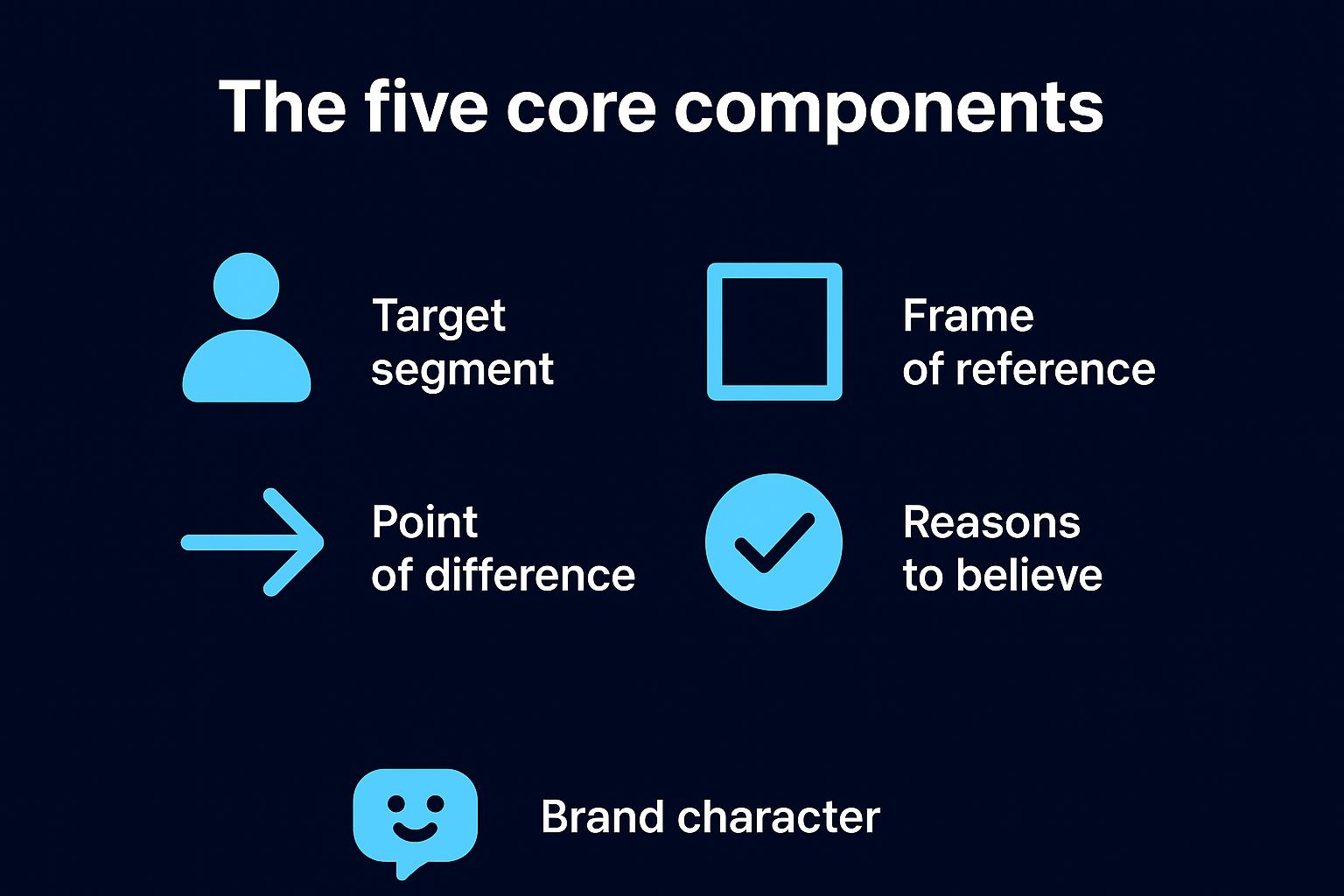
| Component | What It Defines | Example |
|---|---|---|
| Target segment | The specific audience you serve best | B2B SaaS founders raising a Series A |
| Frame of reference | The category your brand competes in | Executive personal branding |
| Point of difference | What sets you apart from alternatives | A data-driven content system vs. manual posting |
| Reasons to believe | Proof that supports your core claim | 750K+ video database, measurable lead outcomes |
| Brand character | The tone and personality behind the message | Direct, analytical, results-focused |
Your point of difference only matters if your target segment actively cares about it. Relevance and differentiation must work together, not separately.
Each component feeds directly into the next. You can't define a meaningful point of difference without first choosing a specific segment, because what differentiates you for one audience may be completely irrelevant to another. A vague answer in any one of these five fields creates a weak link that undermines the entire structure.
The positioning statement template
Once you have the five components mapped out, you compress them into a single positioning statement. This is an internal working document, not a public ad headline. Its job is to align your team around one clear market position and prevent messaging drift across content, sales, and partnerships.
Use this template as your starting point:
For [target segment] who [specific need or problem],
[Brand name] is the [frame of reference]
that [point of difference]
because [reasons to believe].
Here's a filled-in example for a professional brand-building service:
For founders raising their next funding round who struggle to build
credibility at scale, SocialRevver is the content growth system
that converts short-form video into measurable authority and inbound leads
because it applies machine learning to 750,000+ video performance patterns
to engineer predictable results.
This template forces clarity and compression in a way that free-form brand documents never do. If you can't fill it in cleanly, that's a direct signal that you haven't made the hard positioning decisions yet. The framework only works when each field holds a specific, defensible answer.
Step 1. Choose a focused target segment
Every brand positioning framework collapses without a precise target segment. Most founders resist specificity here because they worry about excluding potential customers, but that thinking costs you market traction. Vague audiences produce vague messaging, and vague messaging doesn't convert. The sharper your segment definition, the more directly your entire framework speaks to the people most likely to buy from you.
The goal is not to reach everyone who could benefit from what you sell. It's to dominate the attention of the people who need it most.
Your target segment is not a demographic bucket. Age and income brackets don't tell you what motivates someone to act or what problem they're actively trying to solve. You need behavioral and situational specificity: what they're trying to accomplish, what's blocking them, and what they've already tried that hasn't worked. That level of detail is what makes a segment definition actually useful as a strategic filter.
How to define your segment with precision
Use this three-question exercise to lock in your segment before you write anything else in your positioning document. Answer each question in one to two sentences and resist the urge to hedge or broaden your answers.
- Who is experiencing the specific problem you solve? (Role, stage, and context)
- What outcome are they urgently trying to reach? (Not a feature they want, but a result they need)
- What alternatives have they already tried or considered? (This reveals their awareness level and your competitive context)
Here's an example output from this exercise:
| Question | Example Answer |
|---|---|
| Who has the problem? | Founders building a Series A pitch who lack visible industry authority |
| What outcome do they need? | Consistent inbound credibility signals before investor conversations begin |
| What have they tried? | Manual LinkedIn posting with inconsistent, unmeasurable results |
Once you answer all three, combine them into a single segment statement: "My brand serves [role] who are trying to [outcome] but currently stuck on [obstacle]." That one sentence becomes the first line of your positioning document and the filter you run every content, campaign, and partnership decision through going forward.
Step 2. Map competitors and alternatives
Most brands map competitors too narrowly. They list the two or three names they already know and call it done. Your brand positioning framework only sharpens when you map the full competitive landscape, including alternatives your audience considers even if those alternatives don't look anything like your product or service. A founder choosing a content system isn't just comparing vendors; they're weighing hiring a full-time content manager, doing it themselves, or doing nothing at all. Every one of those options is a competitor.
The real competition is rarely another brand. It's every alternative your audience would consider before choosing you.
Identify who you're actually competing against
Start by building three distinct competitor categories. This structure forces you to think beyond direct rivals and into the full set of substitutes your audience evaluates.
| Category | Definition | Example |
|---|---|---|
| Direct competitors | Brands offering the same core solution to the same segment | Other short-form content agencies |
| Indirect competitors | Different solutions targeting the same outcome | Freelance editors, in-house content teams |
| Status quo alternatives | Doing nothing or a workaround the audience already uses | Manual posting, repurposing old content |
List at least two examples in each category before you move on. Thin competitor mapping leads to weak differentiation, because you end up defining your edge only against the brands you already know rather than against every real choice your audience faces.
Extract the positioning gaps your competitors leave open
Once your map is filled in, scan each competitor for what they emphasize and what they ignore. Look for patterns in their messaging: what claims they repeat, what proof points they lean on, and what audience needs they leave unaddressed. Those gaps are your positioning opportunities.
Run this exercise for each direct competitor:
- What primary claim do they lead with? (Speed, price, creativity, results)
- What segment do they target most visibly? (Audience signals in their messaging)
- What do their customers consistently complain about? (Reviews, forums, public feedback)
The answers reveal the open space your positioning can credibly claim without directly attacking a competitor or overpromising to your audience.
Step 3. Define your edge and reasons to believe
Your point of difference is the single most defensible claim you can make about your brand that competitors cannot credibly copy or match. Most brands confuse features with differentiation. A feature is what your product does. A point of difference is what your brand uniquely delivers for a specific segment that no alternative delivers as well. These are not the same thing, and conflating them produces generic messaging that fades into the background of every market category.
Your point of difference must be both true and relevant. A claim your audience doesn't actively care about is not a competitive advantage.
Identify your point of difference
To build this component of your brand positioning framework, run a direct comparison between what you deliver and what each competitor category emphasizes. Look for the intersection of what you do best and what your target segment prioritizes most. That intersection is where your edge lives.
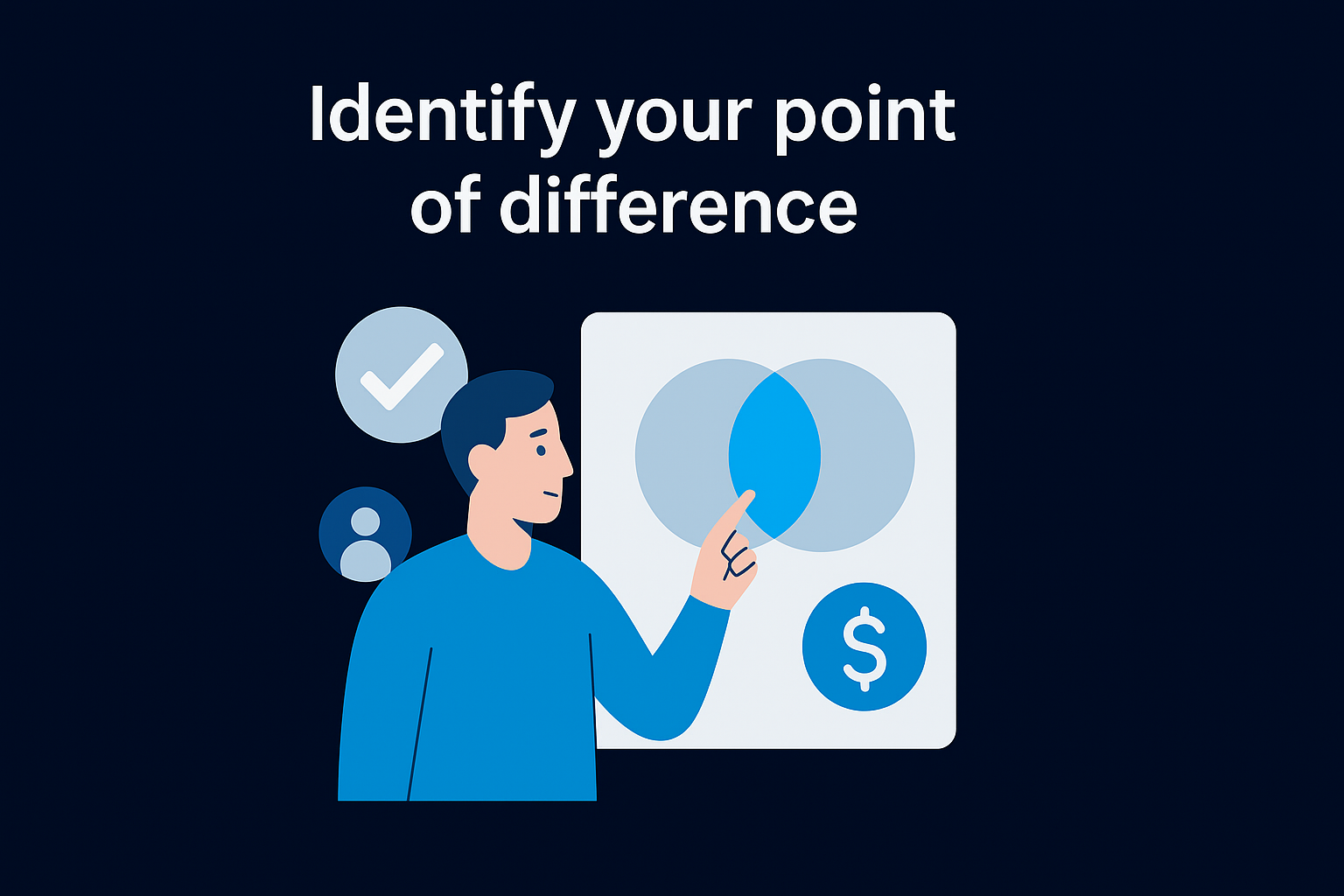
Use this scoring exercise to isolate the right claim:
| Potential Differentiator | Valuable to Segment? | Competitors Deliver It? | Own It? |
|---|---|---|---|
| Data-driven content strategy | Yes | Rarely | Yes |
| Fast turnaround | Yes | Often | No |
| Niche industry expertise | Yes | Sometimes | Yes |
| Lowest price | No (for this segment) | Often | No |
Score each row honestly. Any differentiator where you answer "Yes, Yes, No, Yes" in sequence is a strong candidate for your primary point of difference. Pick one. A positioning statement with two or three competing claims weakens all of them.
Build your reasons to believe
Reasons to believe are the proof that your point of difference is real, not just a marketing assertion. Without this layer, your differentiation is a promise with nothing behind it. Every strong claim needs at least two supporting proof points your audience can verify or experience directly.
Your reasons to believe should draw from concrete, specific evidence rather than vague language like "years of experience" or "passionate team." Use this template to build them:
Claim: [Your point of difference]
Proof 1: [Specific data point, credential, or measurable outcome]
Proof 2: [Case example, methodology, or verifiable process]
Example output:
Claim: A content system engineered for predictable authority growth
Proof 1: Strategy built on analysis of 750,000+ video performance patterns
Proof 2: Clients track lead attribution directly from short-form content output
Step 4. Turn the position into consistent execution
A completed brand positioning framework has no value sitting in a document. The only thing that converts positioning into market traction is consistent, repeated application across every channel and touchpoint your audience encounters. Most brands define their position once and then drift within three months because they have no filter system to run daily decisions through. This step gives you that filter.
Positioning only builds market authority when your audience sees the same core message reinforced across every format, channel, and context, not just your flagship content.
Build a messaging filter
Your positioning statement is your north star, but your team and your content pipeline need a practical decision-making tool they can apply quickly. A messaging filter is a short checklist that keeps every piece of content, every sales asset, and every campaign anchored to your position without requiring a full strategic review each time.
Use this template to build yours:
Messaging Filter Checklist
--------------------------
1. Does this message speak directly to [target segment]?
2. Does it reinforce our [point of difference]?
3. Does it support at least one [reason to believe]?
4. Does it reflect our [brand character]?
5. Would a direct competitor say the exact same thing?

If you answer No to any of 1-4, revise before publishing.
If you answer Yes to question 5, revise before publishing.
Run every content brief, caption, pitch deck slide, and email subject line through this filter before it goes out. Consistency compounds, and a filter is how you build it at scale without reviewing every asset manually.
Apply your position across every channel
Your position should show up the same way whether someone reads your LinkedIn bio, watches a short-form video, or lands on your homepage. Map your core message to each channel format so the execution stays disciplined even when the format changes.
| Channel | What to Anchor | Example Application |
|---|---|---|
| Short-form video | Hook + point of difference | Open with the problem your segment faces |
| Bio/About page | Target segment + frame of reference | Name exactly who you serve in the first line |
| Sales conversations | Reasons to believe | Lead with proof before benefits |
| Content series | Brand character | Maintain the same tone and analytical voice |
Audit each channel quarterly to check for messaging drift, which is the slow, invisible erosion that happens when individual pieces get created without running them through your filter.
Next steps
You now have every component of a working brand positioning framework: a focused target segment, a mapped competitive landscape, a defensible point of difference with proof to back it, and a filter system to keep execution consistent. The framework only pays off when you act on it immediately rather than let it sit as a finished document.
Start this week by completing the positioning statement template from Step 1 and running your last five pieces of content through the messaging filter in Step 4. Look for gaps between your current output and your stated position. Those gaps show you exactly where to tighten first.
If you want to move faster, the content system behind your positioning needs to match the quality of the strategy you just built. At SocialRevver, we engineer that entire system for you. Get your free 40+ slide social media strategy and see what a fully built content engine looks like in practice.