You've got views coming in from short-form content, but they're not turning into leads. That's the gap a lead magnet funnel template exists to close. Most founders and creators build a funnel by instinct: a random freebie, a generic landing page, an email sequence copied from a course they bought two years ago. It leaks leads at every step because nothing was designed as a system.
This guide gives you a working template, not just theory. You'll see the exact sequence: offer, landing page, delivery, and follow-up, and how each piece needs to function for the funnel to convert attention into booked calls or sales. We treat this the way we treat content production: as an engineering problem with measurable inputs and outputs, not a creative guessing game.
We built this from what actually works across hundreds of client funnels tied to short-form content, where cold traffic has seconds to decide if your offer matters. You'll walk through funnel structure, the specific lead magnet formats that convert best for founders and creators, and how to connect your content distribution directly into this system so views stop dead-ending and start generating pipeline.
What every lead magnet funnel template needs
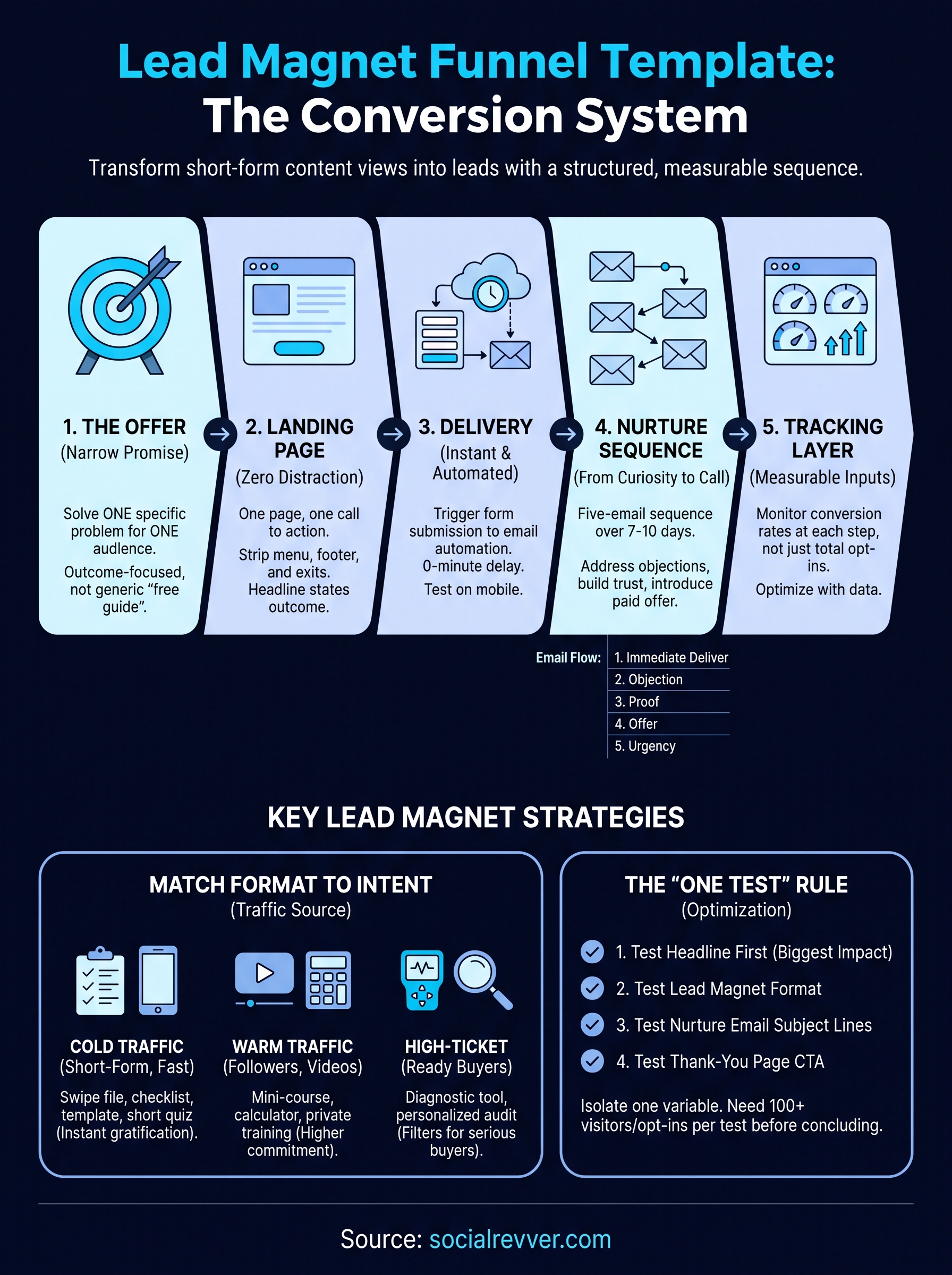
A working lead magnet funnel isn't a stack of tools, it's a sequence of decisions that either move a stranger toward a booked call or lose them at the first click. Before you touch a landing page builder or an email platform, you need to understand the five components that every converting funnel shares, and the one metric that tells you whether each piece is doing its job.
A funnel only converts if every step earns the right to the next one.
The five non-negotiable components
Skip any of these and you're building a leaky bucket, not a system. Each piece has a specific job, and that job is measurable from day one.
- The offer: a specific, narrow promise tied to one problem, not a generic "free guide"
- The landing page: a single-focus page with one call to action and zero navigation links
- The delivery mechanism: instant, automated, and tested on every device before launch
- The nurture sequence: three to seven emails that move the lead from curiosity to a booked call
- The tracking layer: conversion rate at each step, not just total opt-ins
Ignoring the tracking layer is the most common shortcut founders take, and it's the one that costs the most later. If you can't name the conversion rate you expect at each stage, you're not running a funnel yet, you're running a hope.
Where templates usually break
Founders often copy a funnel structure from a course or a competitor without checking whether their traffic source matches the funnel's expectations. Short-form content delivers cold, fast-scrolling traffic, so the funnel has to compress trust-building into seconds, not paragraphs. Generic templates built for email list traffic or paid search rarely account for that speed, which is exactly why so many creators see views without leads.
| Funnel Stage | Common Mistake | Fix |
|---|---|---|
| Offer | Too broad, no clear outcome | Narrow to one result, one audience |
| Landing page | Multiple CTAs, nav menu present | One page, one action, no exits |
| Delivery | Manual follow-up, delayed email | Instant automated delivery |
| Nurture | Generic newsletter content | Sequence built around the lead's next objection |
Once you see the pattern, the fix becomes structural, not creative. You're not writing better copy, you're removing the exits that let leads leave without converting. Every stage in the table above maps directly to the four steps you'll build next, so keep this framework in mind as you move from theory to the actual template.
Step 1. Pick a lead magnet that matches your offer
Most lead magnets fail before the funnel even starts because they were picked for being easy to make, not for pulling the right person toward your actual offer. If you sell a $15,000 consulting retainer, a generic PDF checklist won't attract someone ready to spend that kind of money. Match the format to the buyer's stage, not to whatever you can produce fastest this week.
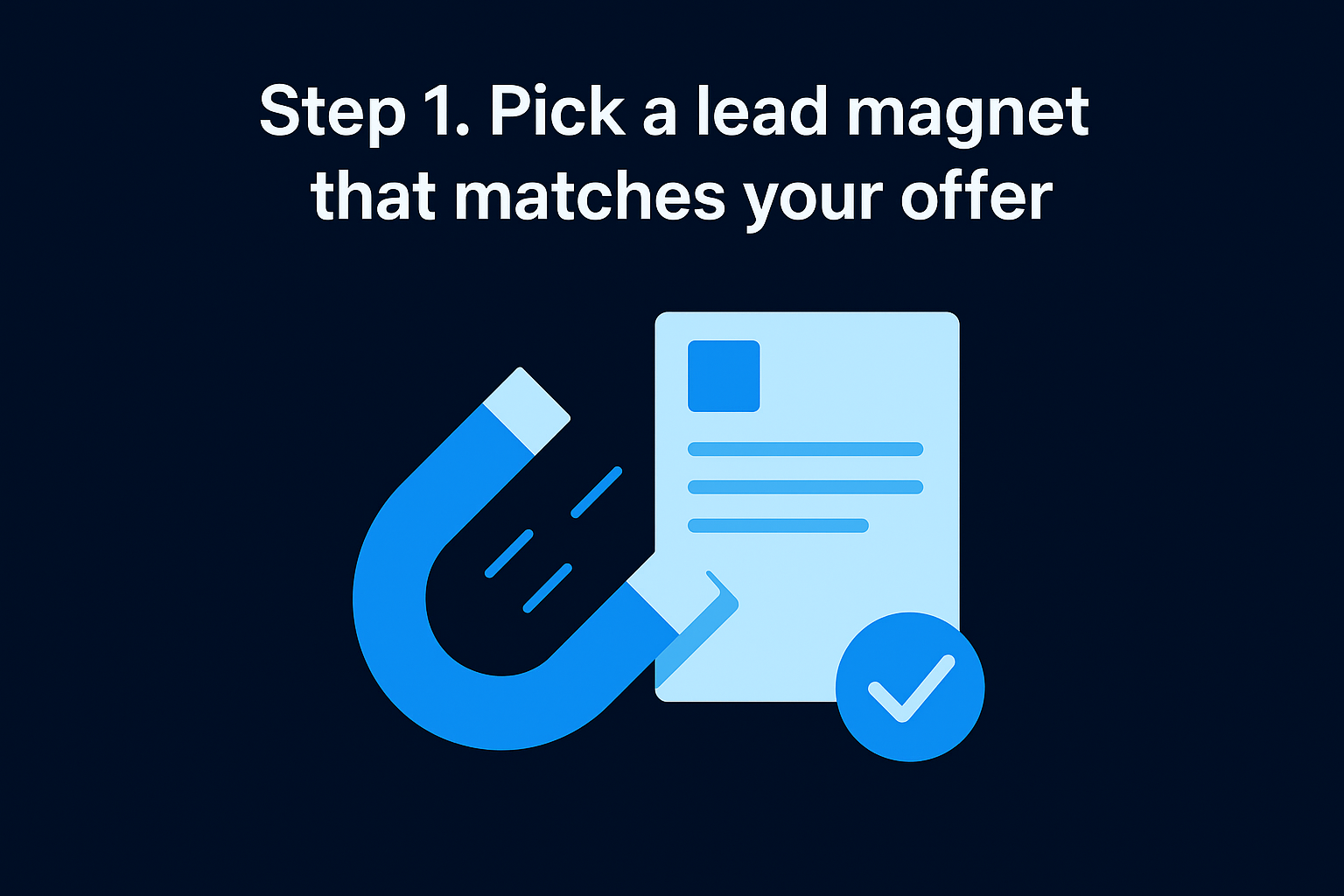
The right lead magnet filters for buyers, not just attention.
Match format to buyer intent
Cold traffic from short-form content needs a magnet that delivers value in minutes, not hours. Warmer traffic, like people who've watched several of your videos or already follow your brand, can handle something denser because they've already decided you're worth their time.
- Cold traffic: swipe file, checklist, template, or short quiz. Instant gratification, low commitment.
- Warm traffic: mini-course, calculator, or private training. Higher commitment, deeper trust already built.
- High-ticket offers: diagnostic tool or personalized audit. Filters for serious buyers, not tire-kickers.
Test the magnet against your offer, not your audience size
Here's the check founders skip: does completing this lead magnet naturally point to your paid offer? If your magnet solves the same problem your product solves, but only halfway, you've built a qualifying filter. If it solves an unrelated problem, you've built a list of people with no reason to buy from you.
Run this test before you build anything:
- Write down the exact outcome the magnet delivers.
- Write down the exact outcome your paid offer delivers.
- Confirm the magnet's outcome is a smaller, faster version of the paid outcome.
- If they don't connect in one sentence, redesign the magnet.
Getting this right at the lead magnet stage sets up every other piece of the funnel to work harder with less friction, because you're not compensating for a mismatched offer with copywriting tricks later.
Step 2. Build your landing and thank-you pages
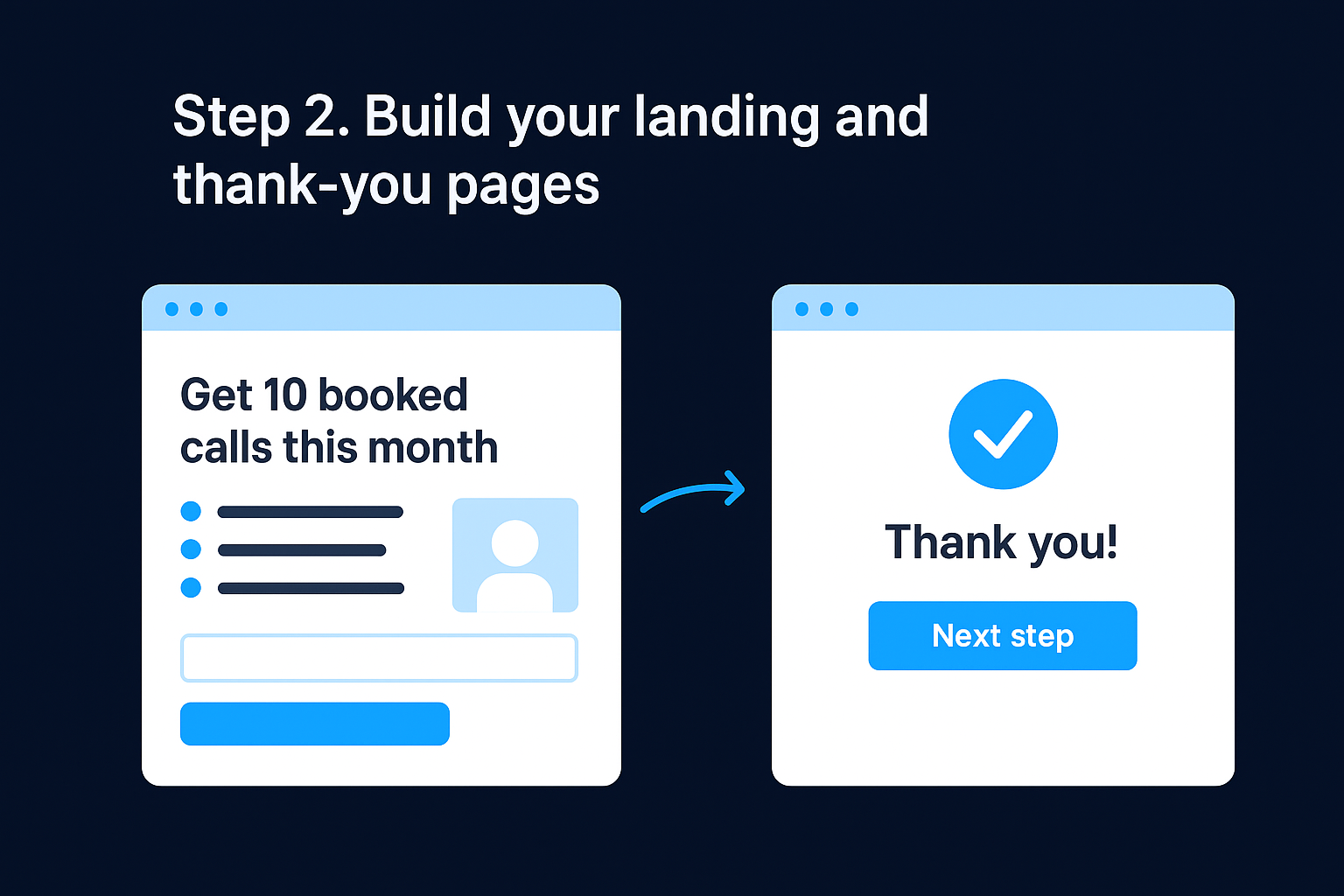
Your landing page has one job: get a stranger to trade their email for the magnet you built in Step 1. Every element that doesn't serve that job is friction. Strip the navigation menu, remove the footer links, and cut any element that gives a visitor a reason to leave without opting in. If someone can click away from your offer without deciding on it first, that's a leak you built yourself.
What goes on the page
Keep the structure simple and repeatable across every funnel you launch. Use this order:
- Headline stating the exact outcome, not the format ("Get 10 booked calls this month" beats "Free PDF Guide")
- Three bullet points showing what's inside
- One image or short preview of the magnet
- One form, one button, one color for that button
- A single line of social proof if you have it
A landing page with two calls to action has zero calls to action.
Don't add a video testimonial carousel or a comparison chart here. Save that credibility-building for later in the funnel. Right now, you're asking for one small yes, and every extra element makes that yes harder to give.
The thank-you page is part of the funnel, not an afterthought
Most founders treat the thank-you page as a formality, a plain "check your inbox" message. That's wasted real estate. This page is the highest-intent moment in your entire funnel: someone just proved they want what you're offering. Use it to point toward a low-friction next step, like booking a call, watching a short video, or joining a community.
- Confirm what was just delivered and when to expect it
- Add one clear next action, matched to your offer's price point
- Include a short video (60 to 90 seconds) if you're selling anything above a few hundred dollars
Skipping this step means you're leaving your warmest traffic with nothing to do but close the tab. Build the thank-you page with the same intent you built the landing page, because the person reading it just told you they're interested.
Step 3. Automate delivery and nurture emails
A lead magnet funnel dies quietly when delivery breaks. If someone opts in and waits ten minutes for an email that never shows up, you've already lost them. Instant delivery isn't a nice-to-have, it's the baseline expectation of anyone who just handed you their email address on a cold-traffic funnel from short-form content.
Delivery speed is the first proof point that you run a real system, not a hobby.
Set up delivery so it never depends on you
Connect your form directly to your email platform's automation, not to a manual export-and-send process. Test the full path yourself, on desktop and mobile, before you send a single visitor to the page.
Trigger: Form submission on [Landing Page URL]
Action 1: Send delivery email instantly, subject line matches magnet promise
Action 2: Tag subscriber with [Magnet Name] for segmentation
Action 3: Add subscriber to [Nurture Sequence Name]
Action 4: Wait 0 minutes, no delay steps before delivery email
Run this test checklist before launch:
- Opt in with a real email address and confirm delivery lands in under 60 seconds
- Check spam folder placement across Gmail, Outlook, and Yahoo
- Confirm the download link or file works on mobile
- Verify the correct nurture sequence tag applied automatically
Build the nurture sequence to move toward the offer
Your nurture sequence exists to answer objections your lead magnet didn't cover, one email at a time, until the reader is ready for a call or purchase. Five emails over seven to ten days works for most funnels tied to short-form content, since that traffic hasn't built deep trust yet.
| Timing | Purpose | |
|---|---|---|
| 1 | Immediate | Deliver magnet, set expectation |
| 2 | Day 2 | Address the most common objection |
| 3 | Day 4 | Share proof or a client result |
| 4 | Day 6 | Introduce the paid offer directly |
| 5 | Day 9 | Create urgency or a clear deadline |
Without this sequence, your magnet becomes a one-time transaction instead of the start of a relationship that ends in revenue.
Step 4. Launch, test, and optimize your funnel
A funnel isn't finished when it goes live, that's when the real work starts. Launching your funnel without a plan to measure it means you're flying blind on the exact numbers that tell you whether this thing works or just looks like it works. Before you send traffic at scale, run a small batch first: 50 to 100 visitors from your short-form content, tracked at every stage, so you catch broken links or confusing copy before you've burned your whole audience on a weak page.
You can't optimize what you haven't measured at every single step.
Watch these four numbers first
Don't drown in vanity metrics. Track the conversion rate between each stage of the funnel, because a drop at any single point tells you exactly where to fix the leak.
- Landing page conversion: visitors who opt in, target 20% or higher for cold traffic
- Delivery confirmation: leads who open the delivery email, target 40% or higher
- Nurture engagement: open and click rate across the sequence, target 15% or higher
- Offer conversion: leads who book a call or buy, target varies by price point
If your landing page sits below 20%, the problem is almost always the headline or a mismatch between your ad and your promise, not the design.
Run one test at a time
Resist the urge to change five things after a slow week. Isolate one variable, run it against a meaningful sample size, and let the data decide instead of your gut.
- Test the headline on your landing page first, it drives the biggest swings
- Then test the lead magnet format itself against a second option
- Then test email subject lines in your nurture sequence
- Then test the call-to-action wording on your thank-you page
Each test needs at least 100 visitors or opt-ins before you draw a conclusion, otherwise you're reacting to noise. Optimization isn't a one-time cleanup, it's the ongoing discipline that separates a funnel that converts today from one that keeps converting six months from now.
Turning your template into a repeatable system
A lead magnet funnel template only pays off once you stop rebuilding it from scratch every time you launch something new. Document each stage, the offer test, the landing page structure, the delivery automation, the nurture sequence, so your next funnel takes hours instead of weeks. That's the difference between a one-off campaign and a system that compounds with every piece of content you publish.
The founders and creators who win with this approach treat funnels the same way they treat content: as measurable infrastructure, not a creative project they redo from feeling each time. If your short-form content is already pulling views, the funnel is what turns those views into pipeline instead of letting them dead-end.
If you'd rather skip the trial and error and plug your content directly into a system built to convert attention into leads, apply to work with our team and get a free 40+ slide strategy built around your funnel.