Most teams think their content problem is creative. They believe they need better ideas, catchier hooks, or a more talented editor. But the real bottleneck almost always sits underneath the content itself, in the operations layer. If you've ever asked what is content operations, you're already looking in the right direction. It's the system of people, processes, and technology that determines whether content gets planned, produced, and distributed consistently, or dies in a shared Google Doc no one remembers exists.
Content operations is what separates a brand that posts randomly from one that treats attention like a scalable business function. At SocialRevver, this is exactly what we build for founders and business owners: a managed content infrastructure where strategy, production, and distribution run as a single system, not a collection of disconnected tasks. We've seen firsthand how the right operational framework turns organic content into a predictable growth channel instead of a guessing game.
This article breaks down content operations in full: what it actually means, the three pillars it stands on, why it matters for growth, and how to build a content operations framework that doesn't collapse the moment you try to scale. Whether you're a solo founder wearing every hat or leading a team that's outgrown its current workflow, you'll walk away with a clear blueprint. No buzzwords, no filler, just the structural thinking that makes content work as a system.
What content operations is and is not
When people ask what is content operations, they usually expect a simple answer. The reality is that content operations is both a mindset and a mechanism: it's the end-to-end system governing how your content gets conceived, built, approved, published, and measured. Think of it as the operating system running quietly beneath your content strategy. The strategy tells you what to say and who to say it to. Content operations determines how that work actually gets done, by whom, with what tools, in what sequence, and with what level of quality control applied along the way. Without that layer, even the best strategy sits idle.
What content operations actually is
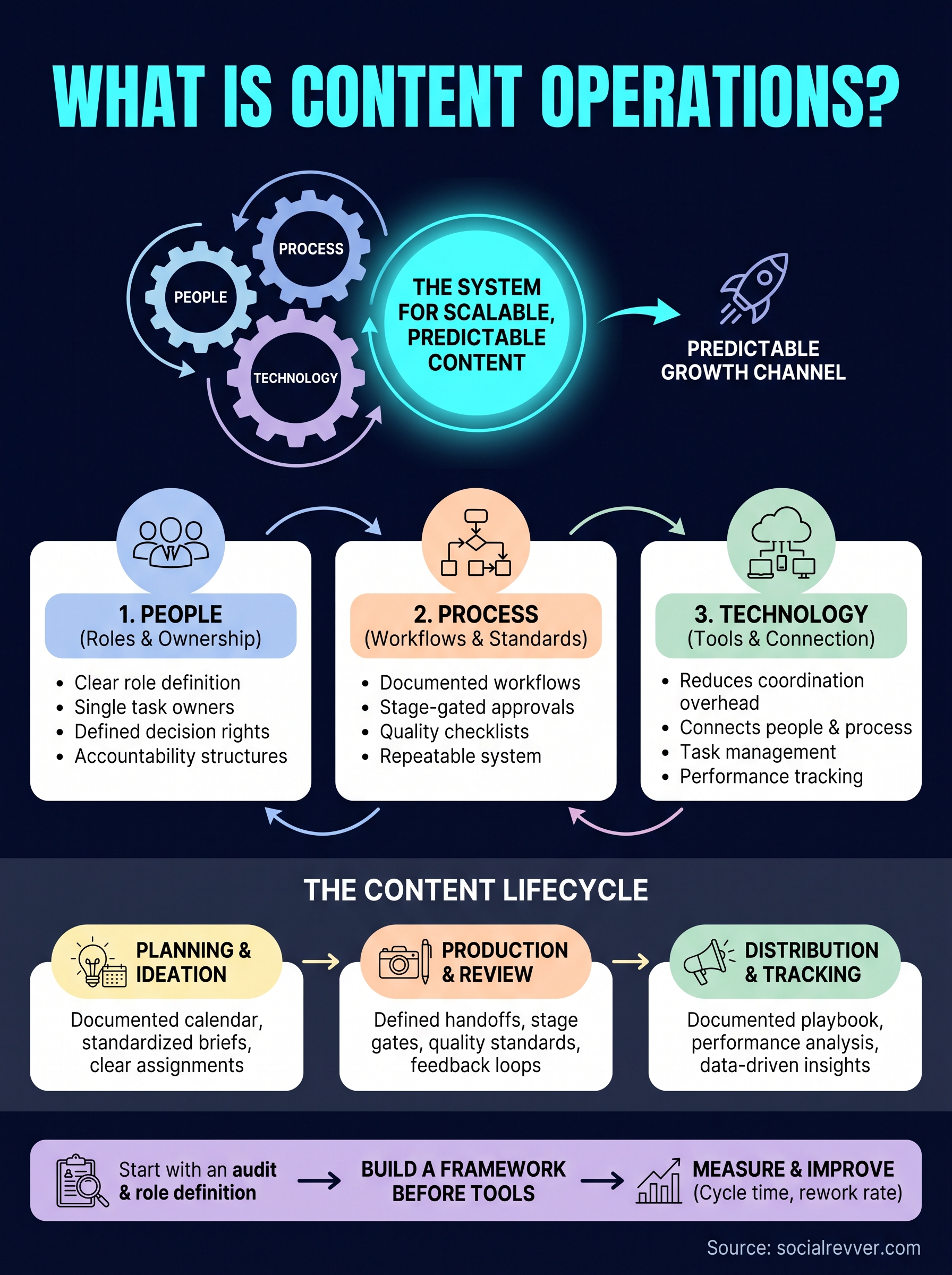
Content operations covers three interconnected layers. The first is people: the roles, responsibilities, and workflows that define who owns each part of the content process. The second is process: the documented steps, approval chains, and feedback loops that move a piece of content from a raw idea to a finished, published asset. The third is technology: the platforms, automation tools, and analytics systems that support and connect the first two layers. None of these three layers functions well in isolation. They depend on each other, and a weakness in any one of them slows the entire system down.
When these three layers are aligned, content stops being an unpredictable creative exercise and becomes a repeatable production function.
A mature content operations setup means your team never starts from scratch. Briefs follow a standard format, editors know exactly where to leave feedback, and distribution follows a documented checklist rather than a gut feeling. It's the difference between a production line that reliably delivers finished output and a workshop where everyone improvises based on mood and availability. The creative work still requires skill and judgment, but the infrastructure around it removes unnecessary friction so that skill gets applied where it actually matters.
What content operations is not
Content operations is not content strategy, and confusing the two is one of the most common mistakes growing teams make. Strategy defines your goals, your audience, your topics, and your positioning in the market. Operations is the infrastructure that executes that strategy. You can have a smart, well-researched strategy and still produce content at a painful crawl, with inconsistent quality, if your operational layer is broken or absent.
It's also not the same as content marketing. Content marketing is the practice of using content to attract and convert an audience. Content operations is the back-end system that makes that practice sustainable at scale. Without operational infrastructure, content marketing is a sprint that burns teams out and produces uneven results. With it, content marketing becomes a long-term, scalable channel that compounds over time rather than collapsing under its own weight.
Finally, content operations is not just a concern for large enterprise teams with dedicated departments. Many founders and small business owners assume they don't need to think about operations until they're producing a high volume of content. That assumption is expensive. Operational debt accumulates early: inconsistent formatting, lost assets, unclear ownership, missed deadlines, and duplicated effort all start small and compound fast. Building operational habits from the start costs far less time and energy than trying to retrofit a functional system around broken patterns that have already hardened into routine.
Why content operations matters for growing teams
Growth creates complexity, and complexity without structure produces chaos. When you're a solo founder or a two-person team, informal coordination works because everyone holds the full picture in their head. But the moment you add a second editor, a videographer, a strategist, or a distribution specialist, the informal approach breaks down. Files go missing. Deadlines slip. Two people work on the same draft simultaneously and overwrite each other's work. Understanding what is content operations becomes less of an intellectual exercise and more of a practical requirement for keeping your output consistent and your team functional.
The hidden cost of skipping operations
Most teams don't notice the cost of poor operations immediately. It shows up as small, recurring friction: a brief that never got written, a video that sat in someone's camera roll for three weeks, an approval buried in a thread nobody went back to read. Individually, none of these feel significant. Collectively, they add up to dozens of hours lost each month and a content output that runs far below what your team is actually capable of producing. The cost isn't only lost time. It's the compounded opportunity cost of content that never reached your audience because the system responsible for shipping it didn't function. That lost content represents authority you didn't build, leads you didn't generate, and positioning you ceded to competitors who stayed more consistent.
Operational debt doesn't announce itself. It accumulates silently and only becomes visible when a team tries to scale and finds that nothing moves fast enough.
Why scale makes operations non-negotiable
When your content volume increases, every gap in your operational layer multiplies in proportion. Publishing one video per week with a broken process means one delayed video. Publishing five per week with the same broken process means five points of failure, five approval bottlenecks, and five opportunities for quality to slip. Adding more people to a broken system doesn't solve the problem; it amplifies it, because more contributors mean more coordination overhead stacked on top of an already fragile foundation.
Teams that build operational infrastructure before they need it scale with far less friction than teams that try to patch problems in motion. The right framework keeps quality consistent, focuses your team on the work that requires real judgment, and ties your content output directly to business growth rather than leaving it running as a disconnected activity with no clear path to revenue.
The three pillars of content operations
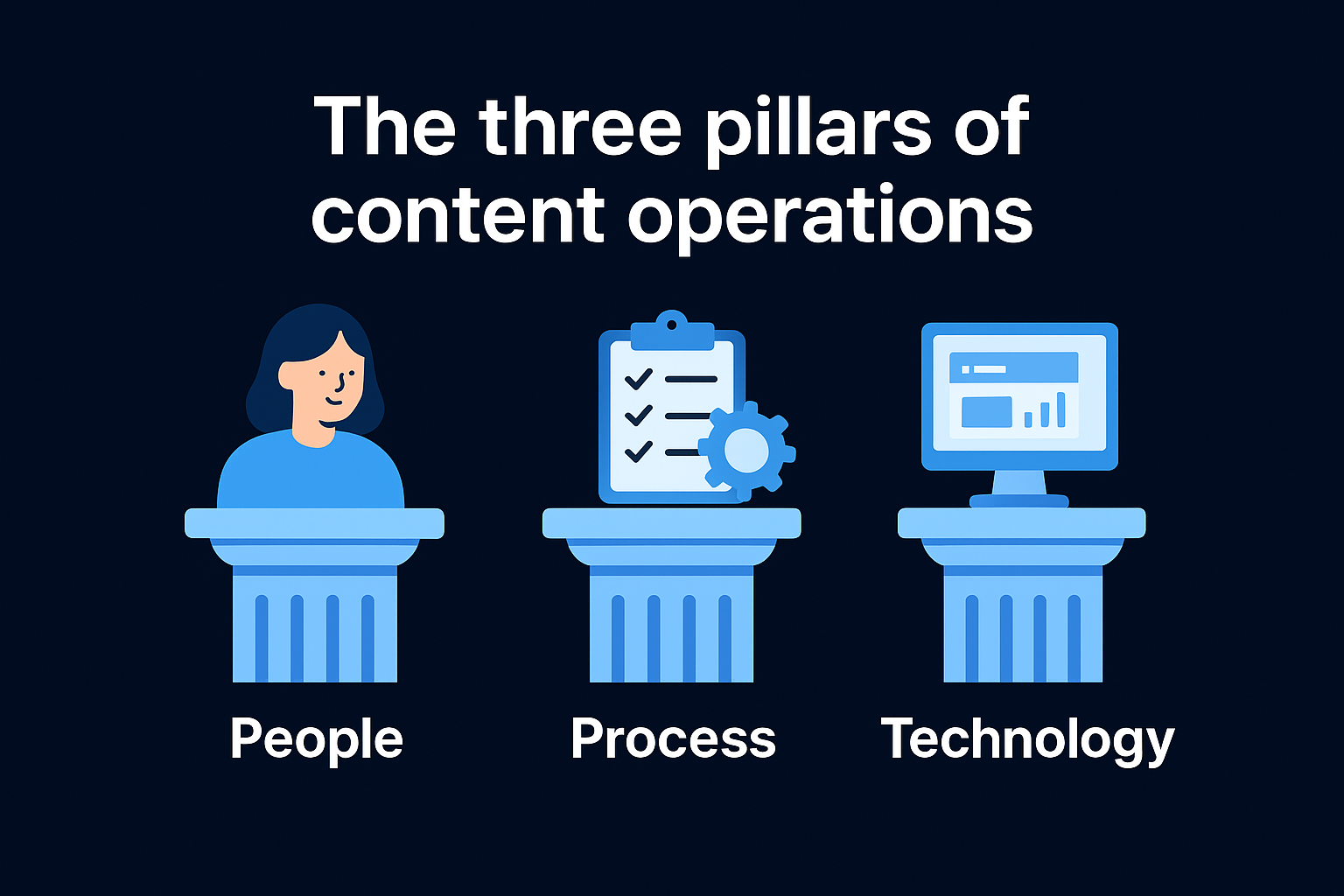
Understanding what is content operations at a conceptual level is useful. But the framework only becomes actionable when you break it into its three core pillars: people, process, and technology. Each pillar carries distinct responsibilities, and each one depends on the other two to function properly. Strengthen all three and your content system compounds. Neglect any one of them and the other two start working against each other.
People: roles, ownership, and accountability
Your content operations are only as reliable as the humans running them. Clear role definition is the foundation here. Every task in your content workflow needs a single owner, not a shared one, because shared ownership in practice means no ownership. When the brief doesn't get written, someone specific should be responsible for that, not "the team." Accountability structures prevent tasks from falling into the gap between people who each assumed someone else would handle them.
Ambiguity around ownership is the single most common reason content workflows stall, regardless of how good the tools or strategy are.
As your team grows, you also need to define the decision rights at each stage of production. Who approves a script before it goes to production? Who has final sign-off on a published post? Mapping these decision points explicitly saves hours of back-and-forth and keeps momentum moving in the right direction.
Process: documented workflows and quality standards
Process is what converts individual effort into a repeatable, scalable system. Without documented workflows, your team reinvents the wheel on every project, and quality becomes a function of who happened to be involved on a given day. A functional process layer includes standardized brief templates, stage-gated approval sequences, and a clear definition of what "done" actually means for each content format you produce.
Documented processes also make onboarding and handoffs significantly faster. When a new team member joins, they don't need to shadow someone for two weeks to understand how a video goes from idea to published. They read the process documentation and follow the steps.
Technology: tools that connect the system
Technology in content operations is not about using the most sophisticated platforms. It is about selecting tools that reduce coordination overhead and connect your people and process layers without creating new friction. Your tech stack should handle task management, asset storage, communication, and performance tracking in a way that makes the entire workflow visible to everyone who needs to see it.
How content ops works across the content lifecycle
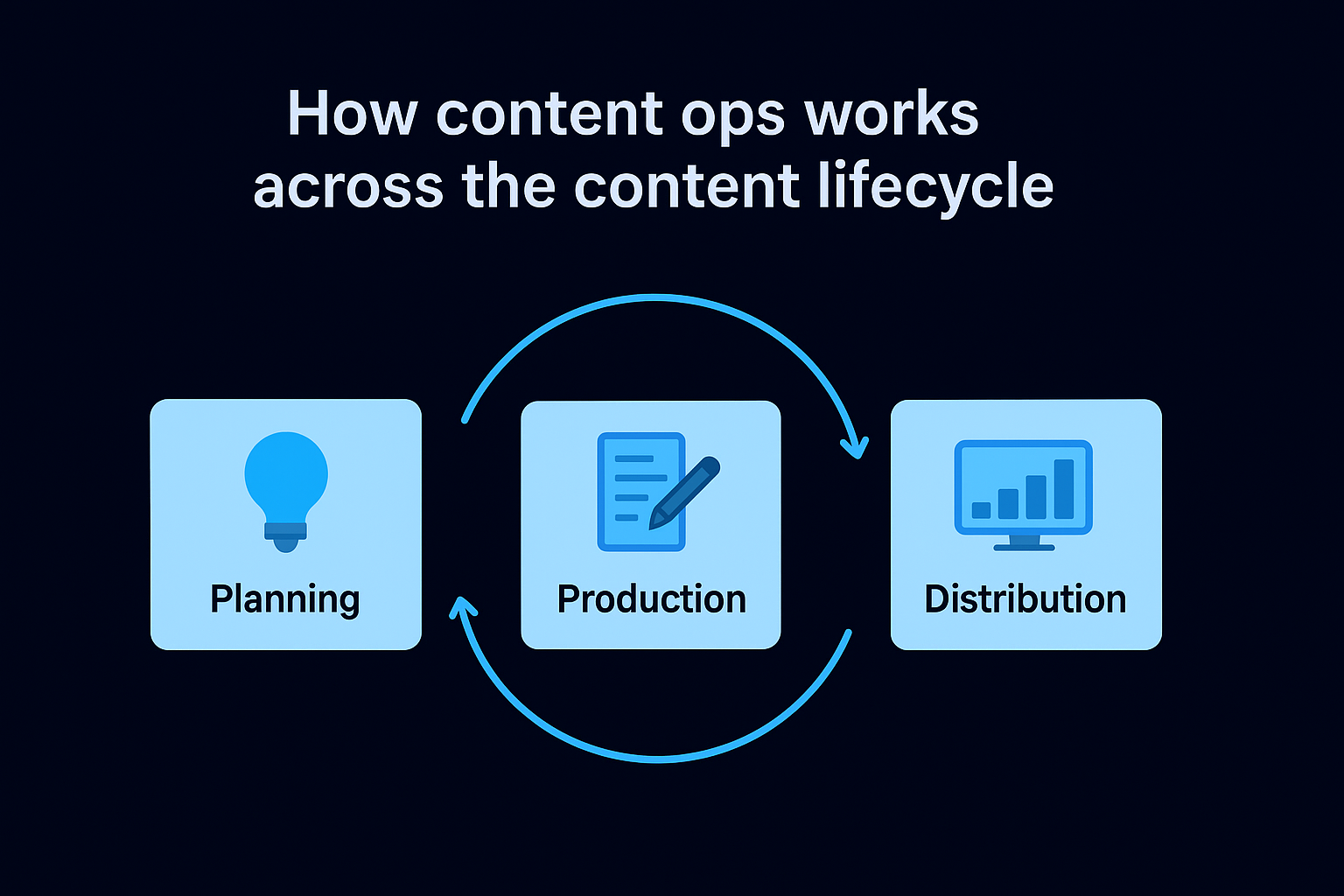
Understanding what is content operations is one thing. Seeing how it functions across every stage of your content's life is what makes the framework practical. Content doesn't move from idea to published asset in a single step; it passes through multiple stages, and your operational layer needs to support each one without creating bottlenecks between them.
Planning and ideation
Planning is where most operational breakdowns begin. Without a standardized ideation process, topics get chosen based on what someone thought of in the shower rather than what your audience needs or what your strategy demands. A functional content ops setup means your planning stage produces a documented content calendar with clear assignments, deadlines, and format requirements before a single word gets written or a camera gets turned on.
Your planning process should also include a brief template that every piece of content runs through before it enters production. That brief captures the topic, the target audience, the intended format, the distribution channel, and the specific outcome you're optimizing for. When everyone starts from the same documented starting point, production moves faster and output stays aligned with your goals.
Production and review
Production is the stage where most teams experience the most friction, usually because handoffs between contributors aren't defined. Clear stage gates determine when a draft moves from scripting to editing, from editing to approval, and from approval to final production. Without these gates, work sits in ambiguous states for days while contributors wait for feedback that never arrives.
When your review process has defined stages and single owners at each one, approval cycles shrink from days to hours.
Your quality standards also live in this stage. Documenting what acceptable output looks like for each format, covering video length, caption structure, and visual brand requirements, removes the subjective judgment calls that slow teams down and create inconsistency across your content output.
Distribution and performance tracking
Distribution is not the end of the content lifecycle; it's the beginning of the feedback loop. Where you publish, when you publish, and how you format content for each platform are all operational decisions that should follow a documented playbook rather than a moment-to-moment judgment call. That playbook is part of what makes your entire content system repeatable and scalable.
Performance tracking closes the loop between what you distributed and what you learn. When your analytics process is standardized, data flows back into your planning stage automatically and your next production cycle starts with sharper inputs than the last.
How to build a content operations framework
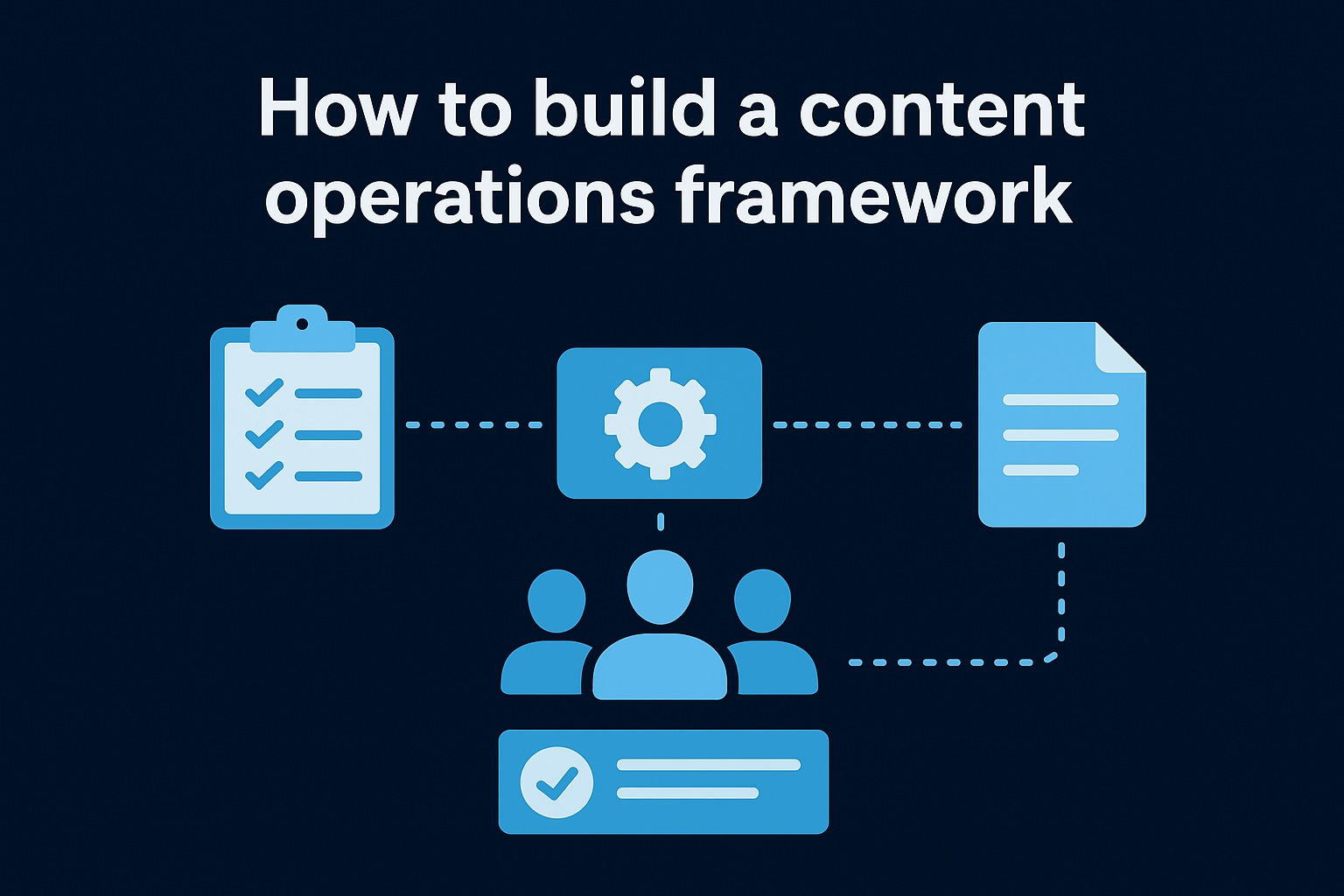
Building a content operations framework doesn't require a large team or an enterprise budget. What it requires is a clear sequence: you audit what exists, define who owns what, document how work flows, and then layer in the tools that support those decisions. Most teams do this in reverse, buying software before they've defined their process, which is why so many expensive platforms go underused. If you've been asking what is content operations and wondering how to put it into practice, the answer starts with structure, not subscriptions.
Start with an audit of your current state
Before you build anything new, you need an honest look at how your content currently moves through your organization. Map every stage of your existing workflow from ideation to publishing, and identify where tasks stall, where handoffs fail, and where quality inconsistencies appear most often. The gaps you find in that audit become the exact problems your framework needs to solve.
An audit done honestly is more valuable than a framework built on assumptions about how your team thinks it operates versus how it actually does.
Pay particular attention to repeated friction points: tasks that take twice as long as they should, approvals that require follow-up, and assets that regularly get lost or recreated. These recurring failures are signals, not random incidents. They tell you precisely where your operational layer is missing structure.
Define roles before you define tools
Once you understand your gaps, assign clear ownership to every stage of your workflow before you open a single tool or build a single template. Each step in your content process needs one person responsible for it. That means naming the person who writes the brief, the person who approves the script, and the person who owns final distribution sign-off, not leaving those decisions to group consensus.
Role clarity removes the coordination overhead that slows most content teams down. When your team knows exactly who decides what and at which stage, content stops pooling in ambiguous review states and starts moving through production at a consistent pace.
Document your process as a repeatable system
With roles defined, build your process documentation: a standard brief template, a stage-gated approval sequence, and a format-specific quality checklist for each content type you produce. These documents don't need to be long. They need to be specific enough that any team member can follow them without asking for clarification, which is the real test of whether your framework is functional or just theoretical.
How to measure and improve content ops
Knowing what is content operations and building a framework for it only gets you halfway. The other half is knowing whether your system is actually working, and having a structured way to improve it when it isn't. Most teams skip this step entirely, treating content operations as something you set up once and leave alone. That assumption is how operational drift happens: small inefficiencies settle into routine, and your system gradually produces less than it should without anyone noticing why or where the slowdown started.
Metrics that reflect operational health
Not all content metrics tell you how well your operations are functioning. Vanity metrics like follower count or total views tell you about audience response, not about how efficiently your team moves content through production. The numbers that actually reflect your operational health are different: cycle time (how long a piece of content takes from brief to published), approval turnaround (how many hours a piece sits waiting for sign-off), and rework rate (how often content comes back for significant revision after it has already moved through production). These three metrics give you a direct signal on where your workflow is healthy and where it is costing you time.
When your cycle time shortens without a drop in quality, your operational framework is doing exactly what it should.
Tracking these numbers consistently gives you a reliable baseline. Once that baseline exists, you can pinpoint which stages of your workflow create the most delay and focus your improvement efforts there rather than making changes based on intuition or whoever complained most recently.
Running improvement cycles
Measuring your ops health without acting on the data is just documentation. Scheduled retrospectives give your team a regular cadence for reviewing what the numbers tell you and making targeted changes to your process. A monthly review of your core operational metrics, paired with a focused discussion about where friction is coming from, is enough to drive consistent improvement without pulling your team into meetings that eat into production time.
When you identify a bottleneck, change one variable at a time. Adjusting multiple things simultaneously makes it impossible to know which fix produced the result. Isolating your changes keeps your feedback loop clean and gives you a repeatable way to understand what your system actually responds to. Over time, this discipline builds an operational foundation that strengthens with each production cycle.
Where to go from here
You now have a complete answer to what is content operations and a practical framework for building one that holds up under pressure. Content operations is not a concept reserved for large teams or enterprise budgets. It is the structural layer that every brand needs the moment they decide content should function as a real business channel rather than an unpredictable side activity. You've learned how to define roles, document process, select supporting technology, and measure whether your system is actually working.
The next step is applying it. Start with your audit, map where your current workflow stalls, assign clear ownership to each stage, and document your process before you touch a single tool. If you'd rather skip the build phase and work with a team that has already engineered this system for scaling brands, apply to work with SocialRevver and get a free 40-plus slide social media strategy built around your specific goals.