
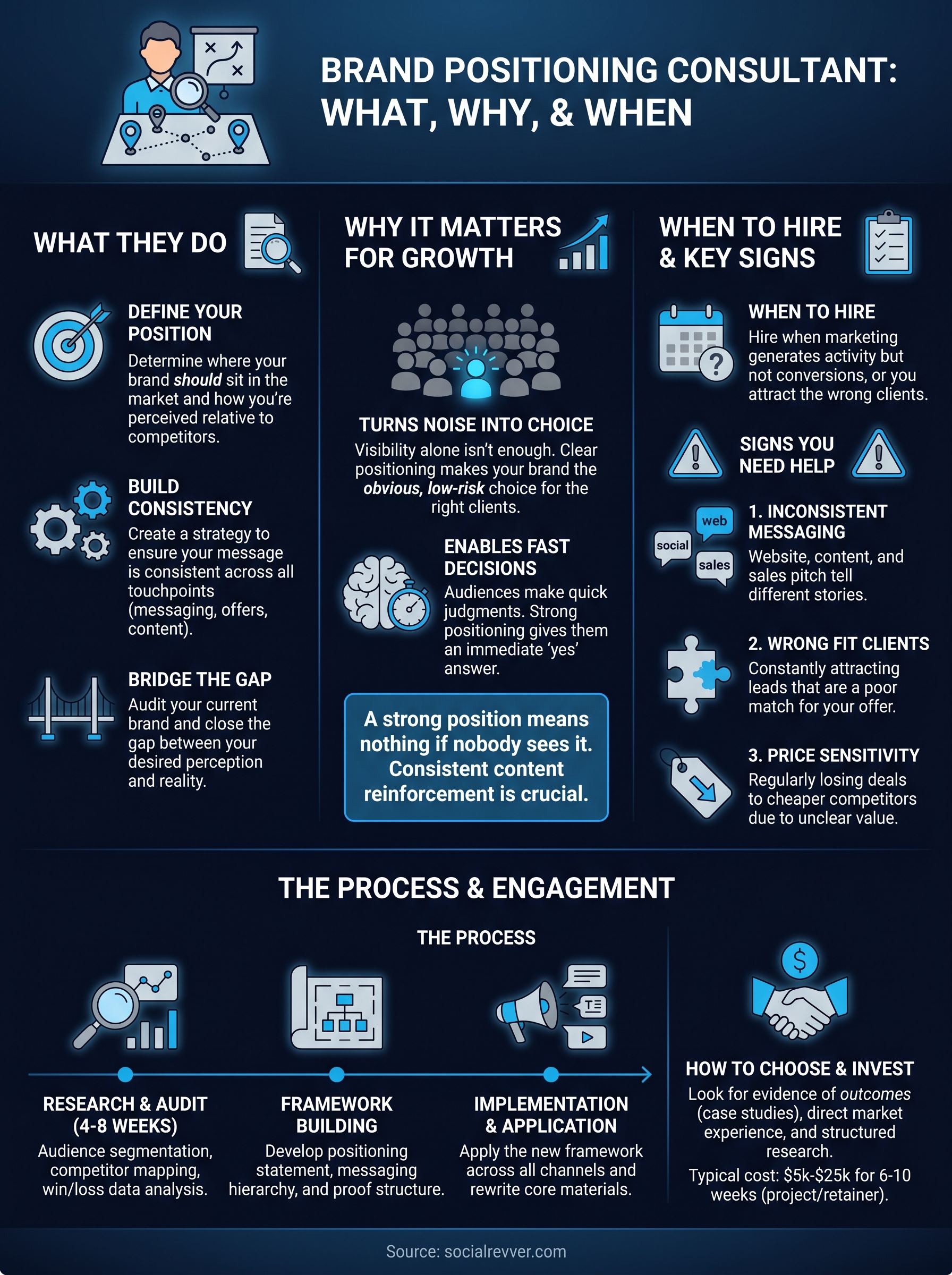
A brand positioning consultant helps you figure out exactly where your brand sits in the market, and more importantly, where it should sit. They define how your audience perceives you relative to competitors, then build a strategy to own that position consistently. It's the difference between being "another option" and being the obvious choice.
But here's the part most people miss: positioning isn't just a strategy document or a tagline exercise. It has to show up everywhere, your messaging, your offers, and especially your content. A strong position means nothing if nobody sees it. That's exactly where content systems like what we build at SocialRevver come in. We engineer short-form content that reinforces your brand's authority and keeps your positioning visible at scale, so the work a consultant does actually compounds over time instead of collecting dust in a slide deck.
This article breaks down what a brand positioning consultant actually does day-to-day, the specific situations where hiring one makes sense, and how to evaluate whether you need one right now. If you've been struggling with inconsistent messaging or feel like your brand blends into the noise, this will give you a clear framework for deciding your next move.
Why brand positioning matters for growth
Most businesses focus on getting more visibility: more followers, more ads, more content. But visibility without a clear position is just noise. If people see your brand repeatedly and still can't immediately understand why you're the right choice, they won't pick you. They'll pick the brand that made the decision feel obvious and low-risk. That's not a marketing problem; it's a positioning problem.
The gap between being seen and being chosen
Your audience makes decisions fast, often in seconds. When someone lands on your profile, watches your content, or hears your name from a colleague, they run a quick mental calculation: does this brand fit what I need? If your positioning is unclear or inconsistent, that calculation returns no answer, and they move on. A brand positioning consultant's core job is to make that answer immediate and unmistakable, so every touchpoint reinforces the same signal.
The brands that win aren't always the best at what they do. They're the best at making the right people feel like the brand was built specifically for them.
How weak positioning drains growth
Poor positioning creates compounding problems over time. When your message doesn't clearly signal who you serve and why you're different, your marketing budget works harder for less return. You attract the wrong clients, lose deals to lower-priced competitors, and spend time educating prospects who were never a fit. Every piece of content you publish and every sales conversation you have gets more difficult when your core position is undefined.
Fixing your position is not a one-time project either. As your market shifts and competitors adjust, your positioning needs active maintenance. Companies that invest in understanding where they stand tend to outgrow competitors who treated positioning as something to figure out at launch and never revisit.
What a brand positioning consultant does
A brand positioning consultant starts by auditing how your brand currently shows up across every channel: your messaging, your offers, your content, and the competitive landscape around you. They look for the gap between how you describe yourself and how your audience actually perceives you. This gap is almost always larger than founders expect, and it's the root cause of most inconsistent marketing results.
The strongest positioning rarely invents something new. It clarifies and amplifies what your best clients already sense is true about you.
Research and competitive analysis
They dig into your market to identify where competitors cluster and where defensible white space exists. This work involves customer interviews, competitor message mapping, and audience segmentation analysis. The goal is to find a position that's both differentiated and credible, one that aligns with what your strongest clients already value about working with you.
Your existing results and client outcomes matter here too. A consultant surfaces specific proof points from your track record to make the claim feel earned rather than manufactured.
Building the positioning framework
Once the research wraps up, a consultant translates the findings into a clear positioning statement and messaging hierarchy you can apply across sales, content, and marketing. This includes your defined target audience, your core differentiation point, and the proof structure that supports it. Everything your brand produces from that point should reference this framework.
When to hire one and what to fix first
Hiring a brand positioning consultant makes sense when your marketing is generating activity but not converting, or when you keep attracting clients who are a poor fit for your actual offer. These are signals that your position is either unclear or aimed at the wrong audience. If your team can't explain what makes you different without a long answer, it's time to get outside help.
Positioning problems rarely look like positioning problems. They show up as price objections, poor-fit leads, and messaging that resonates with no one in particular.
Signs your positioning needs work
Inconsistent messaging across channels is one of the clearest warning signs. If your website says one thing, your social content implies another, and your sales pitch lands differently again, prospects lose confidence before they reach a decision. You should also watch how price-sensitive your deals are. Regularly losing to cheaper competitors usually points to a positioning gap, not a pricing problem.
Common signs worth taking seriously:
- You win deals but can't consistently explain why
- Your best clients came through referrals, not your marketing
- Competitors with weaker results charge more than you do
What to clarify before the engagement starts
Before you bring in a consultant, document your best current clients: who they are, what they hired you for, and what outcome they got. This gives the engagement a much stronger starting point. A good consultant builds on real evidence from your existing results, not assumptions about your market.
The positioning process step by step
A brand positioning consultant typically runs this work in three phases. Each phase builds on the last, so rushing the research tends to produce positioning that sounds clear internally but fails with real prospects. Expect four to eight weeks for most engagements, depending on your market complexity.
Research and audience definition
The process starts with audience segmentation and competitor mapping. Your consultant identifies which customer segment produces your strongest results, then maps where competitors cluster in their messaging. This surfaces the white space your brand can credibly own without overstating your capabilities.
The best positions aren't invented from scratch. They clarify what your strongest clients already sense is true about working with you.
Common research inputs your consultant will use:
- Customer interviews and win/loss data
- Competitor messaging analysis
- Your existing offer and proof points
Translating research into a working framework
Once the research closes, your consultant builds the positioning statement and messaging hierarchy that your team applies across content, sales, and outreach. Every element, including your target audience definition, differentiation claim, and proof structure, ties back directly to the research. This framework becomes the filter for every piece of content and every sales conversation going forward.
Apply the framework immediately. Don't wait for perfect conditions before you use it. Rewrite your core content and sales materials to reflect the new messaging hierarchy first.
How to choose a consultant and what it costs
Choosing a brand positioning consultant comes down to evidence, not credentials. You want someone who can show you positioning work that actually changed business outcomes for clients in markets with real competition. Ask for case studies where the positioning shift led to measurable results: higher close rates, better-fit leads, or pricing power. If they can't show you that, keep looking.
The right consultant makes your existing strengths legible to the right audience. The wrong one replaces your voice with generic category language.
What strong candidates demonstrate
Before you hire, look for these specific qualities:
- Direct experience in markets with defined competitors, not just brand strategy theory
- A structured research process that includes customer interviews, not just internal workshops
- Clear deliverables: a written positioning framework, messaging hierarchy, and implementation guide
What the engagement costs
Most positioning engagements run between $5,000 and $25,000, depending on market complexity and the depth of research involved. Retainer-based consultants who stay involved through implementation tend to produce stronger outcomes than one-time project work. Budget at least six to ten weeks for the full process if you want research that holds up under real market pressure.
Next steps
Hiring a brand positioning consultant is a high-leverage move when your marketing generates attention but fails to convert it into the right clients. The process works when you bring clear evidence of your best results into the engagement and commit to applying the framework across every channel, not just your website copy.
Positioning alone, though, only solves half the problem. Your position has to stay visible to compound over time, and that requires a consistent content system that puts your message in front of the right audience repeatedly. Without that distribution layer, even a sharp positioning framework fades fast.
If you want your positioning to actually build authority and generate inbound leads, you need content that reinforces it at scale. Our team at SocialRevver engineers exactly that. Get your free 40+ slide social media strategy and see how we turn your brand's position into a predictable growth engine.