
Robert McKee's "Story" has been the definitive reference on narrative craft since 1997. Screenwriters, novelists, and playwrights have used it to build stories that hold audiences from the first scene to the last. But here's what most people miss: the Robert McKee story structure framework isn't just for Hollywood. It's a blueprint for any format where you need to capture and hold human attention, including the short-form content that drives modern brand growth.
McKee argues that great storytelling isn't about following a formula. It's about understanding the deep mechanics of how audiences process change, conflict, and meaning. His principles, the beat, the turning point, the gap between expectation and result, explain why some narratives feel magnetic and others fall flat. That's exactly the kind of structural thinking we apply at SocialRevver when engineering short-form content systems. Every high-performing video has a story architecture, whether it's 90 seconds or 90 minutes.
This article breaks down the core principles of McKee's story structure: the hierarchy of story elements from beat to act, the role of the inciting incident, how turning points create irreversible change, and how the controlling idea holds everything together. You'll get clear definitions, concrete examples, and a practical understanding of why this framework has shaped professional storytelling for nearly three decades. Whether you're writing a screenplay or scripting content that converts, these principles are the foundation.
What McKee means by story structure
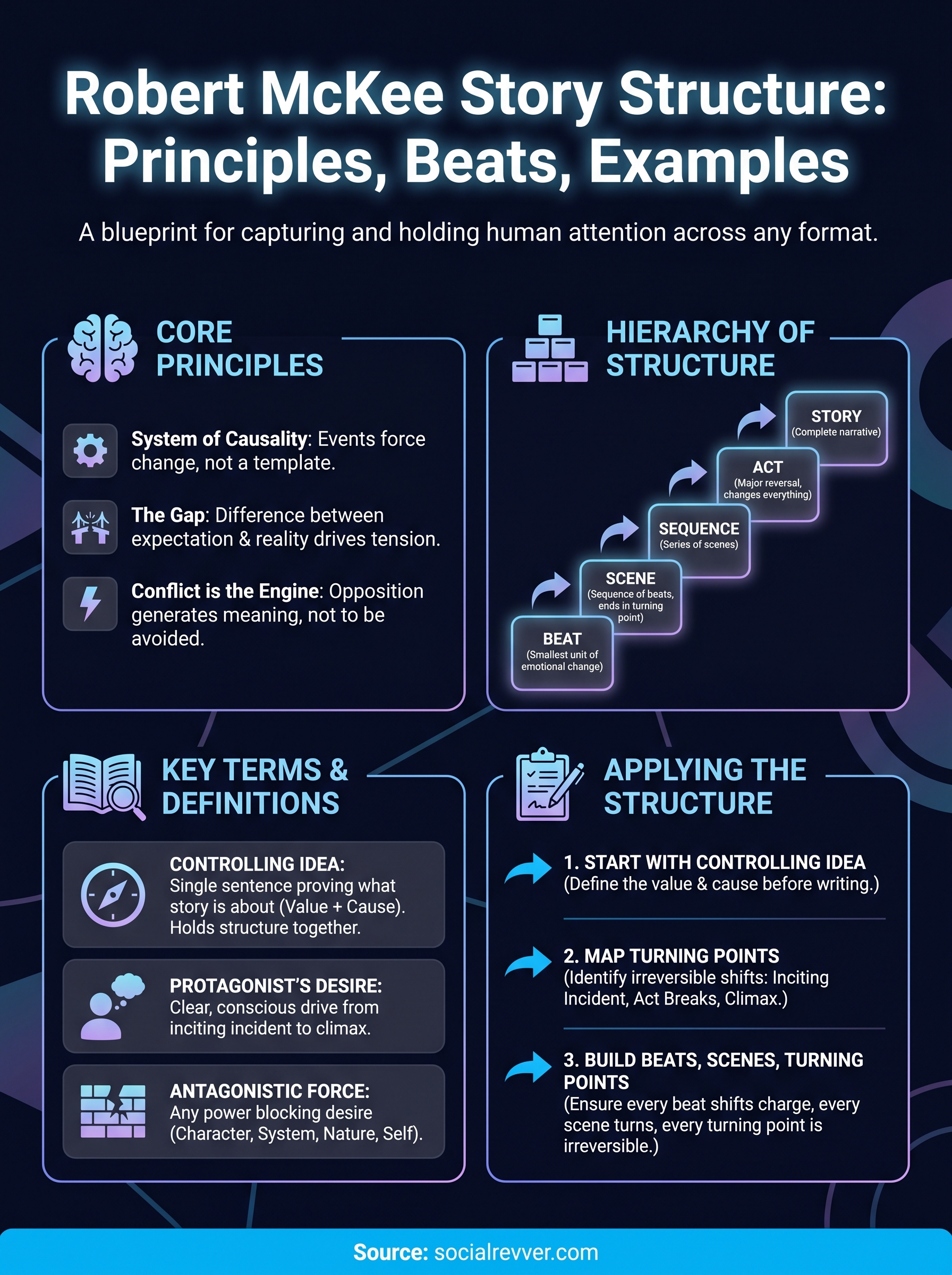
McKee defines story structure as the selection and arrangement of events that create specific emotional and intellectual effects in the audience. He isn't describing a template with three acts and a midpoint. He's describing a system of causality, where every element exists to force change and move the protagonist through a series of irreversible decisions. The robert mckee story structure framework starts from one foundational claim: life presents people with gaps between what they expect and what actually happens, and great stories exploit that gap relentlessly.
The hierarchy from beat to act
McKee builds his framework on a clear hierarchy of structural units. At the smallest level is the beat, a single exchange of action and reaction between characters that shifts the emotional charge in a scene either positively or negatively. These beats accumulate into scenes, scenes build into sequences, sequences build into acts, and acts build into the complete story.
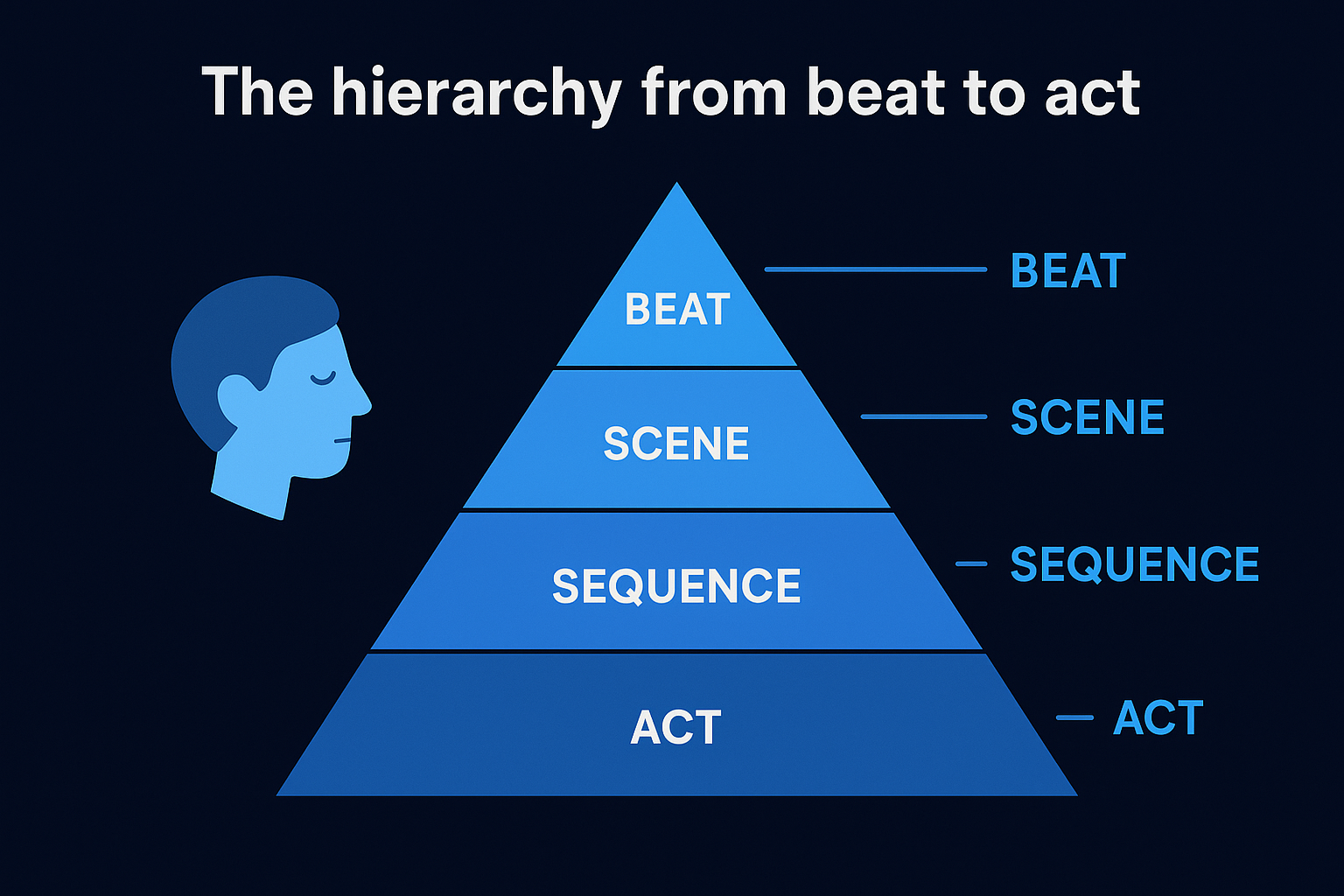
This hierarchy matters because it tells you exactly where to look when a story breaks down. If a scene has no turning point, it's dead weight. If an act doesn't end with a major reversal that changes everything that follows, the structure collapses. McKee insists that every level of the hierarchy must carry its own change, or the audience disconnects and stops caring.
The gap and the inciting incident
The concept of the gap is central to McKee's mechanics. A character takes an action expecting a specific result. Reality returns a different result. That gap between expectation and outcome is where dramatic tension lives, because it forces characters to make harder choices and reveals who they actually are under pressure. Without the gap, you have a sequence of events but not a story.
The inciting incident is the event that throws the protagonist's world out of balance and sets the entire story in motion.
McKee treats the inciting incident as the most critical structural decision a writer makes. It must be significant enough to disrupt the protagonist's ordinary life and raise a central dramatic question that the entire narrative works to answer. In a 90-minute film, this typically happens early in the first act. In a 90-second video, it happens in the first three seconds. The structural logic is identical regardless of format, which is exactly why McKee's principles transfer far beyond traditional screenwriting.
Why McKee's structure works
The robert mckee story structure framework endures because it isn't built on taste or trend. It's built on how the human brain processes narrative. Audiences don't consciously track plot points. They track emotional change, and they disengage the moment a story stops delivering it. McKee's system is designed around that biological reality, which is why it works across genres, formats, and screen sizes.
Conflict is the engine, not the obstacle
McKee argues that conflict is not a problem to be avoided in a story but the core mechanism that generates meaning. Without genuine resistance, your protagonist makes no real choices, and without real choices, there's no character revelation. The audience needs to feel that something is genuinely at stake before they invest attention, and conflict is what creates that pressure.
Conflict doesn't mean arguing or fighting. It means that what the character wants and what reality allows are in direct opposition.
This is why scenes with zero friction feel flat no matter how well written the dialogue is. Every scene needs an antagonistic force, whether that's another person, an institution, nature, or the protagonist's own psychology. Remove that force, and the emotional engine stalls.
Structure gives the audience a frame to care
Your audience needs a structural contract early in a story. The inciting incident establishes that contract by telling them what the central question is and why it matters. Once that's in place, every subsequent scene either tightens or releases tension around that question. McKee's framework works because it keeps the audience oriented within that tension at all times.
When structure is invisible, the audience simply feels gripped. When it breaks down, they feel confused or bored without knowing why. That's not a creative failure. It's a structural one, and McKee's framework gives you the tools to diagnose it precisely.
Core principles and key terms
The robert mckee story structure framework uses precise terminology to describe concepts that most writers handle intuitively but imprecisely. Getting these terms right matters because they give you a diagnostic vocabulary for your own work. When a script isn't working, you need language specific enough to locate the failure.
The Controlling Idea
McKee defines the controlling idea as the single sentence that states what your story proves about human experience. It has two parts: a value and a cause. For example, "Love prevails because of self-sacrifice" identifies both what the story delivers emotionally and the mechanism that delivers it. Every scene, character decision, and turning point should either build toward or test that idea.
Your controlling idea is not your theme in the abstract sense. It is the specific argument your story makes through its action.
Without a controlling idea, scenes drift and the story loses coherence. You can write compelling individual moments, but the audience won't feel the cumulative force that makes a narrative memorable. The controlling idea is the spine that holds the entire structure together.
The Protagonist's Desire and the Antagonistic Force
McKee insists that every protagonist must carry a clear, conscious desire that drives their action from the inciting incident through to the climax. Desire creates direction. Without it, your protagonist reacts instead of drives, and the audience loses their point of entry into the story.
Antagonistic force doesn't require a villain. It requires any force that blocks the protagonist's desire with genuine power. That force can be another character, a system, an environment, or an internal contradiction. The stronger and more credible the antagonistic force, the more revealing the protagonist's choices become, and the more emotionally engaged your audience stays throughout.
How to apply it to your screenplay
Applying the robert mckee story structure to your own work starts before you write a single scene. You need to audit your story's architecture first, identifying whether each structural element is doing its job. Most script problems trace back to decisions made, or not made, at the planning stage. The framework gives you a diagnostic process, not just a theory.
Start with the controlling idea
Before you open a new document, write your controlling idea in one sentence. Include the value your story delivers and the cause behind it. If you can't write that sentence, you don't have a story yet; you have a premise. McKee treats this as non-negotiable because every scene you write after that point should serve or test that single statement.
Check that your controlling idea is specific enough to actually guide decisions. Vague ideas like "love wins" give you nothing to work with structurally. A statement like "love prevails because of sacrifice" tells you exactly what value to build toward and what mechanism to use to get there.
If you can't state what your story proves, you can't make structural decisions with confidence.
Map your turning points before you write
Your next step is to identify every major turning point across your acts before drafting. A turning point shifts the value charge of your story from positive to negative or the reverse, and that shift must be irreversible. Sketch three to five key reversals: your inciting incident, act breaks, and climax. This map gives you a structural spine to write toward rather than discovering structure after the fact.
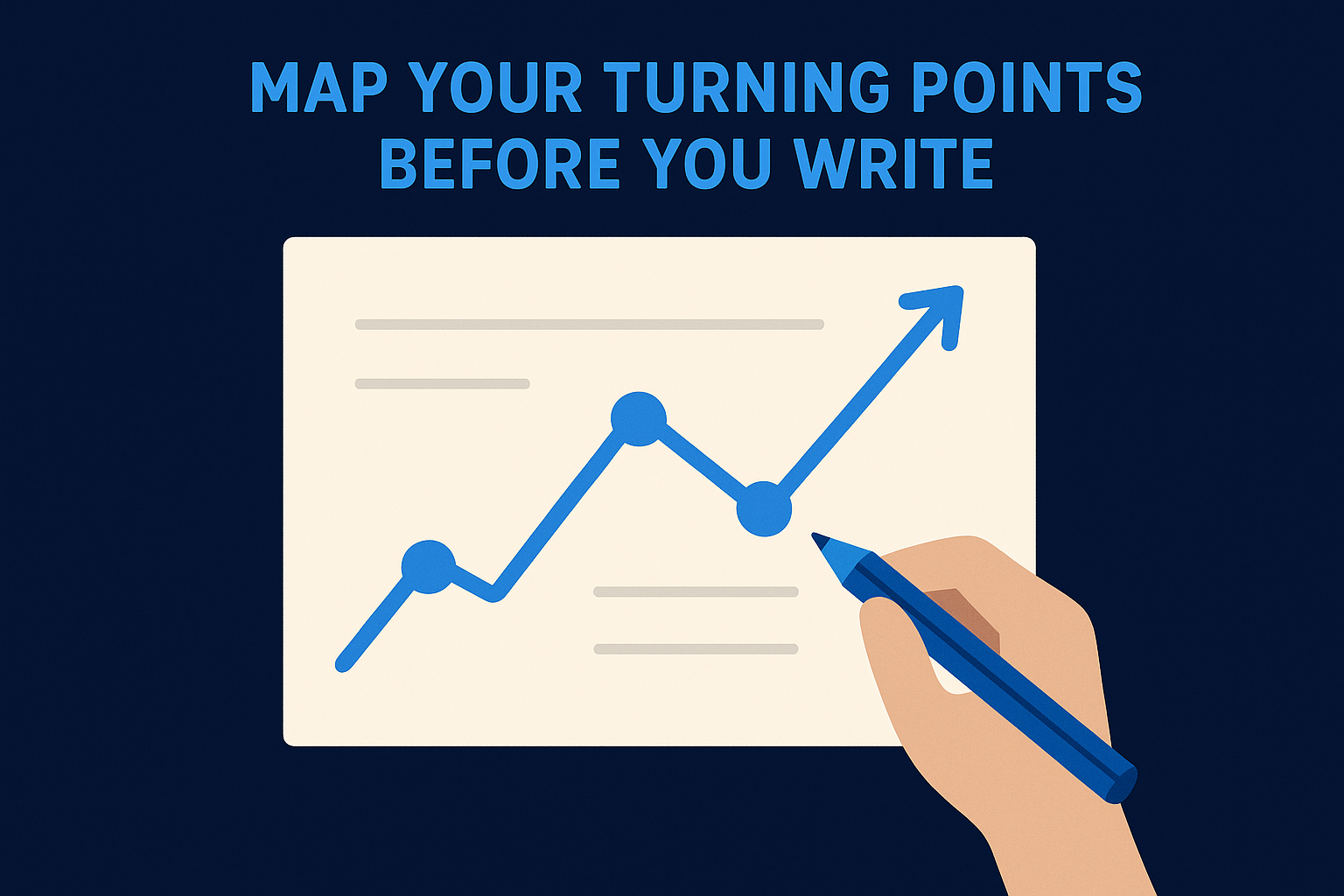
Once you have that map, check each act break to confirm the reversal is strong enough that your protagonist cannot return to the world as it was before that moment. If the character could realistically retreat, the turning point lacks the force McKee demands. Tighten it until retreat becomes impossible, and your structure will hold.
Beats, scenes, and turning points
The robert mckee story structure treats beats, scenes, and turning points as the three operational layers where your narrative either gains or loses momentum. Each layer has a specific job, and understanding how they interact gives you precise control over how your audience feels at every point in your script.
How beats build emotional charge
A beat is the smallest unit of dramatic change in McKee's system. It's a single exchange where one character takes an action and another reacts, shifting the emotional charge in the scene from one polarity to another. These shifts don't need to be dramatic or loud. A look across a room can function as a beat if it genuinely changes what the characters want or fear in that moment.
Scenes are built from sequences of beats that accumulate toward a single turning point. When you write a scene with no beat that changes the emotional direction, you are writing filler. McKee is clear on this: every scene must turn, or it doesn't belong in the script.
If a scene ends with the same emotional charge it started with, cut it or rewrite it until it turns.
Turning points and irreversible change
Turning points carry the structural weight of your entire narrative. A turning point isn't just a surprise or a plot development; it's a moment that permanently shifts the value charge of your story and closes off the path back. Your protagonist's world after a real turning point cannot revert to what it was before.
You can test any turning point you write by asking one question: could your protagonist realistically undo this moment? If the answer is yes, the reversal lacks the force McKee requires, and your structure will feel soft at exactly the moment it needs to hold the most tension.
Next steps for stronger scripts
The robert mckee story structure gives you a complete diagnostic system for your narrative work. Your next move is to apply it at every level, from the controlling idea down to individual beats. Start with one script or one piece of content you already have and run it through the framework. Identify your inciting incident, map your turning points, and check every scene for a genuine emotional shift. If a scene ends where it started, rewrite it or cut it.
Structure is a skill that sharpens with deliberate, repeated practice. The more precisely you apply these principles, the faster you will spot where your narrative loses momentum and exactly how to fix it. Whether you're writing a feature film or a 60-second video, the underlying mechanics are the same.
If you want these principles working inside a short-form content system that converts attention into revenue, get your free social media strategy and see how we build it for your brand.