
Every great story follows a pattern. Exposition, rising action, climax, falling action, resolution, these aren't just academic concepts. They're the building blocks students need to understand how narratives actually work. But getting kids to internalize that structure? That's where a good story structure worksheet makes all the difference.
At SocialRevver, we spend our days analyzing narrative patterns across hundreds of thousands of pieces of content. Whether it's a 60-second video or a five-act play, the same structural principles drive engagement and comprehension. That obsession with story mechanics gives us a sharp eye for what makes a framework click, in a content strategy and in a classroom.
Below, you'll find 11 free story structure worksheet templates built for teachers who want practical, ready-to-use tools. These cover everything from basic plot diagrams to more advanced narrative mapping, so you can match the right worksheet to your students' grade level and learning goals.
1. Plot Mountain Worksheet
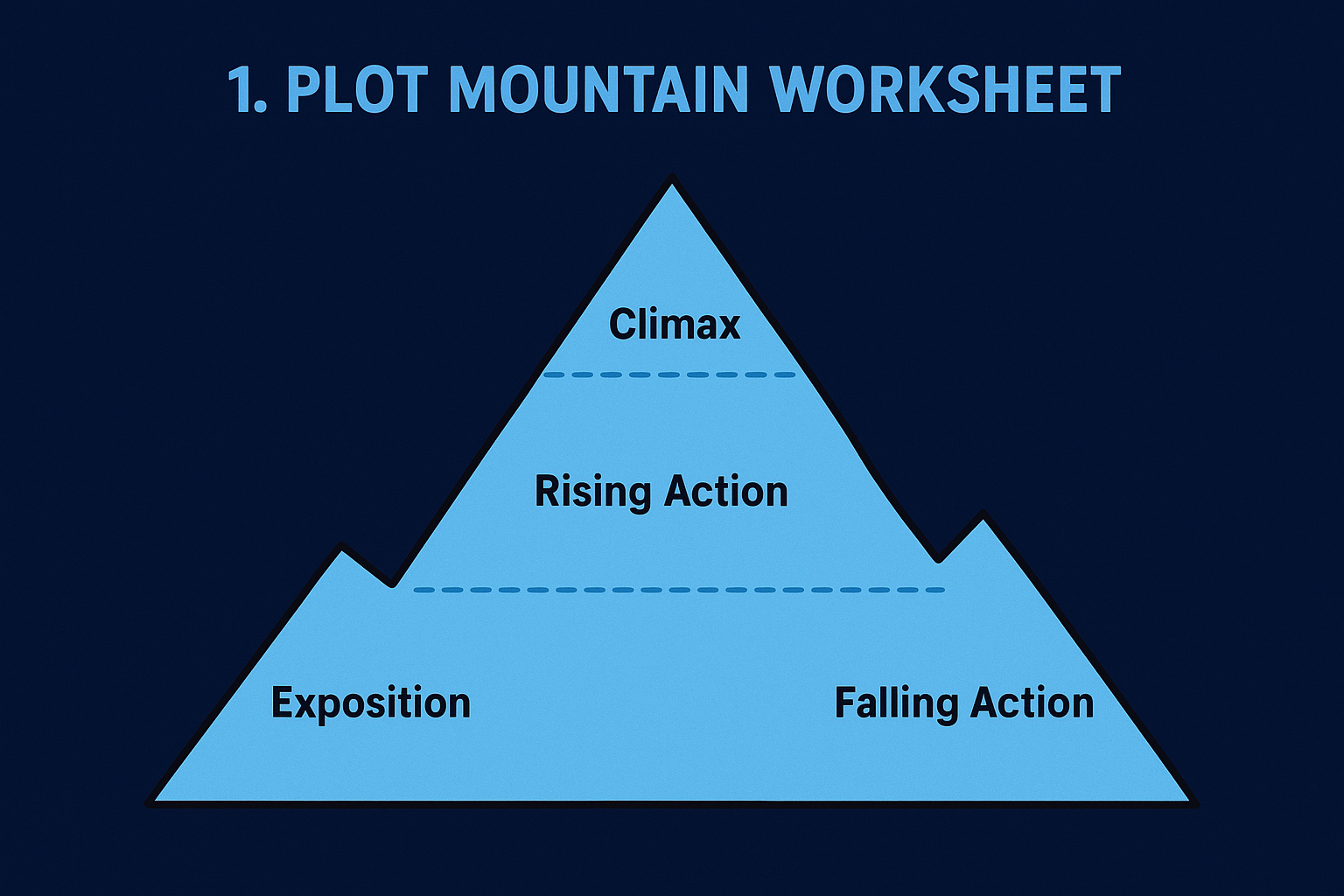
The plot mountain is the most recognizable story structure framework in K-12 education. It presents the five stages of narrative as a visual arc (exposition, rising action, climax, falling action, and resolution) that rises to a single central peak before descending, making the shape of the story literal and easy to grasp at a glance.
What this template teaches
This story structure worksheet trains students to identify cause-and-effect relationships between story events rather than just listing what happens. The visual format forces students to place each plot point at the correct elevation on the mountain, which builds the habit of asking "how does this event connect to what comes next?" Students also practice labeling the protagonist's emotional stakes at each stage, which deepens comprehension beyond surface-level plot summary.
The visual shape of the plot mountain is one of the most effective tools for showing students that conflict builds intentionally, not randomly.
Best grade levels and text types
You'll get the most out of this worksheet with grades 3 through 8, though a simplified version works well for advanced second graders. It pairs cleanly with short stories, fables, and chapter books where the five-stage arc is clear and visible. Longer novels with subplots can muddy the exercise if students haven't yet learned to separate the main plot from secondary storylines.
How to use it in a lesson
Start by walking students through a familiar story before handing out the worksheet, something like a fairy tale they already know. Have them call out plot events while you place each one on a projected version of the mountain together as a class. Then assign an independent reading passage and ask students to complete their own plot mountain from scratch. That sequence builds confidence before independent practice, so students aren't guessing on their first solo attempt.
Common student mistakes to watch for
Students frequently overfill the rising action section by listing every scene as if it carries equal weight, which flattens the sense of escalating tension. Watch also for students who skip the falling action entirely and jump straight from the climax to the resolution. Both errors signal that the student sees plot as a list rather than a structure with momentum. A quick one-on-one check-in during the activity usually catches these patterns before they become ingrained.
2. Freytag Pyramid Worksheet
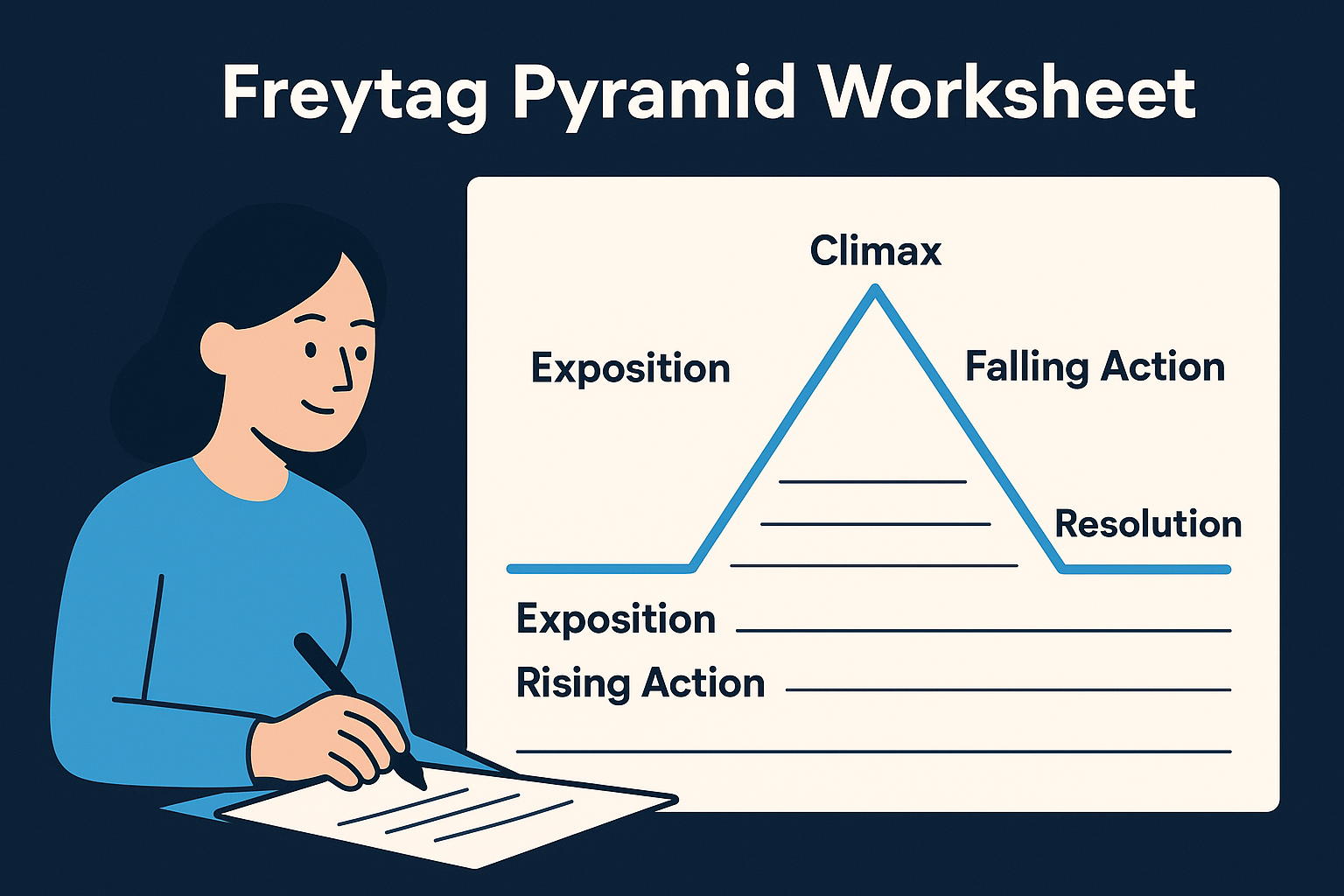
The Freytag pyramid expands on the basic plot mountain by adding two stages that most simplified frameworks leave out: the inciting incident and the moment of final suspense. Developed by 19th-century playwright Gustav Freytag, this seven-stage model gives students a more precise vocabulary for analyzing how tension builds and breaks across a story.
What this template teaches
This story structure worksheet asks students to locate the exact moment a story shifts from ordinary life into conflict, which sharpens their ability to identify the inciting incident as a distinct story beat. Students also learn to distinguish between the climax and the falling action's moment of final suspense, a separation that forces more careful reading and annotation.
Freytag's model rewards students who read closely, because its extra stages only become visible when you pay attention to shifts in tension, not just plot events.
Best grade levels and text types
This template works best with grades 6 through 12. It fits naturally with classical short stories, plays, and literary fiction where the narrative arc is deliberate and layered, such as O. Henry stories or Greek myths.
How to use it in a lesson
Introduce the pyramid using a film clip or picture book first so students can see the stages without the added challenge of a full text. Then have them apply the framework to an assigned reading, and ask them to write one sentence per stage justifying each placement.
Common student mistakes to watch for
Students regularly collapse the inciting incident into the exposition or treat the moment of final suspense as identical to the climax. Both errors signal shallow reading rather than a misunderstanding of the model itself, so targeted questions rather than re-teaching the framework usually fixes the problem fast.
3. Three-Act Structure Worksheet
The three-act structure breaks a story into setup, confrontation, and resolution, giving students a clean, scalable framework that works across nearly every narrative form. Unlike the plot mountain, this model groups events into acts rather than individual stages, which makes it easier to analyze longer and more complex texts without getting lost in the details.
What this template teaches
This story structure worksheet trains students to think about narrative in terms of porportion and function. Each act carries a specific job: the first act establishes the world and the stakes, the second act raises and complicates the conflict, and the third act resolves it. Students learn to evaluate whether a story allocates its space effectively, which is a critical reading skill that transfers directly into writing.
The three-act model is one of the most widely used frameworks in professional screenwriting and fiction, making it one of the most transferable tools you can give a student.
Best grade levels and text types
This template suits grades 5 through 12 and works especially well with film, novels, and short stories that have a clear dramatic structure. It also pairs well with screenwriting units or any project where students are crafting their own narratives.
How to use it in a lesson
Have students divide a blank page into three columns before they read, then add events to each column as they work through the text. That real-time annotation builds awareness of pacing while they read rather than after.
Common student mistakes to watch for
Students tend to overload Act 2 with too many disconnected events, treating it as a catch-all for anything that doesn't fit elsewhere. Push them to identify the central turning point within that act to give it shape and direction.
4. Beginning, Middle, End Worksheet
The beginning, middle, end framework is the most foundational story structure worksheet you can put in front of a young reader. It strips narrative down to its core logic: something starts, something happens, and something finishes. That simplicity is its strength, not a limitation.
What this template teaches
This worksheet teaches students that every story has intentional order and that events are not interchangeable. By labeling what belongs at the start versus the end, students begin to understand that setup and payoff are connected, even in the shortest texts.
Getting students to separate what "starts" a story from what "changes" it is the first step toward deeper structural thinking.
Best grade levels and text types
This template fits grades K through 3 best, though it also works well as a scaffolding tool for struggling readers in grades 4 and 5. It pairs well with picture books, simple folktales, and short read-aloud passages where the narrative movement is easy to follow without heavy annotation.
How to use it in a lesson
Read a short picture book aloud, then project a blank version of the worksheet and complete it as a whole class before asking students to fill in their own. That shared modeling step removes the guesswork. For early writers, you can ask students to draw rather than write in each section to keep the focus on comprehension rather than transcription.
Common student mistakes to watch for
Students often treat the middle section as a single event rather than the part where the main problem develops. Watch for students who write one sentence in each box with equal weight, as that signals they haven't yet grasped that the middle carries most of the story's work.
5. Sequence of Events Worksheet
The sequence of events worksheet shifts the focus from narrative shape to narrative order. Rather than labeling story stages, students track events chronologically using signal words like "first," "next," "then," and "finally." That shift in focus builds a different but equally important skill: understanding that the order of events is a deliberate craft choice, not an accident.
What this template teaches
This story structure worksheet trains students to read for cause-and-effect logic by forcing them to place each event in the exact order it occurs. Students practice using transitional language to connect events, which strengthens both comprehension and written expression at the same time.
Sequence thinking is the gateway skill for understanding that every story decision, including what comes first, shapes how a reader experiences tension and resolution.
Best grade levels and text types
This template works best with grades 2 through 6 and pairs well with informational narratives, procedural texts, and stories with a clear chronological timeline. It is particularly effective with historical fiction, where the order of events carries factual weight alongside narrative structure.
How to use it in a lesson
Give students a cut-apart version of the worksheet where story events are printed on separate strips. Have them physically arrange the strips in order before writing. That hands-on step reduces cognitive load and lets students focus on the logic of sequencing rather than writing mechanics.
Common student mistakes to watch for
Students often list events at the same level of importance, treating minor details the same as major turning points. Push them to identify which events actually change the direction of the story versus which ones simply fill in background.
6. Exposition, Rising Action, Climax Worksheet
This template uses the five-stage classical structure as its backbone but places heavier emphasis on labeling and analyzing each stage with precision. Students don't just name events; they explain what each stage accomplishes and how it connects to the next, which builds analytical reading skills alongside basic plot comprehension.
What this template teaches
This story structure worksheet asks students to move beyond identification and into explanation. For each of the five stages, students write what happens, why it matters, and what changes as a result. That three-part prompt forces close reading and discourages students from treating plot as a simple summary exercise.
Requiring students to explain "why it matters" at each stage is one of the fastest ways to close the gap between surface comprehension and literary analysis.
Best grade levels and text types
This template fits grades 4 through 10 well and pairs strongly with short stories, novellas, and narrative poems where the five stages are clearly defined. It works especially well alongside anchor texts that appear in standardized reading assessments, giving students structured practice with the kinds of texts they'll encounter on tests.
How to use it in a lesson
Pair this worksheet with a class read-aloud so all students work from the same text first. Then assign an independent reading passage and ask students to complete the worksheet without guidance, using the class model as a reference point.
Common student mistakes to watch for
Students often treat the climax as the most exciting scene rather than the moment of highest tension and irreversible change. Push them to ask whether the story's outcome could still go either way at that point.
7. Hero's Journey Worksheet
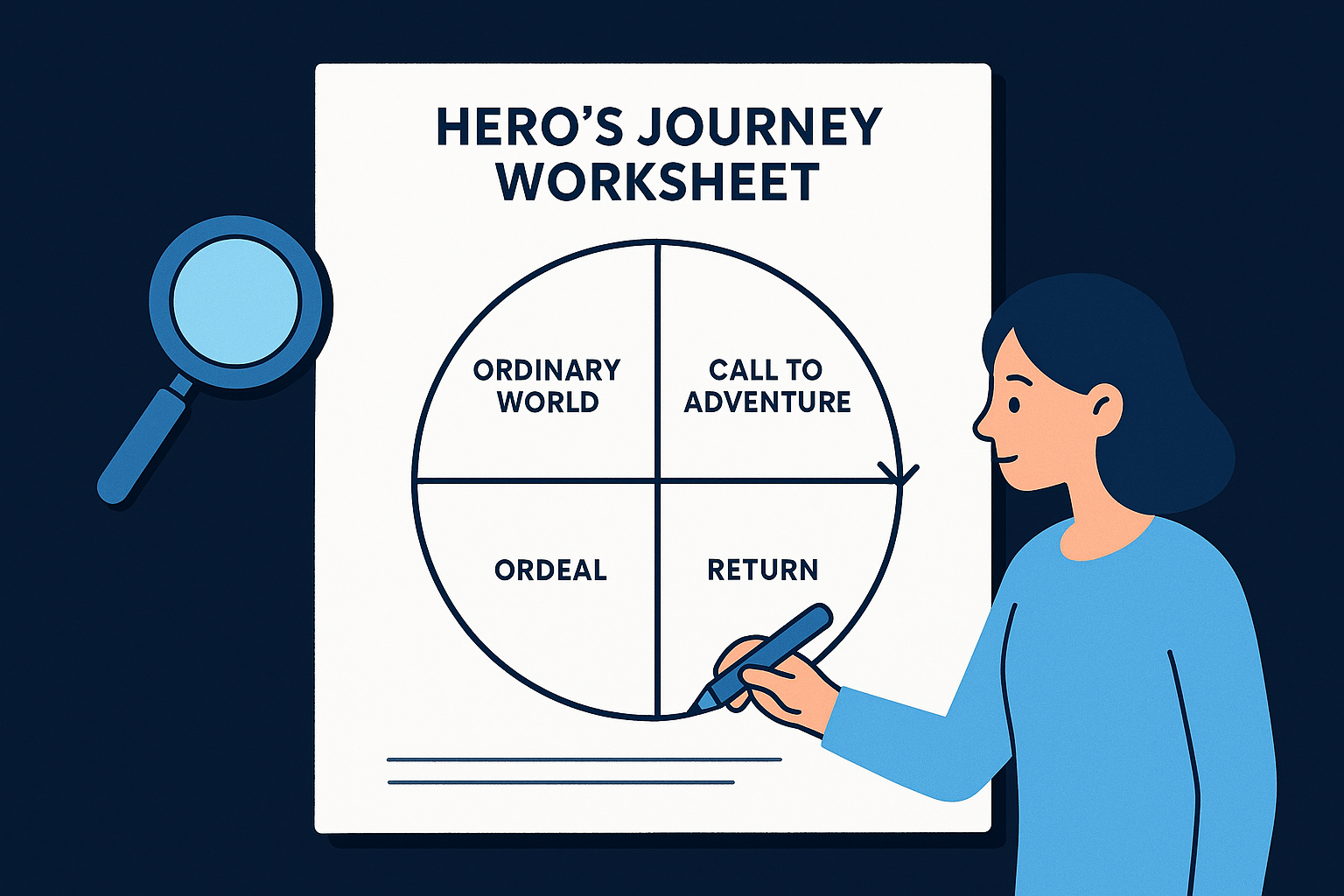
Joseph Campbell's hero's journey maps a 12-stage narrative arc that appears in everything from ancient mythology to modern blockbusters. This template gives students a structured framework for recognizing how the same deep story pattern repeats across cultures and genres, making it one of the most versatile tools in a literature classroom.
What this template teaches
This story structure worksheet asks students to track a protagonist's transformation across distinct stages: the ordinary world, the call to adventure, the ordeal, and the return. Rather than focusing on plot mechanics alone, students analyze character change as the core engine of narrative, which builds a more sophisticated reading lens than standard plot diagrams typically allow.
The hero's journey is one of the few frameworks that connects what happens in a story directly to why the protagonist is fundamentally different by the end.
Best grade levels and text types
This template works best with grades 6 through 12. It fits naturally with mythology, epic poetry, fantasy novels, and films where the archetypal pattern is explicit, such as Homer's Odyssey, Star Wars, or The Hunger Games.
How to use it in a lesson
Introduce the stages using a film students already know before applying the framework to assigned reading. That approach grounds the abstract stage names in something concrete before students work independently. Ask students to annotate the moment each stage begins rather than summarizing events after the fact.
Common student mistakes to watch for
Students frequently skip the return stage because the story feels finished at the climax. Push them to find evidence that the protagonist brings something back to their original world, since that final stage is what separates a complete hero's journey from a simple adventure plot.
8. Story Elements and Problem Solution Worksheet
This template combines two overlapping skills in one worksheet: identifying core story elements (character, setting, plot, theme) and mapping out the specific problem-and-solution arc that drives the narrative forward. That dual focus makes it a uniquely efficient tool for building both literary vocabulary and structural thinking at the same time.
What this template teaches
This story structure worksheet asks students to first identify the story's central problem and then trace exactly how the characters work to solve it. By connecting character decisions directly to the problem, students start reading with a cause-and-effect lens rather than just absorbing events passively.
Tying character choices to the central problem is one of the clearest ways to show students that plot is not something that happens to characters, but something characters drive.
Best grade levels and text types
This template fits grades 2 through 7 well. It works best with realistic fiction, fables, and early chapter books where one clear problem anchors the entire story. Texts with multiple competing conflicts can overwhelm the worksheet's structure, so save those for more advanced frameworks.
How to use it in a lesson
Pair this worksheet with a short, familiar text first so students can focus on filling in the template rather than decoding new content. Then move to an unfamiliar passage and ask students to complete the worksheet independently before discussing as a class.
Common student mistakes to watch for
Students frequently confuse a character's obstacle with the story's central problem. Watch for worksheets where the solution does not actually resolve what was listed in the problem box, as that mismatch usually signals that the student identified a symptom rather than the root conflict.
9. Novel Scene Outline Worksheet
The novel scene outline worksheet takes a different angle than most story structure tools. Instead of mapping an entire narrative arc, it asks students to break a single scene apart and examine the internal structure that makes it function. That shift in focus teaches students to read and write at a craft level, not just a plot level.
What this template teaches
This story structure worksheet trains students to identify what each scene accomplishes: its goal, the conflict that arises, and the outcome that propels the story forward. Students learn that every scene carries its own mini-arc and that a scene without conflict or consequence is dead weight in a narrative.
Teaching students to evaluate scenes by their function, not just their content, is the clearest path from basic comprehension to genuine literary analysis.
Best grade levels and text types
This template works best with grades 7 through 12 and fits naturally alongside novels, novellas, and longer short stories where individual scenes carry distinct dramatic weight. It also pairs well with creative writing units where students are drafting their own work.
How to use it in a lesson
Ask students to select one pivotal scene from an assigned text rather than working through an entire book. That focused scope keeps the exercise manageable while still building the analytical muscle the worksheet is designed to develop.
Common student mistakes to watch for
Students often describe the scene instead of analyzing it, filling in the goal and outcome boxes with plot summary rather than structural observation. Watch for worksheets where the "outcome" section simply restates what happened without explaining how the scene changes the story's direction.
10. 9-Sentence Structure and Summary Worksheets
The 9-sentence structure worksheet gives students a highly scaffolded framework for summarizing any narrative in exactly nine sentences, one per structural beat. That rigid constraint forces students to prioritize information rather than retell every detail, which builds both compression skills and structural awareness in a single exercise.
What this template teaches
This story structure worksheet trains students to map each sentence to a specific story function: introduction, setting, character, problem, rising action, climax, falling action, resolution, and theme. By limiting students to one sentence per beat, they learn that every part of a story carries distinct weight and that summary writing requires active decision-making, not passive retelling.
Forcing students to write exactly one sentence per story beat is one of the most effective ways to teach the difference between summary and analysis.
Best grade levels and text types
This template fits grades 4 through 9 best. It works well with short stories, picture books for older readers, and brief literary passages where all nine beats are present and identifiable without extended annotation.
How to use it in a lesson
Start by modeling the worksheet with a familiar class text so students see how to compress an entire story beat into a single clear sentence. Then assign an independent passage and ask students to complete each sentence box before checking their work against a partner's version.
Common student mistakes to watch for
Students tend to combine multiple beats into one sentence and leave later boxes empty, which signals they are still summarizing rather than structuring. Watch for any worksheet where the theme sentence simply restates the resolution in different words, as that usually means the student has not yet separated moral from outcome.
Next Steps for Your Next Lesson
Each story structure worksheet in this list targets a specific skill level and narrative form, so the most effective approach is to match the template to what your students are actually reading, not just to their grade level. Start with one framework, use it consistently across several texts, and let students build genuine fluency with that model before introducing a more complex one.
Beyond the classroom, the same structural principles that make these worksheets work apply directly to how any audience processes narrative content. Founders and creators who understand story mechanics hold attention and drive action far more reliably than those who don't. SocialRevver's team applies these exact frameworks and behavioral patterns to build content systems that convert organic reach into real business results. If you're ready to put that thinking to work for your own brand, get your free 40-slide social media strategy and see how story structure scales.