
Most founders can describe their product in detail but freeze when asked what makes their brand different from the ten competitors sitting in the same feed. That gap is exactly why learning how to create a brand positioning strategy matters more than posting frequency or follower counts. Without a clear position, every piece of content you publish just adds noise instead of building recognition.
A real positioning strategy answers one question precisely: why should your specific audience choose you over every other option they could pick instead. This guide walks through the step-by-step process professionals use to define that answer, from mapping your competitive category to pinpointing the specific audience segment that actually converts into revenue, not just views.
We built this framework from what we see working across the short-form content we produce and analyze daily, where positioning clarity consistently separates accounts that generate leads from accounts that generate likes. You'll get a practical sequence you can apply this week, covering research, message development, and the kind of testing methods that turn a positioning statement into something your market actually remembers and repeats back to you.
Why brand positioning shapes every growth decision
Every decision you make about content, pricing, hiring, and partnerships flows from one upstream choice: how you've positioned your brand in the market. Brand positioning isn't a tagline you slap on a website. It's the filter that determines which hooks your scripts use, which platforms you invest in, and which leads actually convert once they land in your funnel. Skip this step and you're guessing at every layer below it, which explains why so many founders burn through content budgets without moving the needle.
Positioning determines who takes you seriously
Investors, high-value clients, and top-tier talent size up a brand fast, usually within the first fifteen seconds of watching a video or reading a bio. A clear market position signals competence before you've said a word about your product. A vague one signals the opposite, even if your work is excellent. This is why the founders we work with who treat positioning as infrastructure, not an afterthought, land bigger partnerships with less outreach. They're not working harder for attention. They're working from a position that makes attention easy to convert.
A brand without a clear position isn't remembered, it's just scrolled past.
The cost of skipping this step
Without positioning, content strategy becomes reactive. You chase whatever trend looks promising this week, and your audience perception stays fragmented because there's no throughline connecting one post to the next. Compare what typically happens with and without a defined position:
| Without clear positioning | With clear positioning |
|---|---|
| Content mimics competitors, blends into the feed | Content occupies a distinct lane, gets recognized fast |
| Metrics chase views and likes | Metrics track leads and revenue-qualified attention |
| Messaging shifts with every trend | Messaging stays consistent, builds recall over time |
| Sales conversations start from scratch each time | Sales conversations start with credibility already built |
| Hiring and partnerships rely on personal pitching | Hiring and partnerships come inbound, pre-sold on reputation |
Why this matters more in short-form content specifically
Short-form platforms compress your entire brand story into seconds, so positioning clarity has to do more work with less time than it did in longer-format marketing. A three-minute YouTube video can slowly build a case for why you're different. A nine-second Reel can't. That's why the strongest short-form performers we've studied across hundreds of thousands of videos share one trait: the position is obvious within the first two seconds, before the hook even fully lands. Once that clarity exists, every downstream system, scripting, editing, distribution timing, gets dramatically more efficient because it's no longer trying to compensate for a fuzzy message.
Getting this right isn't a one-time exercise you file away after a workshop. Positioning is a living decision that should get revisited as your market shifts, your competitors reposition, and your audience matures. The four steps ahead give you a repeatable way to define it, test it, and keep it sharp as your brand grows.
Step 1. Audit how your brand is perceived today
Before you can build a brand positioning strategy, you need an honest picture of where you already stand. Most founders overestimate how clearly their audience understands them, because internal assumptions rarely match outside reality. This step forces you to separate what you think your brand communicates from what your market actually receives, and that gap is usually bigger than expected.
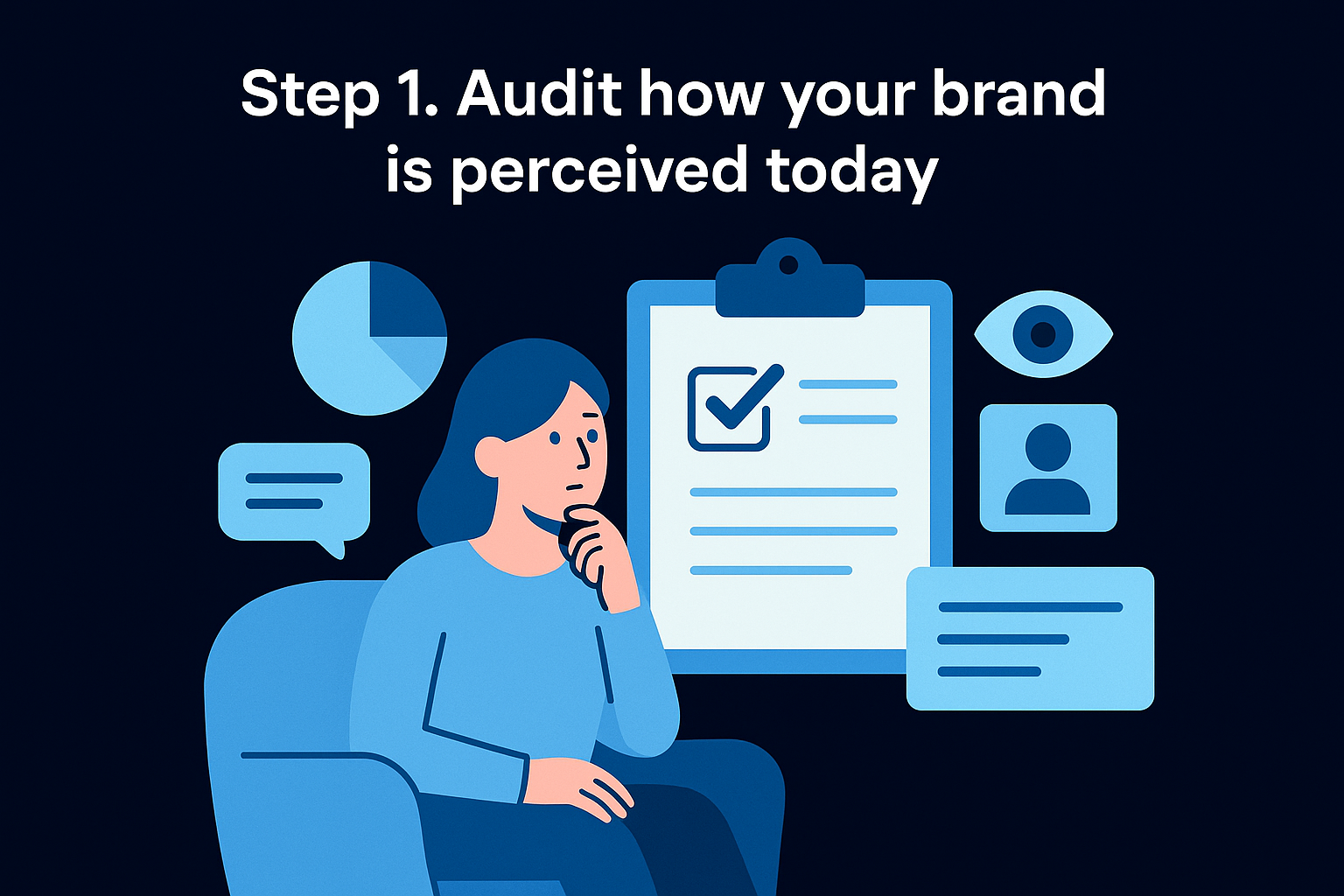
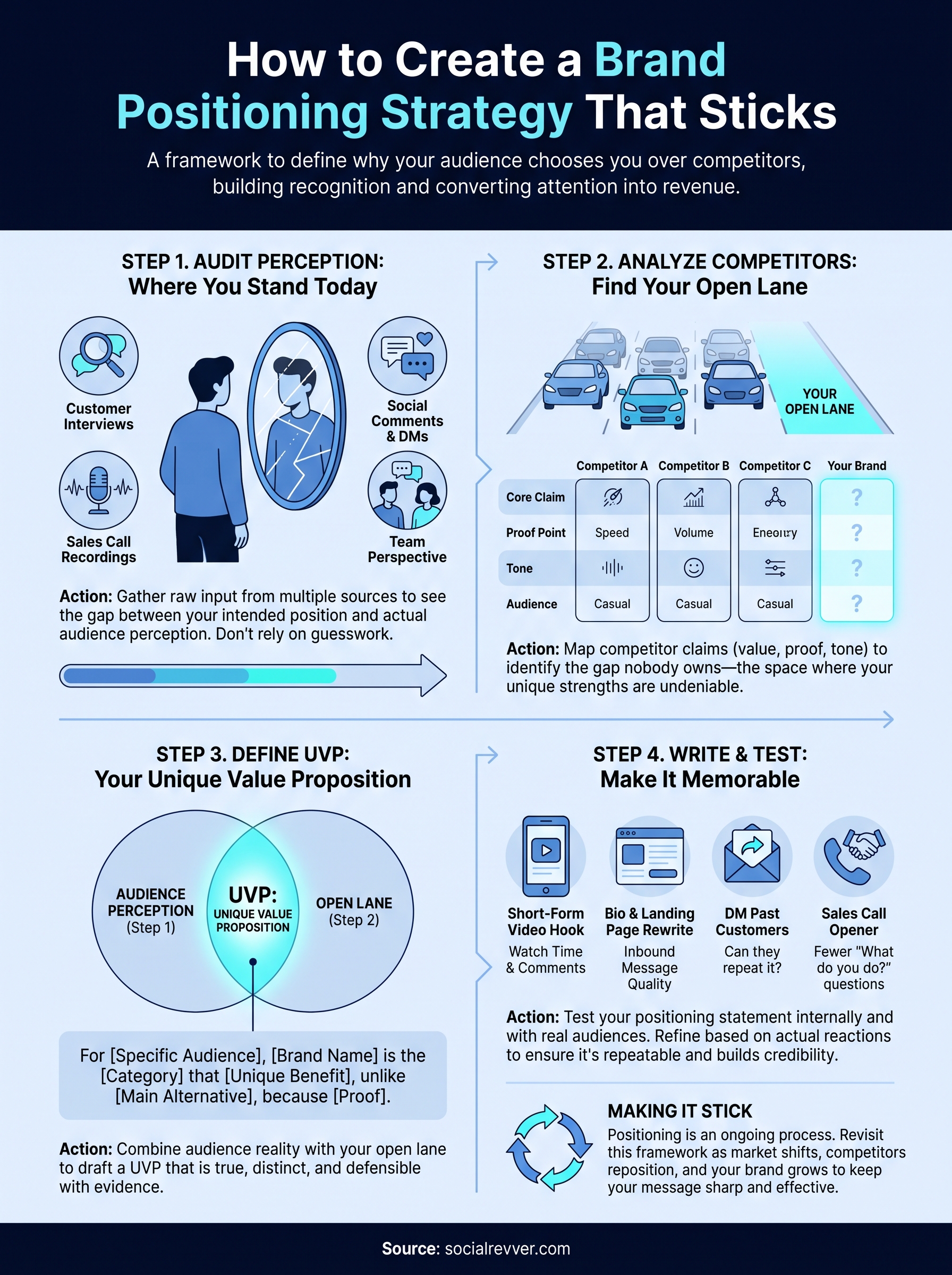
Pull direct feedback from four sources
Start by gathering raw input instead of relying on memory or guesswork. You want language your audience actually uses, not the language you'd prefer they use.
- Customer interviews: Ask five to ten recent buyers why they chose you over an alternative, in their own words.
- Social comments and DMs: Scan the last 90 days for recurring phrases people use to describe your content or product.
- Sales call recordings: Note the objections and comparisons prospects bring up before they commit.
- Team perspective: Ask employees or contractors how they'd describe the brand to a stranger, without coaching them first.
Each source reveals a different layer of audience perception, and patterns across all four are far more reliable than any single opinion.
Compare your self-image to outside perception
Once you've collected that feedback, write down your intended position in one sentence, then write down the position your audience actually described. Put them side by side. The distance between those two sentences is your real starting point, not the polished brand story you tell in pitch decks.
If your audience can't repeat your position back to you in their own words, you don't have one yet.
Expect some discomfort here. Founders often discover their audience associates them with a feature or price point they never intended to lead with. That's useful information, not a failure. It tells you exactly which perceptions you're building from and which ones you'll need to actively shift in the steps ahead, particularly once you move into competitor analysis.
Step 2. Analyze competitors to find your open lane
Once you know how your brand actually reads to outsiders, turn that same lens on the accounts competing for your audience's attention. Competitor analysis isn't about copying what's working for them. It's about finding the space they've left open, the angle nobody in your category has claimed yet. Most niches look crowded until you actually map who says what, and then you notice everyone is repeating the same three claims.
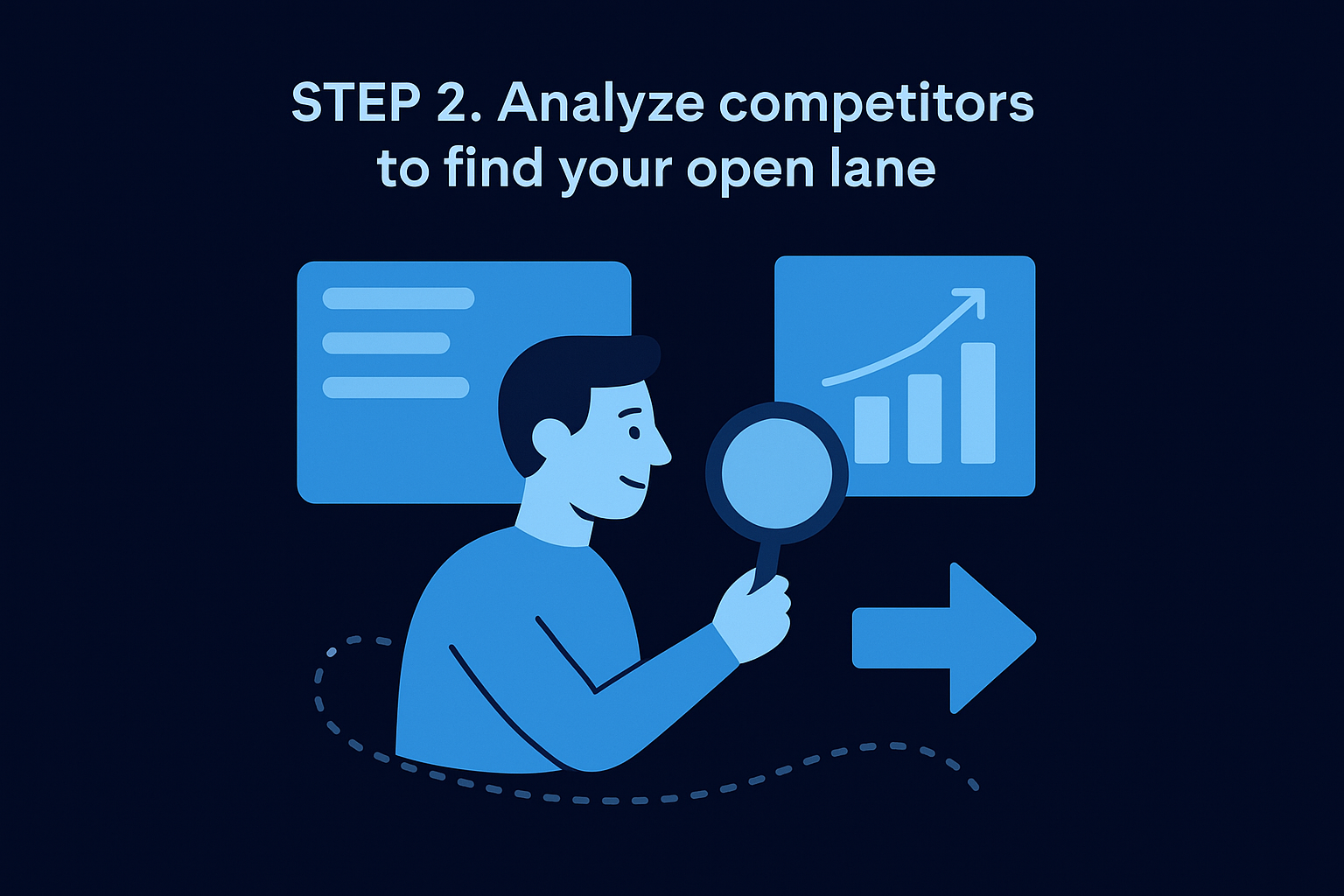
Map the claims your category already owns
Pull up the ten accounts your prospects follow or mention most often, then log what each one actually promises.
- Core claim: the one sentence they'd use to describe their value.
- Proof point: the credential or result they lean on most.
- Tone: authoritative, casual, technical, aspirational.
- Audience: who they're clearly speaking to, based on language and examples.
Lay these side by side in a simple table. Patterns emerge fast, usually two or three claims get recycled across the whole list, which means that territory is saturated no matter how good any single competitor's execution is.
Find the gap nobody has claimed
Look for the claim that's obviously true of your brand but absent from every competitor's messaging. Maybe everyone talks about speed, and nobody talks about precision. Maybe everyone chases volume, and nobody defends quality. That silence is your open lane, and it's usually sitting in plain sight once you've done the mapping instead of relying on gut feel.
Your open lane isn't the space with the least competition, it's the space where your strengths are undeniable.
Resist the urge to pick a lane just because it looks empty. An empty lane you can't defend with real proof collapses the moment a competitor decides to move into it. The lane that sticks is the one where your evidence, your production quality, your results, makes you hard to challenge, and that's the foundation you'll build your unique value proposition on next.
Step 3. Define your unique value proposition
Now you combine the two inputs you've already gathered: the honest perception audit from Step 1 and the open lane you mapped in Step 2. Your unique value proposition sits at the intersection of what's true about your brand and what nobody else in your category is claiming. Skip either input and you end up with a UVP that's either dishonest (a claim you can't back up) or redundant (a claim three competitors already own). This is the step where your brand positioning strategy stops being research and starts becoming a message.
Combine your audit with your open lane
Go back to the gap you identified from your competitor map, then check it against the language your actual audience used during the perception audit. If the two overlap, you've found something solid. If they don't overlap, don't force it, the gap has to be something your audience already half-believes about you, not something you're inventing from scratch. Building a market position on a claim your own customers wouldn't recognize is how positioning statements end up sounding like marketing instead of truth.
The best UVP isn't the cleverest claim, it's the truest one nobody else is saying out loud.
Write your UVP using a simple formula
Use this structure to force clarity before you worry about polish:
For [specific audience segment], [brand name] is the [category]
that [unique benefit], unlike [main alternative], because [proof].
A working example for a B2B founder targeting Series A companies might read:
For Series A founders, SocialRevver is the content system
that converts attention into investor credibility, unlike
agencies that chase views, because every script is built on
data from 750,000+ analyzed videos.
Draft three or four versions using this template, then read them aloud. The version that sounds like something a customer would actually repeat, not something a copywriter wrote, is the one worth carrying into Step 4, where you'll pressure-test it against real audience reactions before it becomes permanent.
Step 4. Write and test your positioning statement
Taking the UVP draft from Step 3, you now turn it into a formal positioning statement that guides every script, caption, and pitch deck going forward. This isn't the same as your UVP, though it's built from it. Your positioning statement is the internal reference document your whole team uses to judge whether new content, offers, or partnerships actually fit the brand, or quietly drift away from it.
Draft the internal version first
Before anything goes public, write the internal version plainly, without marketing polish. State your target audience, the category you compete in, the single benefit you own, and the proof that backs it up. Keep it to four sentences. If you can't explain your position in four sentences to a new hire on day one, the statement isn't ready for testing yet, let alone for a live audience.
Run it through real audience reactions
Getting feedback from real people beats guessing every time, and you don't need a large sample to learn something useful. Test the statement across a few different formats before committing to it publicly:
| Testing method | What to watch for |
|---|---|
| Short-form video hook using the statement | Watch time and comment language in the first 48 hours |
| Bio or landing page rewrite | Change in inbound message quality over two weeks |
| Direct message to five past customers | Whether they can repeat it back accurately |
| Sales call opener | Whether prospects stop asking "so what do you actually do" |
A positioning statement isn't finished until strangers can repeat it back in their own words.
Refine the wording based on what people actually reflect back to you, not on what sounds impressive in a boardroom. Learning how to create a brand positioning strategy that survives contact with a real market means treating this statement as a hypothesis you test, not a plaque you hang on the wall. Once the statement holds up across a few weeks of real reactions, you're ready to lock it in and build your content system around it.
Making your positioning stick for the long run
Positioning work doesn't end once you've written a statement that tests well. Markets shift, competitors reposition, and your own offer evolves, so treat this framework as something you revisit every few months, not a document you file away. The founders who build lasting authority are the ones who keep checking their audience perception against reality and adjusting before the gap widens.
You now have the four steps: audit perception, map competitors, define your UVP, and test your positioning statement against real reactions. That's the same process behind every brand positioning strategy that actually shapes content instead of just describing it. What separates brands that stick from brands that fade is whether someone's actually turning that positioning into scripts, hooks, and a distribution system every week.
If you'd rather have that built for you, get your free 40+ slide social media strategy and see exactly how it applies to your brand.