
You have a business story worth telling, but every time you sit down to script a short-form video, you end up with a pile of disconnected facts and no narrative pull. That is exactly what the pixar story spine template fixes. Pixar's animators built this 8-step framework to turn any idea, product, or founder journey into a story people actually want to follow, and it works just as well in a 30-second video as it does in a feature film.
This guide gives you the exact template, broken into all eight sentence starters, plus a filled-in example so you can see how each line connects to the next. You will walk away with a repeatable outline you can reuse for every piece of content, instead of starting from a blank page each time.
We built this framework into the way we script content at SocialRevver, because a good hook only works if the story behind it holds together. Below, you will find each of the eight steps explained, a template you can copy right now, and practical tips for applying it to brand stories, case studies, and personal narratives that need to convert attention into action.
What is the Pixar story spine and why use one
Playwright Kenn Adams built the story spine as a teaching tool for improv actors in the 1990s, long before Pixar picked it up. Pixar's story department later adopted it as an internal shorthand for testing whether a script actually had a spine, hence the name. The story spine template breaks narrative into eight sentence starters that force you to move from a stable world into conflict and back into a changed world. It works because it mirrors how humans have processed cause and effect since before written language existed: something was normal, then something disrupted it, then things got worse, then someone acted, then the world changed.
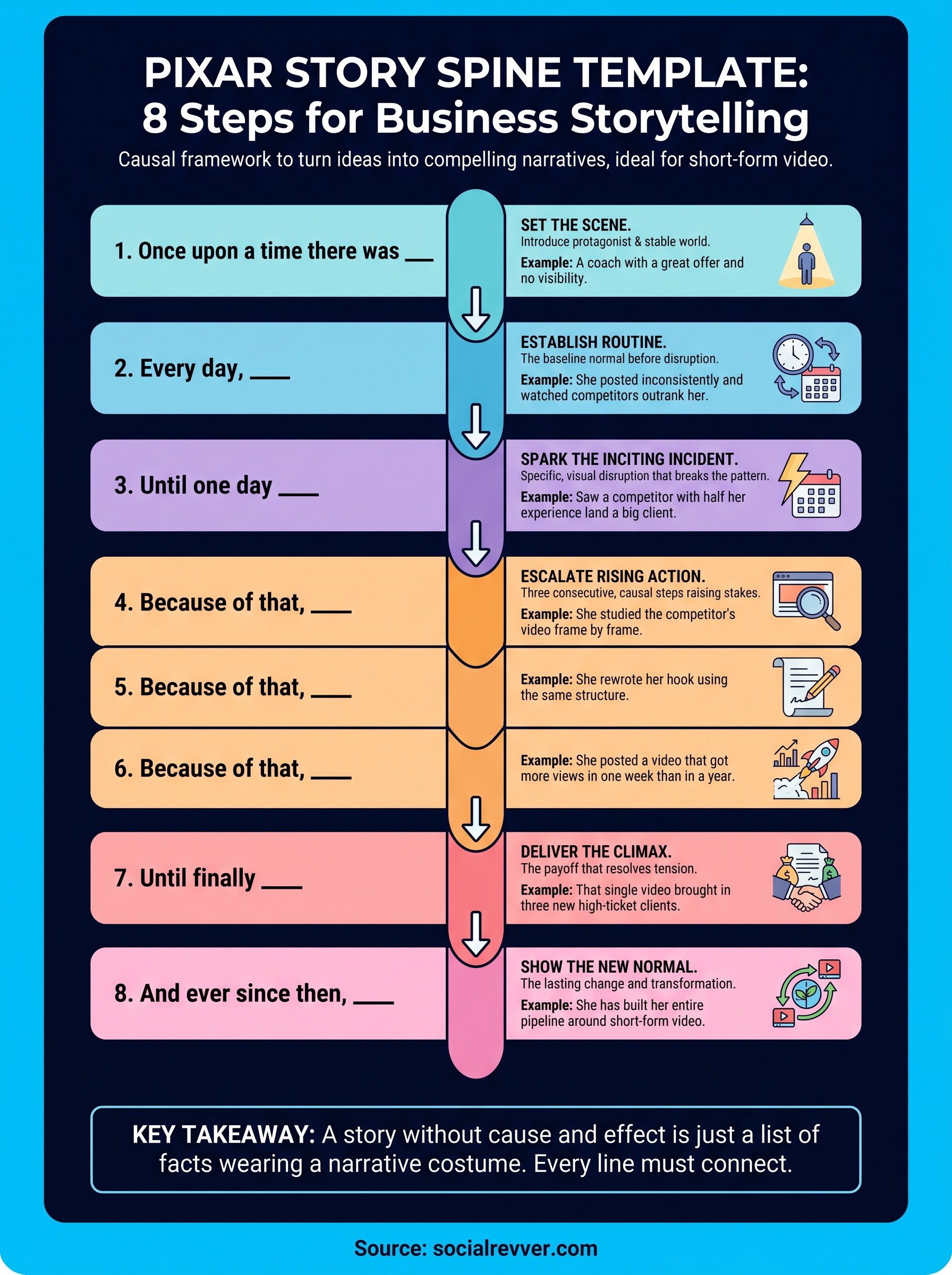
Here is the full eight-step skeleton before we break down each piece:
1. Once upon a time there was ___
2. Every day, ___
3. Until one day ___
4. Because of that, ___
5. Because of that, ___
6. Because of that, ___
7. Until finally ___
8. And ever since then, ___
Each line has to connect causally to the one before it. That single rule is what separates the story spine from a generic outline. Most business content fails not because the production value is weak, but because the writer lists features and outcomes without showing why one thing led to another. The cause-and-effect chain is the mechanism that keeps a viewer watching past the third second.
A story without cause and effect is just a list of facts wearing a narrative costume.
For short-form video specifically, this structure earns its keep because you have almost no runway to establish context. You need a scene-setting step that orients the viewer in under two seconds, and a spine gives you exactly that discipline built in. Whether you are scripting a founder story, a client transformation, or a product demo, the same eight beats apply. The next sections walk through each pair of steps with a filled-in example you can adapt line by line.
Steps 1-2. Set the scene and everyday routine
Start with "Once upon a time there was ___." This line names your protagonist and drops them into a world. For a founder story, that might be "a marketing consultant who kept losing clients to bigger agencies." For a product story, it could be "a small e-commerce brand shipping fifty orders a day by hand." Keep this sentence to one clause. If you need a comma to explain backstory, you are already overloading step one.
Next comes "Every day, ___." This step establishes the routine, the baseline normal that the rest of the story is going to disrupt. It is the most skipped step in business content, and skipping it is why so many brand videos feel like they start in the middle of a sentence. You need this beat because contrast is what makes an inciting incident land.
Without a clear "every day," your audience has nothing to compare against when things go wrong.
Here is a filled-in example using a coaching business:
1. Once upon a time there was a coach with a great offer and no visibility.
2. Every day, she posted inconsistently and watched competitors with worse content outrank her.
Write both lines before moving on. If step two does not feel mundane or repetitive, rewrite it until it does.
Step 3. Spark the inciting incident
This is the line "Until one day ___", and it is the moment everything shifts. The inciting incident has to break the routine you just spent step two establishing, otherwise the story has nowhere to go. For the coaching example, this might be: "Until one day she saw a competitor with half her experience land a five-figure client from a single video." Notice how the incident references the routine directly. It does not introduce a random new problem; it disrupts the exact pattern you already showed the viewer.
Good inciting incidents are specific and visual, not abstract. "Until one day business got hard" tells the viewer nothing. "Until one day her biggest client cancelled the morning of a launch" gives them something to picture. In short-form video, this line often doubles as your hook, since it is the moment a scroller decides whether to keep watching. Treat step three as the sentence that has to justify the next fifteen seconds of runtime.
If your inciting incident could happen to anyone, it will not hold anyone's attention.
Here is the spine so far, continuing the same example:
1. Once upon a time there was a coach with a great offer and no visibility.
2. Every day, she posted inconsistently and watched competitors with worse content outrank her.
3. Until one day she saw a competitor with half her experience land a five-figure client from a single video.
Once this line feels sharp, the rest of the spine gets easier to write.
Steps 4-6. Escalate the rising action
Three consecutive lines start with "Because of that, ___," and this is where most business narratives collapse into a flat list instead of a rising sequence. Each line has to be a direct consequence of the one before it, not a parallel example. If you can reorder your three "because of that" lines without changing the meaning, they are not actually causal, and the escalation will feel weightless to a viewer.
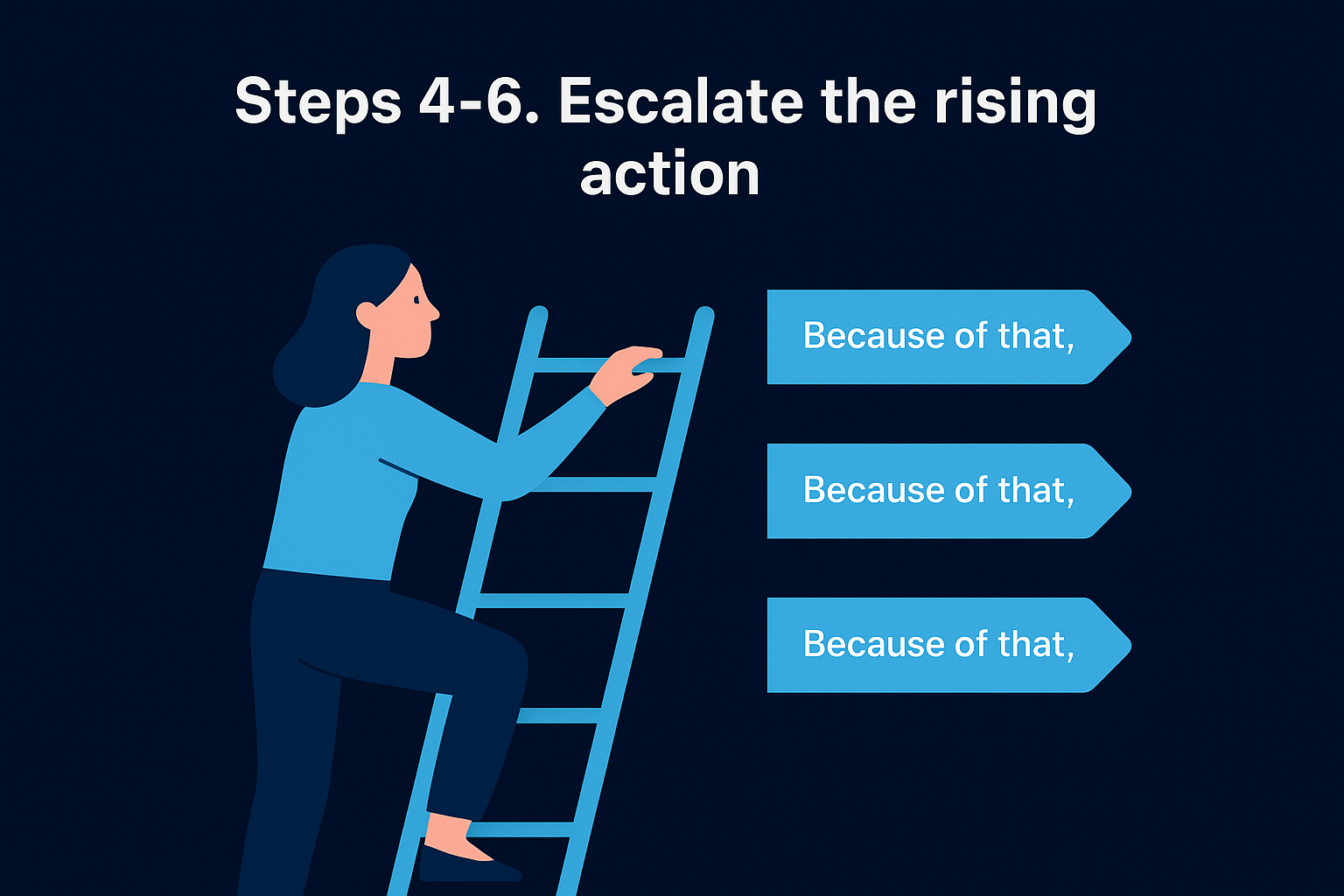
Think of these three steps as rungs on a ladder, each one raising the stakes established by the inciting incident. For the coaching example: "Because of that, she studied the competitor's video frame by frame," then "Because of that, she rewrote her own hook using the same structure," then "Because of that, she posted a video that got more views in one week than her account had gotten in a year." Notice the stakes climb with each line, moving from private research to public action to a measurable result.
Rising action only works when each step makes the next one impossible to avoid.
Here is the full escalation block:
4. Because of that, she studied the competitor's video frame by frame.
5. Because of that, she rewrote her own hook using the same structure.
6. Because of that, she posted a video that got more views in one week than her account had gotten in a year.
Once you can read all three lines aloud and hear tension building, you are ready for the payoff.
Steps 7-8. Deliver the climax and resolution
Step seven is "Until finally ___," and it has to resolve the tension you built across the three escalation lines, not introduce a new twist. This is the payoff line, the moment the coach's video actually lands the client, or the founder closes the round, or the product hits the sales number that changes the business. For the coaching example: "Until finally that single video brought in three new high-ticket clients in one month." The climax should feel earned, not lucky, because the viewer just watched the exact chain of decisions that led here.
Step eight, "And ever since then, ___," shows the new normal. This is where you name the lasting change, the thing that is different now that would not have happened without the inciting incident. Skip this line and your story just stops instead of resolving. Include it, and you give the viewer a reason to believe the transformation stuck.
A climax without a stated "ever since" leaves the viewer wondering if anything actually changed.
Here is the completed spine:
7. Until finally that single video brought in three new high-ticket clients in one month.
8. And ever since then, she has built her entire client pipeline around short-form video.
Read all eight lines together before you script a single shot.
Putting your story spine to work
Eight lines are enough to carry a full script, and that is the point. The pixar story spine template forces you to prove cause and effect before you ever touch a camera, which is exactly what separates a video that gets watched to the end from one that gets scrolled past. Write your spine on paper first, read it out loud, and only then start blocking shots. Every founder story, client case study, or product launch you script from now on can run through the same eight sentence starters.
Spines get better with reps, not theory. Fill one out today using your own business, then run it against a real audience before you scale it into a content calendar. If you want that scaling handled for you, including scripts built on frameworks like this one, get your free 40+ slide social media strategy and see how it fits your niche.