Most brands waste thousands of dollars on influencer partnerships that generate zero return, not because influencer marketing doesn't work, but because they picked the wrong people. Knowing how to find influencers for your brand is the difference between a campaign that prints revenue and one that burns budget on vanity metrics.
The problem isn't a shortage of influencers. It's the opposite. Millions of creators are posting every day across Instagram, TikTok, YouTube, and LinkedIn. Sorting signal from noise requires more than scrolling hashtags and hoping for the best, it demands a systematic, data-backed approach to identification, vetting, and outreach.
At SocialRevver, we analyze performance patterns across 750,000+ short-form videos to help brands build authority and generate inbound leads through content. That same data-driven lens applies directly to influencer selection: understanding what actually drives engagement, trust, and conversions versus what just looks good on a media kit. This guide breaks down the exact step-by-step process to find influencers who align with your brand, reach your target audience, and deliver measurable results, from discovery tools and vetting frameworks to outreach templates you can use today.
What makes an influencer right for your brand
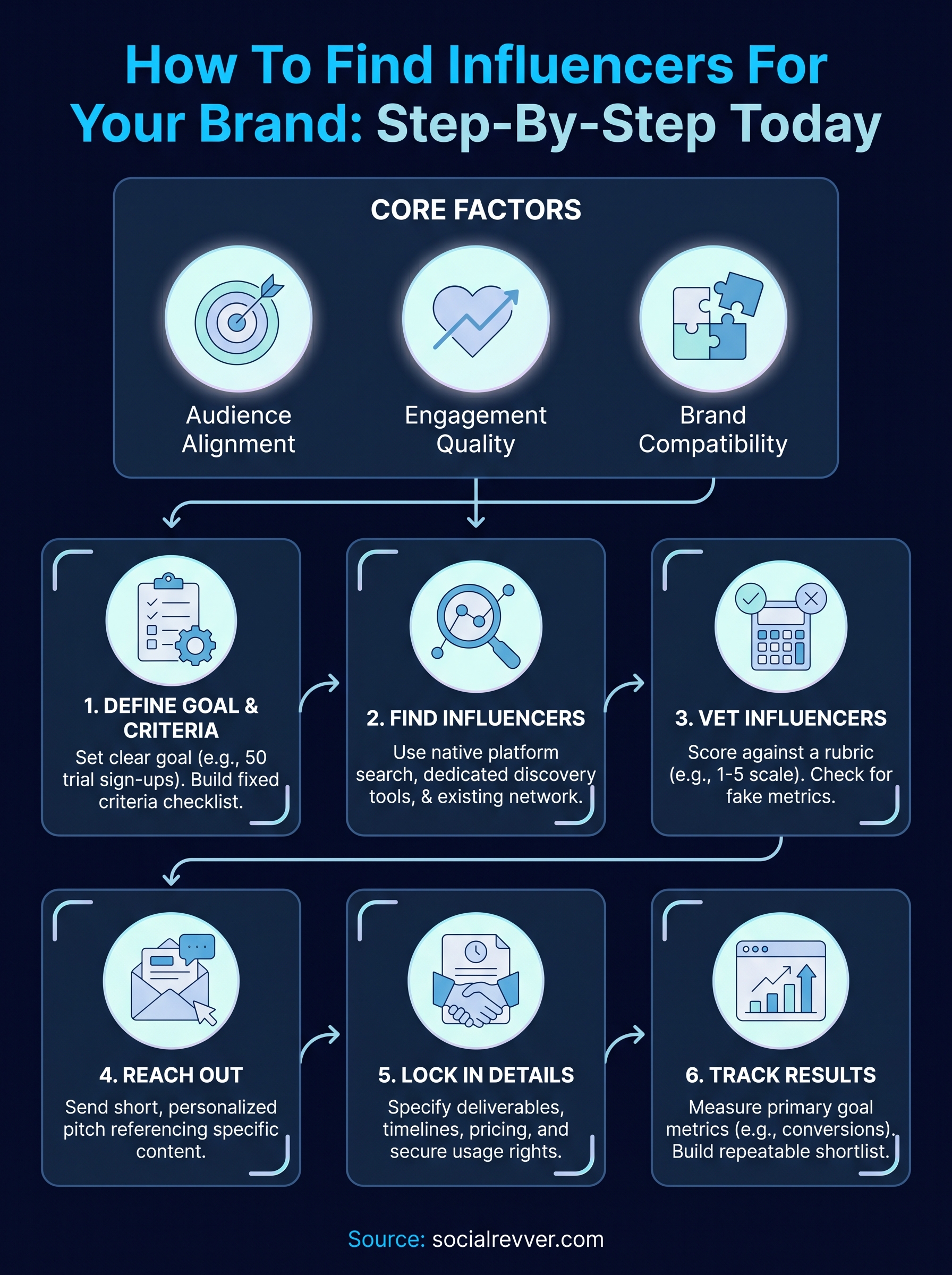
The instinct most brands follow is to look at follower count first. That's a mistake. An influencer with two million followers in the wrong niche will deliver far worse results than a creator with 80,000 highly targeted subscribers who trust every recommendation they make. When you're figuring out how to find influencers for your brand, the right fit comes down to three core factors: audience alignment, engagement quality, and brand compatibility.
Audience alignment over follower count
Your ideal influencer's audience should mirror your target customer. If you sell B2B software to founders, a lifestyle creator with millions of Gen Z followers won't move the needle for you regardless of how polished their content looks. What you need is a creator whose audience demographics (age, location, profession, income level) closely match the people you're trying to reach. Most creators will share this data in a media kit if you ask, and platforms like Instagram and YouTube give creators demographic breakdowns directly in their analytics.
Audience alignment is the single strongest predictor of campaign ROI, more than reach, aesthetics, or production quality.
A micro-influencer with 10,000 to 100,000 followers in a tight niche often delivers better conversion rates than a mega-influencer with a broad, mixed audience. The specificity of the community matters more than its raw size.
Engagement rate and content quality
Engagement rate is the percentage of an influencer's audience that actively interacts with their content through likes, comments, shares, and saves. A creator with 50,000 followers and a 6% engagement rate is far more valuable than one with 500,000 followers at 0.4%. As a rough benchmark, anything above 3% on Instagram or 5% on TikTok signals a genuinely responsive audience worth paying for.
Beyond the numbers, watch the comment section closely. Authentic comments that reference specific parts of the video or post signal real community connection. Generic responses or comment pods inflating numbers artificially are red flags you should not ignore before signing any deal.
Brand fit and values
Content style and values have to match your brand's tone. A creator who builds their following on raw, unfiltered opinions is a poor fit for a polished, premium brand even if their audience demographics line up perfectly. Watch at least five to ten pieces of their recent content before you decide, and pay close attention to how they handle sponsored integrations specifically since creators who weave brand mentions in naturally tend to drive better results than those who treat them as obvious interruptions.
Look for creators who have worked with brands in adjacent categories (not directly competing ones). This tells you two things: the audience already accepts recommendations, and the creator understands commercial content well enough to execute it without alienating their followers.
Step 1. Define your goal, audience, and creator criteria
Before you search for a single creator, you need to know exactly what you want to achieve and who you want to reach. Skipping this step is the fastest way to waste budget on a partnership that looks good on paper but delivers nothing you can measure. Every decision you make later, from which platform to focus on to what engagement rate you'll accept, flows directly from the clarity you build here.
Set a clear campaign goal
Your goal determines which creator metrics matter most. If you want to drive direct sales, you need creators with proven conversion records and strong calls to action. If you want to build brand awareness in a new market, reach and impressions become more relevant than click-through rate. Pick one primary goal per campaign so you can measure it cleanly.
Campaigns with a single, defined goal consistently outperform those chasing multiple objectives at once.
Tie that goal to a specific number before you begin outreach. "Increase sales" is not a goal. "Generate 50 trial sign-ups" from a single campaign with a tracked link is a goal you can actually evaluate and improve on.
Build your target audience profile
Write down the specific characteristics of the person you want your influencer to reach before you look at a single creator account. Include age range, location, profession or life stage, and the core problems they're actively trying to solve. This profile acts as a filter: if an influencer's audience doesn't match it closely, they're not the right fit regardless of their follower count.
Write your creator criteria checklist
Once your goal and audience profile are set, translate them into a concrete checklist you apply consistently across every candidate. This removes guesswork when evaluating dozens of creators. Knowing how to find influencers for your brand becomes far easier when you replace gut calls with objective criteria every candidate either meets or doesn't.
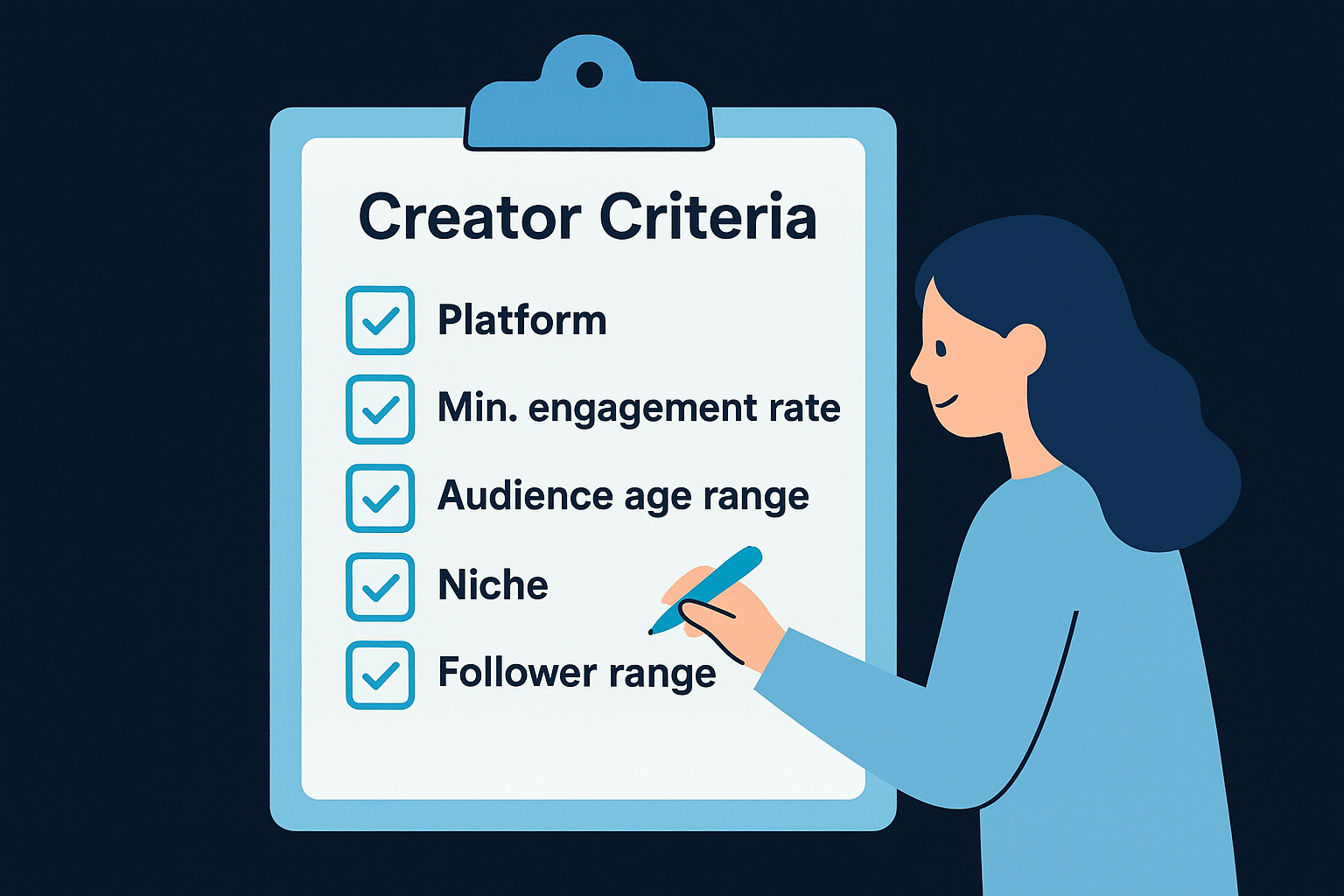
| Criteria | Your Requirement |
|---|---|
| Platform | e.g., TikTok, Instagram, YouTube |
| Minimum engagement rate | e.g., 3% on Instagram |
| Audience age range | e.g., 28-45 |
| Niche or content category | e.g., B2B SaaS, personal finance |
| Follower range | e.g., 20K-200K |
| Past brand partnership experience | Yes / No |
Step 2. Find influencers using search, tools, and platforms
With your criteria checklist built, you're ready to start pulling candidates. The most effective discovery process combines three distinct approaches: native platform search, dedicated influencer tools, and your own existing network. Running all three in parallel gives you a larger pool to filter from, which means you're more likely to find a genuinely strong match instead of settling for whoever shows up first.
Search natively on each platform
Every major social platform has built-in search functionality you can use right now at no cost. On TikTok and Instagram, search your core niche keywords and filter results by creators (not posts). Look at the top accounts in that result and check whether their content aligns with your criteria checklist from Step 1. On YouTube, search your topic and filter by channel to find creators who consistently produce content in your space.
Native search works best when you search the problem your customer has, not just your product category.
Use these search terms as starting points and then follow the recommendation algorithm. When you find one strong candidate, browse who similar creators follow and who appears in their comment sections, since tight-knit niches tend to cluster around the same group of engaged accounts.
Use dedicated discovery tools
Paid tools give you filtering capabilities that native search can't match. Platforms like Modash, Heepsy, and Creator.co let you filter by engagement rate, audience demographics, follower range, and niche simultaneously. This turns a multi-hour manual search into a 20-minute shortlist you can then evaluate individually.
Most tools offer a free trial. Run your criteria checklist as search filters and export a raw list of 20 to 30 candidates before you commit to a subscription.
Tap into your existing network
Check whether customers or brand advocates already create content in your niche. Search your brand name on TikTok and Instagram to see who is already posting about you organically. These creators already trust your product, which makes them the strongest starting point when you're learning how to find influencers for your brand with minimal outreach friction.
Step 3. Vet influencers with a simple scoring system
Once you have a raw list of 20 to 30 candidates, the next challenge is narrowing it down without letting personal preference or follower count bias your decisions. A scoring system removes that bias by forcing you to evaluate every creator against the same criteria. This is where learning how to find influencers for your brand shifts from discovery into data-driven selection, and it's the step most brands completely skip.
Check for fake engagement and audience quality
Before you score anyone, run a quick audit to filter out creators with inflated metrics. Look at the ratio between followers and average likes per post. Check the comment section for generic phrases like "Great post!" or "Love this!" repeated across multiple accounts since these patterns signal coordinated inflation.
If more than 20% of an influencer's comments look generic or robotic, remove them from your list immediately.
Here are the specific red flags to check during your audit:
- Follower-to-engagement ratio is far below platform averages
- Comment section filled with single-word or emoji-only responses
- Sudden follower spikes visible in historical growth charts
- Audience location concentrated in countries that don't match your target market
Score each candidate against a fixed rubric
Assign each candidate a numerical score across your five most important criteria so you can rank them side by side without subjectivity. Use a 1 to 5 scale for each factor, then total the results. The highest-scoring creators move forward to outreach.
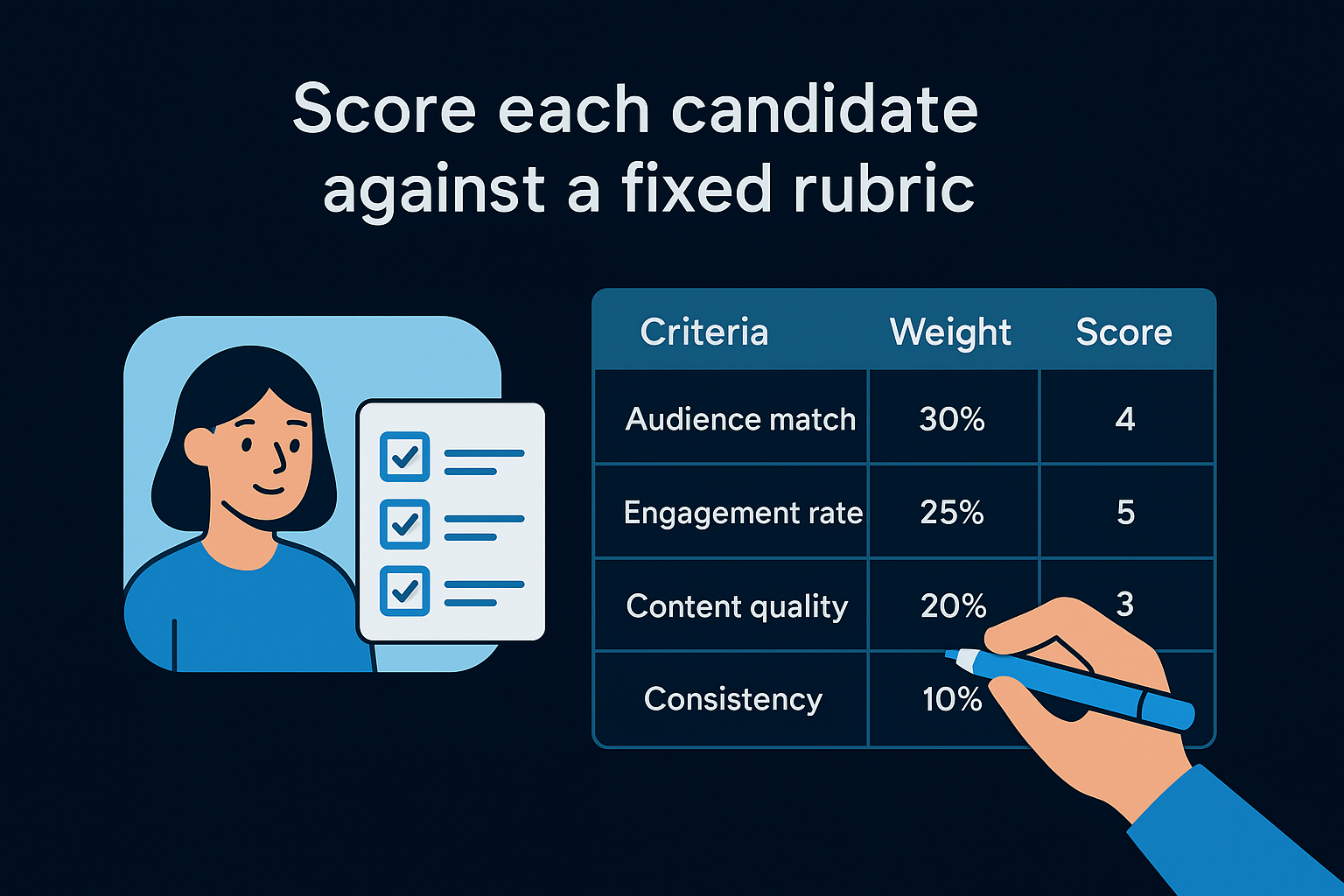
Here is a scoring template you can copy directly:
| Criteria | Weight | Score (1-5) | Weighted Score |
|---|---|---|---|
| Audience demographic match | 30% | ||
| Engagement rate | 25% | ||
| Content quality and brand fit | 20% | ||
| Past brand deal execution | 15% | ||
| Posting frequency and consistency | 10% |
Multiply each score by its weight and add the results to get a total out of 5. Any candidate scoring below 3.0 gets cut. This process takes roughly ten minutes per creator and gives you a defensible shortlist you can present to any stakeholder with full confidence.
Step 4. Reach out with a pitch creators will answer
Your shortlist is ready, and this is where most brands stumble when learning how to find influencers for your brand. Writing an outreach message that gets a response is not about having a big brand name or a large budget. Creators receive dozens of pitches weekly, and they can spot a copy-paste template from the first sentence. You need to write something specific and short that proves you actually watched their content before reaching out.
Write a pitch that feels personal
Reference something specific from their recent content in your opening line, not just their niche or follower count. Mention a video that performed well or a point they made that connects directly to your product. Keep your entire message under 150 words since anything longer cuts your response rate significantly.
A pitch that proves you watched their content will always outperform one that leads with your brand's story.
Here is a tested outreach template you can adapt directly:
Subject: Collab idea for [Creator Name]
Hi [Name],
Your recent video on [specific topic] stood out to me, especially the way you explained [specific point]. It connects directly to what we're building at [Brand Name].
We help [target audience] with [core benefit]. Based on what your audience already engages with, I think they'd find real value in [product/service].
I'd love to send you [free product / a brief overview] and explore a paid partnership if it feels like a fit.
Would a quick 15-minute call this week work?
[Your Name] [Brand / Title] [Contact info]
Follow up once and stop
Send one follow-up five to seven days after your first message if you hear nothing back. Keep it to two sentences that reference your original note and make it easy to reply with a simple yes or no. Sending more than two messages total signals desperation and closes the door with that creator permanently, so resist the urge to keep pushing.
Step 5. Lock in deliverables, pricing, and usage rights
Good intentions don't protect you when a campaign goes sideways. Before you transfer any payment or ship any product, you need a written brief that spells out exactly what you expect and when. This is the step that separates brands who truly understand how to find influencers for your brand from those who pay full rate for content that arrives late, off-message, or never at all.
Specify deliverables and timelines
Vague instructions produce vague content. Your brief should state the exact number of posts, the format (Reel, TikTok video, YouTube integration, or Story), the required length, and any mandatory elements like verbal mentions, on-screen text, or bio links. Include a review window of three to five business days so you can request revisions before anything goes live.
Here is a deliverables brief template you can adapt directly:
| Element | Detail |
|---|---|
| Content type | e.g., 1x TikTok video, 1x Instagram Story |
| Video length | e.g., 45-60 seconds |
| Required mentions | Brand name, product benefit, call to action |
| Posting date | e.g., June 28, 2026 |
| Review deadline | e.g., June 24, 2026 |
| Link placement | Bio link active for 48 hours post-publish |
Set pricing and usage rights
Pricing varies widely by tier and platform. Micro-influencers (10K to 100K followers) typically charge between $100 and $1,500 per post, while mid-tier creators (100K to 500K followers) often range from $1,500 to $8,000. Flat fees are simpler to track than performance commissions for a first partnership, and they give both sides a clear financial commitment upfront.
Always negotiate usage rights separately from the base rate before you finalize payment.
Usage rights determine whether you can legally repurpose the creator's content in paid ads, on your website, or in email campaigns. Without explicit written permission, running a creator's video as a paid ad exposes you to a rights dispute. Specify the license duration (typically 30 to 90 days), the channels covered, and whether exclusivity applies to competing brands in your category.
Step 6. Track results and build a repeatable shortlist
Paying for a campaign and never measuring it is how brands stay stuck running one-off partnerships that never compound. Tracking results closes the loop on everything you defined in Step 1 and tells you exactly which creators, formats, and audiences delivered real return. This final step is also what separates a one-time influencer experiment from a scalable, repeatable system for growing your brand through creators.
Measure what matters after each campaign
Track the metrics that connect directly to the goal you set before the campaign launched. If your goal was trial sign-ups, your primary metric is the number of conversions traced back to the creator's unique link or promo code. If your goal was reach, measure impressions and new follower growth during the campaign window, not just likes. Pull these numbers within 48 to 72 hours of the post going live since engagement velocity drops quickly and early data reflects the truest audience response.
The only metrics worth tracking are the ones tied directly to the goal you defined before the campaign started.
Use this tracking template after every campaign:
| Metric | Target | Actual | Notes |
|---|---|---|---|
| Conversions / sign-ups | |||
| Click-through rate | |||
| Impressions | |||
| Engagement rate on sponsored post | |||
| Cost per conversion |
Build your repeatable creator shortlist
Once you have results from two or three campaigns, you have enough data to build a tiered shortlist of creators sorted by performance. Keep a running document with each creator's contact info, the campaigns you ran together, their average cost per conversion, and notes on communication quality and turnaround time. This document becomes your most valuable asset when scaling how to find influencers for your brand beyond individual one-off campaigns.
Revisit and update your shortlist every 90 days by checking whether top performers are still active, whether their audience demographics have shifted, and whether any new candidates from your discovery pipeline score high enough to earn a test campaign.
Next steps
You now have a complete system for how to find influencers for your brand: from defining your criteria and building a discovery pipeline to vetting candidates, sending pitches that get responses, locking in contracts, and tracking performance over time. Each step builds on the last, which means following the process in order gives you a compounding advantage rather than a collection of disconnected tactics.
Start with Step 1 today. Write your campaign goal, build your audience profile, and fill out your creator criteria checklist before you open a single social app. That groundwork takes less than an hour and makes every step after it faster and more focused.
If you want to go further and build a full short-form content system that turns organic attention into consistent inbound leads, apply for a free 40-slide social media strategy from the SocialRevver team and get a data-backed plan built specifically for your brand.